Fort, Thine Name Is Brute
For its size, I would classify Brute Fort as maximalist. Which perhaps sounds contradictory, given it’s a microgame that runs on only 18 cards and comes in a plastic cassette case. But each of those details unfurls into something more. The cassette case is double-wide, necessary for holding the synth soundtrack alongside the cards. And the included dice, concealed under the tuckbox, can be used to generate the rooms of a haunted fort in a TTRPG.
What’s more, the microgame within is hand-drawn in garish inkstrokes that wouldn’t be out of place in a game like Cave Evil or The Restless. This is my first attempt at a game by Alfred Vale, but it’s solid enough to make me sit at attention and consider the other entries in his catalog. Maybe, for instance, the solitaire zine that requires you to spin a coin while you complete drawing minigames.
But for now, I’m contenting myself with Brute Fort. This thing doesn’t quite fit the Button Shy model. It’s way too metal.
You stand at the foot of a shrouded fort…
Brute Fort is about sacrifice.
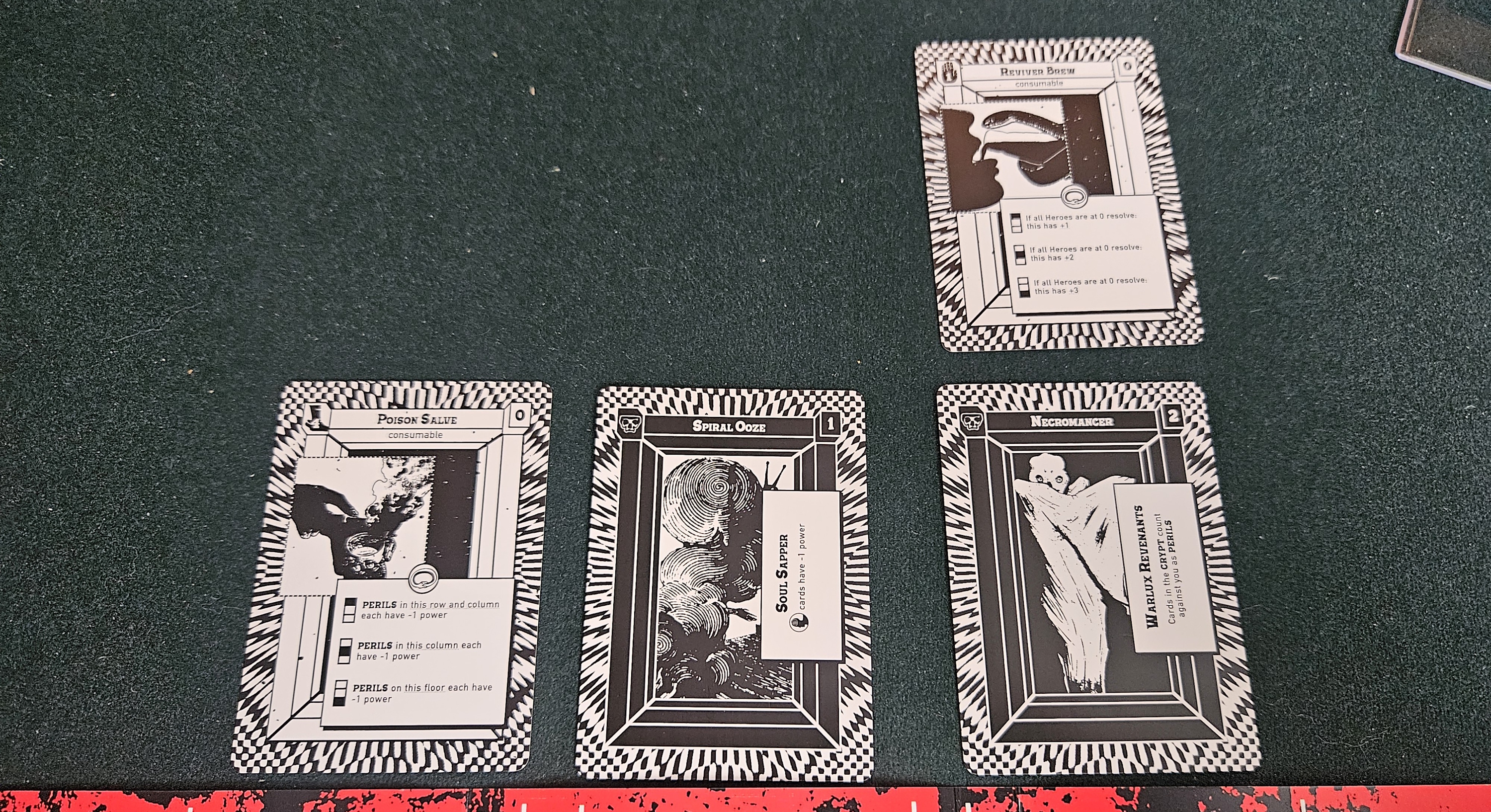
When the game begins, you have three heroes: the Wanderer, the Champion, and the Sage. Each hero is arranged so that it partially covers the one next to it. A fourth card, drawn at random from the main deck, covers the last hero, and in the process also imposes some penalty on your session. The Gloomswiller destroys artifacts the instant they’re played. The Demon Imp threatens to flip more cards against you. The Warlux Revenant transforms any dead cards in the crypt into your enemies.
But it’s the heroes who are the important part, at least right at first. Each hero begins fresh with four points ready to be spent. You draw a trio of cards from the deck. Each one costs some amount of those points. You might, for example, be holding a Poison Salve (poisons enemies — not quite a salve, but fine), a Harbinger’s Mask (grows stronger near specific other items), and a Cursed Banner (also makes you stronger when placed near certain items). All useful in their own way.
Except most of these items don’t cost four points. In fact, only one of them does. The Poison Salve, in case you were wondering. But the Harbinger’s Mask costs two and the Cursed Banner costs one.
Now, normally this wouldn’t be a problem. But in Brute Fort, your heroes don’t give change. If you spend any of the Sage’s four points, the remainder is gone. All that effort, spent to place a single card. What’s an adventuring party to do?
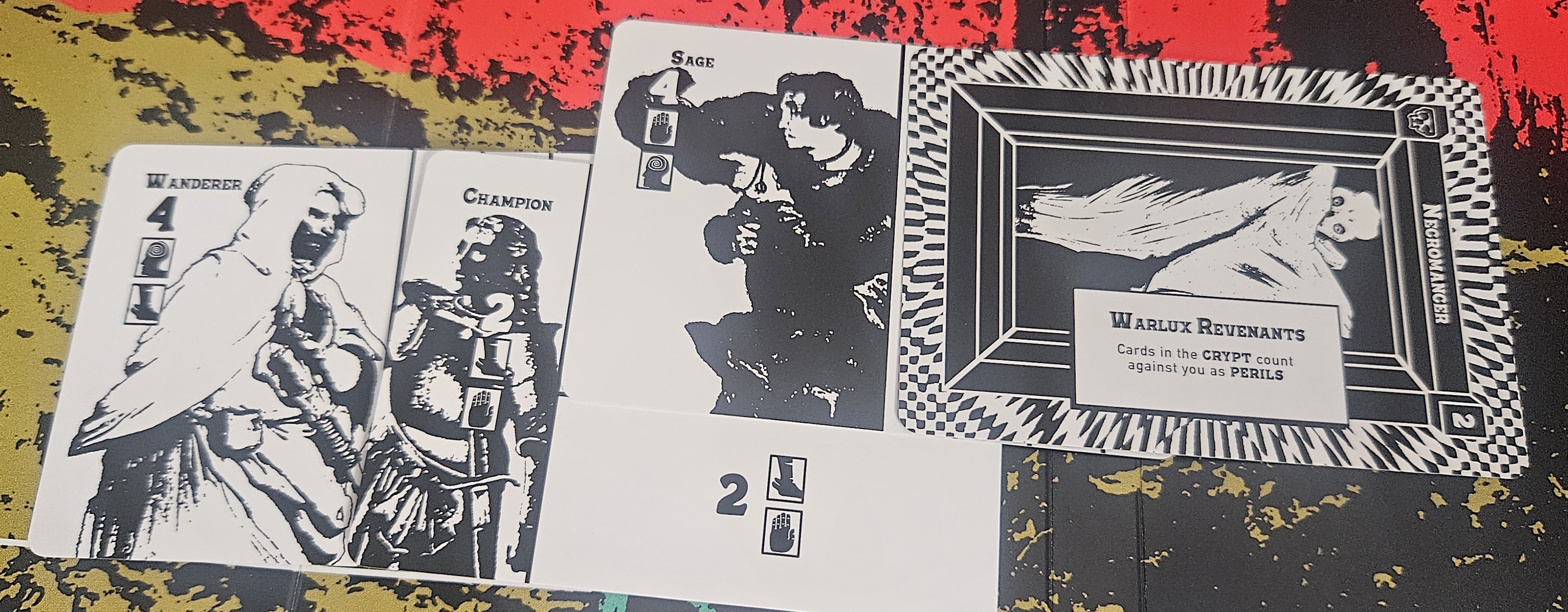
Heroes can be spent for resources, or divided to stretch those resources a little further.
In this case, you divide your attention. By adding one of the cards from your hand to the fort, but doing so in the fort’s favor — flipping it over to its evil side — you’re allowed to divide a hero’s resources in half. Now instead of your Sage having four points, he has two bundles of two points. Only, uh oh, the Harbinger’s Mask has transformed into an Infernal Seer. Now it will be even harder to overcome the fort.
Later, you might make another sacrifice. More time, another baddie, to divide your points yet again. Now your Sage’s two and two becomes two and one and one, the latter half halved again. Now you can play that Cursed Banner without losing out on any points. The only problem is that between the Infernal Seer and the Iron Talon Raptor you just added, the fort is starting to look rather tough indeed.
Brute Fort continues like this. One sacrifice after another. Cards transforming into monsters. Resources rationed and dwindling. At the right moments, your own cards — items and allies and artifacts, all that stuff — coming into play to slowly raise your own score to hopefully trounce that of the fort. In the end, it’s a simple tally. Your strength versus the fort’s strength. Only nine cards in the fort itself, plus some tucked cards maybe for a bonus here or there.
The sacrifices I make to review board games.
It’s all very microgame-like, although it doesn’t feel anything like the fare you’d get from Button Shy. I don’t mean that as an insult. It’s just that Brute Fort is a little darker than the titles in that catalog. There’s the art, obviously, which is a far cry from the cartoonier style that usually fills those wallets. But also in the sense that Brute Fort feels a little wilder, a little less ultra-tuned. Some cards offer obvious combos. Others require more massaging. There are some I’m not sure can be made to work, not for any shortage of trying.
As for the feel of the game, it’s tradeoffs all the way down. Every card feels like a tangible sacrifice to the dark gods that inhabit this place. Even the ones you actually purchase might wind up in the wrong spot, with each one offering slightly different abilities depending on where in the fort they get placed. This is the remedy to the danger of Brute Fort growing rote: since cards are more powerful lower in the fort, you’re encouraged to make at least one or two purchases at suboptimal exchange rates, sacrificing a hero’s strength before parceling it all the way down to its constituent fragments.
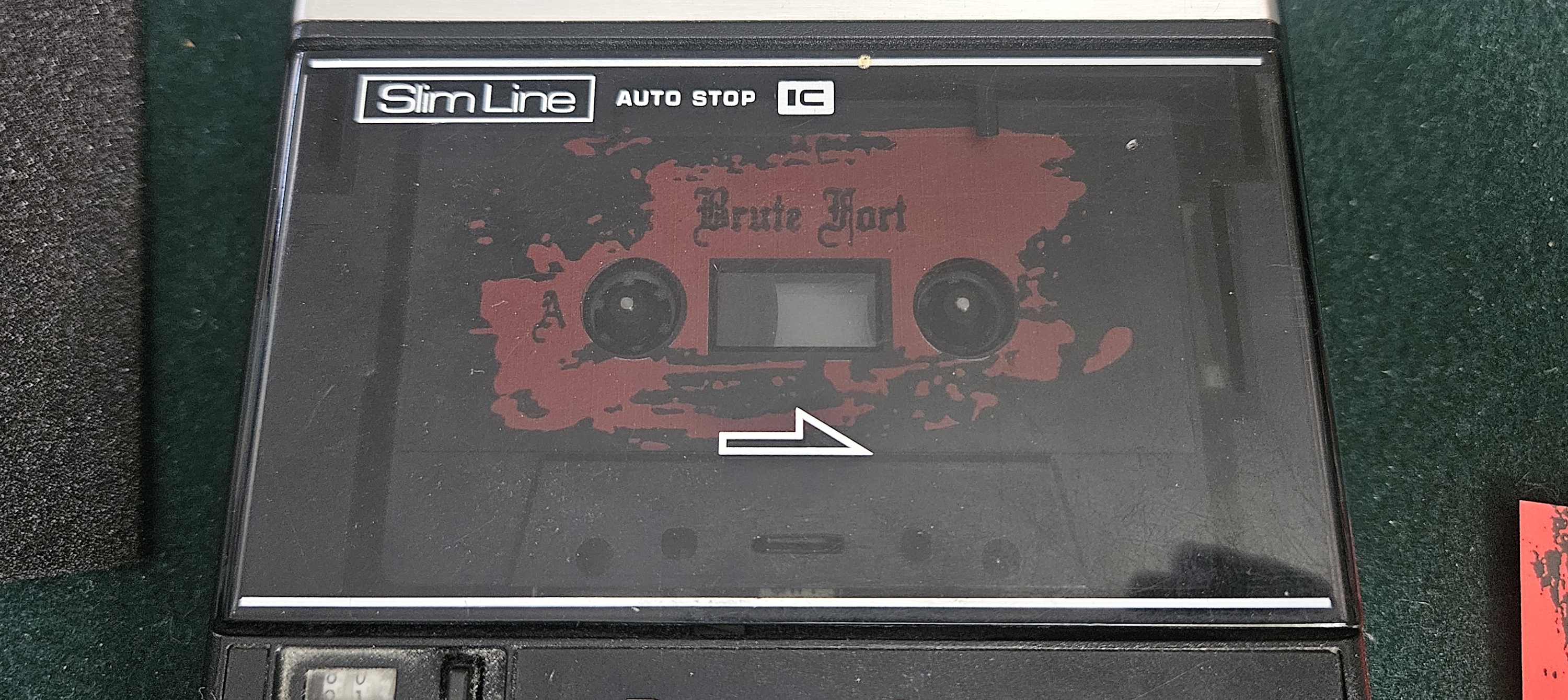
And then there’s that soundtrack. I even had my mother scrounge a cassette player from some undusted corner of her castle so I could listen while I played. I’ll confess I don’t understand the return to tape, despite being a fervent advocate for physical media in this age of rented art. But as the deck scraped to life, some part of me was taken back to an earlier time. To listening to books on tape on long car trips, only to abscond with the rest of the set when our time on the road didn’t quite conclude the latest Tony Hillerman or Michael Crichton novel. Listening to them in my bedroom, in the dark, on the boom box I owned mostly for Green Day CDs, but which included a tape deck because there were still a fair few cassettes floating around in those days. The scratch and whine complemented the narrator’s voice the way the rotating spindles complemented John Darnielle’s early albums, and I’ll be damned if the crackle didn’t evoke a sputtering torch here.
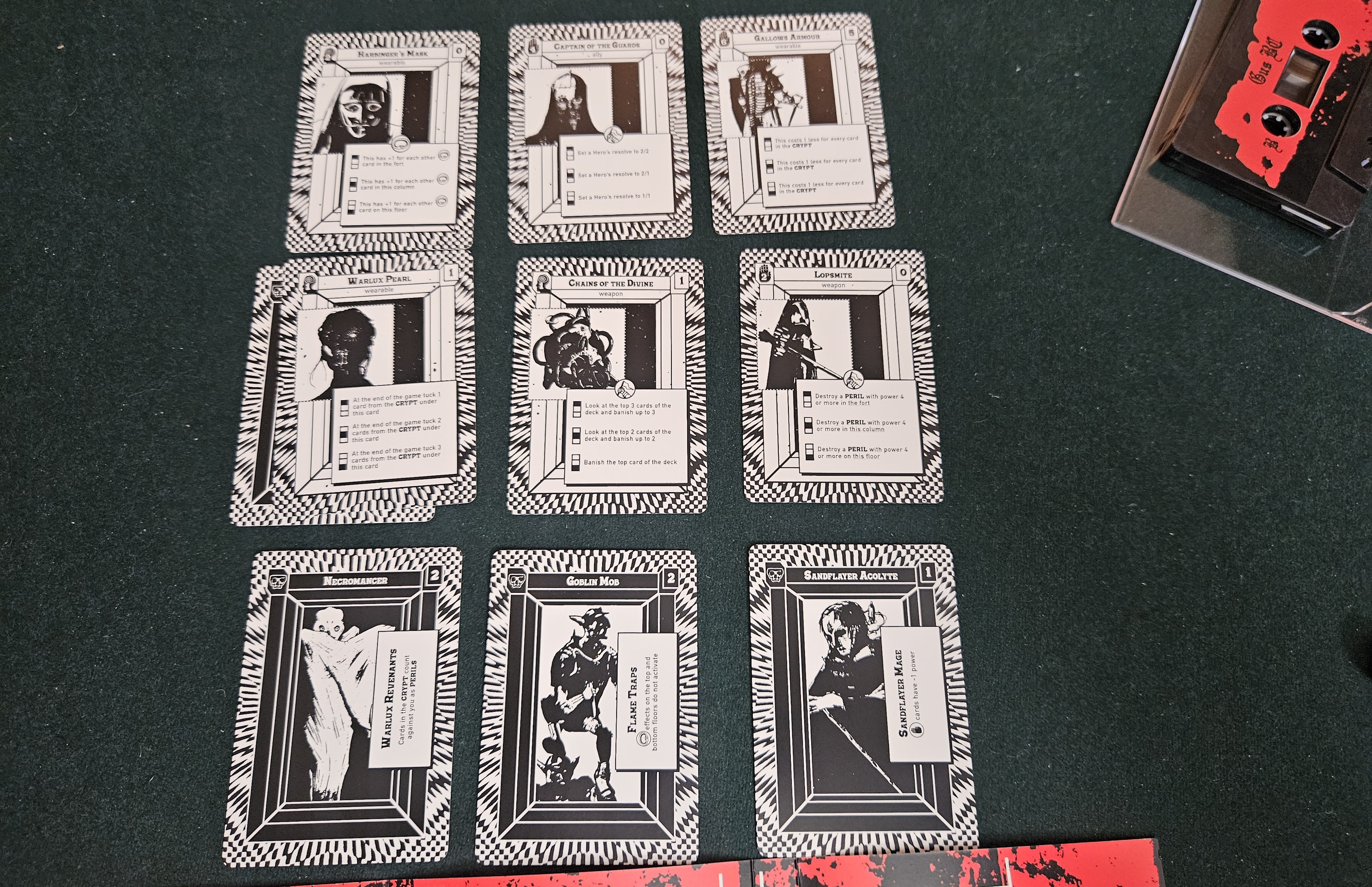
A completed tableau full of both good and evil cards.
It isn’t often that I play a game that feels quite this complete. Brute Fort works, and it works because it has such a zine sensibility, merging art and media and even disparate types of play without seeming like it’s even thinking about how it’s crossing boundaries. I have a little corner of my collection for microgames. Most of them inhabit plastic wallets. I’m delighted to now have a double-wide cassette case misfitted among them.
Brute Fort is available over on Alfred Valley’s itch page.
A complimentary copy of Brute Fort was provided by the designer/publisher.
(If what I’m doing at Space-Biff! is valuable to you in some way, please consider dropping by my Patreon campaign or Ko-fi. Right now, supporters can read the next installment in my series Talking About Games, this time tackling the topic of what makes a good list! Naturally, the piece includes a list.)
Posted on September 21, 2026, in Board Game and tagged Board Games, Brute Fort. Bookmark the permalink. 4 Comments.


I’m really happy we have these type of delights floating around out there, turning up to surprise us bitter, jaded boardgame collectors. 😉
Me too!
Sounds like great fun! Thanks for the heads-up on this one!
If you try it, I hope you have a great time!