Goop vs. Goop
Board games aren’t always very good at themes. Actual themes, as in underlying messages, not “themes,” the settings that appear in a game’s artwork. One of the hobby’s essential exceptions was Sol: Last Days of a Star. Set in some distant future, players were asked to harvest their dying star’s last embers to propel an ark into the great beyond, only to realize that their efforts were hastening the same solar death they were striving to outrun. Part climate change parable, part meditation on thermodynamics, Sol was not only playable, it was a genuine effort at using gameplay to tell a worthwhile story.
Now Ryan Spangler, one of Sol’s three creators, is back with Organism. Where Sol propelled itself outward, Organism utilizes the smallest possible lens to zoom all the way down. In a way, its diminutive subject matter is even more meaningful than Sol’s space opera. I’m speaking, of course, about the building blocks of life.
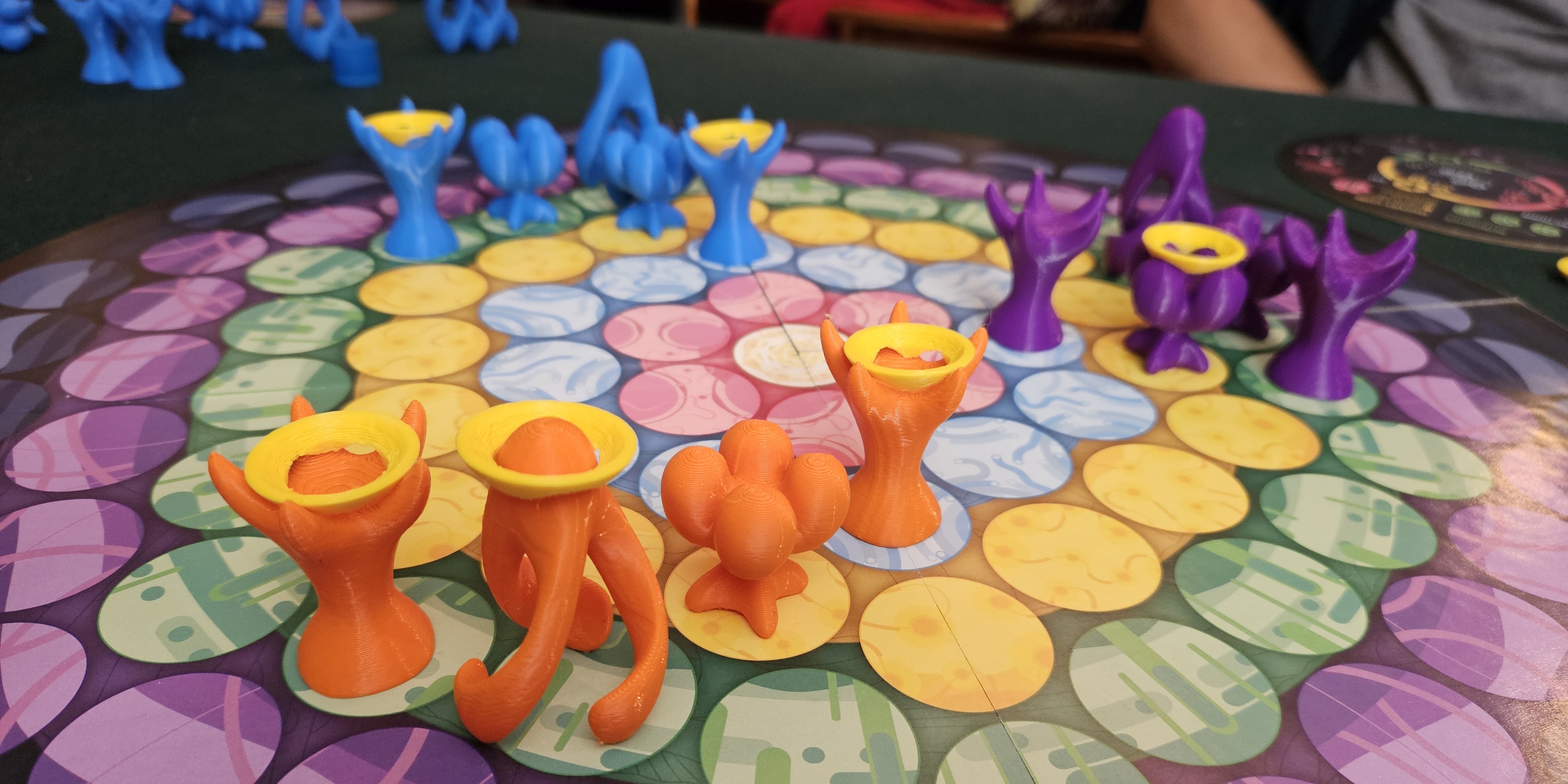
My goopy guys versus your goopy gals.
What are the smallest components that are necessary for something to constitute “life”? When I interviewed Spangler for Senet Magazine, that’s the question that led to Organism. Here players become… not even cells, really. Cells and their constituent components. Organelles. Nuclei and ribosomes and flagella. Grasping, uh, mouth-parts. Can you tell I was never very good at biology?
Fortunately, Organism drills down onto some simple terminology. To constitute an organism, there are three parts. These are your cellular building blocks. Without any one of them, the organism will die. With many of them, it becomes a lurching thing capable of doing more work. Maybe more importantly, it might split into two separate bodies altogether.
Those three building blocks are as follows. There’s the Eater, which is how your organism takes in nutrients; the Grower, which allows your organism to sprout new components; and the Mover, which allows it to shuffle around the petri dish or hydrothermal vent that is the game’s playground. At the game’s beginning, everybody begins with one of each. That’s your organism: Eater, Grower, Mover.
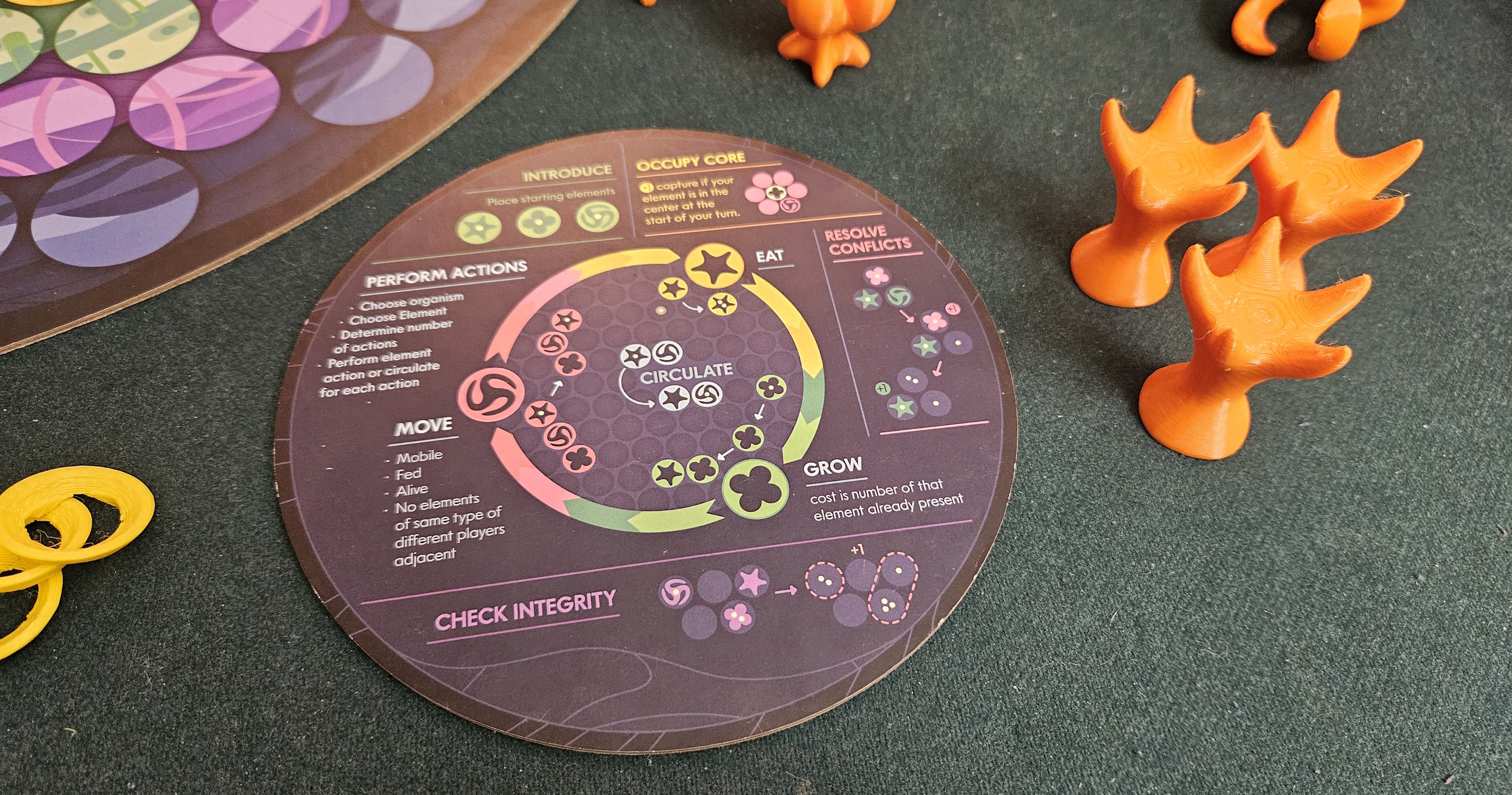
The life cycle of life.
Turns consist of selecting a single action for your organism. (Actually, you could select a different action for each organism, but now I’m putting the flagellum before the pili.) Those actions correspond with your organelles, with the crucial detail that you get to take as many actions as you have cellular bits. Want to absorb food? Choose Eat. Now every Eater in your organism gets to chow down on ambient soup, pulling food discs into your body. Want to expand your cell? Growers spend food to add new structures in adjacent spaces. Move? Look, you know what Move does.
Except you probably don’t! Organism, it turns out, is about grappling with your own lumbering body as much as it is about the smallest possible components of life. It isn’t all elegance and skater-like gliding down there. Sometimes your body is a malformed, asymmetrical blob, only capable of pushing around its parts on one side, or maybe wedged into a corner because your limbs are tucked against the edge of the board rather than putting their best foot forward. As someone who recently had both legs fall dead asleep because I was sitting too hard on my bum — normal sitting posture, just sorta wedged into a cushion — I’m in this picture and I don’t like it.
What I’m trying to say is that turns are two things at once. There’s raw potential here. Provided you have a solid handful of Movers in your body, you can rearrange yourself quite quickly, scooting your little organs all over the place. But when those Movers are in the wrong spot or few in number, movement becomes a chore. The same goes for Eating and Growing. With enough mouths and, ahem, reproducing bits, your organism gains the advantage of scale. Without them, you might soon find yourself dead in the water.
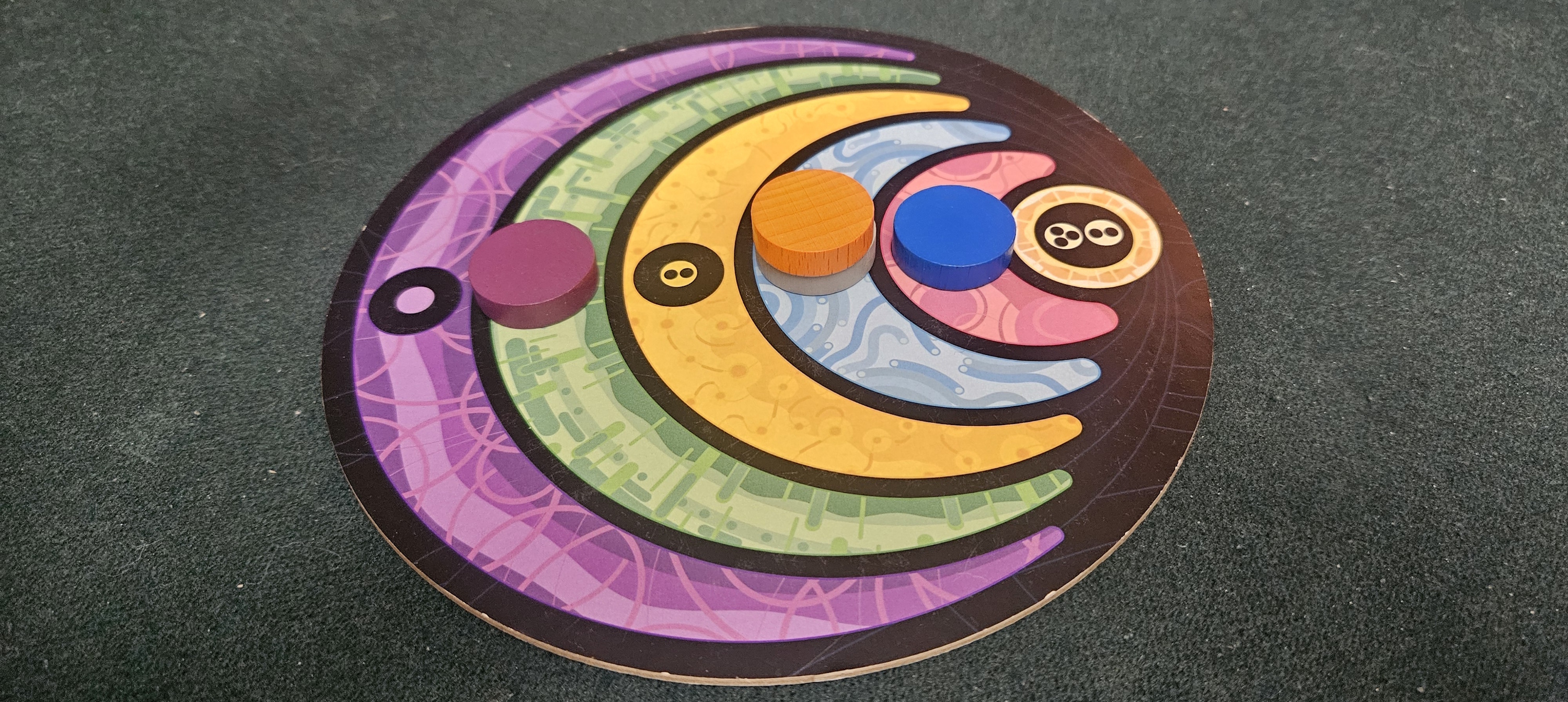
Even the scoring track is cool.
Literally dead, in fact. Organism is cutthroat. When two rival organisms move into contact with another, there’s a quick-and-dirty rock-paper-scissors check where Eaters destroy Growers, Growers smoosh Movers, and Movers circle around to strangle Eaters. This destroys the organelle on the receiving end of the circle of life and deposits an extra morsel of food in its wake. What’s more, if the recipient of this microscopic violence no longer has all the necessary components to sustain life, the whole thing is reduced to a pile of mushy calories.
And this is tied directly to how victory functions. There are two ways to win. Either you rack up five points by occupying the nutrient-dense space at the center of the board and destroying body parts — which can be done surprisingly swiftly if a surgical strike eliminates an entire hostile organism — or you outrun your rivals by dividing into three separate bodies.
These are roughly analogous to aggressive versus turtle playstyles, although the game’s open-ended nature means it’s an imperfect comparison. More often, Organism allows both approaches simultaneously. Having two bodies is better than one in terms of diversification, since now you can take two separate actions per turn. But mitosis is not a decision to undertake lightly, leaving your newly separated organisms open to attack and liable to grouse at each other for lack of sleep. [Note: Insert parenting joke.]
What this really does for Organism is make every decision matter, both in the micro sense and the larger conflict. It isn’t uncommon to look at your bloated cell and realize you optimized it poorly a half-dozen turns ago and the bill is only coming due now that you can’t figure out how to move it into battle with a rival organism without sacrificing two appendages.
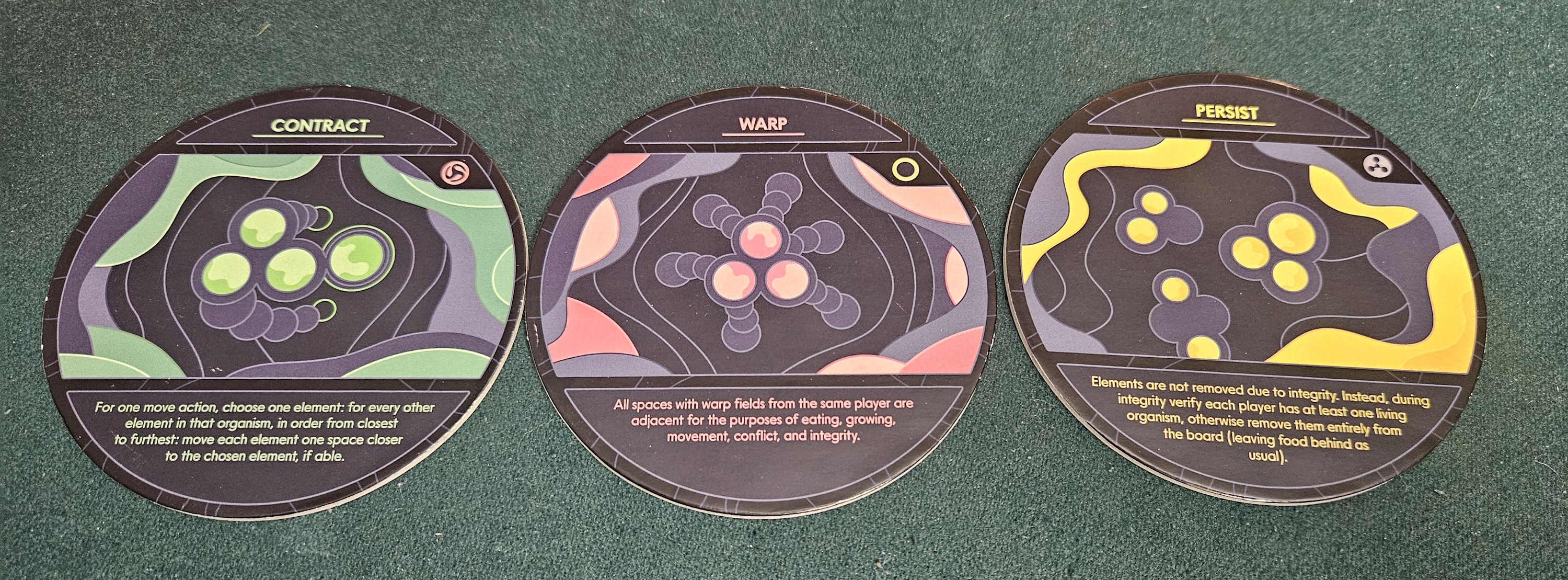
Mutations introduce all sorts of complications.
Speaking purely mechanically, Organism is an abstract game — obviously — but one with its own internal coherence. After that awkward learning phase, which has as much to do with the game’s novelty as anything else, one can look at the board and read the slow-motion topography of its microcosmic battleground, like skilled eyes reading tectonic plates or a football match.
And as an abstract game, it’s entirely distinct from anything else out there. Like Chess, it’s sometimes elegant and sometimes ungainly; like Go, it’s possible to read the state many turns into the future only to find oneself blindsided by a clever turn. But it’s also wholly unlike either of those benchmarks.
One of its biggest departures is that it’s also only a starting point. I’ve been exploring a handful of the game’s mutations, discs that introduce special rules. It’s a similar approach to what Spangler did with Sol, letting these little powers alter the progression of the game without undermining the rules wholesale. Except, well, sometimes the rules do get undermined wholesale. Such as when a mutation introduces “fields,” little discs that function as sub-systems within a cell. Some foster aggression, others lean into the optimization puzzle, and still more transform the game into something else entirely.
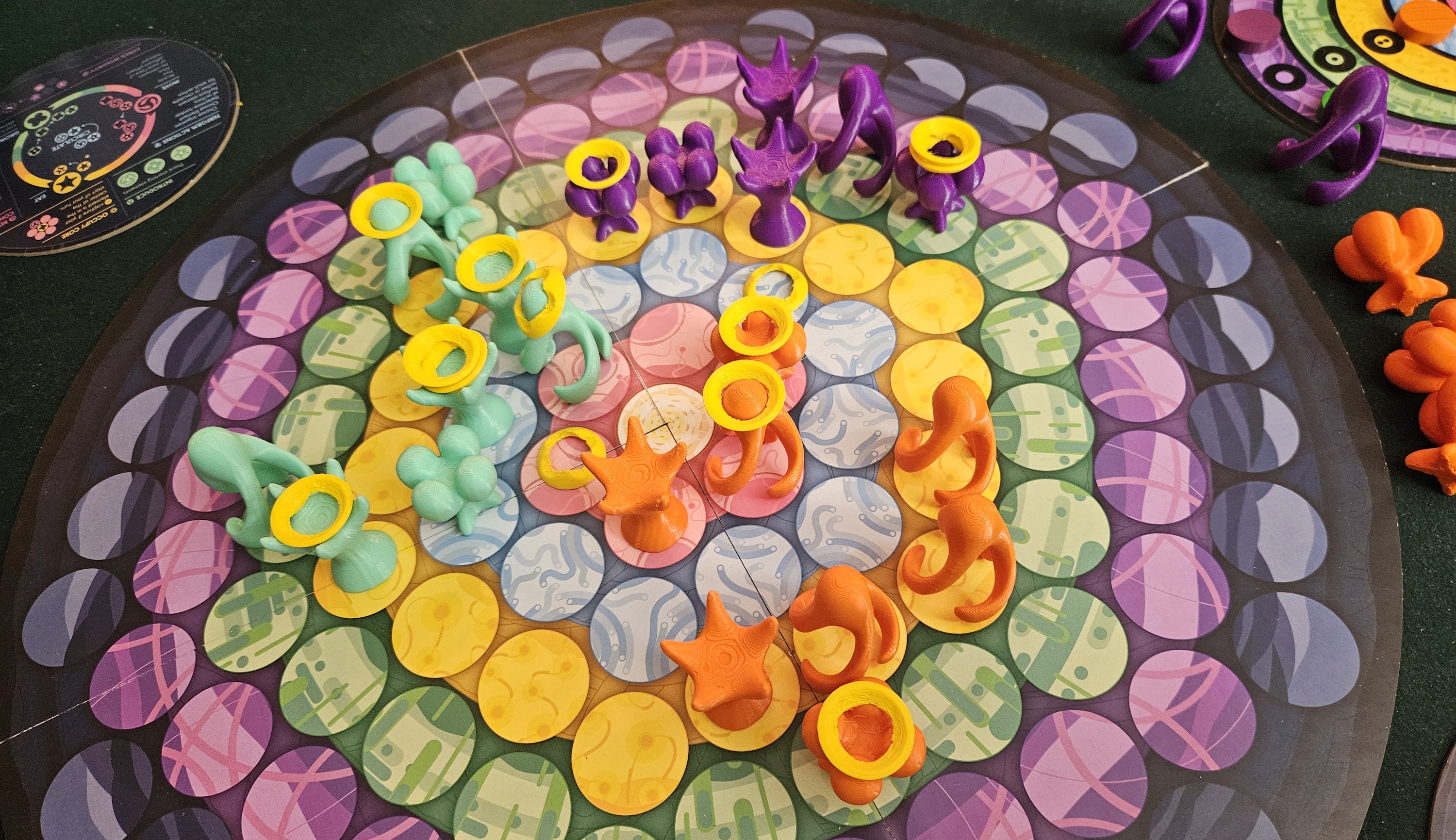
Under a microscope.
No matter how it transforms, though, Organism remains truly exciting. There have been some excellent games about evolution over the years, in particular the North Star titles Evolution, Oceans, and Nature. Organism takes an entirely different tack from those games’ recombinant traits. In a sense, it recalls those games but with only three cards and a whole lot of careful positioning. But there’s a certain thematic overlap, an arms race that never lets up. That it works not only with two players, but as many as six, is nothing short of astonishing. I’ve played with four, and while the session took longer than lower counts, it was a wonderful experience, full of little feints and flankings.
Anyway. That’s Organism. As a parable, its ambitions are narrower than Sol, but also given the focus of an electron microscope. I can’t wait to push around its tendrils, mouth-parts, and weird jiggling udders for years to come. It’s on Kickstarter right now.
A prototype of Organism was provided by the publisher.
(If what I’m doing at Space-Biff! is valuable to you in some way, please consider dropping by my Patreon campaign or Ko-fi. Right now, supporters can read the next installment in my series Talking About Games, this time tackling the topic of what makes a good list! Naturally, the piece includes a list.)
Posted on September 17, 2026, in Board Game and tagged Board Games, Elephant Laboratories, Organism. Bookmark the permalink. 9 Comments.


And not even one painfully clever organism <-> orgasm <-> onanism pun. What, you goin’ upclass on us?
Space-Biff! is gentrifying.
this is probably the first time I’ve looked at a KS, thought it looked completely dull and generic, saw a Dan Thurot review, then reconsidered. There’ve been times in the past you sold me on a game with a negative review.
I can’t really comment on the KS campaign, since that isn’t something I have any knowledge of… but yeah, at a glance, I’m not sure it acquits itself all that well, haha.
Not sure I’ve gone from – oh, what’s this kickstarter to back, back, back! so quickly. Great review, but it was the haphazard but amazingly charming playthrough that got me 🙂
I found this yesterday when Cole Wehrle urged people to take a look on Bluesky. It seems remarkably elegant and interesting and might even work with some of the non-gamerz in my life. You’re right about the campaign not really selling itself, as the gameplay video doesn’t do a great job of explaining the details of how the game actually functions (and Ryan admits that it’s the first time he’s produced one, so there’s that.) Your approval pushes me a bit closer to actually signing on. I’ve just become more reluctant to add to the pile since we moved across the pond and space is now an issue. Still thinking.
Dan, your description makes me think of the simpler but similarly organic abstract game Adaptoid which I enjoyed both as a game and a sketch of the pressures of competition on organisms. It was strictly for two players, though. Have you encountered it?
I have not, sorry. Although I’m always curious about any Nestor design!
I have been following Organism’s development since Ryan first announced it many moons ago. I had already backed the KS campaign before reading Dan’s preview, but his description has only increased my excitement for this title.
Also looking forward to the next installment in the Sol universe (which Ryan has also teased previously). Thanks, Dan! 🖖