S’pose
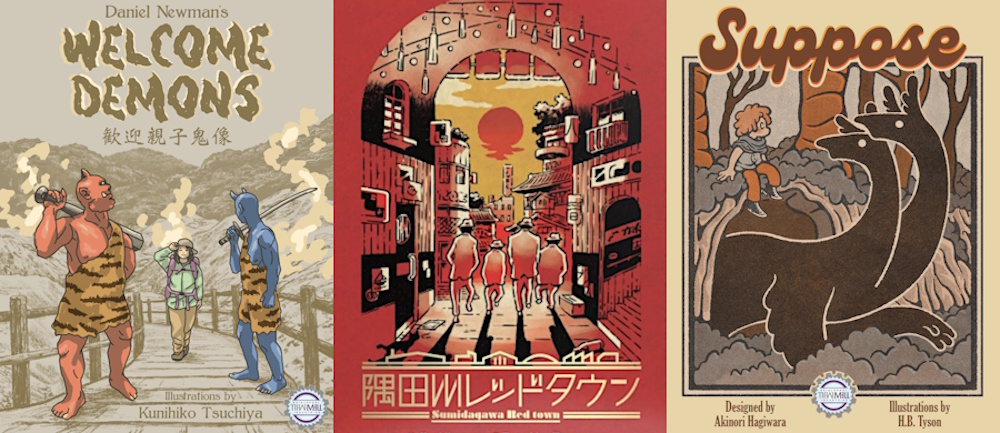
All I play anymore is trick-takers. And climber/shedders. Are those the same thing? Some say so. Others disagree. I don’t take a strong stance on it. Which is why I’m lumping these three titles together. For this quarter’s roundup, we’ve got friendly oni, unfriendly gangsters, and some super cute monsters that might be friendly or unfriendly depending on whether you correctly guess their identity.
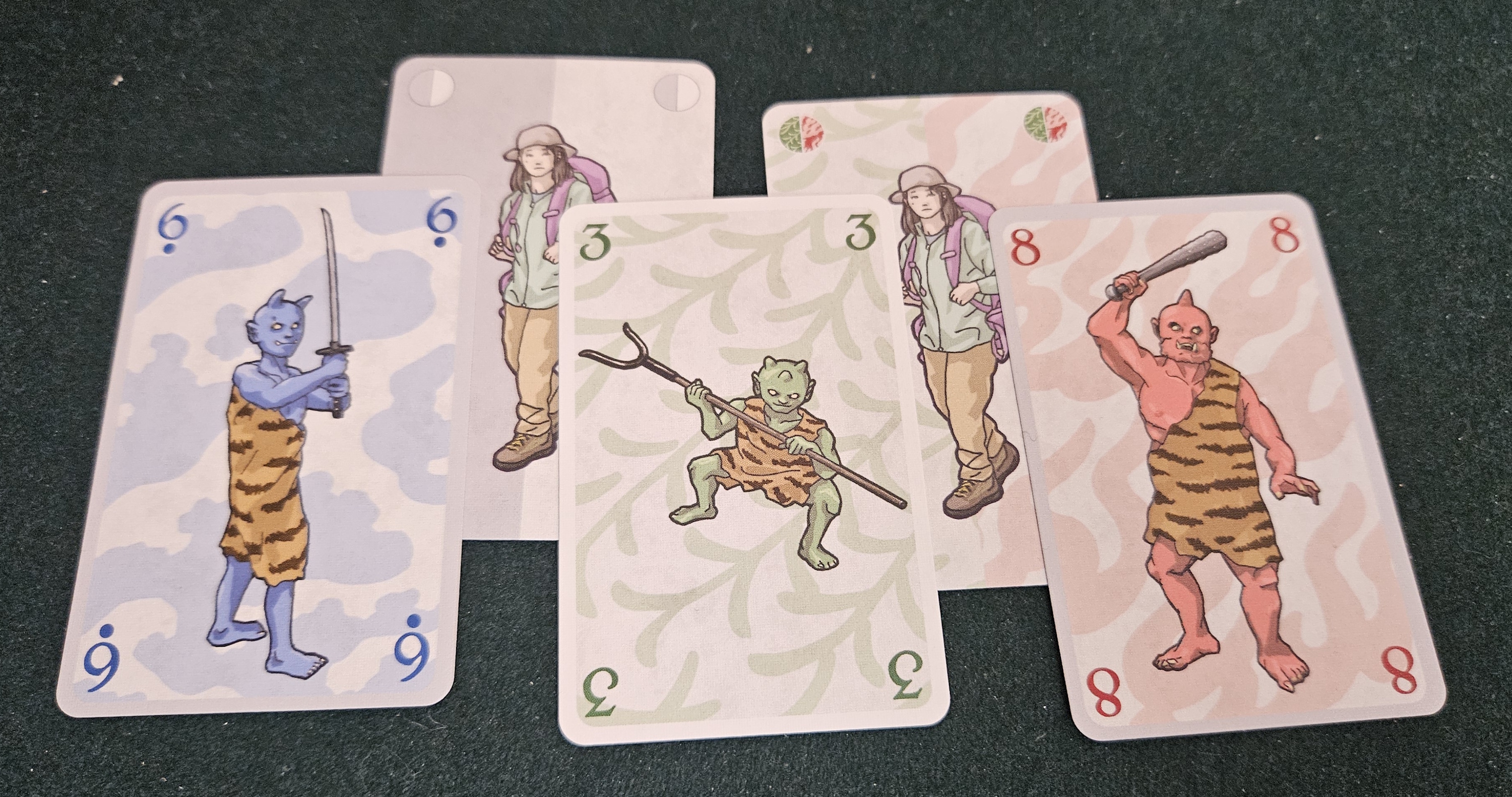
Boo! We’re here to help!
Welcome Demons
If I were a Japanese demon, I’d be like the oni from Welcome Demons — a menacing li’l guy with a sword, but really just here to make sure you get home safe. Designed by Daniel Newman, this is a shedder about using the cards from your hand to guide lost hikers out of the mountains.
It’s also as atypical as it gets, seating exactly three players and, rather than building melds in the usual fashion, having you match your cards to your hikers. Each hiker has their own needs, whether odd/even ranks or various suits of oni. What’s more, players are required to format these melds using at least one card from the previous player’s set. This forces everyone to pay some attention to what their rivals are putting on the table. More than some attention, really. Because your meld must contain the same number of hikers (one, two, or three) but a higher sum of ranks, or more hikers but a lower overall rank. Which makes things tricky indeed, especially if you’re holding a bunch of mid-rank cards.
And then, if it becomes impossible to follow, everyone passes and the last demon to shepherd their lost hikers begins the process all over again with one lonely hiker. This continues until somebody most definitely can’t save any more hikers, at which point they lose and the other two players are crowned… I don’t know, the most helpful oni of the month.
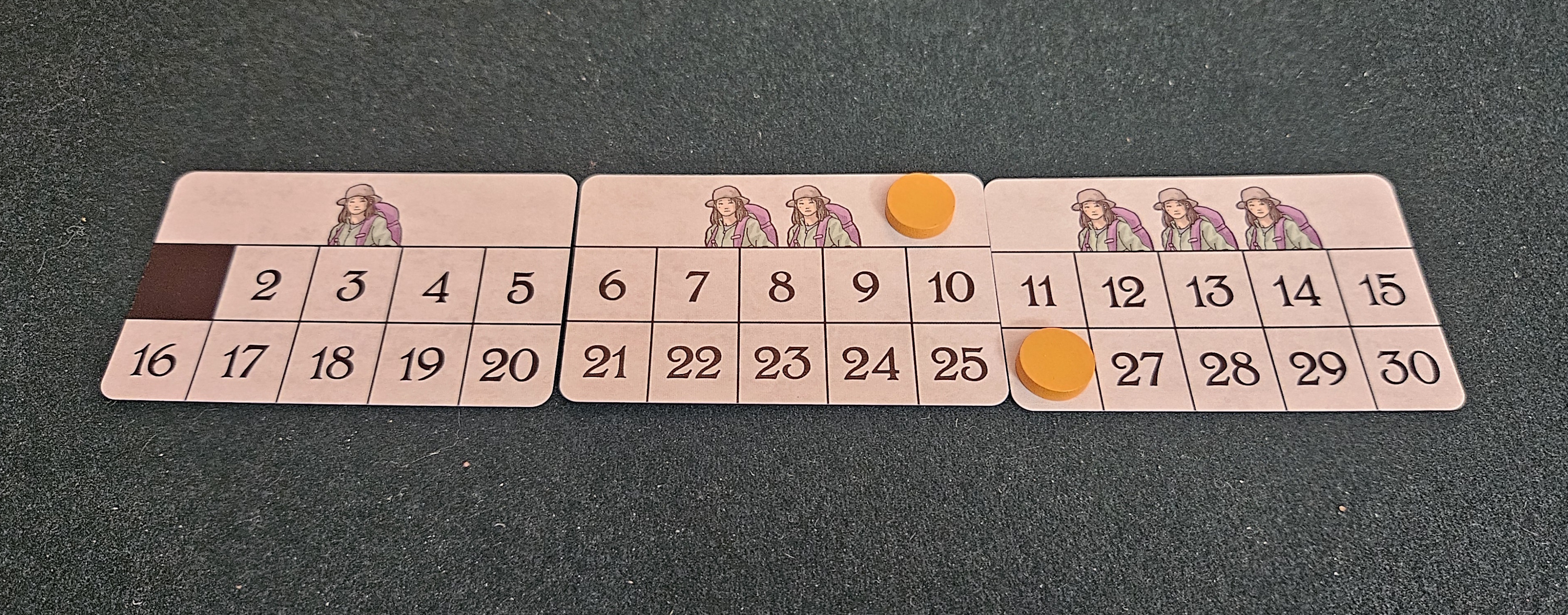
How many hikers can you aid?
It’s a clever little thing, emphasis on both “clever” and “little.” Newman pulls a trick we’ve seen before, where you aren’t playing to win so much as playing to avoid losing. Oni are spiteful that way. Especially near the end of the hand — and the hand is the game, this isn’t some multi-round affair — it isn’t uncommon for players to struggle to build the right melds, sometimes resulting in an early quit for the session. Like many shedders, this makes the game’s back half less interesting than its opening salvo.
Fortunately for Welcome Demons, its approach to meld-building is novel enough that it’s worth witnessing, even if only as a filler. I would put this one in the midnight nugget box: a tasty snack with a crunchy exterior, but not the most filling meal out there.
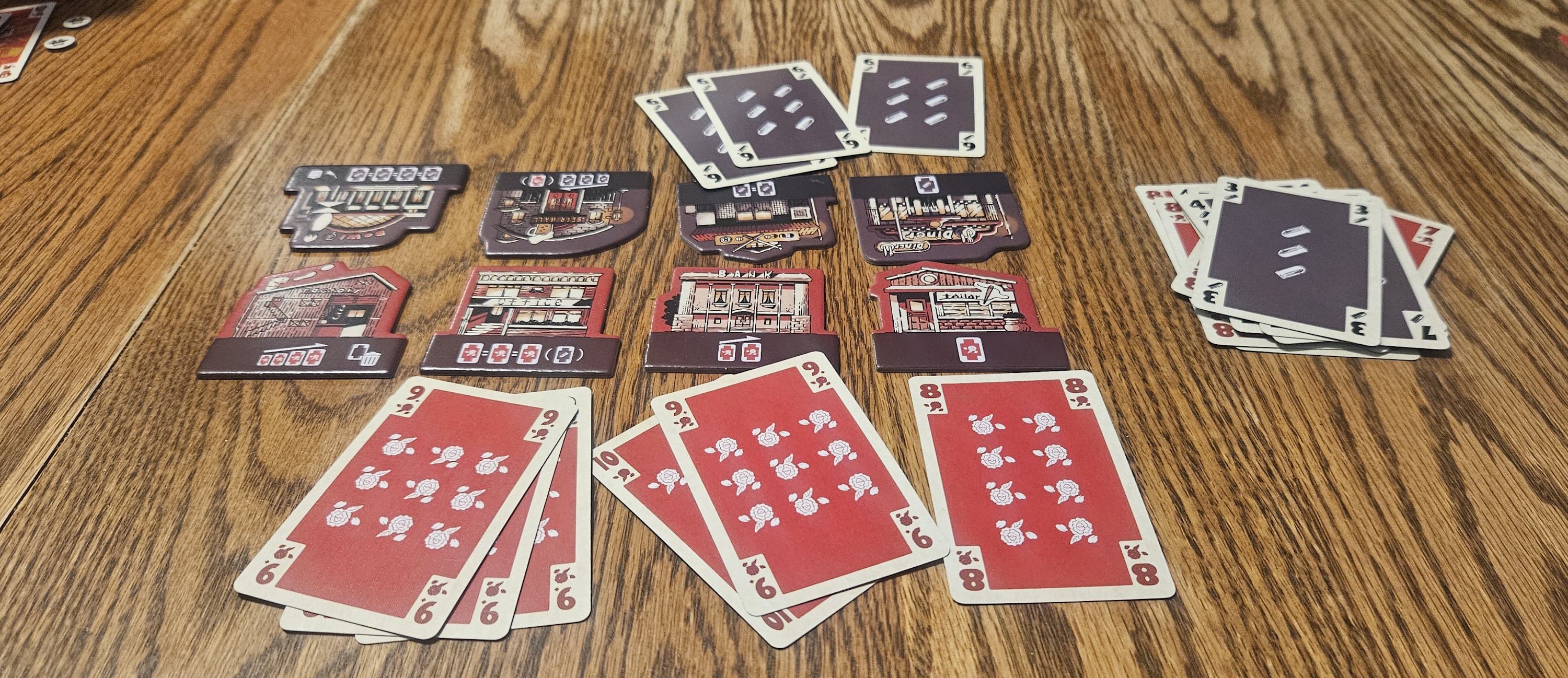
Take ’em out back and gun ’em down.
Sumidagawa Red Town
Like our previous entry, Sumidagawa Red Town is a shedding game about sinking slowest. Players, of which there are between two and five, step into the rain-slicked trenchcoats of small-town gangsters who need to subtract a column from the organization’s payroll. By which I mean they need to murder one of their companions. With the oni doing emergency response, it raises the question of who the real monsters are. Sobering, etc.
The main twist is that players aren’t one-upping each other’s melds, at least not in the traditional sense. Instead, the titular red town is presented as eight sections, each of which holds its own unique meld. There’s a space for a sequence of three brown cards, another for a triplet of red cards, two for singles of either suit, and so forth. Into these spaces you play a meld. This must start at a higher rank than whatever the previous player deployed, but otherwise you’re free to choose whether to play one card or four.
Assuming the proper space remains open, that is. And that’s the rub. After even one round, it becomes very tricky indeed to find a good fit. This marks Sumidagawa Red Town as one of those titles absolutely riddled with tactical passes. While dropping four cards on the town’s biggest space is certainly a power move, it might be better to pass and let the town clear out for the next round. Especially if you’re likely to go second.
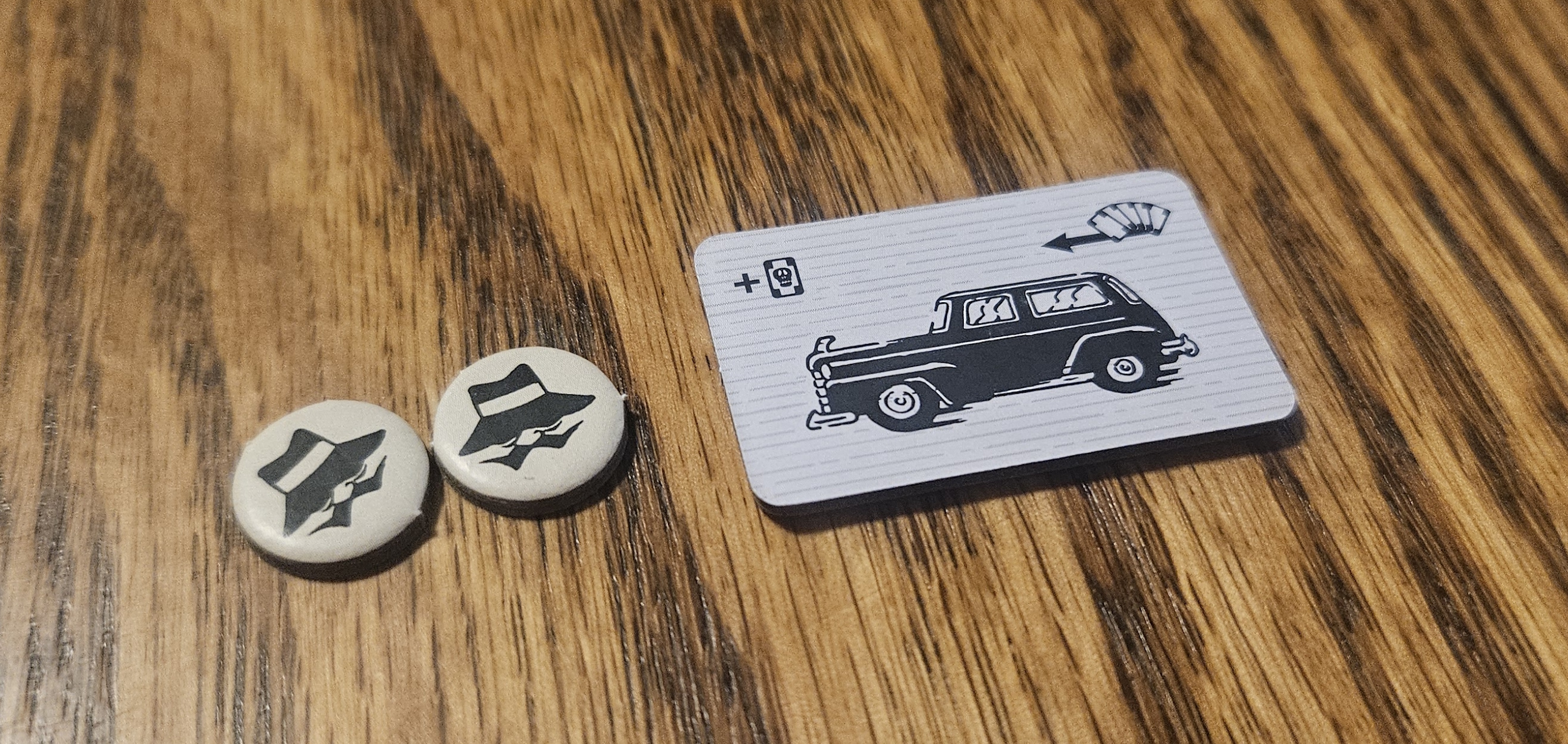
First to lose. Might as well get some help.
It’s thrilling to follow a four-card bomb with a single, and for that reason alone Sumidagawa Red Town establishes itself as one of my favorite shedders.
But Mashikamaru doesn’t stop there. In between rounds, players get to decide if they want to summon hitmen — in game terms, suit-coded wild cards — to beef up their hand. If only one player elects to do so, they receive broad latitude to add as many hitmen from their private pool as they like. But if multiple players choose this option, they only add one hitman, then swap hands with everyone else who made the same decision. It’s a brilliant piece of brinkmanship, potentially making or breaking your entire hand, plus offering the chance to drop a real stinker of a hand onto somebody else.
And really, that’s what this one is all about. Choosing your battles, knowing when to go all-in, and then slipping your rival a mickey rather than facing them directly. The main downside is that it’s hard to find outside of Japan and requires a translated rules sheet. Personally, I’ve found it well worth the effort. Forget it, Jake. It’s Sumidagawa Red Town.
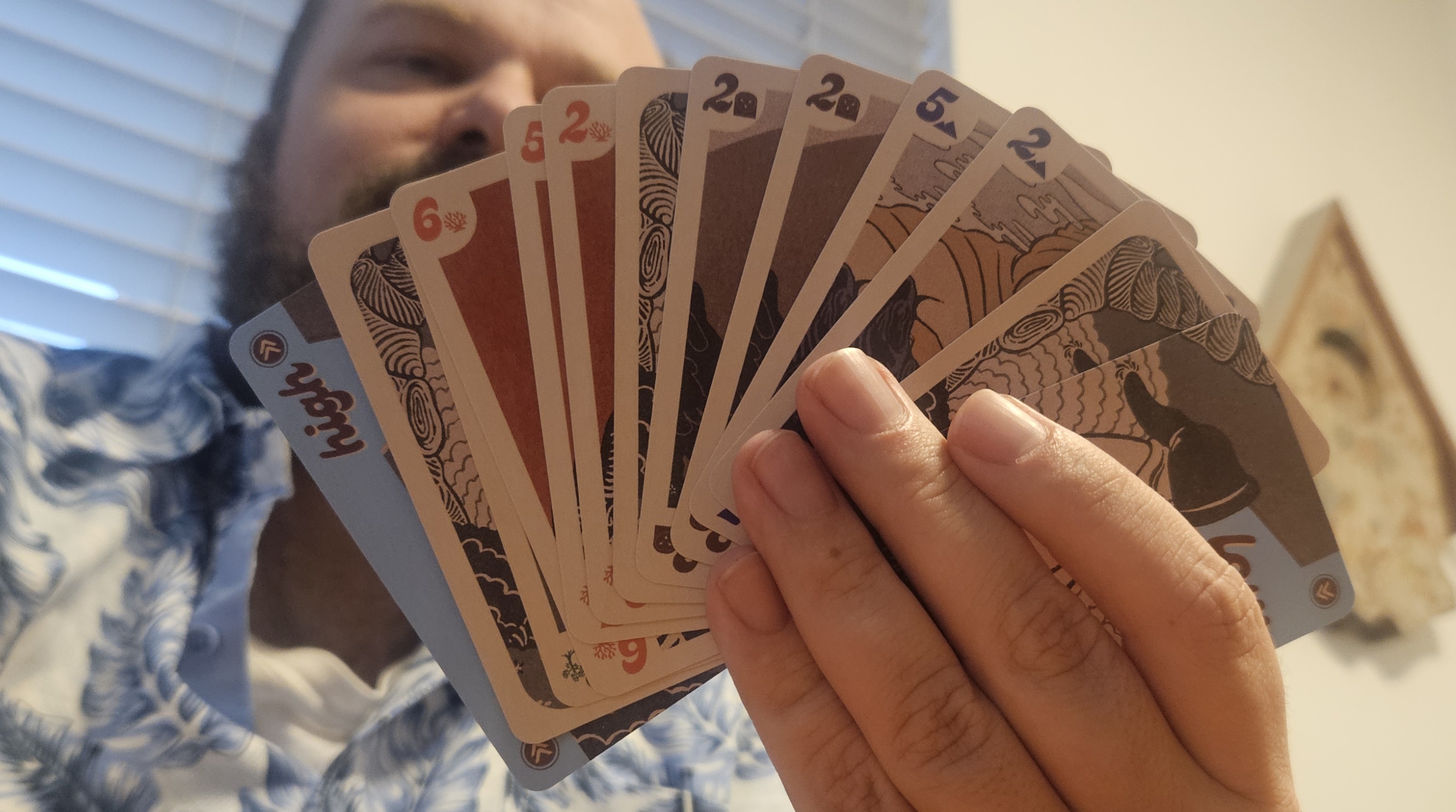
Check out that handsome devil.
Suppose
On the more traditional end of things — although only marginally — is another New Mill import in the form of Hagizou’s Suppose. This is a trick-taker, and for once there’s an actual winner, but the game’s may-follow nature marks it as rather distinct from most of its peers.
Scratch that, everything is distinct. There’s the way your hand is arranged: sorted by your neighbor and splayed so that ranks increase within suits, but with only a few cards facing you while the others peek outward to show everyone else at the table what you’re holding. In fact, much of the game revolves around your hand’s concealment. Whenever you play a card you can’t see, you’re permitted to guess its identity. There’s no penalty for guessing wrong, while a correct guess awards a “suppose” token. These translate into points at the end of the hand. Which is a good thing, given the relative scarcity of points elsewhere.
How, then, does one score? Tricks, first of all, although at one point per, these aren’t much to write home about. Your larger tally comes from another guess. When the round begins and you sort your neighbor’s hand, you wager how many tricks you think they’ll take. Contract bids are always testy, but here they’re especially tough. Since you’re never forced to follow suit, sabotaging a neighbor’s bid is especially easy. It’s possible to split your bid for fewer points, but, well, that only makes it marginally easier to hypothesize what your opponent is going to do during the round.
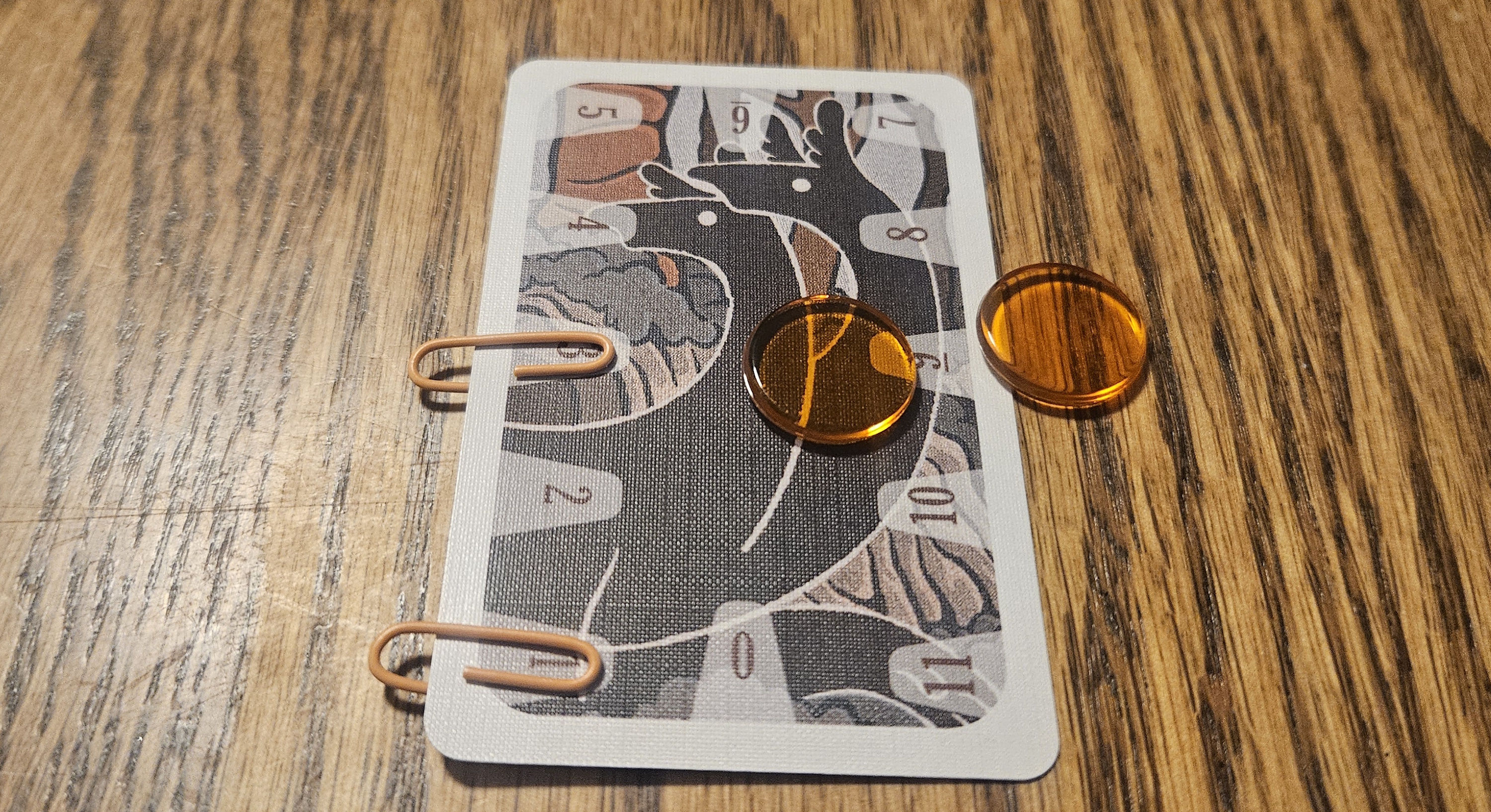
Making good guesses, I guess.
The outcome, then, is an extended guessing game, but one that strikes out along multiple avenues of conjecture. What you’re holding, what everybody else is holding, how your target neighbor is faring, whether this is a good time to nab another trick or yield it to someone else… it’s a lot to take in.
That said, Suppose is something special. It might even be my favorite New Mill release all year. The deck is tight enough that correct guesses are possible, but the inclusion of two copies of each card makes card-counting, while not impossible, at least not such an advantage that it changes the nature of the game entirely. The result is a game that’s as much about sabotage and the careful sniping of unexpected tricks as it is about reading everyone’s hand. Truly, this one is a gem.
You know. I suppose.
A complimentary of Suppose and Welcome Demons was provided by the publisher.
(If what I’m doing at Space-Biff! is valuable to you in some way, please consider dropping by my Patreon campaign or Ko-fi. Right now, supporters can read the next installment in my series Talking About Games, this time tackling the topic of what makes a good list! Naturally, the piece includes a list.)
Posted on September 16, 2026, in Board Game and tagged Board Games, New Mill Industries, Sumidagawa Red Town, SUNNY BIRD, Suppose, Welcome Demons. Bookmark the permalink. Leave a comment.


Leave a comment
Comments 0