Party Up, Party Down
UFO 50 was one of the coolest gaming artifacts of the past few years, a collection of fifty unique video games by Derek Yu, Jon Perry, and a handful of other developers that pitched itself as a digital excavation of a long-lost 8-bit console. The collection was special for many reasons, but my favorite trick was the way its creators employed modern design principles that contrasted the system’s hardware and input limitations.
For example, Party House. Designed by Jon Perry, this was a full-fledged solitaire deck-building game that fictively predated Dominion by over two decades. Now, in a design ouroboros, Perry is shifting Party House to tabletop.
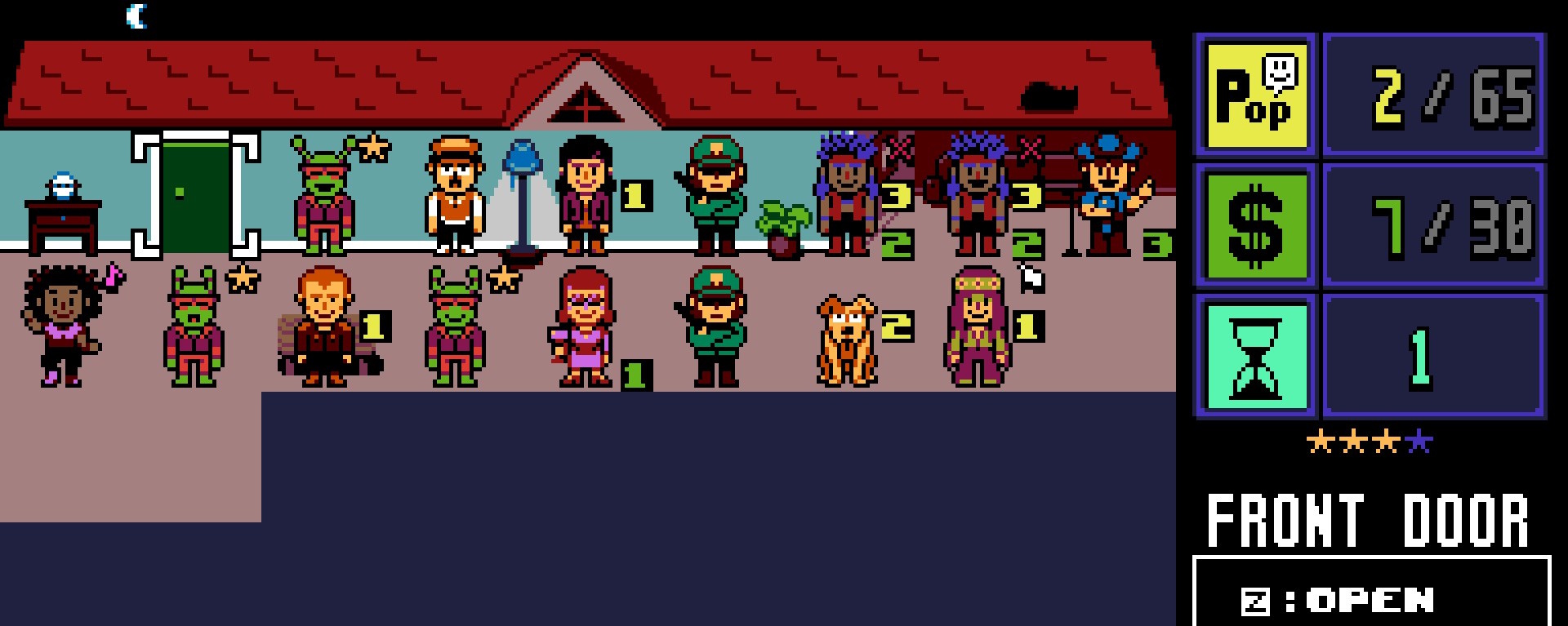
Check out my sick group of friends. (UFO 50 version)
If nothing else, Party House is more relatable than most gamified topics. You want to throw a party. A big party. But you also don’t want the cops and/or the fire marshal to bust up the festivities. In the UFO 50 original, that meant building out your Rolodex, expanding your apartment to accommodate more bodies, and then randomly drawing guests until you decided you’d had enough. Or until the door got kicked in.
Basically, the whole thing was a merger of Dominion-style deck-building and press-your-luck gameplay. Good guests awarded popularity and cash, while rowdy guests egged your neighbors into taking matters into their own hands. Others served as utilities: bouncers for tossing out troublemakers, private investigators who could drag the right people to the party, college mascots for nostalgic gatherings of old friends. Special guests like aliens and mermaids, meanwhile, served as objectives, awarding the stars that proved you had mastered a particular set.
That’s the gist of the physical version as well, although Perry has made a number of changes, some delicate and others structural.
The biggest alteration is Party House’s format. Because the UFO 50 version was a solitaire game, it presented a series of challenges, each offering a pre-built selection of guests and objectives. Tackling these levels required some luck, but the game’s core concern was more with finding the right build order for your Rolodex than responding to dynamic problems. The result wasn’t quite a puzzle with a set solution, but it was closer to that side of things than one might expect.
For the physical edition, Perry has tossed all the digital game’s goodies into a single box. Gone is the set marketplace. Instead, players are presented with three rows of guests that are constantly refreshing as they’re befriended with popularity and cash. Gone are the puzzle-style levels. In their stead is a race to earn a certain number of stars before anybody else at the table. Gone is the apartment limit. Now your place can hold as many guests as possible. Provided the party doesn’t end prematurely, that is.
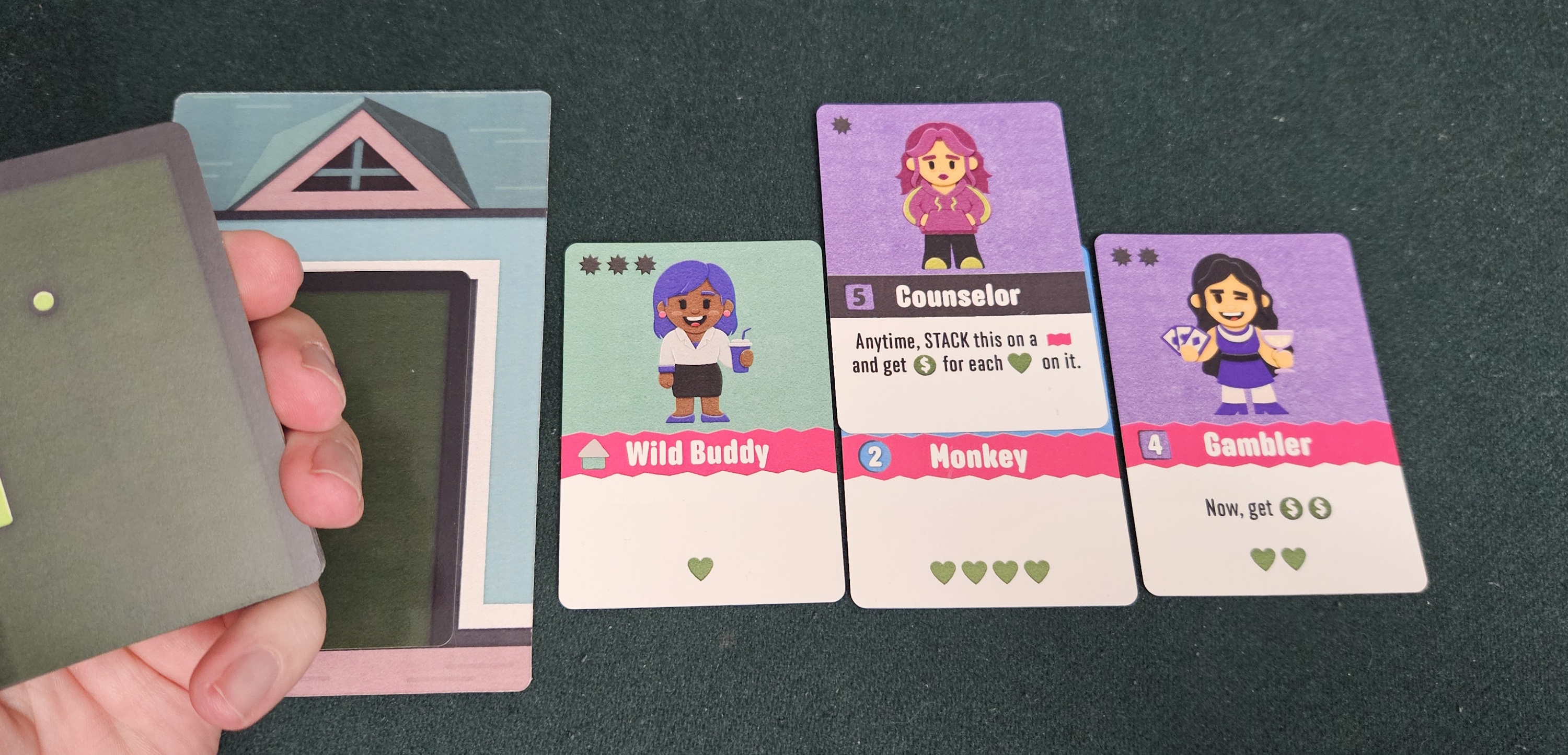
Parties are better in person.
On the topic of premature ejection, troublemakers have received a significant facelift. Previously, the police would crash the party as soon as three troublemakers were clomping around the living room. Now every guest — or nearly all of them — produces some amount of noise. As soon as you hit eight points of ruckus, the party’s over. Worse, you skip the Rolodex phase entirely. And unlike in the original game, popularity fades each round. Only money can be hoarded. Fortunately, these twin currencies are interchangeable. What one lacks in charisma they can make up for with Benjamins.
As a side note, there’s a nice balancing mechanism where a crashed party puts an accessory card in your deck. Accessories are always positive, just not as positive as a good guest. Still, a charcuterie board or karaoke machine is handy in a pinch. It’s a nice concession for the occasional stroke of rotten luck. Failing players stay in the game, but with less control over how they assemble their guest list.
Perhaps most importantly, the whole thing is fast. You hold your deck in your hand the entire round. A turn takes maybe twenty seconds at most. And cards flip at a rate comparable to the typewriter clatter of FlipToons, but with the occasional mid-turn decision to prevent it from feeling quite so rote. Actually, the comparisons don’t end there. Party House feels like FlipToons with considerably more direct control. Whether it’s the ability to peek at cards mid-party via spies and superheroes, cover your loudest offenders with cute dogs and counselors, or deploy occasional cards that directly confront your opponents, your Rolodex is a bespoke assemblage that can be bent to your will.
The other big point of inter-player friction arrives in the form of party cards. Each game puts two of these on display, then asks players to jostle for control by fulfilling their stated objectives. This allows for some distinction between sessions. Hosting a Class Reunion feels different from a Legendary Rager, with the former favoring gatherings of old friends while the latter requires you to ride the line with plenty of troublemakers. Importantly, these cards can be stolen, encouraging players to one-up each other over the course of the game.
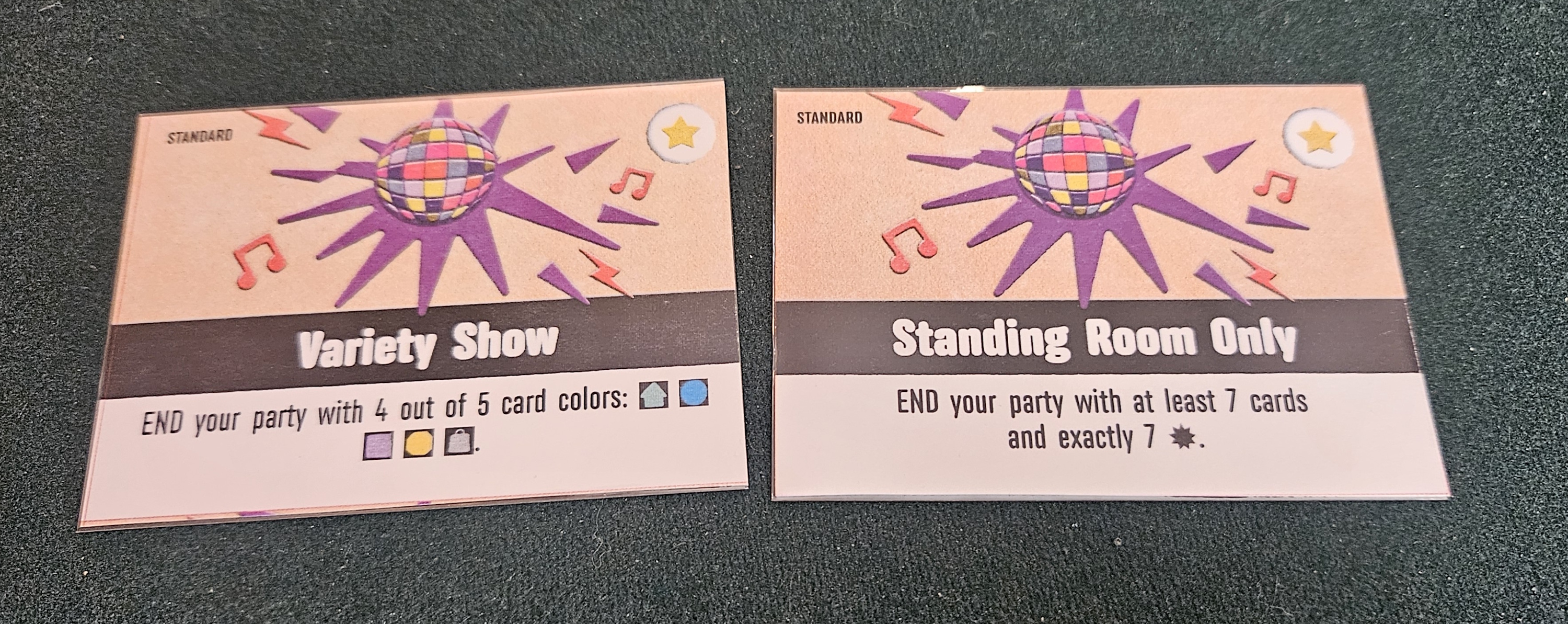
Different party types can also award stars.
On the whole, Party House does an admirable job of translating the version that existed in UFO 50. It captures the spirit of the original, incorporates more players, and expands the decision space, while also keeping the play punchy and pacey. There are even little touches that speak to Perry’s deep mastery of how a hand of cards can and should be handled, such as the single guest that must be peeled from your deck to become the “door” (read: discard pile) of your apartment, a trick he pulled in Hot Streak to prevent players from developing too robust of a predictive mental model of their deck.
I’d also be remiss to forget Daniel Profiri’s illustrations, which resemble felt board cutouts and are a perfect way to depict the guests’ retro appearance without defaulting to pixels.
At the same time — and keeping in mind that I’ve only played the prototype — Party House comes across as a minor title in Perry’s ludography. It isn’t as subversive as some of his other hits, lacking the emotional range of Scape Goat, the genre-redefining nature of Air, Land, & Sea, or the family breadth of Spots. To be sure, this isn’t to say that Party House has to be revolutionary, and there’s a tyranny to expectations that can prevent us from appreciating what’s right in front of us. But by and large, my experience with Party House has been a gentle one, a pleasurable process of revealing and shifting cards that still feels largely automatic. Where the version found in UFO 50 fit that collection’s 8-bit limitations, here it lands somewhat more thinly.
Then again, there’s a lot to be said for pleasurable physical processes, and that’s where Party House succeeds best. With the right group, it’s the sort of game that gets people chanting “Hit, hit, hit!” And the game upsets genre formulas in subtler ways. For instance, this is one of the few deck-builders to shrug off the absolutism of the five-card hand. Here a party might consist of three guests or ten, all depending on chance and how well you’ve assembled your Rolodex. It’s a smart little thing. Just be aware that it’s littler than you might expect.
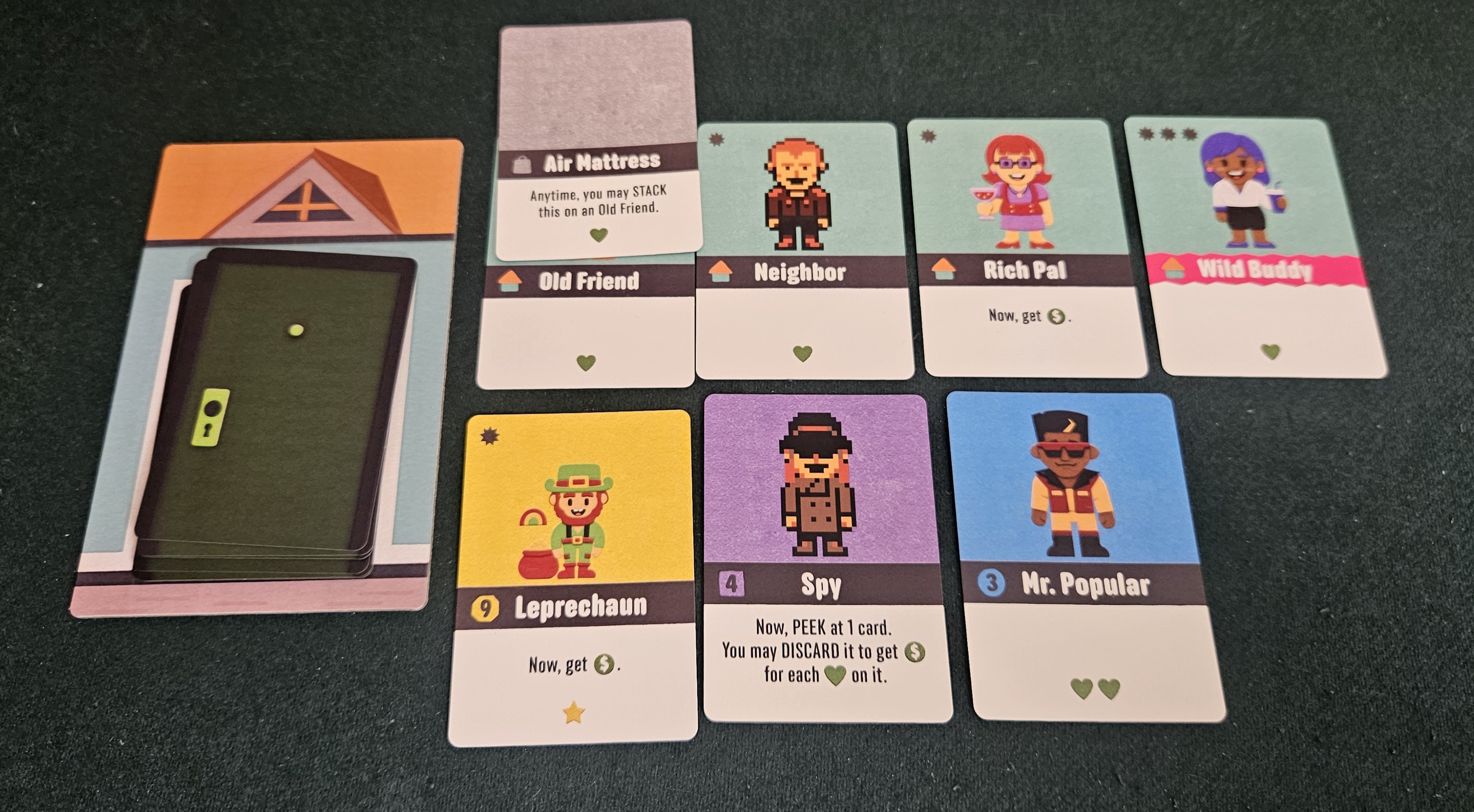
The bigger the party, the more likely the cop roll-by.
Where does that leave Party House? On the threshold, I suppose. Playing prototypes is always a risk. Sometimes you get Baba Is You, which feels poised to become an instant cult classic. Other times you get a game that’s still finding its identity. That’s where I would put Party House. Class Reunion or Legendary Rager — we’ll see next year which party this shindig shapes up to be.
A prototype copy of Party House was temporarily provided by the publisher.
(If what I’m doing at Space-Biff! is valuable to you in some way, please consider dropping by my Patreon campaign or Ko-fi. Right now, supporters can read the next installment in my series Talking About Games, this time tackling the topic of what makes a good list! Naturally, the piece includes a list.)
Posted on September 15, 2026, in Board Game and tagged Bitewing Games, Board Games, Party House. Bookmark the permalink. 4 Comments.


Worth noting that UFO 50’s version of Party House is not strictly solitaire, there is a 2 player split screen mode that has you racing against the other player to achieve a certain number of stars. 🙂
Oh gosh, I always forget about the multiplayer stuff! That’s right. I never played any of UFO 50 in multi, so it slips the mind. Thanks for the reminder.
It just feels to me as if someone went and asked, “What if Fliptoons were a push your luck game?” and that makes it an easy skip for me.
Party House predates Fliptoons, at least!