Circlet of Mutual Antagonism
Circle of Conflict is a really bad title. Just terrible. You know what would have been better? Anything. Ring of Conflict, maybe, seeing as how this is a Lord of the Rings shindig. Crud, just call it Circlet. That has an elegant chime, doesn’t it? Circlet.
I imagine the thinking behind the title, which was designed by Geoff Engelstein and Stephen Buonocore, was that it’s descriptive. Because the game actually plops you right into the middle of a circle, you see, and that circle happens to be not a circle of harmony, but a circle of conflict. You’re reenacting the War of the Third Age from both perspectives, commanding the Free Peoples against the player to your left and Sauron & Friends against the player to your right. Thus the Circle. The Circle of Conflict.
The other rancid thing about the title is that… oh, what’s that? You want to hear about the game? Very well. It’s quite good. Not perfect, but good.
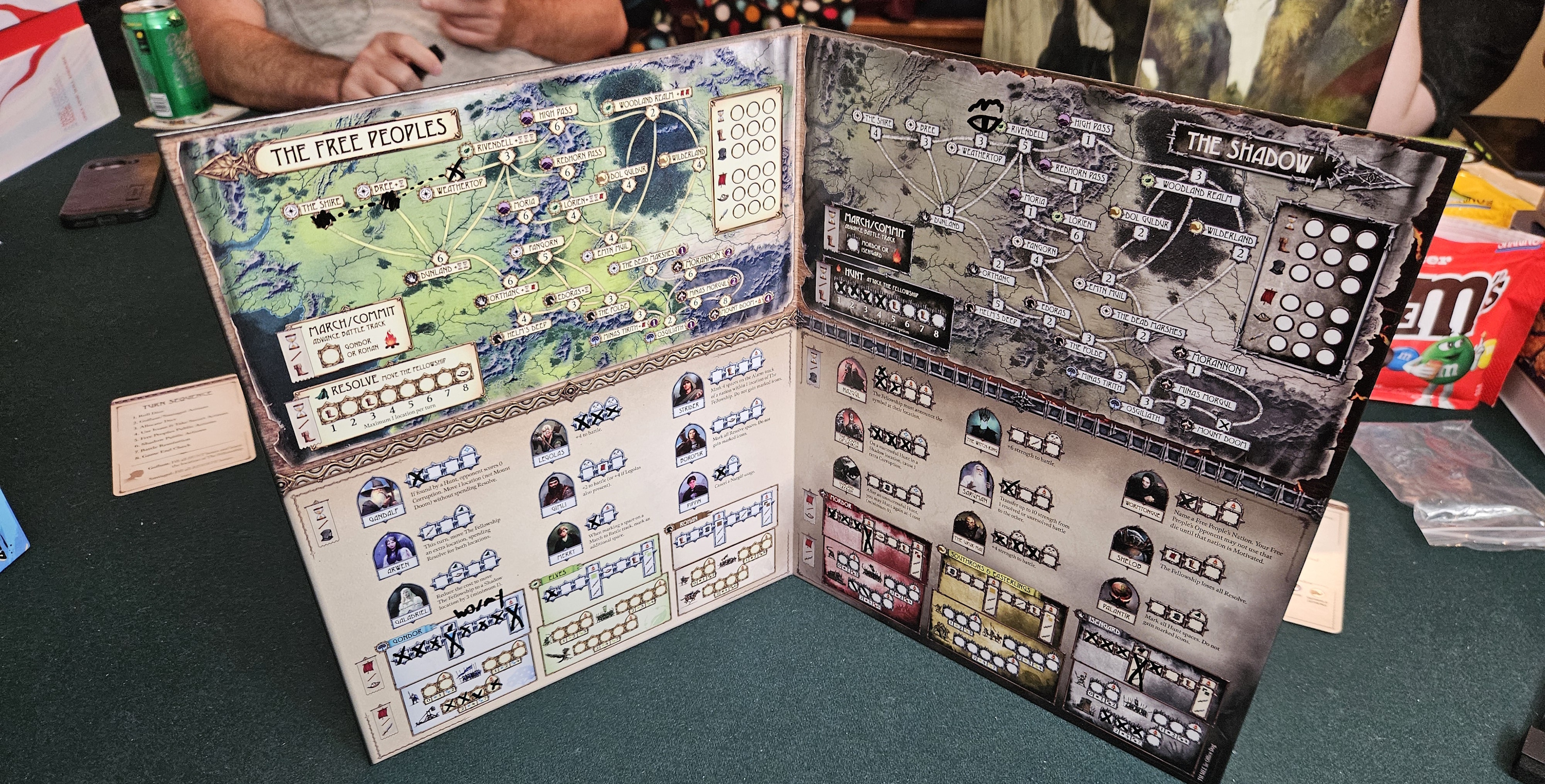
More board games should be in folders. For the lazy.
As gimmicks go, one could do a lot worse than Circle of Conflict. It’s like the inverse of its title: just a great idea from top to bottom. As the Free Peoples, you’re trying to safeguard the One Ring on its trip to Mount Doom, muster armies to defend Rohan and Gondor, and generally vouchsafe the hearts of men so they don’t falter. As the Shadow, you’re doing all that but exactly the opposite. Find the Ring, burn Rohan, burn Gondor, indulge every impulse.
And it works. Works well, in fact. Works too well, perhaps, in the sense that the system very quickly scurries out of the way and opens up the holistic design to any number of nitpicks.
The baseline mechanism is roll-and-write, landing this in the long and not-often-successful lineage of titles that have tried to fashion a roll-and-write-but-bigger game. Every round — which is a mess of phases, just be warned — opens with a big handful of chunky dice getting rolled onto the table. When the game begins, only two of these dice are actually usable, and you’re required to divide them between the halves of your demesne. One for the Free Peoples, one for the Shadow.
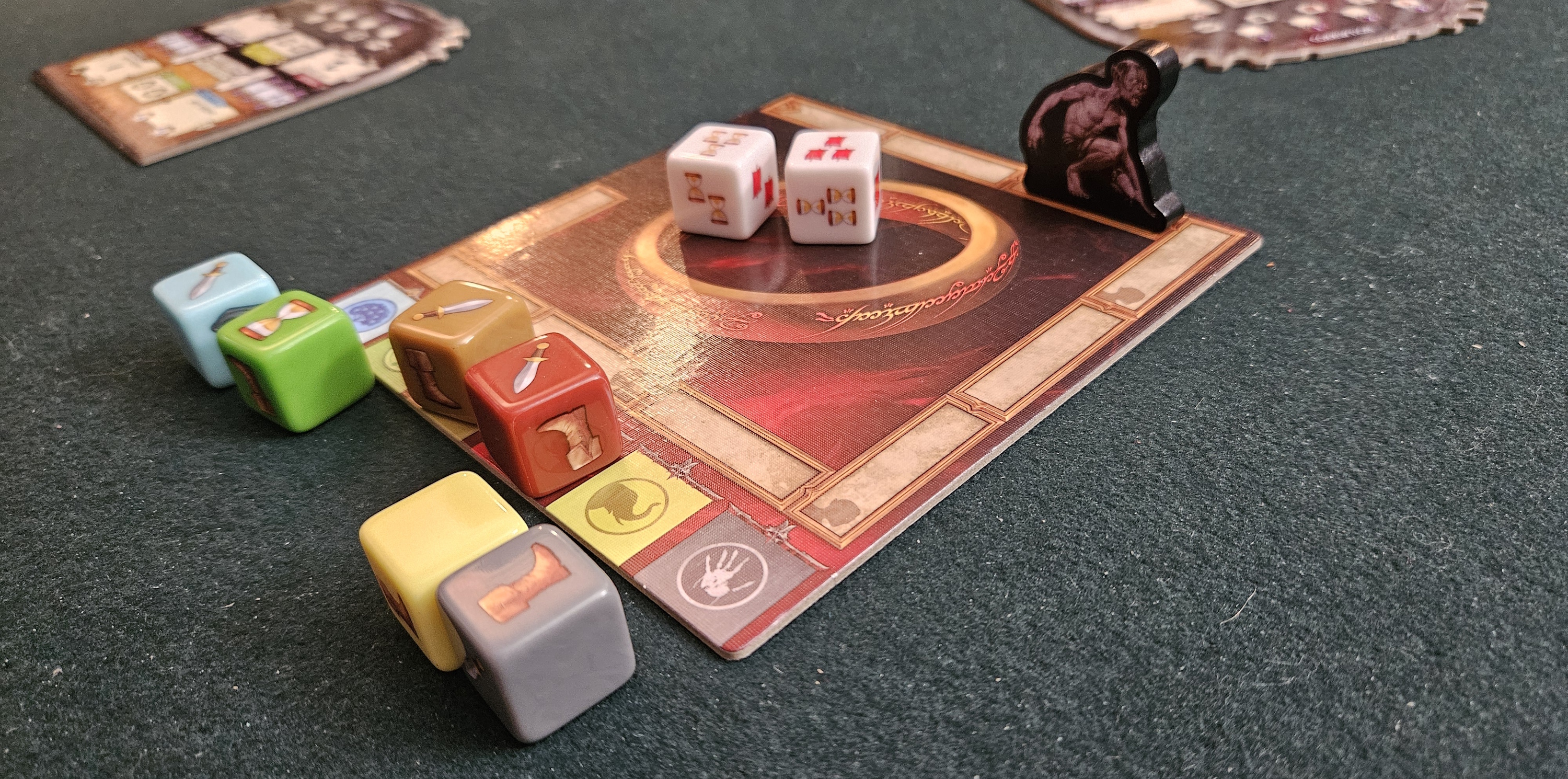
I do love some nice dice. And a nice Sméagol, too.
It’s a simple enough decision, although of course there’s more to it than first meets the eye. It isn’t long before players begin to hear rumors from their neighbors. Perhaps the player to your left announces that they’ve rallied Isengard. This means they also gain the icons from the gray die, and may soon begin deploying troops to assault your version of Rohan. Meanwhile your Nazgul are hunting for the Ring somewhere around Weathertop; this initiates a call-and-response phase where you check your investigation against the player to your right, who reveals whether you’ve managed to corrupt their Ringbearer.
Point is, while you aren’t given total control over whether to go all-in on one side or the other, you’re afforded just enough authority to lather up some nice apprehension. At times, it can feel like both sides are pressing in on you while ignoring their neighbors on the opposite side. It’s a smart way of divvying up the action on Engelstein and Buonocore’s part. Some activities are concealed, others reveal essential breadcrumbs of military intelligence. Along the way, you hope you aren’t playing with cheaters. Or people who don’t really understand the rules and might interpret them in their favor.
At all times, this puts you in twin headspaces: hunter and hunted, army on the march and defenders under siege, Gollum and Sméagol. Actually, you’re only ever Gollum or Sméagol. There’s a special phase for that. Everyone chooses whether they’re the li’l guy’s good side or bad side, then reveals their decision and handles the fallout. If anything, Gollum’s madness seems like the one thing to collapse the game’s cosmological superposition. But that’s neither here nor there.
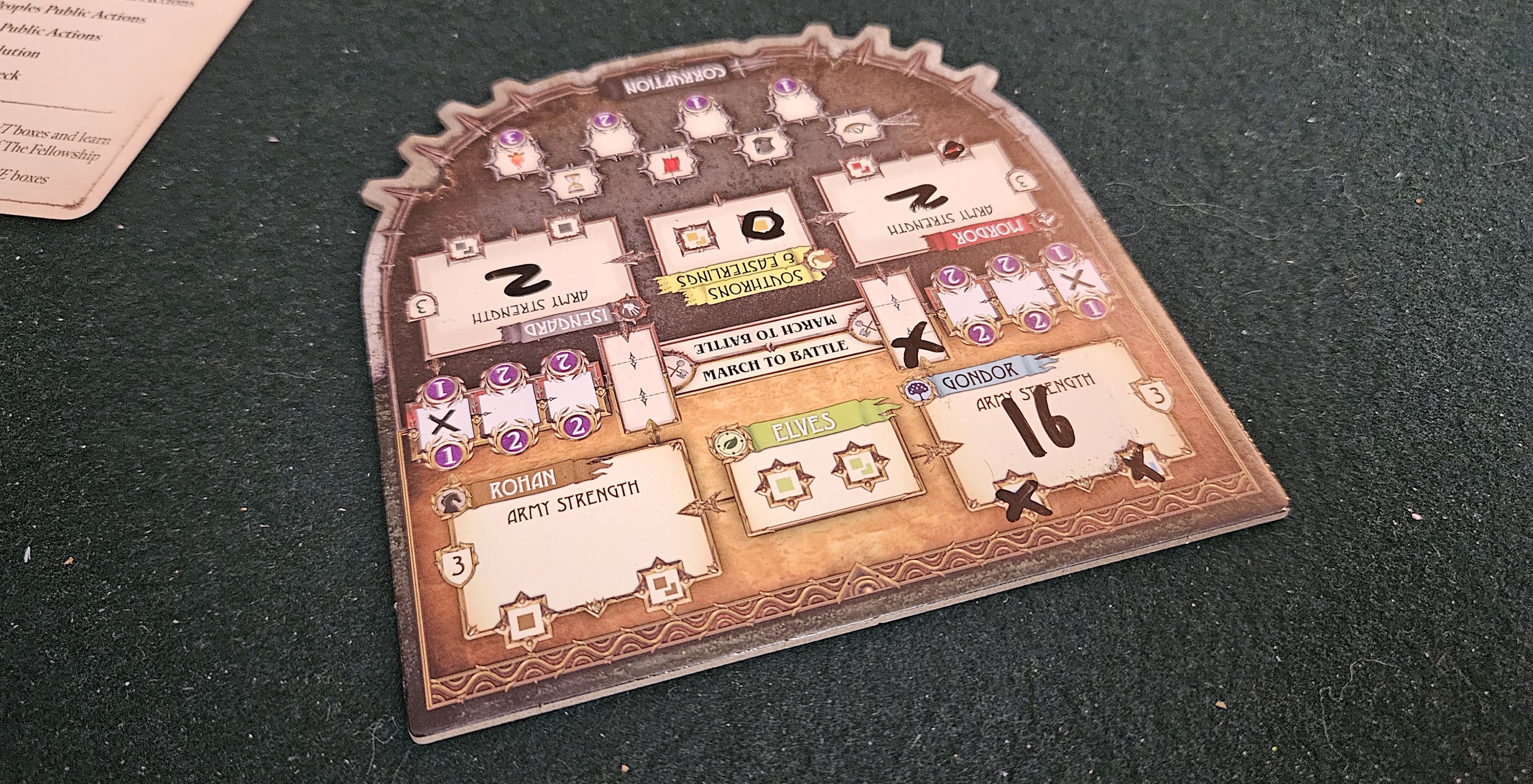
The battle board is, ahem, functional.
If anything, there are a few points where Circle of Conflict (ugh) seems to throw up its hands, as though Engelstein and Buonocore knew they were onto something great and realized they had to bring it back down lest they invent something too mind-expanding. There are a lot of the customary roll-and-write combos, for example, where you’ll be filling in one bubble that then awards another icon that lets you mark another bubble, and then that bubble lets you mark something else, and on and on until an ordinary turn has transformed into two or three turns’ worth of dry-erase daubs. In a game this distinct, these moments always feel like a throwback to the format’s puzzle-going past, more of a conundrum to solve than a dynamic contest between players.
And, yes, at times Circle of Conflict (hurk) feels like too much of a puzzle. After one or two sessions, you get a good sense for which combos will really let you whip along its tracks. Some early Boromir and Galadriel to secure the loyalty of Rohan toot suite, Wormtongue to tank the loyalty of whichever nation your right-ward neighbor embraces first, just enough Legolas ♥ Gimli to max out your battle value but no more. I don’t want to say it can be “solved”… but one of my opponents in our most recent session sure believed so.
Which isn’t to say this ruins the game. Not by a long shot. It’s just that Circle of Conflict (uruk-hai) is at its best when it leans into the suspense between neighboring players, but not every portion of the design is pitched toward maximizing that. The slow buildup of armies, with both sides growing stronger, closer, and more likely to win a bunch of points from the coming battle: incredible. The gradual chase and evasion of the Ring on both sides: wonderful. The occasional game-disturbing abilities from the heroes: appropriately enraging. Waiting around while somebody completes their tenth mark on a turn when you earned two or three: a bit of a downer.
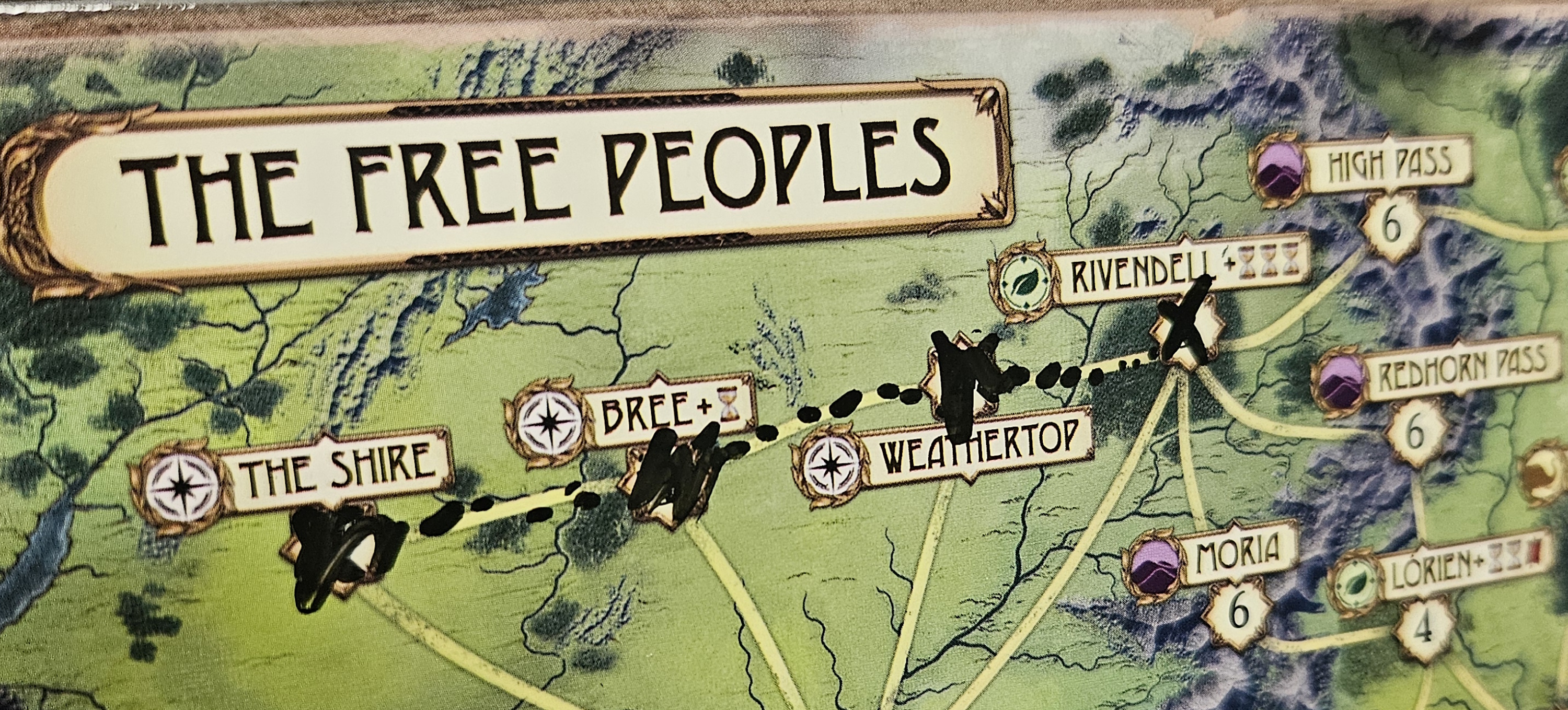
Conducting the grand tour.
On the whole, I dig it. It calls to mind other experimental titles like Captain Sonar and The Anarchy in its willingness to tinker with the usual formula, even as it doesn’t quite reach their heights. Even so, there are little touches that make it especially considerable, like how the hobbits are tiny until suddenly they matter quite a lot, the occasional ability to move or hunt with greater efficacy, or, my favorite detail, the fact that the whole thing is presented as a single folder so you can lean back in your chair while you jot down your moves. One could do a lot worse.
A complimentary copy of The Lord of the Rings: Circle of Conflict was provided by the publisher.
(If what I’m doing at Space-Biff! is valuable to you in some way, please consider dropping by my Patreon campaign or Ko-fi. Right now, supporters can read the next installment in my series Talking About Games, this time tackling the topic of what makes a good list! Naturally, the piece includes a list.)
Posted on September 7, 2026, in Board Game and tagged Board Games, Circle of Conflict, Office Dog. Bookmark the permalink. 6 Comments.


Enjoying your revulsion😎.
All the best.
“In a game this distinct, these moments always feel like a throwback to the format’s puzzle-going past, more of a conundrum to solve than a dynamic contest between players.”
Which roll & write game(s) most feel like dynamic and interactive contests in your opinion? I’d like to try one some time but I tend to dislike non-interactive or too puzzly experiences.
Also, I’m kind of dreaming of a Dune roll & write, I think there is a lot of potential there.
Somehow I can’t get past the fact that CoC (yikes) seems more like a game with a well-integrated theme than one that allows you to fully give into it. I’m not saying that it would be better as a 2-player game allowing you to play either one side or the other, but I’ve got a really hard time picturing myself engaging as both at the same time.
Well, there are already a lot of of stellar LOTR games out there (you should try War of the ring the card game, I’m sure you’ll find it interesting), maybe this one just isn’t for me.
I have WotR:tCG! I should give it a shot.
At first I was like, “Oh, another LOTR game. Ok then.” Then you mentioned roll & write and I shot right up in my chair!
gottem!