All Hail King Ludd
What recourse is there for the public when their leaders will not listen, their employers have broken the compacts that bind society, and their bellies gnaw with hunger?
If two examples are sufficient to draw a motif, that seems to be the recurring question at the center of Yoni Goldstein’s work. Last year’s Chicago ’68 was a refreshing look at civil disobedience in the streets; now Goldstein and the Dietz Foundation are publishing The Nights of King Ludd, which raises similar questions about resistance and state repression despite being translocated across an ocean and 150 years.
Gettim, lads!
I’ve been twice called a Luddite. The second time was not that long ago, after publishing an article explaining why I wouldn’t be reviewing any board game that used non-human artwork. A few years before that, it was because I mentioned to a friend that I thought it was wrong for corporations to use programmed obsolescence to spur consumers to purchase replacement cell phones.
In both cases, the response felt similar. “Get with the times. You can’t fight progress. This technology is inevitable. Go with the tide or get washed away by it.”
At the turn of the 18th to 19th century, English stockingers and woolworkers were hearing similar sentiments. Their trade, which had been conducted by domestic labor for over a century, was facing upheaval. The stocking frame was not a new technology — it had been invented in Nottingham way back in 1589 — but gradual improvements, such as rotary-, water-, and steam-powered frames and Jebediah Strutt’s derby rib, made it possible to turn out greater quantities than ever before.
Now, I know what you’re thinking. Isn’t easier work better than harder work? In theory, absolutely. I’m as lazy as they come, so you won’t hear a peep out of me on that count.
But the people who made their living knitting stockings weren’t the ones who benefited from these improvements. Over the course of a few short decades, mill owners used one dirty trick after another to dispossess an entire class of laborer. They violated price-collaboration laws. They used enclosure acts to drive commoners from the lands they had occupied for centuries, producing hordes of desperate workers who would work for almost nothing. They used their superior access to parliament to lobby for frame-breaking protections and outlaw collective bargaining. They churned out cheaper but less durable products. They employed children with no care for the blood their amputated limbs left in the machines. They used war as a pretext to declare their industries essential and therefore in need of military protection.
With every peaceful recourse blocked off, some textile workers took matters in a different direction. They took up their hammers not to work the machine, but to break it. And they did so under the fictional name of Ned Ludd.
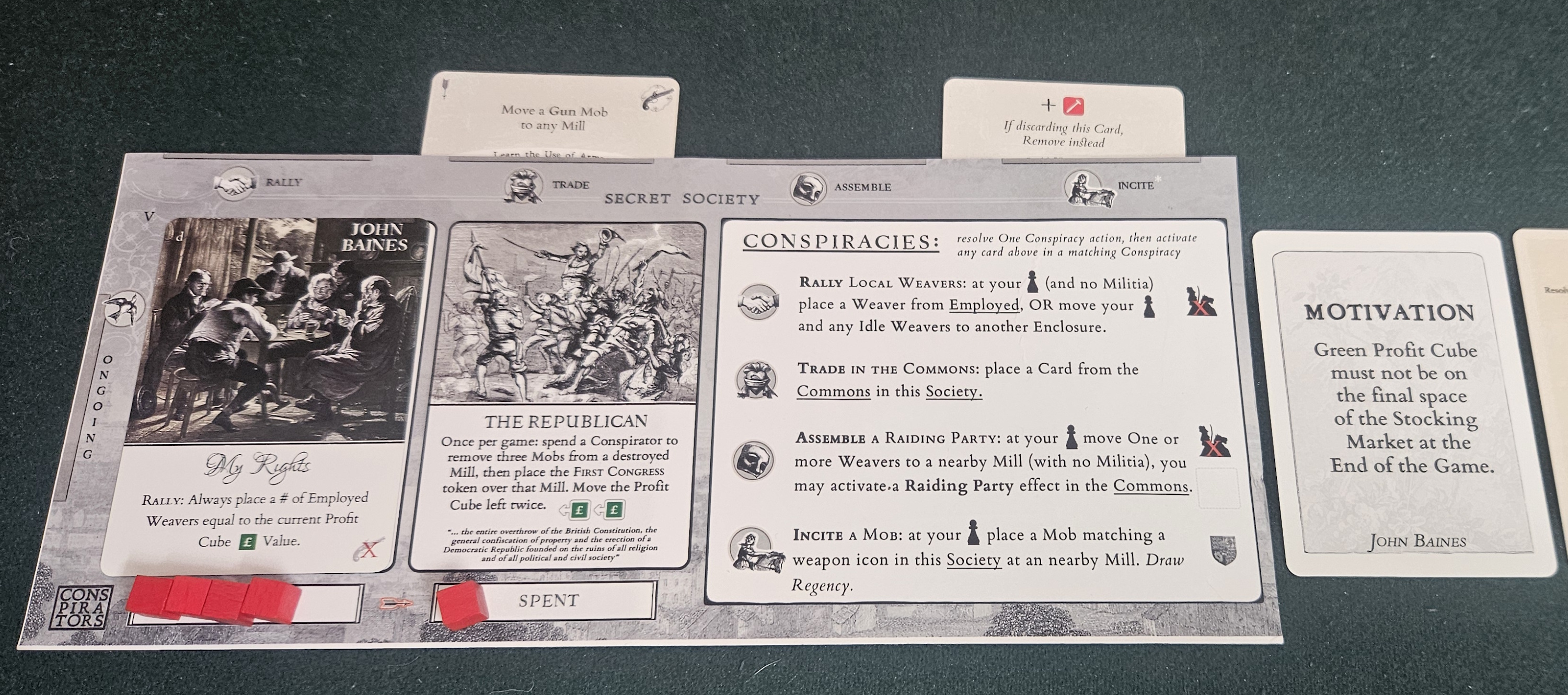
Roles are dynamic, with self-interested goals and unique abilities.
This is where The Nights of King Ludd deposits us. The mills are roaring. Thousands have already been displaced. It’s going to get a lot worse before it gets better.
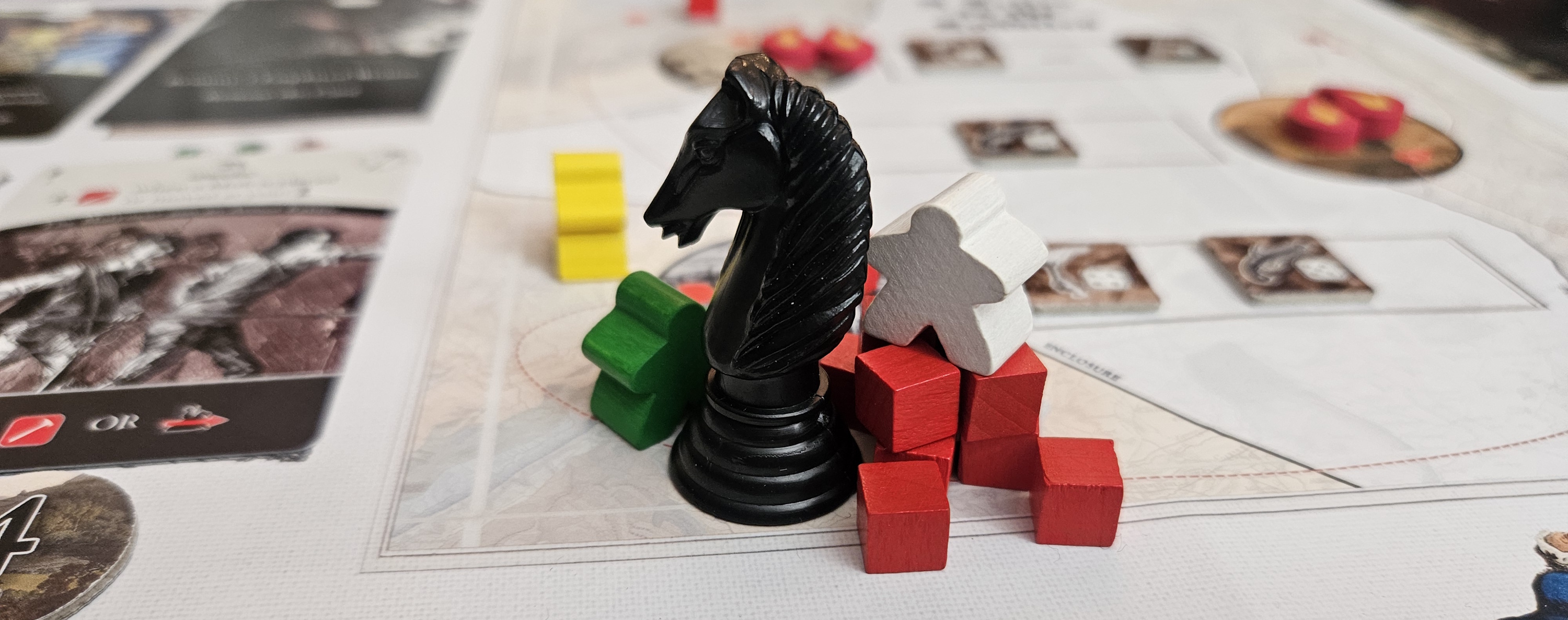
Goldstein presents the Luddite movement from two vantages. There’s the sky-high perspective, showing the three epicenters of Luddite activity in Nottinghamshire, Yorkshire, and Lancashire. This portion has the look of a traditional historical simulation game: there are enclosures for unemployed laborers, mills where workers or mobs can congregate, and a chess knight making the rounds to crack down on anyone threatening the supply of cheap stockings and lace.
But there’s another, more intimate perspective, and it’s here that Goldstein’s approach to the Luddite movement becomes clearer. Rather than embodying the Luddites as a faceless mass, as they’ve customarily been represented by the intervening two centuries of Oxford tut-tutting, here they’re given names and faces — and, above even those signifiers, personal aspirations and fears.
It works like this. When the game opens, everybody adopts an identity. You might become George Mellor, King Ludd’s “right-hand man” who infamously assassinated the wealthiest mill owner of Yorkshire and hanged for it. Everybody at the table loses the game together if they don’t burn the map’s three mills, but Mellor must also assassinate the manufacturer, a nasty piece of work who sits at the side of the board and hoovers up cards from the deck with each passing round. This is a dangerous proposition, liable to bring the military down on the movement’s head sooner than later, ensuring that Mellor’s appearance lends the session a riotous edge.
That’s the extreme end of things. The remaining identities provide other objectives, like sisters Mary and Lydia Molyneux’s desire to hold onto their family’s position in society and John Baines’ fear that the price of goods will collapse. These characters necessitate a more cautious approach, one that strives to keep as many weavers employed as possible rather than whipping everyone into a frenzy. These figures have been brought together by a manufactured crisis, but they have stark differences of opinion on the movement’s operation.
Crucially, these identities are more than clusters of special abilities and personal objectives. Each character seeds a woe into the deck, representing a personal problem that might rear its head at any moment. They also have personal lines they refuse to cross. Elizabeth Studham has joined the Luddites to save her home and community. Will she eventually become so impassioned — some would say radicalized — by the cause that she risks exile to the colonies? The celebrity parliamentarian Lord Byron is another option, his distance from the movement reflected by a weaker pool of conspirators. Will he throw away his standing in polite society to champion laborers who hold so little in common with him? These are the questions The Nights of King Ludd asks early and often, presenting the movement as a tangle of competing interests and concerns.
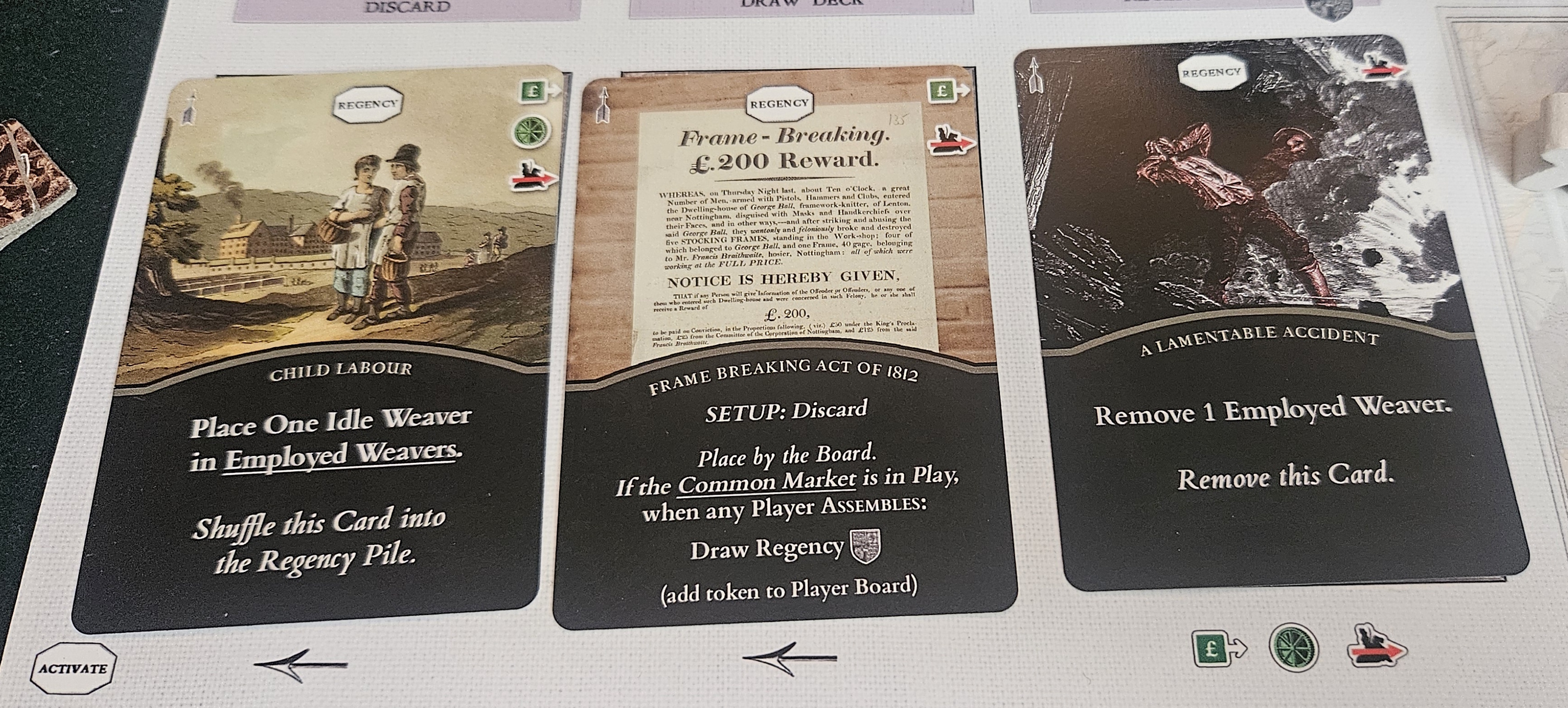
The Regency gets up to no good in response to the Luddites’ no good.
The Luddite movement has always eluded easy classification. Given the revolutionary fervor on the Continent, some historians portray it as a similar moment of English class consciousness. Others interpret it as the earliest stirrings of what would become later labor reform and even Marxism.
Perhaps it’s appropriate, then, that Goldstein presents the movement in such contradictory terms. Just as the game tells its story via two vastly different scopes, and just as its characters squabble over the appropriate course of action, the game itself is suspended between identities.
On the one hand, there are familiar elements of both card-driven wargames and paxgames. There’s the river-style market, which recalls Pax Porfiriana and its many successors, while the cards themselves are multitools that hew closer to the system found in Mark Herman’s We the People and popularized by Twilight Struggle. Much of the game revolves around figuring out which cards to purchase and when to deploy them, familiar fare for anyone who’s been involved in the historical gaming scene at any point over the past three decades.
But the cards play second fiddle to the game’s real core: its dice. At heart, The Nights of King Ludd is about building a pool of dice and then rolling them to determine whether your frame-breakers have successfully broken enough frames to put a mill out of commission. This is a multi-step process. First your conspirators must organize unemployed weavers, bringing them into the movement and assembling them at the sites where their agitation will do the most good. Then they must be persuaded to take up arms and occupy the mills — both of which are testy affairs, drawing ire from the Regency and the patrolling militia. All the while, you must assemble a pool of dice that can be spent for those workers, now suitably organized and positioned, to assault the mill.
If everything goes right, a mob of weavers will enter a mill, burn it down, and disappear back into the moonlight. No need for anybody to get hurt. No trials, no hangings, no masses of deportations to Australia. Some property will be ruined, but like the historical Luddite movement these attacks will shock authorities with their targeted precision.
The hitch, as you can probably discern for yourself, it that it is exceedingly rare for everything to go right.
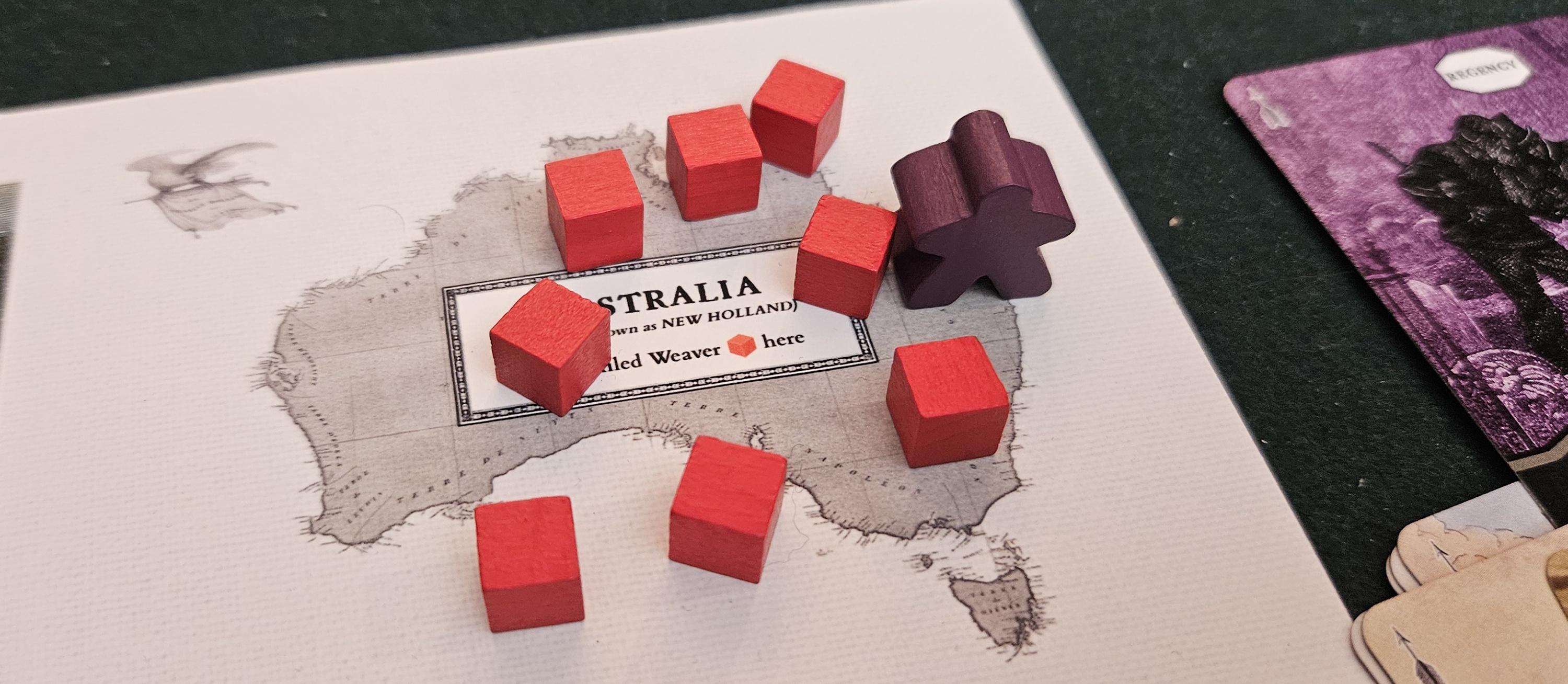
Hm. I knew those Aussies were up to something.
In practice, The Nights of King Ludd plays out like a jigsaw puzzle whose pieces keep getting hidden beneath the tablecloth, squirreled away by cranky uncles, and sometimes fed to the family dog.
Consider this. To wreck a mill, you must organize those unemployed weavers. But the passing militia will lock down entire counties at a time, sometimes for extended durations. This makes it near-impossible to organize with any precision, especially if your character is currently in hiding in the affected portion of the board. It may become necessary to wait out the occupation. Or even to bait the militia into removing itself to another region. Just be careful you don’t draw them toward a mill where your workers are on the verge of an uprising; that will exile the entire lot to Australia, severely limiting the movement’s access to manpower.
Okay, so you’re keeping an eye on the local garrison. But what about the Regency in London? Certain actions force you to draw a card from the Regency deck, and these cards are, to use the terminology of the day, a right burr in the arse. Their effects are far-ranging. Government spies tip off the authorities before a mob can act. Preemptive hangings permanently lower the ceiling on your dice pool. The cavalry show up to move the militia token two spaces instead of the usual one. Child labor and sixteen-hour workdays and workplace accidents ensure that laborers are too exhausted to resist their plight.
There are other, more transformative consequences as well. Somewhere in the game’s midsection, the card row shifts from a common pool to a laissez-faire market that’s open to those with capital — hint hint: Lord Byron still does okay — but not so much to those who actually produce its goods. This alters how players access cards. No longer is every card the same price. Now their values are tiered, requiring greater expenditures to purchase until they slide leftward in the market. It’s a remarkable flourish, illustrating the radical changes this industrializing generation underwent as food prices soared, their livelihoods were stripped, and their legal representatives were bought out by moneyed interests.
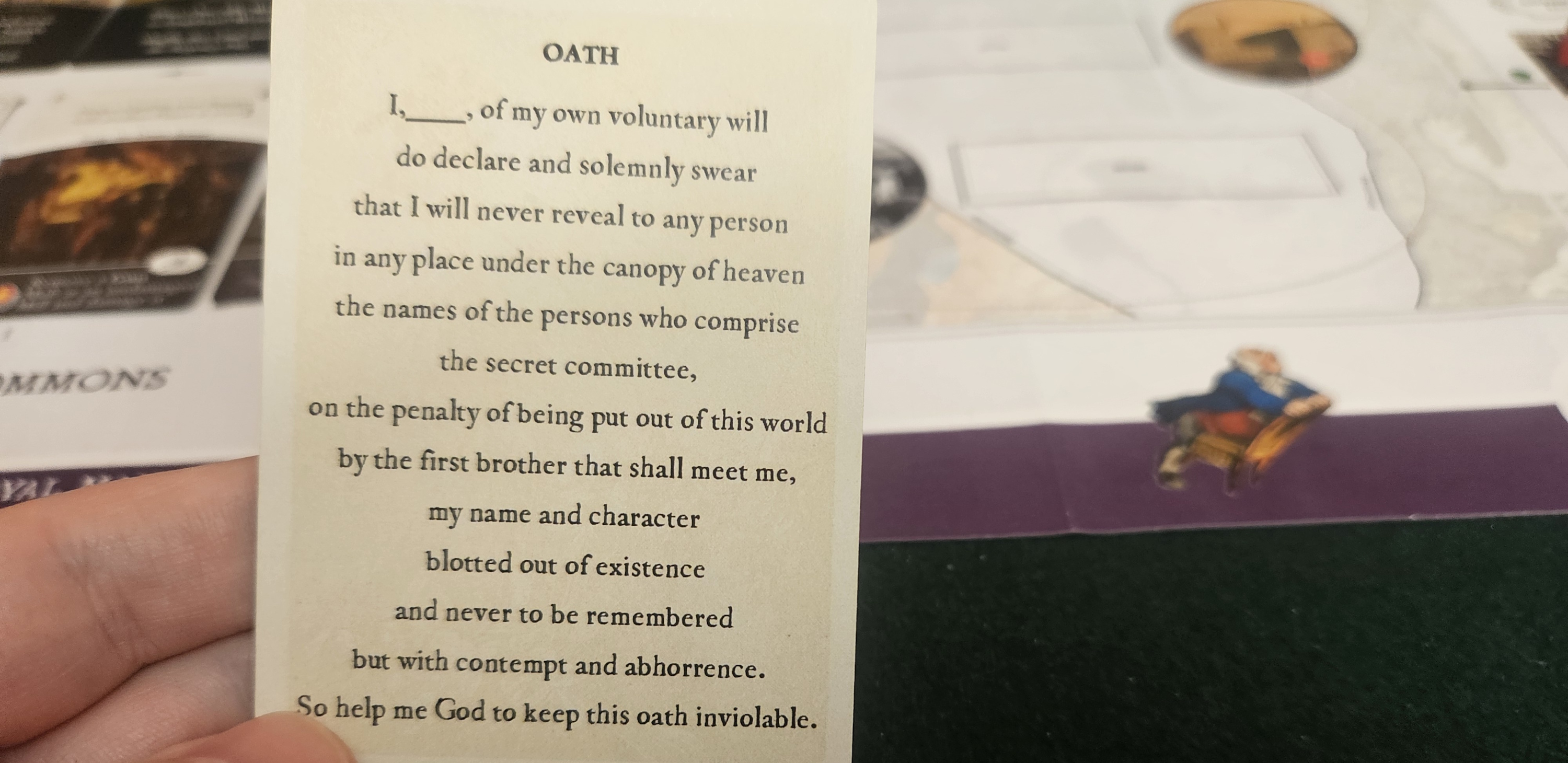
Swear me an oath!
Put together, these elements give the game the sensation of trying to keep a sinking ship afloat even as you commit mutiny. There are occasional refreshing breezes: an ambush that delays the militia’s approach, such a mass of unemployed workers that their grievances become impossible to ignore, even early attempts at establishing labor cooperatives. But make no mistake, what initially seems like a straightforward task will soon be stymied from all directions. Even when the movement’s success is secured, it often comes at the expense of a conspirator’s personal goal.
At times, it’s also an uneven task, and not only because the Regency is scrambling to protect the people with the most from having slightly less. Thanks to Goldstein’s hybrid system, The Nights of King Ludd can be tricky to operate. At any given moment, you’re operating along multiple vectors. There’s the strategic layer, with its emphasis on timing and positioning. The personal level, with its diverse objectives and abilities. The card market, always in flux, plus the gradual attentions of the Regency. Keeping in mind that I’ve only played a prototype, it’s a lot to unpick.
And then, of course, there are the dice. Goldstein provides opportunities to mitigate a flubbed roll, not to mention a few alternate tricks for damaging mills, but these options are few and far between. Most of the time, the only path forward is a healthy dice pool, a well-armed mob, and a prayer in one’s heart. There’s nothing as uniquely irksome as showing up to a mill-burning with torches and hammers, only to somehow roll all misses. Those who balked at John Company’s retirement rolls will likely find themselves similarly disappointed here.
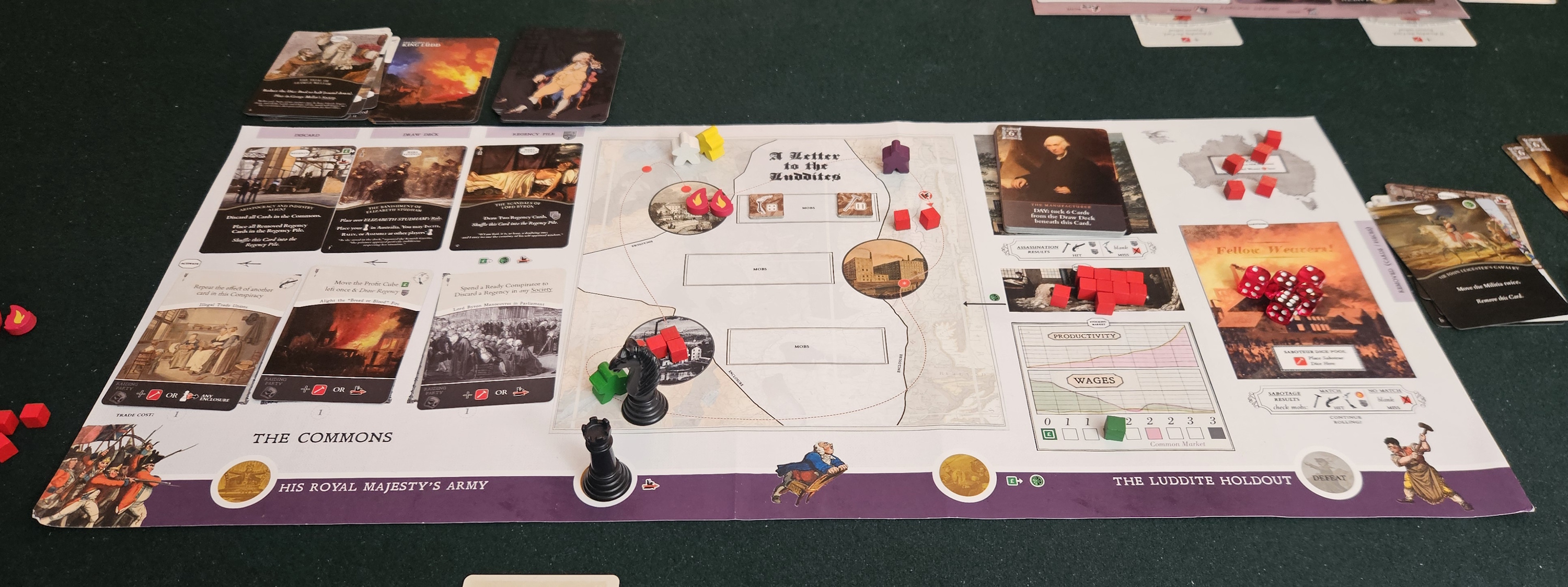
It takes a village to burn a mill.
For my part, The Nights of King Ludd is a strange, evocative thing, as much a machine as those it seeks to break. It’s a more radical experiment than Chicago ’68, but Goldstein leverages it to similar ends, asking hard questions about who societies prioritize. Put somebody in a sack and don’t be surprised when they choose to fight their way out.
Were the Luddites doomed? Maybe. The textiles industry was transforming with or without powered mills and innovative knitting frames. Trousers were soon to supplant hosiery in popularity. Cotton and silk were growing more affordable. The United States was starting to throw their economic weight around. And, pardon my French, Napoleon was being a real butthole.
But some men chose to oil their machinery with blood. The response was fire and fury. And, yes, sometimes blood for blood. A few droplets pattered into an ocean. Once again, Goldstein has crafted a challenging, thought-provoking rumination on an oft-misplaced history, collective anger, and the depths power and capital will plumb to protect their interests. Stark, sobering, and sometimes hopeful, The Nights of King Ludd is an essential work for students of labor history and new-wave historical simulation.
A prototype of The Nights of King Ludd was temporarily provided by the designer. It is on Kickstarter right now.
(If what I’m doing at Space-Biff! is valuable to you in some way, please consider dropping by my Patreon campaign or Ko-fi. Right now, supporters can read the next installment in my series Talking About Games, this time tackling the topic of what makes a good list! Naturally, the piece includes a list.)
Posted on September 3, 2026, in Board Game and tagged Board Games, The Dietz Foundation, The Nights of King Ludd. Bookmark the permalink. 6 Comments.


Dan — thanks as always! The one thing I couldn’t quite gather from your review: how do the different players interact? Thematically, I would have expected this to be almost a semi-coop, everyone fighting the machine but with slightly different expectations of what the future should look like, maybe akin to the approach from Land and Freedom.
If not, is there indirect interaction? If one player shuts down a mill does that help everyone with their objective(s)? Does the resulting increased military presence affect everyone?
The game isn’t quite semi-cooperative, since there isn’t really any competition between players. Everyone agrees that all three mills need to be wrecked. But when that happens, only players who have met their personal motivation will “win.” Meanwhile, whether they’ve kept their personal oath will apparently alter the game’s epilogue for better or worse, but the book that describes the possible outcomes wasn’t provided to me for the prototype. So there’s plenty of interaction, but not competition as such.
This sounds fascinating. I see many parallels with AI developments today, I wonder which lessons we can learn from this history?
I think so too. Personally, my main takeaway is that any project that emphasizes profit for the few over the humanity of the many will prove dehumanizing to everyone.
Pertinent setting for 2026 for sure, thanks for previewing this game. Went back and read your Chicago ’68 review, I hope I can get that played soon!
These inspired emotions keep building up in me and I don’t know what else to do but play dorky, woke-ass boardgames with my friends.
Pingback: Interview with Yoni Goldstein Designer of The Nights of King Ludd: The Luddite War on Industry, 1811-? from The Dietz Foundation Currently on Kickstarter – Part II – The Players' Aid