Joker’s on You
Say one thing for Carl Chudyk, he’s always swinging for the fences. His latest, Chess Joker, is full of wonderful ideas. At its most basic: what if we took the game-altering jokers from Balatro, say half a thousand of them, and transformed Chess, that ancient game of strategy and discipline, into a cast-iron bathtub filled with jelly beans and marmalade and one or two razor blades just for fun.
At its best, Chess Joker lives up to that promise. The problem is that it isn’t often at its best.
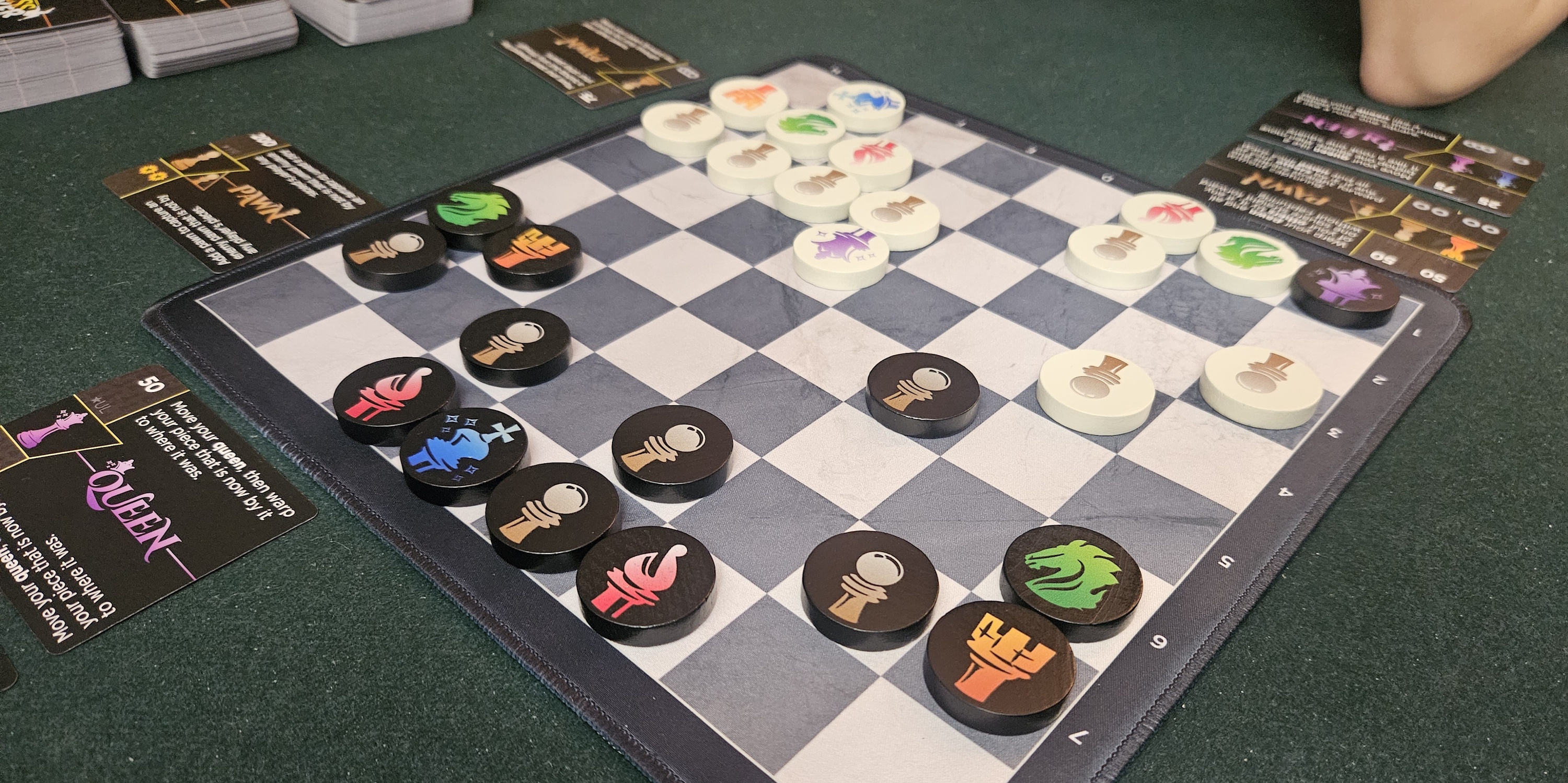
This is chess.
Picture Chess. I don’t have to explain Chess to you people, do I? Knights, bishops, queens. Castling and checkmates. Years ago, some dork with taped eyeglasses and a collared shirt buttoned all the way up to the top pulled an untimely en passant and you haven’t played the game since.
Chess Joker is Chess.
But it’s also Joker.
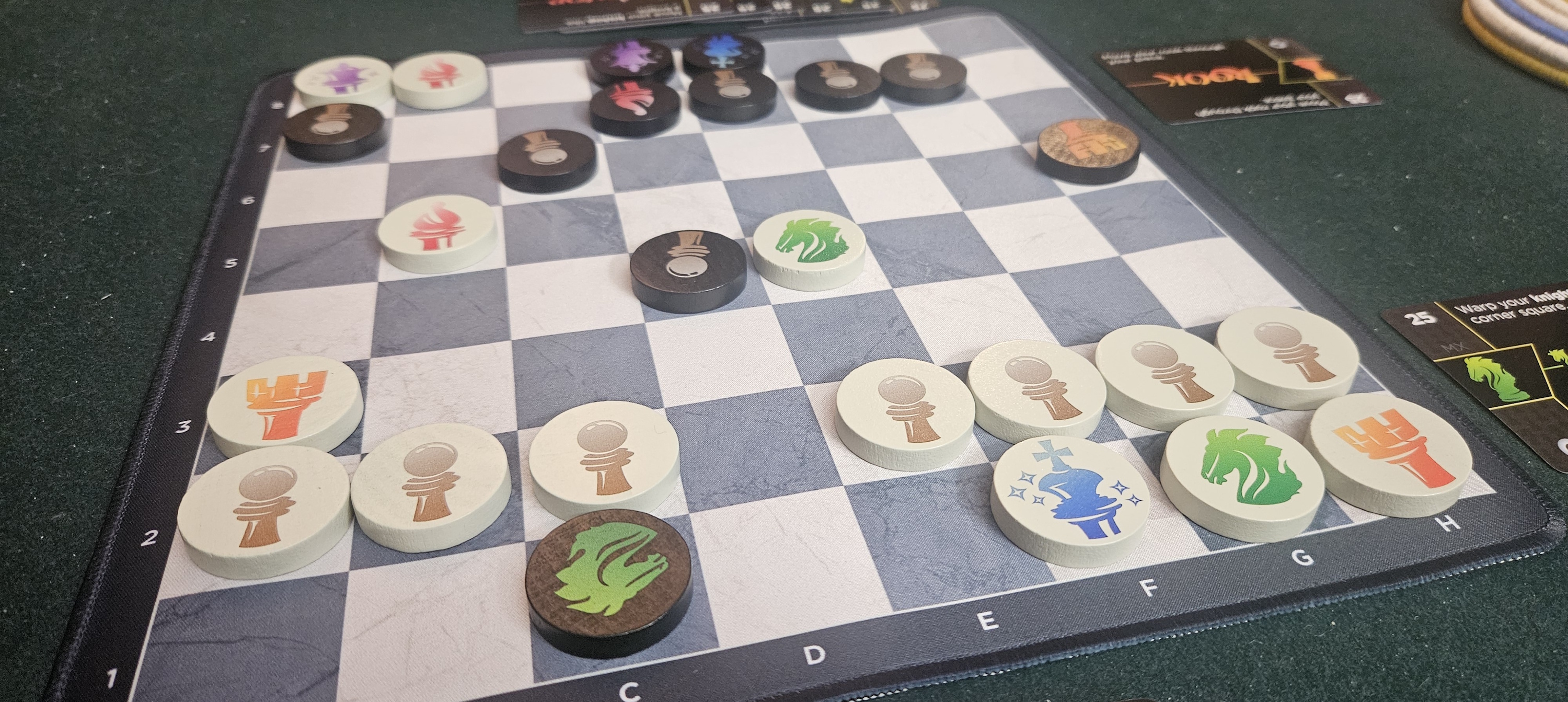
The Joker portion of Chess Joker works like this. At the end of your turn, you draw a card. On your next turn, this offers a new possibility. Like, say, letting you warp one of your pawns sideways two squares. Or moving a bishop like a knight. Or swapping one of your bishops with an opposing piece on the same-color of square. Or placing your queen on h5, no matter what’s in that space right now.
Now, the thing about these cards — these jokers — is that they award points for their shenanigans. The tougher their effect is to pull off, the more points they award. The examples above were low-scoring opportunities. 25 to 50 points. Others are more potent. For 100 points, you might be asked to move your queen to capture an enemy piece (easy) and then capture both an enemy piece and your own piece next to wherever the queen ended her turn (uh oh). For 150: warp whatever piece is currently seated on g5 to any open square. For 200: take any piece that was captured last turn and return it to an empty square by one of your bishops.
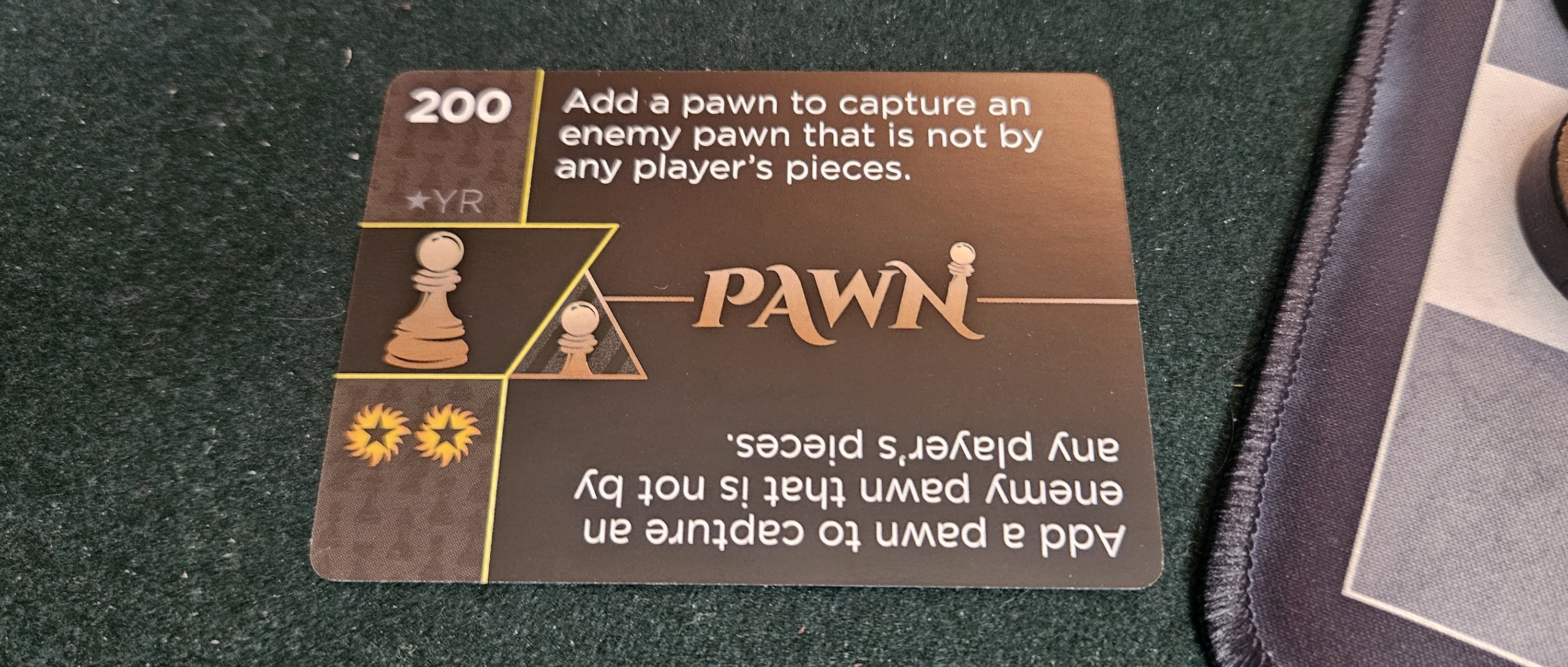
This is a chess joker.
Cutely, these points are called Elo, just like the system invented by Arpad Elo to improve on the previous Harkness system for ranking chess players. While it’s possible to win by checkmating your opponent, it’s also possible — and far more likely, for reasons I’ll discuss momentarily — to win by amassing 800 Elo points.
As you can probably already tell, higher points are significantly tougher to earn than lower denominations. Most of the time, they require preparation in advance. That your queen is already poised to capture; that anybody is seated on g5; that your opponent doesn’t preempt your card. That last point is major. Because jokers are visible to both contestants at the table. And they cycle every turn whether you accomplish them or not. This gives Chess Joker a loose, improvisational air. One that is, naturally, rather the opposite of ordinary Chess.
There’s more to Elo. Reducing your opponent to three or fewer pieces means earning 25 points per turn. On the flipside, putting your opponent in check means awarding them 25 points, discouraging snitty little sequences of checks lest you trickle them closer to victory. And most cards can be “masqueraded,” substituting the stated piece for something else, but at a penalty that reduces the card’s scoring to 25, the lowest possible quantity.
These rules make sense, given the chaotic nature of Chess Joker’s gameplay. Each rule comes across as a patch on a system that would otherwise break down under its own permissiveness. Jokers make putting the rival king in check a trivial matter, thus checks become counterproductive. With pieces dying left and right — again the result of jokers that often eradicate troops outright — the masquerade becomes necessary to prevent the bulk of cards from not having any effect in any given session’s back half.
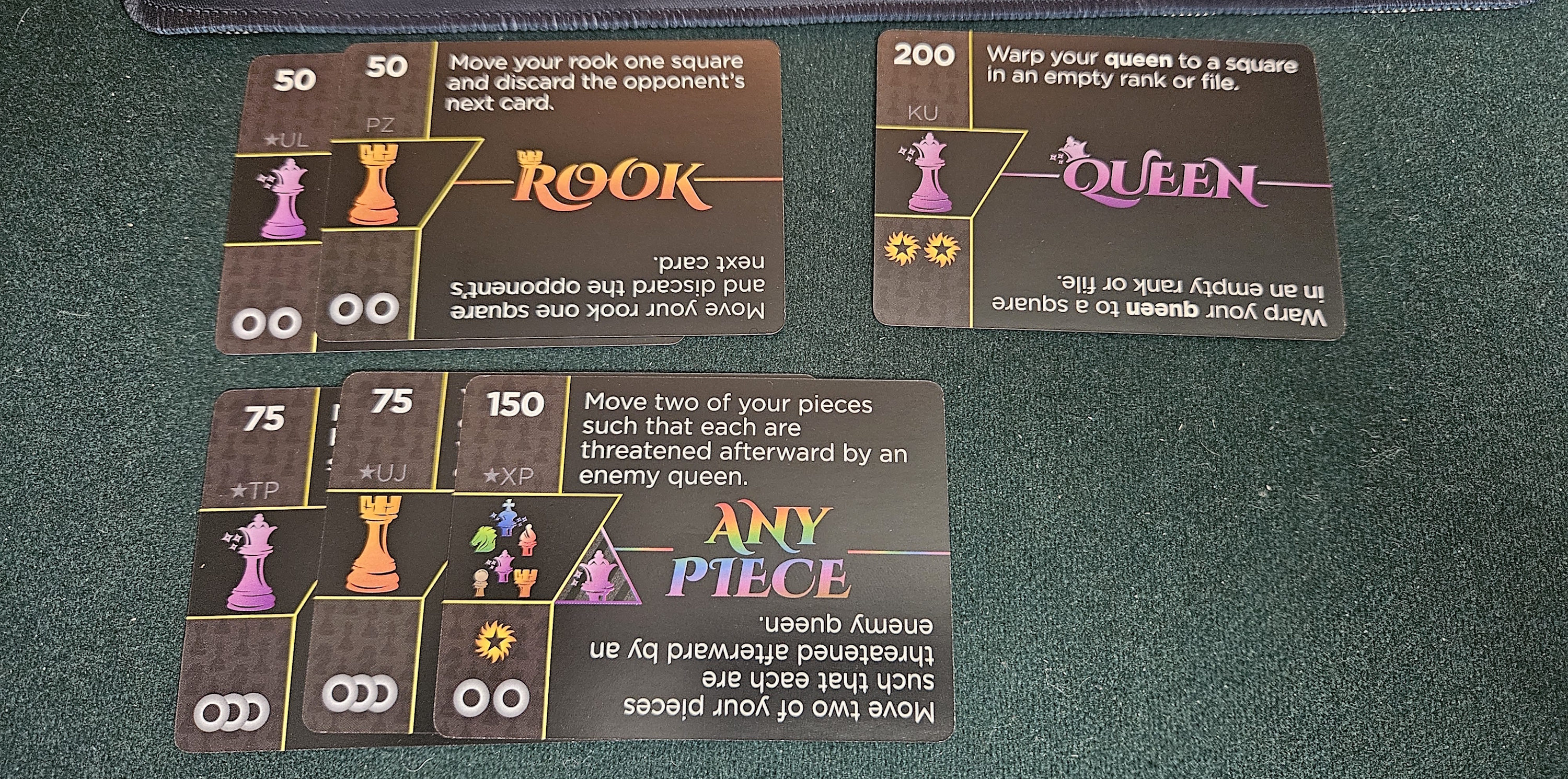
This is a chess joker scoring pile.
Which is to say, when I called the gameplay “chaotic,” a better word might have been “sloppy.” Indeed, Chess Joker isn’t only a variant of Chess; it’s a repudiation of its deliberate nature. Nearly everybody knows how to play Chess, but most people do not, in fact, play Chess. Because it can be slow and boring and cerebral. Chess Joker is the version that’s fast and reactive and goofy.
As such, it actually shines brighter the more one departs from the headspace that classic Chess demands. Who cares if you lose that knight to only take a pawn? The next flip from the deck might eliminate the poor guy anyway. As long as you earn 75 Elo there’s no good reason not to make the exchange.
To be clear, this can be wild and exciting. I’d even go so far as to call it transgressive, like some ancient taboo has been violated under your fingertips. Because it has been. Over and over again, Chess Joker smears mud on the face of sacred statuary. Don’t want to get into a tit-for-tat exchange of checks and counter-checks? Just don’t. Teleport your queen to the enemy back row. March an entire block of seven pieces forward a single step to menace five enemies with the same move. Warp so many pawns forward that you’re suddenly fielding four queens. Anything is possible at Zombocom… pardon me, in Chess Joker.
Look at me, talking myself into liking Chess Joker more than I actually do. The thing is, I’ve played some wonderful sessions of Chess Joker, full of laugh-worthy reversals and absurd escalations and plenty of board states that would never in a trillion simulations occur in an ordinary match. But I’ve also had some real stinkers. Strings of draws that do very little. Rival jokers that chew through my lines. Moments where the game’s brilliance decides to hide behind its nonsense, like a wise old trickster god giving life-altering advice only to spin around and flatulate in your face.
This is an outro image.
The twist, which you surely saw coming, is that most of those sessions are one and the same. There’s no separating them. The good and the bad mashes together. There are hundreds of jokers in the box, and only a fraction appear per game. But with one peeling from the deck every turn, there’s no end to the disruption. Every turn might reveal something amazing or something… not. Not amazing. Not interesting. Not even amusing. And there’s nothing quite like the disappointment of concluding an anarchic volley with something ordinary.
In the end, Chess Joker is a fine experiment. It’s silly and amusing. At times, it even approaches brilliance. In crafting his own variant, Chudyk has joined one of tabletop’s oldest conversations, and for the most part his hooting is as worthy a thesis as any of the others that have been proffered over the centuries. “What if Chess was stupid as hell?” he seems to ask. Sure, yeah. What if it was. I dig it. For a while. And then the question grows obnoxious, and Chess Joker spins out of control yet again, and I’m left wondering if there’s a curated selection of these jokers that makes for a more controlled experience, and somehow we’ve circled back to preferring Chess. The trickster god leans forward from where he’s been dancing on the table, tweaks my nose, and disappears in a puff of confetti.
(If what I’m doing at Space-Biff! is valuable to you in some way, please consider dropping by my Patreon campaign or Ko-fi. Right now, supporters can read the next installment in my series Talking About Games, this time tackling the topic of what makes a good list! Naturally, the piece includes a list.)
Posted on July 21, 2026, in Board Game and tagged Asmadi Games, Board Games, Chess Joker. Bookmark the permalink. 6 Comments.


have you tried Steve Jackson’s Knightmare Chess? Sounds similar
It’s been years. There are some parallels, including one or two cards that effectively do the same thing. But Chess Joker lacks the persistent upgrade element. It’s more changeable, with cards cycling every single turn. You might get something useful, you might not.
I’d be curious to hear your thoughts on Queen Alice when it comes out which apparently takes the base level chess movements on a board to collect resources, take actions, and engage in mini games. It sounds like a lot (a positive lot or a negative lot is TBD).
Wow, I hadn’t heard of this one! Thanks for the recommendation. I’ll try to secure a copy somehow.
Bruno Faidutti have proposed quite similar experience… in 1989 (!) with “Tempête sur l’échiquier”
There was, notably, an “Apartheid” card: “all white pieces on black squares and all black pieces on white squares disappear.” When viewed in the context of its release date, it really shone a spotlight on the issue…
https://boardgamegeek.com/boardgame/30966/tempete-sur-lechiquier/images
Interesting! Thanks for sharing.