Delver’s Dilemma
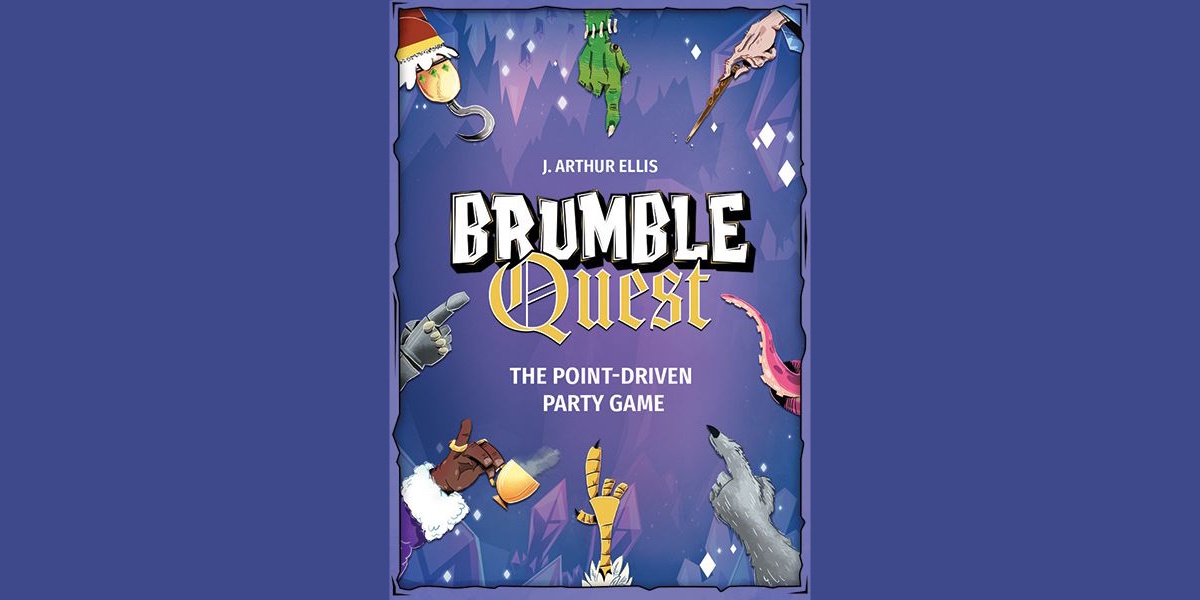
Brumble Quest is a peculiar inclusion in Plaid Hat’s catalog. Unlike their other touchstones, whether expandable duelers like Ashes and Summoner Wars or comedy adventures in the vein of Forgotten Waters, it’s a diminutive thing with minimal components, a ten-minute playtime, and — oh yeah — it only sells in sync with big conventions. Fortunately, that means during conventions, not at them; online ordering is still a possibility for those of us unable or unwilling to make the annual pilgrimage to Indianapolis.
For such an odd duck, though, it’s… kinda great? Designed by J. Arthur Ellis, Brumble Quest is a prisoner’s dilemma game for pretty much any number of players. Minimum three. But as many as fifty out of the box. With a projector and laser pointers, theoretically it could go even higher.
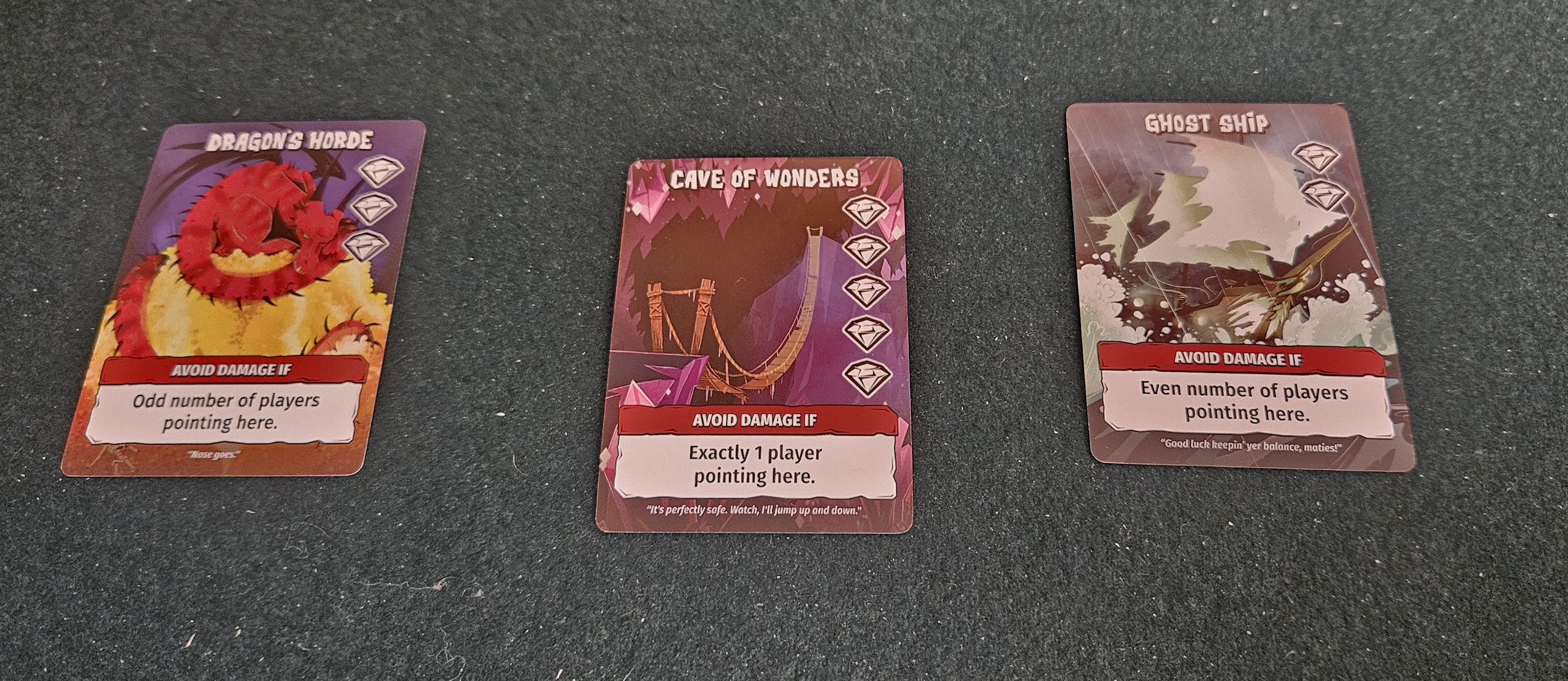
It’s all location location location.
Down at its roots, Brumble Quest is familiar enough. Every round seeds three new locations onto the table. At the count of “One, Two, Three, Brumble” — I know, it’s cheesy — everyone points at the location they intend to visit. Depending on the outcome, players then take home some quantity of loot and/or suffer an injury.
There are two things that set it apart. First, the production. Rather than gussying itself up with a whole to-do, Brumble Quest is as minimal as they come. In lieu of tokens for loot and wounds, each player receives a peel-off hero from a pad, then folds its corners to track their current wealth and health. The rules are compressed onto a single card, front and back, and takes so little time to internalize that it’s closer to hopping into a childhood classic than learning something new. As for the locations, there are only fourteen. That’s a slender deck indeed, all but guaranteeing you’ll see repeats within a session.
But the second point is that the locations are nicely diversified, even if there aren’t many to play with, and really it’s the way they combine and conflict and, even at times, pre-solve their own conundrums, that make the game so special.
I’ll give an example. Let’s say the current trio is the Lonesome Peak, the Shadow Wastes, and the Cursed Prison. That first location provides four gems, but you’ll take damage if you visit it unless it’s the least visited destination. The Shadow Wastes are even more tempting: five gems, and you avoid damage if everyone is pointing there but one player. But then there’s the Cursed Prison, a locale very unlike the others. It subtracts a gem, but everyone at the table will suffer a wound unless at least one adventurer goes there.
No time to think. One. Two. Three. Brumble. (Ugh.)
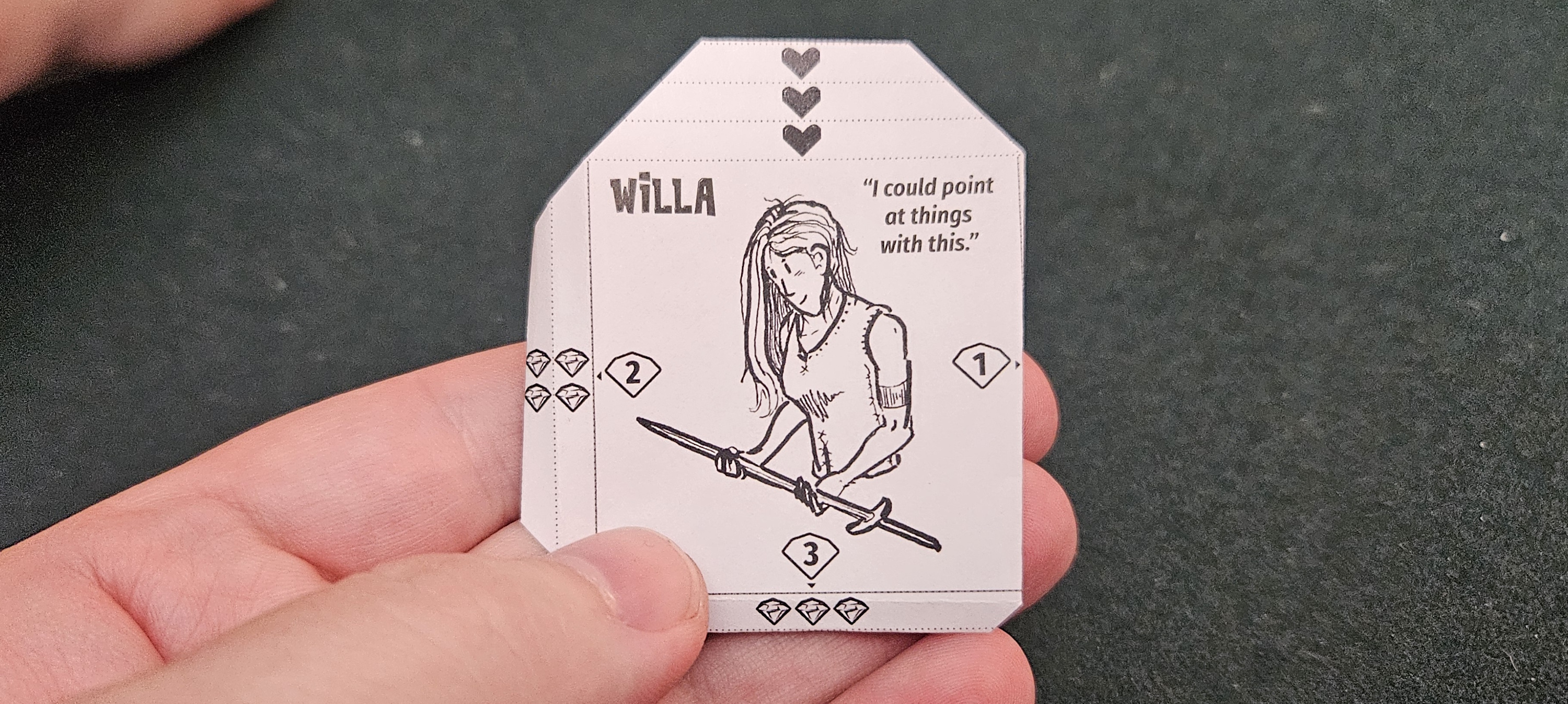
Measuring health and loot is done by folding a paper tracker. Cheaper than tokens!
The beauty of these social conundrums lies in their clarity. The stakes are always perfectly clear, barring an unfortunate misunderstanding. But this clarity is sharply contrasted with the slow departure of objectives at the table, not to mention the sheer uncertainty of human behavior.
For instance, how does the previous scenario alter if you’re the player with the least remaining health? How about the most? What if your score is meager so you’re trying to drive everyone else into an early grave? Sure, all things being equal, everyone should do the optimal thing, right? But get together a half-dozen players and it becomes clear pretty quickly that “the optimal thing” may be a matter of interpretation.
And, sure, sometimes the game coughs up a problem that really does feel solved. More than once, I’ve looked down at a trio and thought, wow, why would anybody ever go to that one spot? But, again, people are unpredictable. Almost as often as Brumble Quest seems to proffer a solved dilemma, someone at the table has appeared hell-bent to un-solve it.
The result is a pleasantly crisp little thing. There are no character abilities, no sudden reversals. Some locations might bump your health up a notch, but that’s a rare outlier. For the most part, it’s you, your friends, and pockets that grow heavier while your blood supply gets lighter. That’s it. Honestly, anything else would clutter the experience.
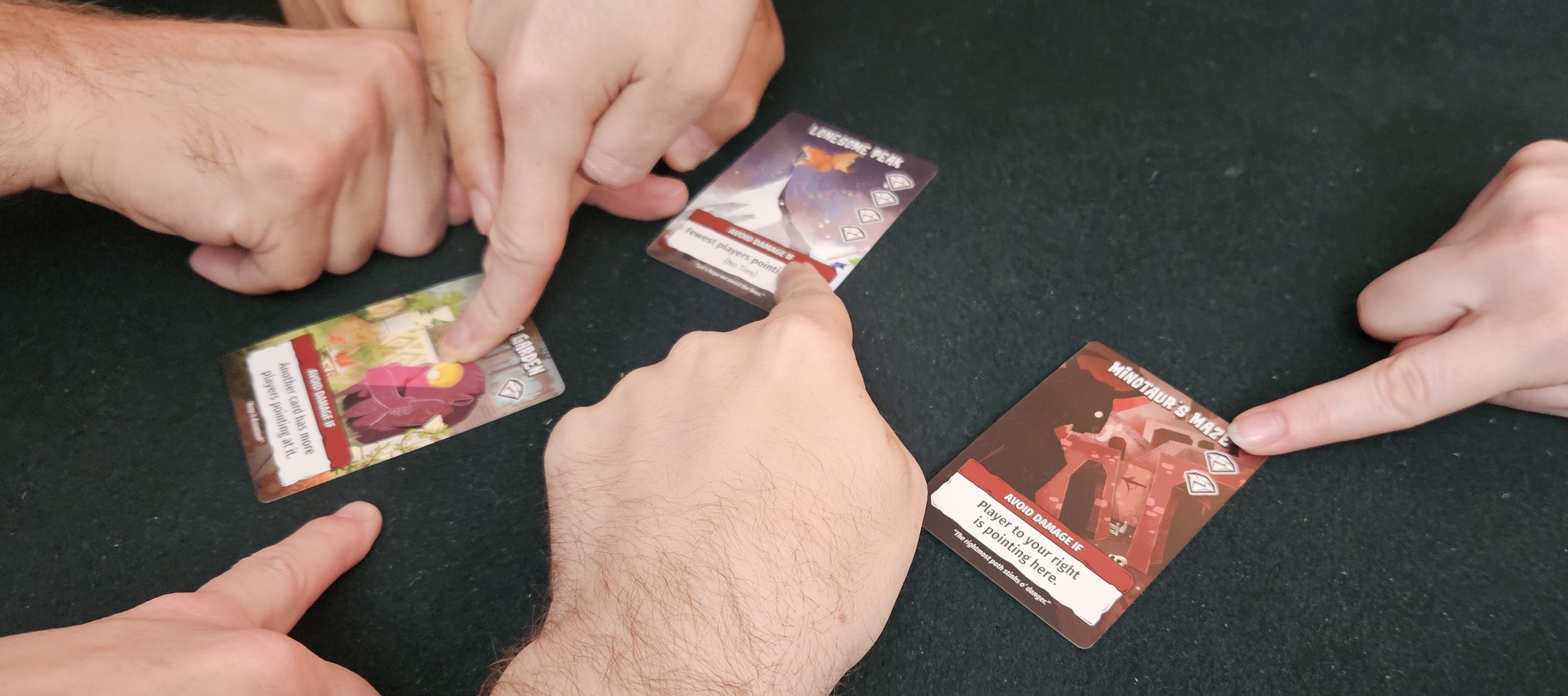
These fellas had better’ve washed.
Barring the addition of extra junk, this is nigh-perfect in its restraint. Maybe Plaid Hat won’t be able to help themselves. Last I checked, the second edition of Summoner Wars was up to thirty factions. (Yes, I have all of them.) (Yes, they are amazing.) (No, I probably won’t have time to write about them.)
Then again, maybe not. As I understand it, Brumble Quest may soon have peers, other teensy-tiny boxes that provide their own miniature siblings. For this game in particular, I’m hard-pressed to imagine it getting any better. This is a true pocket game, slender enough it could have been compressed into one of those plastic Button Shy wallets. I expect it’ll make for a good candidate at our family dinner this weekend.
A complimentary copy of Brumble Quest was provided by the publisher.
(If what I’m doing at Space-Biff! is valuable to you in some way, please consider dropping by my Patreon campaign or Ko-fi. Right now, supporters can read the next installment in my series Talking About Games, this time tackling the topic of what makes a good list! Naturally, the piece includes a list.)
Posted on July 20, 2026, in Board Game and tagged Board Games, Brumble Quest, Plaid Hat Games. Bookmark the permalink. 3 Comments.


Thanks for this, Dan, though, the review seems to whet the appetite for an updated review of Summoner’s Wars, no? (Perhaps not all 30 factions individual but some standouts and one’s that are less appealing to play)
Hmmm… maybe. I’ll consider it.
I’d read that.