Gooey-Free Classification

Two years might not seem like enough of an interval to warrant a second edition, but Connor Wake’s Out of Sorts is not your average board game. Actually, it’s become something of a counterpoint for me. While Wilmot’s Warehouse has become the proof of concept for what a modern memory game can accomplish, to such a degree that I have played it something like fifty times, Out of Sorts is that but bizarre, that but frightening, that but even more unwilling to guide its players by the hand. Because it is weird, my appreciation is even more boundless.
How weird is it? Here’s the premise: You’ve been abducted by an alien and put to work categorizing their spacefaring library. Presumably the delay of lightspeed means they’ve only recently learned of Melvil Dewey’s book classification system. “There are less racist alternatives!” one might protest. Yes. We have more pressing problems at the moment, but too true. Unfortunately, the alien doesn’t know about those Dewey-free alternatives. All it knows is that humans are good at sorting books. And it owns a lot of books.
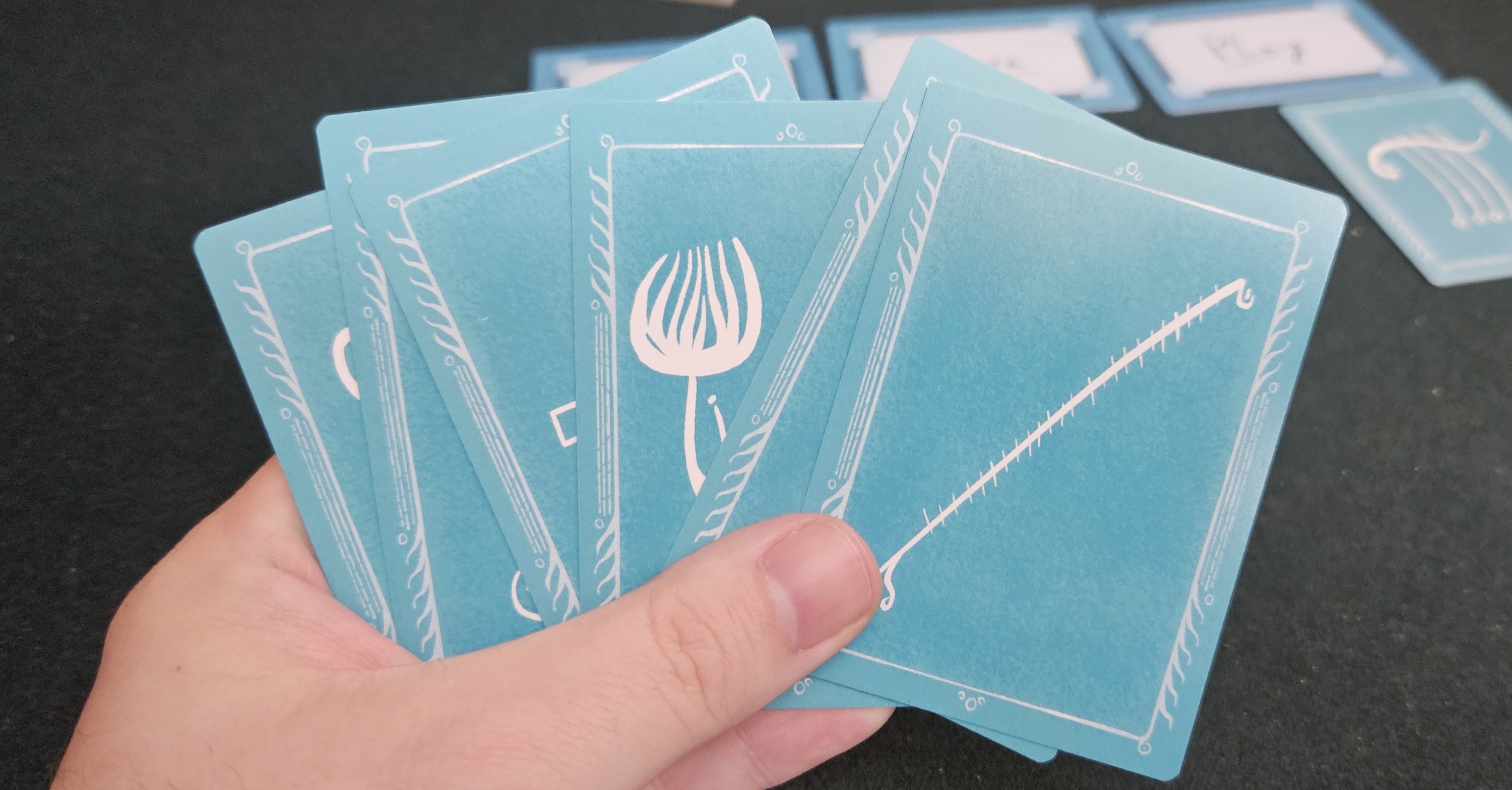
What’s this nonsense?
So you sort. And sort. And sort.
I’ve always found it beautiful, our human tendency to see shapes in foliage and gods in static. We are thing-ordering machines, if you want to go that way, with such a talent for hearing music and witnessing divine geometries that we sometimes drive ourselves mad. When we look at the cards Wake has illustrated, we don’t see nonsensical scribbles. We see — so many things. Little projections of our selves. Examinations of our private pareidolia. Here is a hand-tied fly, ready to be cast into the river. There is a tadpole bopping along to a song. Which song? “Barbara Ann” by the Beach Boys. It could be none other.
When the game begins, we receive three categories. These, like everything else in Out of Sorts, have been retouched from the original edition. Perhaps we have been tasked by our alien overlord to organize their xenic scrawl into Death, Math, and Art History. Or perhaps Royalty, Life, and Rituals. Some combinations are easier than others. Some seem impossible. What’s the crucial visual distinction between Reptiles and Monsters? How about Thermodynamics versus Cosmos? Best of luck. We’re gonna need it.
There are two roles. One player is the Sorter, responsible for shelving these cards. In game terms, assembling them into a hand. Everyone else is a Finder. They find the cards, both at the beginning of each round and then when the alien decides to check our homework.
This latter portion is the game’s version of a pop quiz. One by one, the Finders reveal cards from the deck and put them into an order that matches the hand built by the Sorter. It’s analogous to diving into a card catalog for some random book, then immediately identifying where in your personal ordering system you’ve decided to place it. Structural Dynamics of Flow, easy, that’s in the middle. Noblesse Oblige & Other Obsoletions, that goes after the first one. Wheels: The Denunciation. Uh oh, that’s in the same category as the previous title. Fortunately, we created a sub-category that lands it squarely before that one.
Except here we’re faced with alien squiggles rather than readily-identifiable classics of the Western Canon. Sometimes the symbols collapse into a mental mishmash. Other times we spark the magic that is our capacity to organize even the most nebulous of concepts. Within a century, pedants will grouse at one another over which category is truer than the other. Mostly, we’re spinning these categories on the fly, terrified of being fed out the airlock.
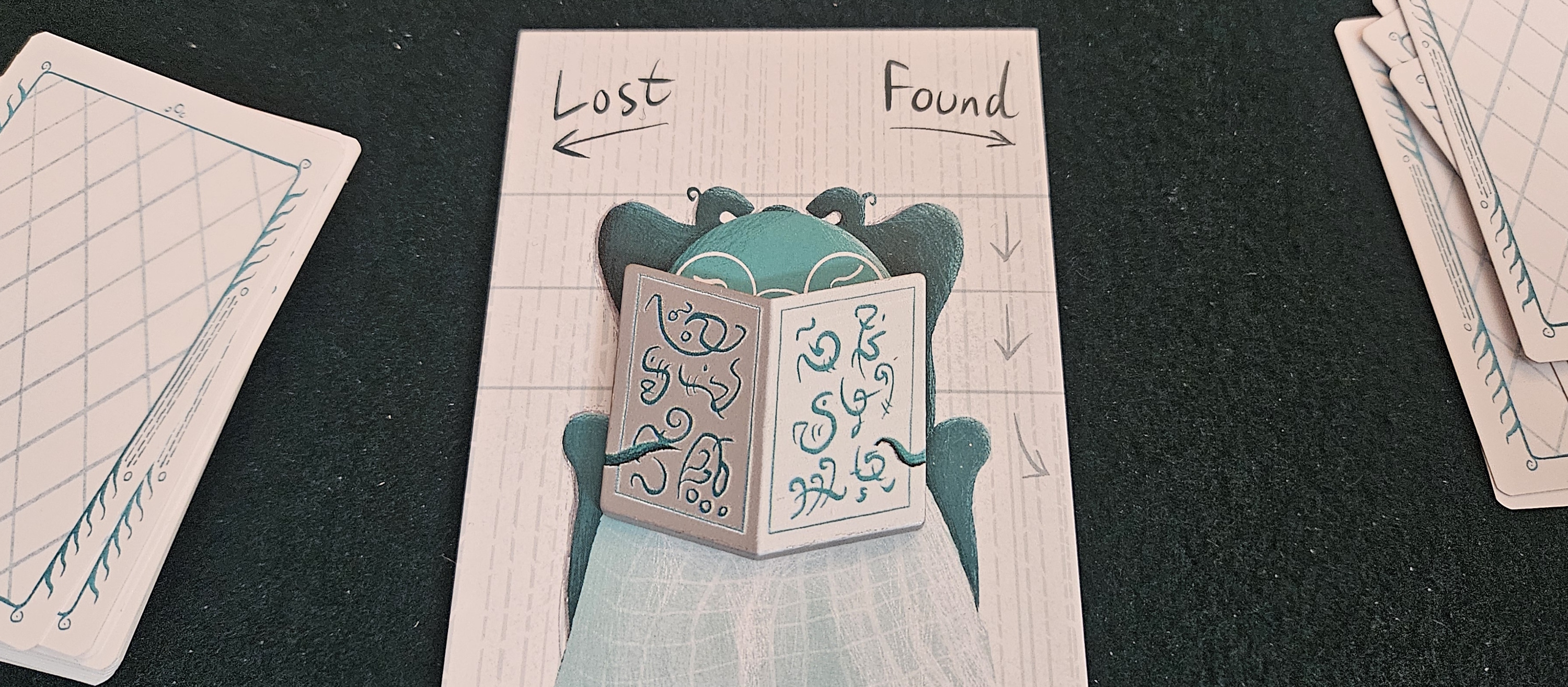
These surveillance measures are getting out of hand.
Where this latter edition departs from the original is in its open-ended nature and overall fluidity. The original, if you haven’t played it, was a march to a finish line that probably never arrived. Victory required passing through every one of the game’s checks. Nine in total. I’ve never managed it. Frankly, I’m not actually sure it was possible for normies to accomplish.
This time around, Wake has grown more playful. As before, the game begins with a twenty-minute timer, followed by escalating requests from the alien. Only this time, rather than hoping you’ll make it through all nine rounds, the game assumes you’ll falter. Maybe we’ll deplete our limited supply of minutes. Or maybe the alien will notice the errors in our categorization system. (Adorably, it peeks suspiciously from behind its alien magazine. What we cannot know is that its reading material is smut.)
Either way, we’re given one last chance to sort the deck we’ve created, ordering the entire thing in a panic. The more checks we passed previously, the more we have to sort, but also the longer the alien gives us to accomplish our task. Our performance awards us a final score, tallied for every card we put into its correct place. As conclusions go, it’s far smoother than what Out of Sorts provided before, more of a crescendo than an abrupt termination.
But that’s not all. While our score matters, Wake also rips a page from Jon Perry’s Hot Streak by assigning our rank a post-script to this whole debacle, a one-sentence note right out of a ’90s sports flick. “Bobby went on to play in the Majors. Tom married Queenie. Jerry died of lung cancer at 34 from smoking eight packs a day.” That sort of thing. Only more likely to involve airlocks.
These changes make the new edition gentler in some ways, more approachable, but this isn’t to say it’s been defanged. If anything, the game has been given a rounder shape, one that suits its gameplay so perfectly that it’s hard to imagine it ever occupied a different vessel. In fact, I’d half-convinced myself that it was always this way. I had to go back to the original rulebook to make sure I wasn’t imagining a slightly worse version of the same game.
There are other little additions. The biggest is a variant that sees the alien librarian occasionally interjecting its own recommendations. Sometimes these are helpful, like having the Sorter flip a card around so everybody can see it. More often, they’re petty annoyances, like tossing a book onto the front of the stack or having the Finders assign a title in the Sorter’s place. It’s a small alteration, but worthwhile in how it forces your squad of unwilling astro-librarians to adapt to further impositions.

There’s now an ultra-mean variant where the alien proposes ideas.
All told, Out of Sorts is every bit as good as I remember. Partly that’s because it’s such an improvement that it retroactively persuaded me that this is how the game was always played, a suitable trick for a game about both the fuzziness and indefatigability of creative memory.
But the real reason is because it’s still that same weird memory game, only improved in nearly every way from Wake’s earlier effort. For a game about alien libraries, Out of Sorts is defiantly human. Its illustrations are hand-drawn, its design is iterative, and its central spark is the same promethean fire that is our human capability to organize and imagine. I love its squiggles and crotchety alien kidnapper. I love even more what it reveals about our human capacity to index a shelf of shame.
A complimentary copy of the new version of Out of Sorts was provided by the designer/publisher.
(If what I’m doing at Space-Biff! is valuable to you in some way, please consider dropping by my Patreon campaign or Ko-fi. Right now, supporters can read the next installment in my series Talking About Games, this time tackling the topic of what makes a good list! Naturally, the piece includes a list.)
Posted on August 20, 2026, in Board Game and tagged Always Awake Games, Board Games, Out of Sorts. Bookmark the permalink. 4 Comments.


So glad you liked the new version! For anyone interested, here’s a link to the Kickstarter launching September 8th.
I’d like to hear more about these alternatives to the Dewey decimal system, and thank you for informing me of Melvin’s history.
This game sounds delightful too, in a way similar to some of the challenges in the recent Big Walk videogame that deliberately constrains communication methods into silly conveyance puzzles.
There are quite a few, as you can imagine. The Dewey Decimal System (DDS) has grown out of favor for a number of reasons, not only because Dewey was pretty rancid and organized books in a way that prioritized certain disciplines, religions, and histories, but also because it’s just sort of… bad. It doesn’t really work in a non-academic setting, but academia has outgrown it in a bunch of ways as well.
The main two alternative schools of book cataloguing that I know about — and my knowledge is by no means extensive, it’s been a really long time since I worked in a library — are those based on the Library of Congress Classification (LCC) and those that use some variant of the Book Industry Standards and Communications (BISAC) subject headings. The former is a little more academically inclined, while the BISAC stuff has been more standardized by booksellers. They both have their drawbacks, which might be enough to prevent them from overcoming the old DDS. The LCC tends to have an American bias (duh), while BISAC is too broad for stacks-based research. There’s also the Universal Decimal Classification (UDC) approach, which is probably superior but is younger. I don’t really know much about UDC. Since it’s based in the international movement around the Hague, I’ve never actually encountered it in the wild.
Like I noted in the article, these aren’t the most pressing concerns, but those with careers in cataloguing, preservation, and library sciences hold strong opinions on the matter. Now you know a few acronyms if you really want to learn more!
Pingback: Space-Cast! #59. Mostly Awake | SPACE-BIFF!