Solar Funk
Remember those bad years when every other board game was a deck-builder? Solar Titans reminds me of that.
It’s not that Solar Titans is bad. Just that it’s perfunctory. This is a deck-builder the same way everything back then was a deck-builder. Its identity as a deck-builder makes zero sense. Its deck-builder systems run contrary to its fiction. It even commits the capital sin of deck-builders by letting each hand’s composition matter so much that everything else becomes secondary.
But let’s back up. Solar Titans. What’s it about, eh?
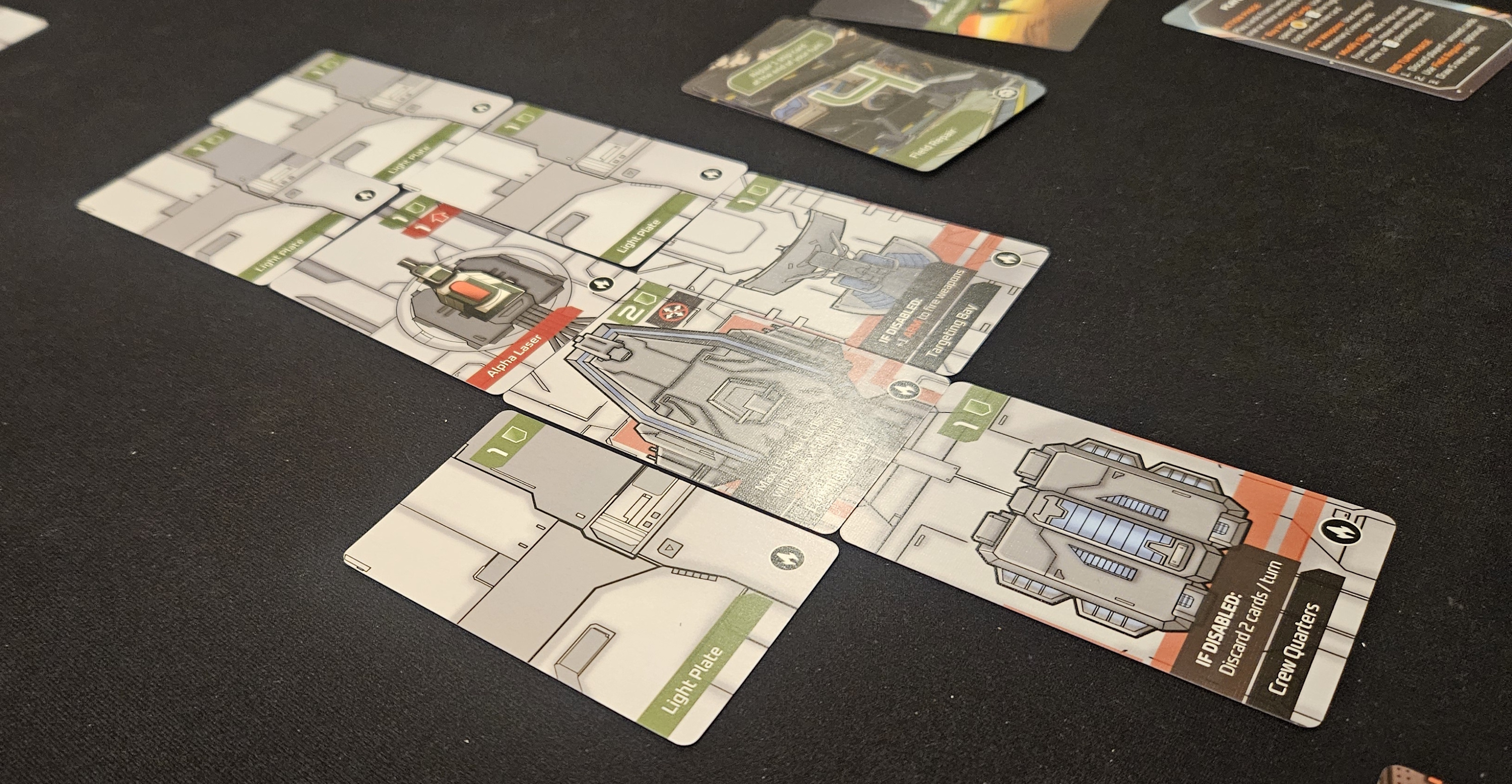
That’s a solar titan there. Yep.
On paper, Solar Titans ought to be my jam. My site is called Space-Biff!, for heaven’s sake, named for gigantic spaceships lasering and rocketing and otherwise exposing one another’s pressurized interiors to the hard vacuum beyond their eggshell hulls. So when Solar Titans claims to be about building and then ripping apart spaceships, I’m down to wrassle in the mud.
When the game opens, there’s nothing amiss. Players begin with a basic ship that includes the bare minimum systems to keep flying. There’s your command deck; sacrifice that and it’s curtains for your entire vessel. Crew Quarters, mostly there to keep your hand at a healthy size. The Targeting Bay, a really bad thing to lose if you want to continue pelting any enemy ship(s). One Alpha Laser, a basic weapon that will soon be more useful as armor. Finally, a few segments of light plating, the thin line between your squishy interior and the instant death beyond.
Cue the actual space-biffing. Procedurally, Solar Titans has a comfortable familiarity to it. Turns consist of playing cards. Early on, this takes two main forms. Arming Crew heats up your weapons, thus discharging your vessel’s arsenal at the opposing ship and flipping some portion of it face-down. Cargo Crew give you cash. Cash that you then spend on a variety of other ship components.
Those components make up the bulk of your decision space, and the marketplace that sells them is really two slightly separate offerings. The first is a static pool of reliable standbys, mercenaries for firing your lasers more often and better crewmembers that wield greater purchasing power. The second is more dynamic, a river of ever-changing cannons and armors that can be bolted onto your ship to improve its abilities mid-battle. By attaching the best katana beams, jammer plates, salvage crews, and other greebles to your ship, the odds that you’ll emerge victorious grow steadily greater.
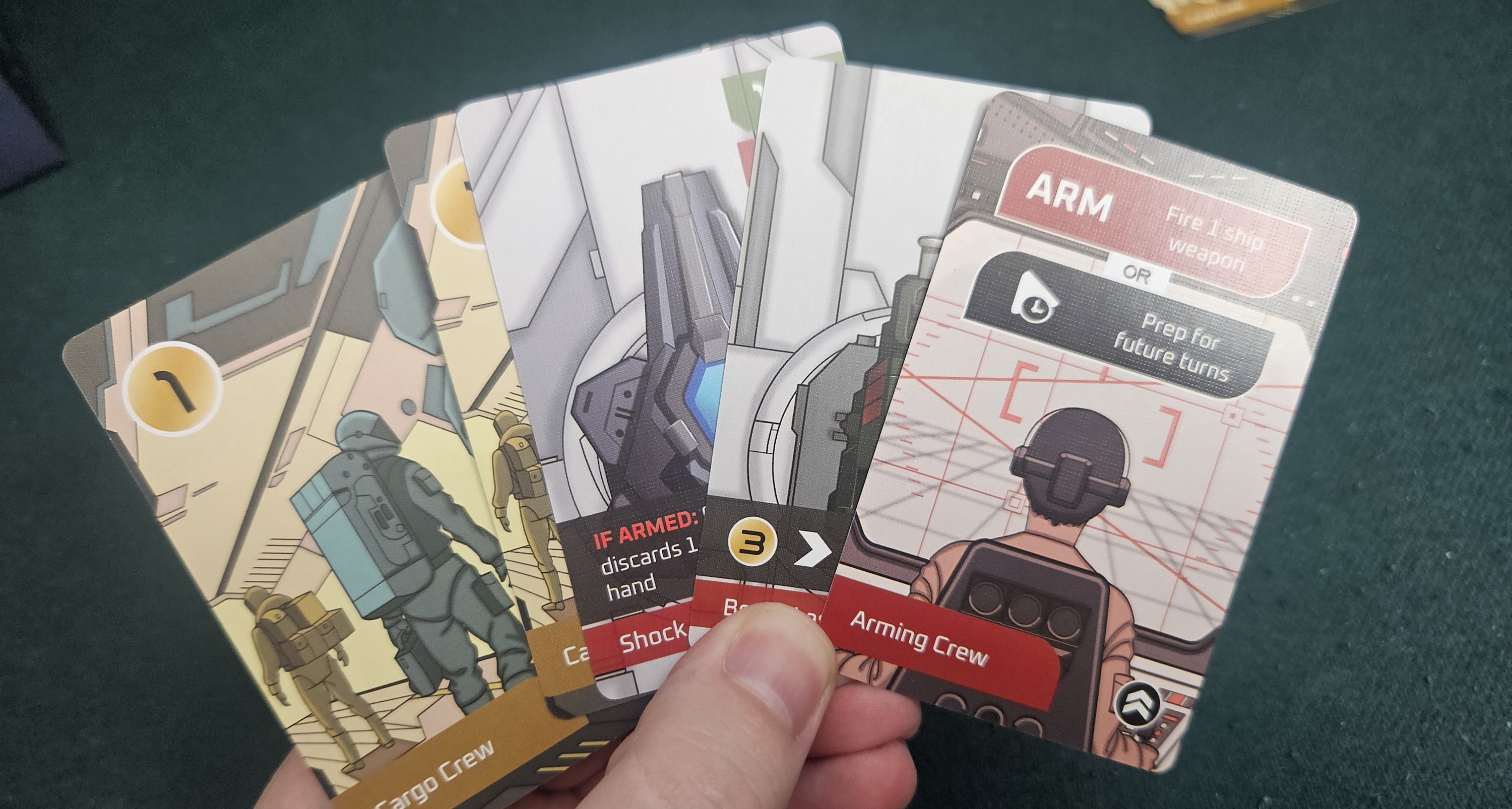
This is an unusually exciting hand for Solar Titans.
As a game, Solar Titans works well enough. The deck-building and -cycling are functional, if not inspiring. There are no big ruptures in its fuel lines. But it still carries layered issues that prevent it from making that crucial jump to light speed.
Perhaps most superficially, I prefer to know what we’re doing in a game, to see the ways the actions on the player aids are reflected in the fiction and vice versa. So when our ships sprout entire missile pods mid-duel, there’s a part of me that recoils. It isn’t as though the HMS Surprise sprouted a fresh deck of cannons right before a broadside at the Acheron. Then again, this is the future. Maybe it’s nano-something. Quantum-whatever. Fine. I can live with that.
But making peace with the game’s fictive tempo doesn’t alleviate its drumbeat on the table. Buying a card means adding it to your discard pile. Only then will it eventually cycle through your deck to your hand, at which point it may bud onto your vessel like a spring blossom. This is the norm for almost everything in Solar Titans, but when it comes to ship components, it transfers the sum of your player agency to the whims of the deck. Will your phase cannon come online in time? Can you armor that essential section before it crumbles under enemy fire? Will your crew aim your whatever-beam before the enemy’s such-and-such plate grows to block the shot you’ve lined up? These are questions of which side draws the proper card in time.
Which might be palatable if only the game bothered to provide interesting verbs. Here, though, those verbs are limited to shooting and buying. Sure, there are varieties of cannons. Some smack the enemy vessel head-on. Others snake in from the side. Some are delayed. Others unleash pronged attacks that hit two sections of armor at the same time. But for the most part, damage is damage is damage. There’s none of the cleverness that marks space combat in fiction or other games. You’ll never reposition your ship. You’ll never set life support aflame. You’ll never deplete a vessel’s reactor. There are cards that gesture at such occurrences. Boarding pods. Energy beams. Nano-whatevers. But their results are damage, countered with repairs, back and forth until one side or the other chances upon the right combination of market cards and deck draws to carry the day.
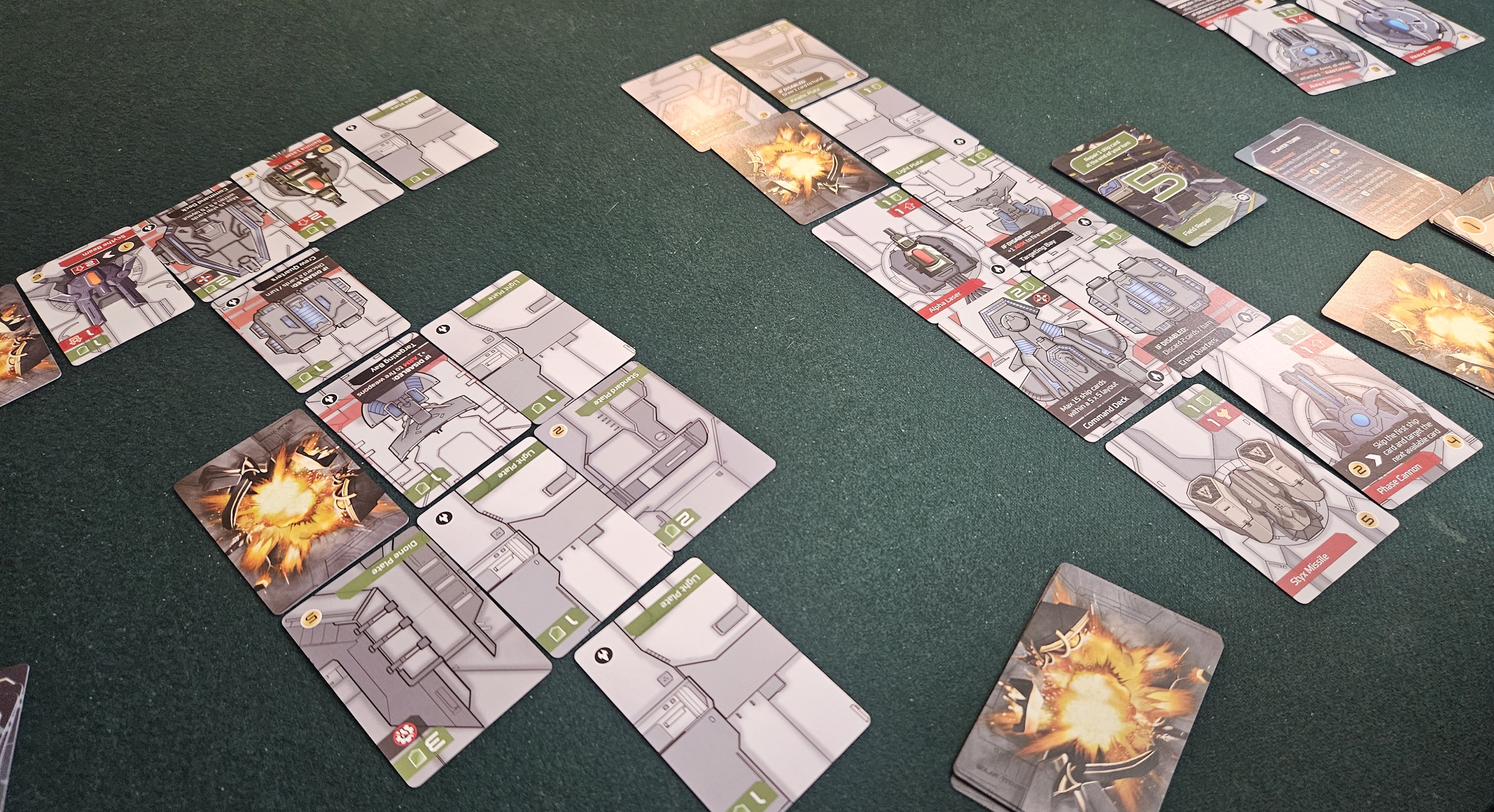
Two solar titans really pounding each other.
It’s a shame. There’s a great deal of creativity on display here, including different play modes that see partnerships ganging up on mega-vessels. But it’s all funneled through such a filter that the result is an evolutionary dead end. This is no space-biff. Maybe a space-paff. And nobody’s going to name their website Space-Paff.
A complimentary copy of Solar Titans was provided by the designer/publisher.
(If what I’m doing at Space-Biff! is valuable to you in some way, please consider dropping by my Patreon campaign or Ko-fi. Right now, supporters can read the next installment in my series Talking About Games, this time tackling the topic of what makes a good list! Naturally, the piece includes a list.)
Posted on June 17, 2026, in Board Game and tagged Board Games, Solar Titans, Solsora Games. Bookmark the permalink. 2 Comments.


Still plenty of time. To name yourself Space-Paff that is…
Coming 2028, Space-Paff! is a new website about laundry detergents and other household necessities.