Middling Kingdom
At this point, the civilization genre needs an intervention. We could all sit in a circle on folding chairs we borrowed from the local church. Set out a little tray of cheeses and olives. Have plenty of tissues on hand for everyone. Speak in that voice we reserve for serious moments. “Hey,” someone would say, breaking the ice. “I’ve noticed you’ve been in a rut lately.”
Rising Cultures, designed by Aske Christiansen and Francesco Testini, almost begs to be described entirely via comparisons. It’s a lower-fidelity Imperium, a blown-out Ancient Realm. Clash of Cultures in how closely it sticks to an inherited form, as far as possible from Arcs on the personal-to-longue-durée matrix. Not as good as any of the bests, but neither so bad that it’s worth observing for its missteps.
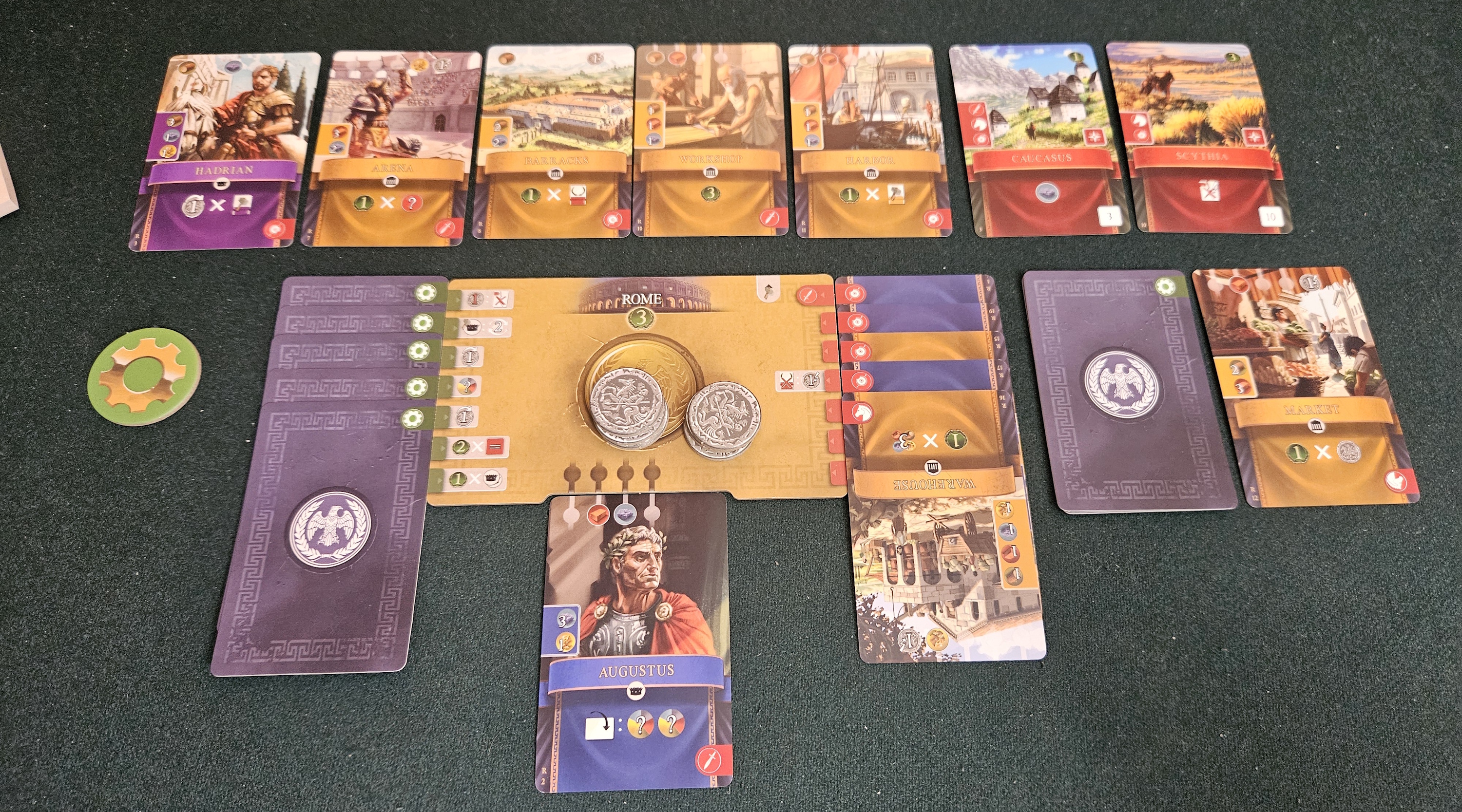
What have the Romans done for this tableau?
No sooner is its lid cracked than Rising Cultures reveals a few inborn limitations. There are four civilizations to helm, three of which are Egypt, Rome, and Persia, those old standbys that aren’t exactly going to blow anybody’s hair back. The experience is two-player-only. No solitaire, although what follows will be mostly solitary in nature, nor welcoming of a third or fourth player, although it feels like the designers could have pushed it to those heights had they really wanted to.
Also, there are heaps of icons. So many icons, in fact, that each civilization comes with its own fold-out crib sheet that translates every single line of the boards and every single card. Oh, and sometimes explains concepts in eight-point font that must be scraped from the surrounding info-spatter. Transcribing these details calls to mind City of Six Moons, another civilization game Rising Cultures is very much unlike.
From there, the gameplay grumbles into action. And it’s good action. Each round sees players figuring the best use for the four cards they’ve drawn from their hand. Scratch that; three of them will be used, the fourth will return to the top of the deck to reappear on the next go. The action economy is thus strictly limited. Three cards per round. Seven rounds per game. Nominally, that’s twenty-one actions in total.
Of course, there are plenty of ways to break this rubric, although Rising Cultures isn’t quite as combo-tastic as some of its peers. At any given time, there are four main uses for each card. First — and flimsiest — you can discard it to pick up two coins. This always feels like a defeat. Second, you can slot it into your empire as resources, the bricks and stone and so forth necessary to, third, build cards into your tableau. This is the most durable option, permanently earning access to that card’s best benefits, whether scoring abilities or ongoing perks. Fourth, any card can enter your military. More on that in a moment.
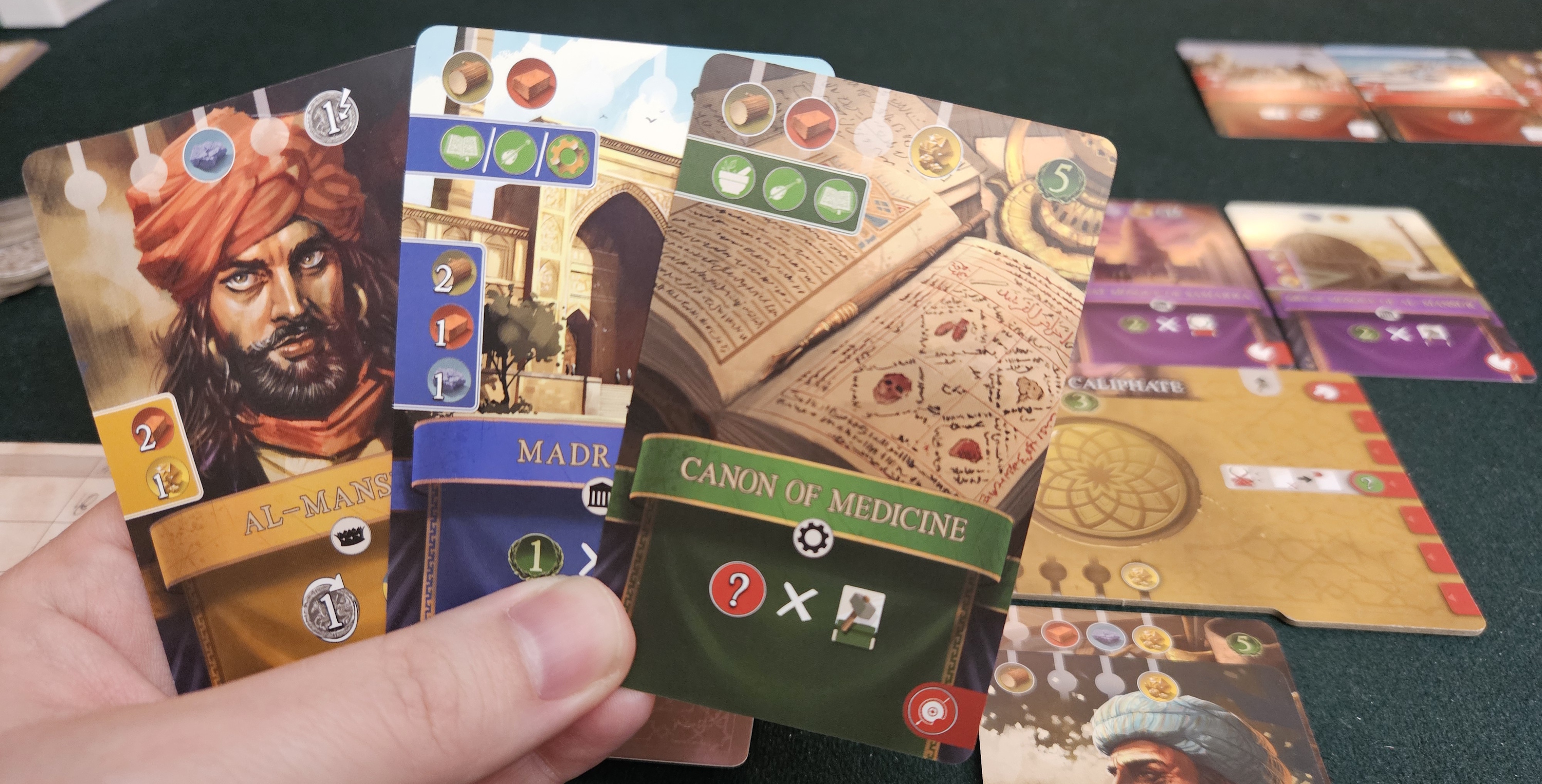
Each turn revolves around a few cards.
As processes go, this is good stuff. Interesting stuff. Compelling stuff. Cards aren’t quite multi-use, in the sense that they might tempt players to wander distinct avenues. If possible, you’d probably want all of them in your main tableau. But that isn’t possible, and anyway there’s a clever tradeoff whenever you build a card. Basically, you’re given the option of flipping the bottommost resource onto your civilization board, unlocking further abilities but decreasing your overall wealth. It’s a smart move, one that goes a long way toward preventing players from falling into a formula where they spend their first few cards on resources and then keep building everything afterward.
Little by little, your civilization takes shape. That shape, naturally, is largely predetermined by whichever faction you’re playing at the moment. The Romans go to war a lot. The Egyptians must manage the ebb and flow of the Nile. The whole thing feels a lot like Imperium, except you’re going through a deck once rather than cycling through and improving it over multiple stages.
At points, players are invited to glance at one another across the table. Usually this happens when gearing up for the fight that caps each round, when some province will be awarded to only one side depending on whichever civilization has assembled the most suitable army. In rare cases — okay, one case — a civilization offers bonus actions to its rival. Beyond that, this is a heads-down affair.
Which is fine. I’m not slamming multiplayer solitaire. But I am left wondering where Rising Cultures’ identity might be found. Its four civilizations each play like their own puzzle. With their cards jumbled together, all those natural synergies out of order, can you assemble them into a points engine that outpaces your opponent’s? Maybe. It depends. On the shuffle, sure, but also on whichever faction sits before you. Some are more complicated than others. Egypt has that shared Nile row going both for and against it. The Abbasid Caliphate requires some strict sequencing in order to usher in its era of science, which is notably tougher than the slapdash approaches available to Rome and Persia.
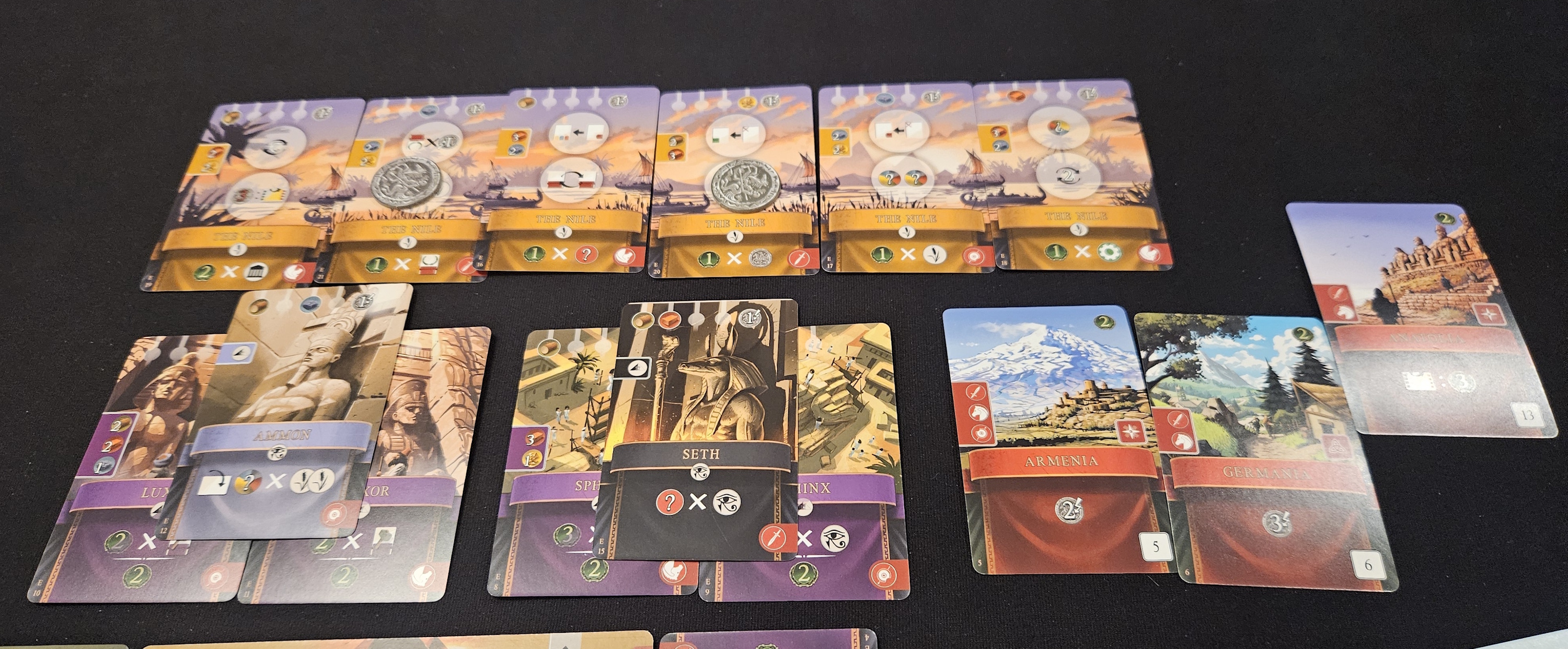
The Egyptians are in the Nile about this game.
What it never manages, unfortunately, is to stand apart. At its best, it feels like a microgame that got too big for 18 cards, or like a less generous and less flexible version of Imperium with half as many civilizations and a stricter play count. It isn’t weird or experimental, but neither is it especially standard, in the sense that it might appeal to someone who’s looking for an unvarnished civgame. The result is a middle-of-the-road title that says and accomplishes little. I don’t expect it to survive the test of time.
A complimentary copy of Rising Cultures was provided by the publisher.
(If what I’m doing at Space-Biff! is valuable to you in some way, please consider dropping by my Patreon campaign or Ko-fi. Right now, supporters can read the next installment in my series Talking About Games, this time tackling the topic of what makes a good list! Naturally, the piece includes a list.)
Posted on June 18, 2026, in Board Game and tagged Board Games, Capstone Games, HUCH!, Rising Cultures. Bookmark the permalink. Leave a comment.


Leave a comment
Comments 0