Buried

Ruins, the card-building, card-shedding game by John D. Clair, served to answer a question that’s been niggling at the back of my skull since I first played Mystic Vale almost a decade ago. Namely, why don’t I like these things?
Not John D. Clair games, to be clear. I like plenty of his games. Rather, these of his games, the ones about sliding inserts into sleeves to build custom cards. At a notional level, it’s a solid concept. Plenty of digital card games let you modify your cards. By using inserts and sleeves, these titles circle some of that bespoke nature back to its origin point. Yet none of Clair’s experiments with the form, whether Mystic Vale, Dead Reckoning, Unstoppable, or now Ruins — which is based on an earlier title, Custom Heroes — has really landed with me.
I now know why. It isn’t the sleeving that’s the problem. It’s that Clair doesn’t exhibit much trust in his own sleeves.

Custom cards are cool.
To start at the beginning, Ruins is a shedding game, which means that every round is a race to empty one’s hand of cards. You dump them either one at a time or as matching sets, and then one-up the competition with better offerings, around and around, until players’ hands start depleting. Going out first earns more points than going out later.
It’s such a basic setup that adding modifiers is one of those “oh duh” ideas, perfect in its simplicity. And Clair’s approach to drafting those modifiers is superb. The gist is that everybody begins with three resource tokens — campfires, but don’t worry about that, the setting is nonsense — which they can spend on various inserts. Most nudge the card’s rank upward. What was once a card with a value of nine becomes a fourteen, later the fourteen becomes a nineteen, that sort of thing. There are other abilities as well. Like, say, turning a card into a wild rank, ready-made for pairing with other cards. Or letting a card clone itself. Or rekindling your spent campfires. Or drawing and discarding extra cards in hope of picking up something that matches better with your hand. Or, only a few times per game, marking a card as permanently yours, ready to be plucked from a rival’s hand at the start of a new round.
This transforms Ruins into a highly reactive experience. Normally in a shedding game, somebody will play a tough set — for example, four 5s — and you’ll glance at your hand and go, “Oh, that’s impossible to follow, I’ll pass for now.” Shedding, like trick-taking, is generally more about long-term planning than moment-to-moment play. In Ruins, that tendency is flipped on its head. Up against that tough set, you’ll look at your hand and then at the market and go, “Okay, if I buy that +3 and that +6, and attach them to these other cards, now I can follow my opponent’s play by dropping four 13s.” You’re still playing the long game, since big plays tend to deplete your resources, not to mention burn options out of your hand. But the play is highly responsive, standing in contrast to what is customarily a more measured form of play.
At its best, this is exciting and immediate, and even at this level sometimes Ruins gets away from itself. Stuffed with modifiers, cards eventually become little math problems. It’s one thing to note that a card’s value is 11 plus 4. But how about 11 plus 4 plus 8 plus 7? Now keep those values sorted across all the cards in your hand. Now adjust those values by the modifiers in the market. By the game’s third round, the slowdown is noticeable. So much for “exciting and immediate.”
Even so, this core concept would make for a fine shedding game. It’s punchy. Lean. Feels distinct from other shedders. I’d even call it the best use of Clair’s inserts-in-sleeves gimmick.
Shame how he kept packing it with extra servings.

The market offers all sorts of inserts.
For whatever reason, Clair determined that Ruins wasn’t done baking. The modifiers weren’t enough, so more stuff kept getting tossed in. Even as the game’s sleeved cards grew heftier with each added insert. Even as the deck’s bulk become noticeable with each shuffle. Even as its mathematical load grew more tedious. Even as the game’s cognitive load bulged outward with its overloaded sleeves.
So, for instance, we get cards that aren’t only moddable, but reversible. At the start of each round, you’re allowed to flip a card over to its opposite side. This tweaks its rank and perhaps adds a special ability. Okay, fine. This can help mitigate a bad draw.
But then there are all the special abilities, some of which slow down play even further. Like the insert that forces somebody to draw an extra card. Or the one that sees you drawing and discarding to fine-tune your hand. Early on, these are fine and dandy. Later on, when people are constantly pausing to evaluate their options, they become downright irritating.
But then there’s the skipping rule. Whenever somebody plays an exact duplicate of what was played before them, the next player in sequence must auto-pass. In a game that often revolves around passing, that can prove fatal. To get technical about it, this problem is compounded for a couple of reasons. First, Ruins sees card ranks ballooning at their upward ranges thanks to all those inserts; but second, thanks to the ability to modify cards on the fly, it’s often possible to craft a response that will force a pass. These combine to give leading players a strong edge. And if there’s anything Ruins did not need, it was a tendency to favor leading players even more.
But then there’s the way everybody but the final player needs to shed their entire hand. What happens when someone accomplishes this goal? The next person in clockwise order becomes the next leading player. In the game’s latter stages, when cards have gone through said ballooning and holding the lead has been thoroughly strengthened, it isn’t uncommon for this order to calcify. Player A goes out, the lead passes to Player B, Player B goes out, the lead passes to Player C, and so forth. There’s potential for disruption there, but the range of modifiers is so wild that it becomes nigh impossible to hit the right targets anymore.
But then — and this is the last one, I promise — there’s that awful conclusion. Ruins doesn’t just keep score. Oh no. Instead, it only ends when somebody reaches enough points and then goes out first in the next round. Barring that, Ruins asks for a final tiebreaker round solely between those who have reached its highest threshold. I hope you like waiting. I don’t. At least not enough to sit through another sluggish round of Ruins that I’m not even involved in.
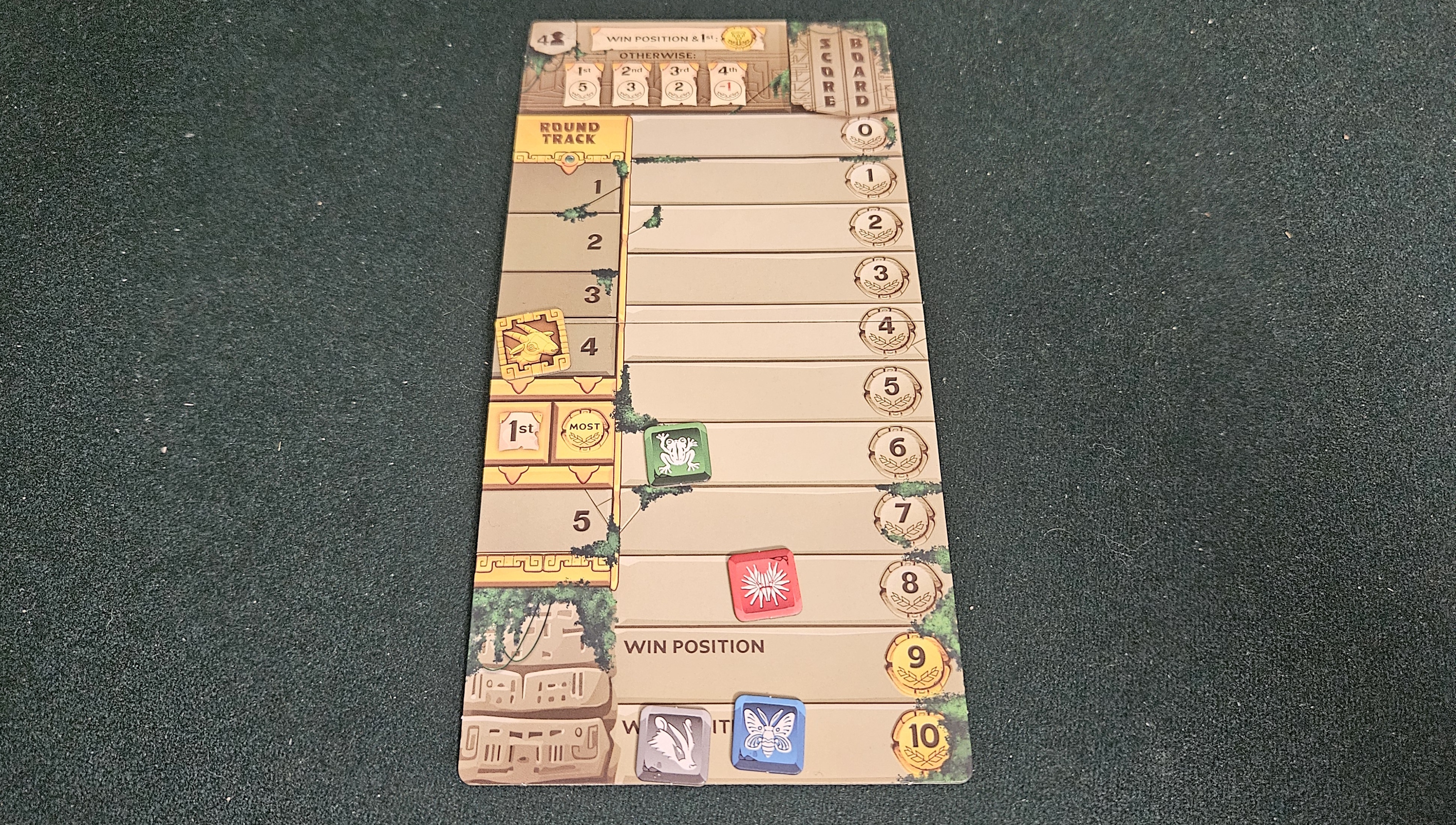
I genuinely don’t know what’s going on with this score track.
I know some of these points are overly technical, and I apologize for that. But I’m trying to illustrate a point. The point being that Ruins began with a crackerjack idea, only Clair kept adding more and more stuff, some of it useful and interesting, but much of it ill-considered and sluggish. Eventually, its basic idea got buried. The effect was not unlike lighting a battery of firecrackers — and then dumping a load of gravel over the top of the whole show.
There’s a good inserts-in-sleeves game in here. There was a good inserts-in-sleeves game in Dead Reckoning and Unstoppable. Someday, I hope Clair trusts those good inserts-in-sleeves games rather than burying them.
A complimentary copy of Ruins was provided by the publisher.
(If what I’m doing at Space-Biff! is valuable to you in some way, please consider dropping by my Patreon campaign or Ko-fi. Right now, supporters can read the next installment in my series Talking About Games, this time tackling the topic of what makes a good list! Naturally, the piece includes a list.)
Posted on July 14, 2026, in Board Game and tagged Allplay, Board Games, Ruins. Bookmark the permalink. 2 Comments.


Sooo around the same complexity as Campaign for North Africa? I thought that was a great party game and I hope the publisher comes out with more family-level titles like that soon!
Surprised you didnt like it our group loves it as a filler between games and its not that hard