Blog Archives
Pack O Review: GEM

At some point, I really ought to acknowledge that each of the titles in the Pack O Games consists of only three letters. Speaking as a wordsmith, that alone is an achievement. I picture Chris Handy lying awake at night, struggling to name his latest creation. “GNT? RBY? NYX? DMN?” He furiously blots out the combinations of letters that fill his notepad, then calls out to his wife, rousing her from her sleep. “What’s another word for a bijou?” he asks, wiping away the perspiration on his forehead with the back of his hand.
Meanwhile, GEM is a game about the high-powered world of diamond auctioning.
Pack O Review: TKO
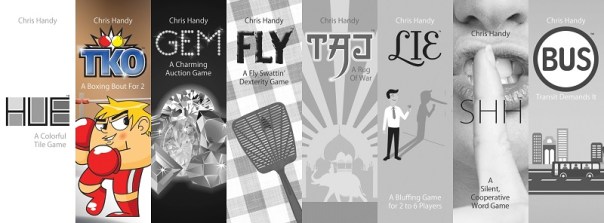
Riding high on last week’s look at HUE, the first installment in the first Pack O Games, we arrive at TKO. This one’s a boxing match for two, and it bears a striking resemblance to something else.
Ten Observations on Gloomhaven

For the duration of the next month, the enormously popular Gloomhaven is back on Kickstarter for a second print run. Perhaps more tellingly, it has blitzed its way onto the BoardGameGeek top ten, currently hovering at number nine. Who does it think it is, Pandemic Legacy?
Personally, I haven’t played enough of Gloomhaven to warrant a review. Even after a dozen-plus hours in its presence, I just haven’t seen that much of it. Some laughs, some battles, some leveling up, some tinkering with character and party builds — yet still only a fraction of the gorilla that is the game’s twenty-pound box. For many games, six plays is easily enough to form an impression. In Gloomhaven, it doesn’t even mean getting your feet wet. Damp, perhaps. Perspiring, maybe. But not wet.
All the same, what follows are ten impressions of those first half-dozen plays. A sort of review-in-progress, as it were.
Pack O Review: HUE

Easily one of the coolest things about Chris Handy’s Pack O Game has nothing to do with the fact that it’s eight games in one handy-dandy carrying case. Nor that the reception was warm enough to warrant a sequel set. Nor that each of the games has a cutesy three-letter title. Blah blah blah.
No, the coolest thing is that each of these games is literally the size of a pack of gum. And not one of those deluxe gum silos or gum diskettes, or wherever else you commercial teenagers with your ice breath and lack of shirts and easy sex are storing your gum. Rather, one of those tiny cardboard gum boxes that smells of spearmint and gets lost between the cushions. That’s where my real interest lies.
Today, we’re inspecting the opening salvo of the first Pack O Game. Meet HUE.
The Distant Future, The Year Two Thousand
After playing Richard Amann and Viktor Peter’s Kickstarter success story Trickerion: Legends of Illusion, I vowed that I would try anything else this duo dreamed up. Fortunately, I didn’t have to wait long. Anachrony — which also features Dávid Turczi in the design column — sports an even cooler pitch than Trickerion’s city of magicians. Here it’s the distant future, the Earth has been trashed, and competing factions vie for supremacy and to survive an impeding asteroid impact. Oh, and there’s some light time travel.
Anachrony, it’s weird how many of my switches you’re flipping.
Some Things Are Better Left Unknown

Unknown is perhaps the most appropriately-titled board game of the past few years. Not only is it about uncovering the darkness of an underground bunker complex after a world-ending disaster, but it’s also relatively, well, unknown. And I aim to put an end to that. The last part, I mean.
If He Dies, He Dies

Okay. Deep breath. Whew. Gotta shake out these trauma wiggles.
The thing about Russian Roulette is that the stakes are just too high. I mean, I won, and still I’ve been staying up nights just thinking about what could have happened. One in six doesn’t seem so bad at first. That’s only about a sixteen percent chance. But after you pull the trigger the first time, you just keep on pulling. That second pull, your odds are more like twenty percent. Then twenty-five. My buddy Chris, we’ve been friends since high school, and he… well, I won.
Russian Roulette, Final Score: ★☆☆☆☆☆
Run Boy Run

Remember Burgle Bros.? It was a rather nifty stealth-heist game hampered ever so slightly by a gamey event system. Still, it was slick. And now it’s got a sequel. Sort of.
The culprit in question is Fugitive, and it’s one of those very rare games that doesn’t sound like much at all — not with its fifteen-minute playtime, a single deck of fewer than fifty cards, and rules that take maybe two minutes to explain — but once laid out upon the table reveals itself to be nearly perfect.
Making a Monstrous Mess

I’ve got a hypothetikos situation for you. You’re a Greek god, okay? You live on Olympus, flatulate lightning and belch storm clouds, all that. But the residents of Greece just aren’t giving you any respect. They leave goat offal for votive offerings, dampen the back of your shrines whenever nature’s urge strikes them, and deploy your exalted name as a mere punchline. “Where do you keep all your Pegasuses?” they ask. “In Zeus!”
Deep breath. What do you do?
If your answer is to create a bunch of monsters and chuck them at the cities of Greece in what amounts to an Olympian temper tantrum, you’ll get along just fine with Monstrous.
Ire Is Bad

Perhaps the most sobering tragedy of the Hungarian Revolution of 1956 is that its most significant global impact was to cause a few Communist philosophers in France to reevaluate their stance on the benevolence of the Soviets. Without support from President Eisenhower, the revolution’s early success may have temporarily placed their occupiers on the back foot, but there was nothing they could do in the face of an all-out mechanized assault. Tens of thousands were killed, injured, executed, or deported. That year, Time magazine named “The Hungarian freedom fighter” their man of the year. Come 1957, it was Nikita Khrushchev.
Days of Ire: Budapest 1956 is all about capturing that first triumphal week of the revolution, when brave men and women rose up throughout Budapest to express their displeasure at the Secret Police, State Protection Authority, and other emblems of Soviet control that had taken hold of their country. It sounds like exactly the sort of game that ought to tickle my fancy. So why hasn’t it?

 SPACE-BIFF!