Blog Archives
It’s Pronounced “Dragger”

It’s a tale as old as time. Boy meets girl. Girl isn’t interested. The town of Stjørdal gets invaded by flesh-hungry undead. Flesh-hungry undead are the only ones who can pronounce “Stjørdal,” so by ancient tradition they now own the town. Boy, with nothing better to do with his misdirected masculinity, loads up on iron stakes and vials of holy water. It’s on.
We haven’t covered anything by prolific print-and-play designer Todd Sanders for a while, but the recent envelope printing of Todd’s solo microgame The Draugr by BoardGameGeek seems like as good a time as any to jumpstart our moldering heart. So listen up, because this one’s lean, gorgeously ugly, and arrives printed on paper you might bring groceries home in.
Spew-Quiff!

There’s something about Grant Rodiek’s most recent designs that’s equally bold and foolhardy. Bold, because he’s willing to toy with our preconceptions about tried-and-true game systems to an extreme that most designers would balk at. And foolhardy for, well, pretty much the same reason. Whether you’re drafting somebody else’s cards in Solstice/Imperius or fumbling with the blind wagers and multi-use cards of Five Ravens, you can wager green money that his games will see you doing something familiar in an entirely unfamiliar way.
Enter SPQF. It’s a history pun, standing for the Senatus Populusque Forest — while gleefully disregarding that a Latin forest doesn’t begin with “F.” And it’s a Disney’s Robin Hood’s take on deck- and civilization-building with a Rodiek twist: cute animals, familiar concepts, and one bear of a first play.
Specter Oops They Did It Again
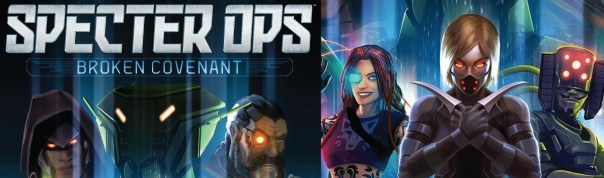
Five minutes into Broken Covenant, Plaid Hat’s standalone follow-up to Specter Ops, and I was already in trouble. Let me tell you why.
The Lonely Stoic
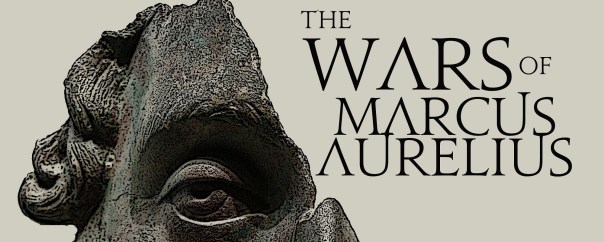
As the last of the Five Good Emperors, Marcus Aurelius was inclined to philosophy over military matters. So much so that he was given the totally unique nickname, “the philosopher.” But sadly for Marcus, his reign was quickly marked by trouble. When Roman soldiers brought home a nasty bout of plague from Parthia, it wasn’t long before Germanic and Sarmatian tribes took advantage of the weakened empire and begin their advance across the Danube and into Gaul. And no quantity of stoicism was going to solve that one.
Robert DeLeskie’s Wars of Marcus Aurelius covers a decade of brutal frontier fighting from 170 to 180 CE. And much like its source material, it’s full of hard decisions, infuriating reversals, and some slogging through the muck to get to the good stuff.
Starshiz Samurai

Every so often, along comes a board game so perfectly silly, so wonderfully bombastic, so altogether joyous, that how could it fail? Like Starship Samurai. This thing is a Saturday morning cartoon realized in cardboard. Gigantic mechs socking each other in the rivets, warring clans courted and spurned, and fighter craft glittering between the stars. Surely it isn’t possible that such a thing could be a painful unmemorable slog that happens to contain some reasonably pretty miniature robots?
Surely not.
Dur Dur Dûhr

Bemused was not only a fantastic game, it was also one of my favorites of 2017. Where most social deduction games revolve around a single secret of falsified identity, Bemused hosted an entire madhouse of enigmas. Obsession, passion, lust, petty hatred, unknown goals and broken promises — all crisscrossing over and under one another, and all as impenetrable and changeable as the players commanding their fates. It was both less and more than social deduction; just a social game full stop, ambiguous and uncertain.
Now Jim Felli has further refined the concept with Dûhr: The Lesser Houses. And although its name is guaranteed to elicit at least one sarcastic howl of “Dur dur dur!” per play, it’s an improvement on Bemused in every sense but one.
Passenger 56

Ever wanted to run your own airline? An airline in a universe where scheduling computers and aviation engineers don’t exist, so you’re in charge of designing planes and booking flights mid-route? On a fifteen-second timer?
Yeah, me neither. But at least Now Boarding makes it better than it sounds.
COIN Volume VIII: Pendragon

I’ve heard some people mention COIN Fatigue. Not me. For a long time, my attitude was that if the powers-that-be at GMT Games desired to produce a hundred of these things, I’d be there. Each new volume is like a component-dense map pack for some popular train game, sans the trains and plus some deeply clever card play and action manipulation and politicking.
Okay, nothing like a train game.
Then I played the latest volume in the series, Marc Gouyon-Rety’s Pendragon: The Fall of Roman Britain. And despite everything it gets right — and it’s a lot — it dawned on me that I was beginning to feel tired. Though it’s possible that my fatigue may have been philosophical. So let’s engage in some therapy!
Vaster, More Mysterious, More Manor

Vast: The Crystal Caverns always possessed one glaring fault, which was only compounded by its expansion, The Fearsome Foes. What to do when you want to play this beautiful sprawling asymmetrical thing, but don’t want to teach four, five, six, seven separate roles? Much of the time, the simplest answer was also the easiest: don’t. It was the sort of game that quickly established itself as the bane of groups with rotating players, especially since it only truly came to life once the roles were learnt and the interactions between its characters and haunts became second nature.
Vast: The Mysterious Manor doesn’t solve that problem, not fully. Any game with multiple roles is going to require its players to learn those roles, and the Vast series — I think we can safely call it that now — has always thrived on the broad differences between its sides. But The Mysterious Manor is at least going to make the task of teaching its rules faster, easier, and more rewarding than before. And the result just might strike the balance between the sweet, sweet asymmetry that gave Vast its appeal in the first place and the approachability to make sure its players stick around long enough to learn its rhythms.
The Knizian Society

Want to know the best thing about all these Reiner Knizia reprints? It’s that somebody else is doing the hard work of curating the good doctor’s 500+ games. Rather than picking through every last trifle, experiment, and flub, they’re all being sorted for the brightest, smartest, and most fulfilling of Knizia’s catalog.
The latest in this spree of curated Knizias — remade with gorgeous art by Osprey Games — is High Society. And much like its namesake, it’s elite, holier-than-thou, and oh so catty.

 SPACE-BIFF!