Blog Archives
When Two Bears Love Each Other Very Much…
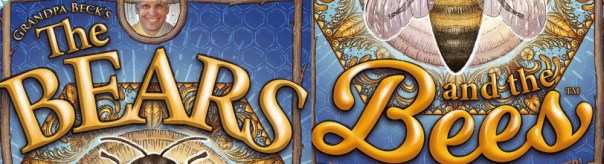
Even though I’ll joke about it, I don’t hate UNO. In fact, I’ll prove it by saying something positive about UNO right now. UNO is good because hhhhhnnnnnnngggggggrrrrrrr uuuuuuuuggggggghhhhhhh eeeeeehhhhhhhhhhggggggg winning by getting rid of all your cards is pretty smooth. Jeffrey Beck’s The Bears and the Bees takes that model and shapes it into something much better — UNO with hexes.
Yes, I’m being fantastically reductive with that description.
Space-Cast! #1. Go Play a Summoner War

After three unbearable years, the Space-Biff! Space-Cast! is back! And to celebrate this momentous occasion, Dan Thurot and Brock Poulsen are joined by Colby Dauch to talk about a much more important revival: the independence of Plaid Hat Games. We also chat about Summoner Wars old and new, Dungeon Run (that’s Brock’s fault), and Forgotten Waters.
Listen over here or download here. Timestamps and a clue can be found after the jump.
Clue Too: Paradise Lost

Paradise Lost tricked me into playing Clue. Not that that’s a bad thing. If anything, I admire Tom Butler’s deftness in pulling out the rug. One moment I was expecting a bland fantasy excursion, so generic as to be staffed with public domain heroes like Hercules and Alice — not the first time I’ve been surprised to see her show up — and a few minutes later, we were asking questions about the Water Witch’s henchmen. “Was it the Big Bad Wolf with the Vorpal Blade?” There’s no third part: “…in the Eternal Cedar Forest?” There’s a reason for that.
But I’m getting ahead of myself. Let’s start at the beginning.
Dale of Deck-Builders
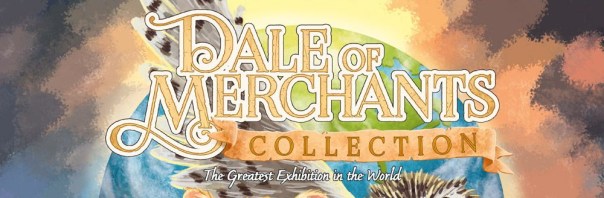
Perspective is a funny thing. When Sami Laakso reached out to inquire whether I’d like to take a look at Dale of Merchants — more specifically, Dale of Merchants 1, 2, and Collection — I hesitated. Not because of Laakso’s talents as a designer, but because the game in question was a deck-builder. And not a hybrid deck-builder; a straight-up, pure, honest-to-goodness cards-and-tokens deck-builder.
Why such hesitation? Because for a moment that felt like a decade, you couldn’t enter a game shop without tripping over that month’s shipment of DBGs, barely-themed stacks of wallpaper with a license slapped over the top. How many decks have I built? How many settings have gone underutilized? The answer is not flattering, either for me or the industry.
But it had been a while since I last built a deck. Doubly so a “pure” deck, sans larger strategic considerations like a map or a lootable dungeon. So I said, sure, why not. And, after a half-dozen plays, I couldn’t be happier.
Alone Outta Hades
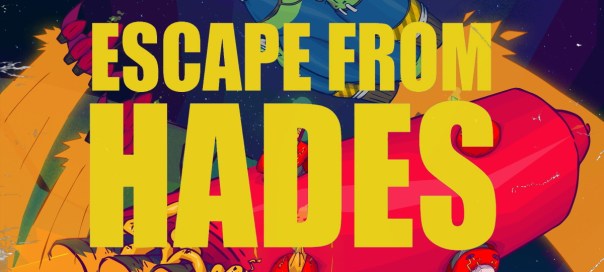
Fred Manzo’s Escape from Hades isn’t what I expected. So much not what I expected, in fact, that I can’t quite remember what I expected in the first place. Certainly something fluffier, something reflective of its radioactive candy-corn cover. Maybe something that didn’t require quite so many gut-checks and mid-play rulings. A handful, sure. After all, this was brought to life by independent publisher Hollandspiele. But this many? This often?
What I expected least, however, was that in between the neon surface of the Hades and too many clarifications resided a story generator as daring and dashing as a WW2 commando film.
When You’re Not Stalin, You’re Russian

Don’t make the mistake of calling Dual Powers: Revolution 1917 a wargame. I learned that lesson the hard way. Like 13 Days: The Cuban Missile Crisis and Fort Sumter, Dual Powers is about what happens before the war — in effect, a pre-wargame. This is the jockeying, the shakeout, the period when everybody decides who they’ll sidle up to when the shooting starts. Even better that Brett Myers has selected a topic I’ve yet to see explored. With the February Revolution out of the way and Tsar Nicholas II off the throne, Petrograd has settled into an uneasy truce between the Provisional Government and the Bolshevik Party. Surely such an arrangement will last more than a few months.
Two-Headed Monster
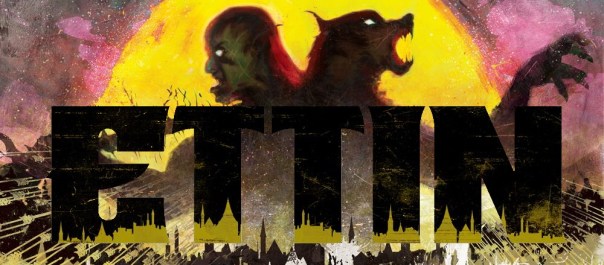
Upon critiquing Tournament at Camelot/Avalon, you could say I was eager for Ken Shannon’s next design. When I heard about Ettin, which merged one of my favorite genres with a mode of play I hadn’t encountered before, I was practically buzzing.
After playing Ettin a number of times, I can definitively claim that it’s appropriately titled. As a two-headed monster, it’s not always easy to tell which direction it wants to travel. Although that isn’t always a bad thing. Only when the goofier head is in charge.
And Not a Catacomb in Sight

Whenever you call something a “dexterity game,” there’s one last ambiguity to resolve: are we talking about flicking dexterity or stacking dexterity? For a number of years, Aron West, Ryan Amos, and Marc Kelsey’s Catacombs was the finest examples of the former, equal parts competitive and slapstick. Now West has teamed up with Ken Valles for Catacombs Cubes, which is all stacking and no flicking. But with plenty of excellent stacking games out there, how does it stack up?
I will never apologize for the crime of a good pun.
Tournament at Camelavalon

Comparatively speaking, Ken Shannon, Jody Barbessi, and Karen Boginski’s Tournament at Avalon is largely identical to their earlier Tournament at Camelot. They’re both trick-taking games with an Arthurian twist, they both tend to go wild halfway through, and as a result of said wildness they both occasionally require minor clarifications. In fact, they’re so similar that it’s possible to blend them together for even less certainty and greater player counts. Most of the time, the only way to identify what belongs to which is to look for the microscopic “A” adorning the bottom corner of Avalon’s cards, like telling apart identical twins via their disparate blemishes.
Which makes it doubly strange to point out that I heartily recommend one and only reservedly appreciate the other. But before we get to that, let’s talk about what all these tournaments are for in the first place.
Dan’s Dilemma
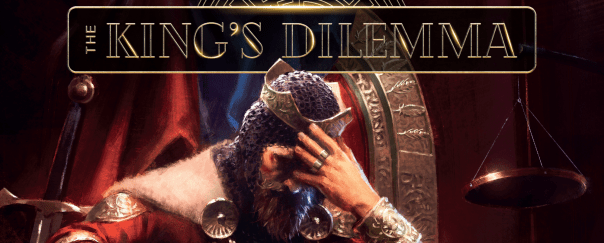
There’s a disclaimer on the front page of the rulebook for Hjalmar Hach and Lorenzo Silva’s The King’s Dilemma, the latest hot thing in legacy games. Written with an assortment of bolded words that would do a comic inker proud, it promises morally challenging situations, tough choices, and sensitive topics. “Remember that this is a just game,” it proclaims, flipping its grammar and its intended meaning. “You’re playing a fictional character. Even if the game world follows elements of the real world, nothing should be taken as real.”
What follows is everything I dislike about board game narratives, wrapped together in an exceptionally compelling package. At least the game is telling the truth about presenting me with “tough choices.”

 SPACE-BIFF!