Blog Archives
Croissant Moon
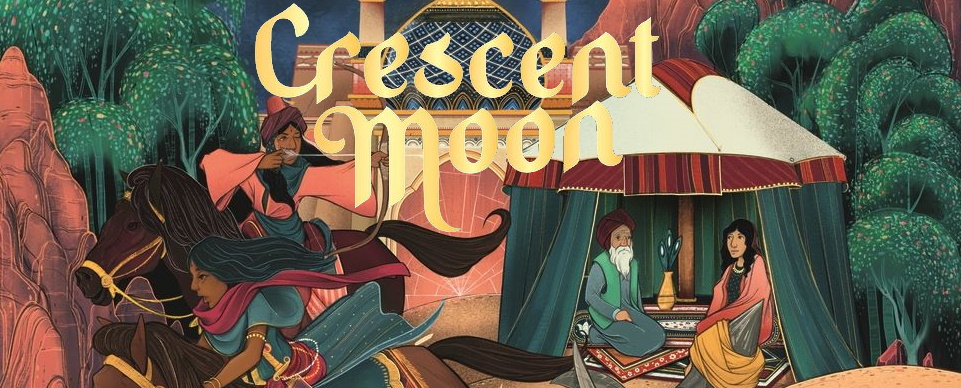
There’s an undeniable beauty to script that has yet to be deciphered. I recall watching a street artist pen words in soaring Arabic calligraphy. As a child whose English cursive looked orcish, the artist’s handiwork seemed indistinguishable from magic. The words themselves could have been anything. Whatever they were, they were elevated by the form itself, transferred from paper to some glimpse of a divine image.
Every so often, a board game prompts a similar feeling. Colored inks on shaped cardboard, painted wood in various sizes and arrangements, cards laden with unfamiliar symbols, their combinations speaking to some deeper understanding into which we have yet to be initiated. Crescent Moon, the recent design by Steven Mathers, draws on lush illustrations by Navid Rahman to evoke a world apart. I think I’ve finally decoded its meaning.
Space-Cast! #20. The Acts of the Interviewees

Come to hear about Jeff Warrender’s The Acts of the Evangelists, stay for the rambling discussion about New Testament scholarship. Or don’t. Stay away, all ye who fear extended chats about religion, independent publication, and games as devotion.
Listen over here or download here. Timestamps can be found after the jump.
City of Something, All Right

With Detective: City of Angels, Evan Derrick wants so badly to channel L.A. Confidential. Book or film, take your pick. The same goes for Chinatown and The Big Sleep. Anything noir, really. I’m not sure what else he could have done to say so. Stash a pack of unfiltered cigarettes beneath the box insert? Bribe your dame to go full femme fatale? Call the game master a Chisel? Oh wait, he did that one.
As with any setting as starkly drawn as the hardboiled genre, City of Angels runs the risk of slipping across the line from pastiche to parody. By now, the tropes have calcified into the bones of American fiction. So thorough is their digestion that certain notes are America. What does Derrick do with those bones?
He makes one heck of a detective game.
Talking About Games: Excavating Memory

There’s a phrase we use in English, one meant to strike upon its hearer the importance of a topic or the need to keep an atrocity close at heart for fear of its repetition. You’ve heard it before, cast in somber and memorializing tones: “Lest we forget.” The irony, of course, is that we’re a fastidiously forgetful species. We forget things all the time. As a defense mechanism, forgetfulness is unrivaled. In the rare occasion that we don’t forget, we do our damnedest to afflict ourselves with collective amnesia. Lest we recall.
John Clowdus’s history trilogy plays like variations on a theme. Its three titles, Neolithic, Bronze Age, and The Middle Ages, are mechanically similar. They’re all about excavating cards from a deck and then using those cards to build toward a brighter future.
They also express something deeper: cultural memory, in all its complexity and simplicity.
Streets Behind

When I contemplate Haakon Gaarder’s Villagers, its defining characteristic is its “light touch,” a careful avoidance of going too far with its complexity or authorial intrusion. Instead, it employs sparing strokes: a few abilities, sparse rules, a shared social space that made immediate sense to everyone involved.
Streets is a follow-up to Villagers in more ways than one. And it could have used a heavier touch.
“Republic, Socialism, Humanism”

The story of the Spanish Maquis is a long one, laden with setbacks, betrayals, and defeats. First formed as a guerrilla force in the waning years of the Spanish Second Republic’s fight against the junta that propelled Francisco Franco to power, the resistance was soon displaced to France. There they spent time in Vichy concentration camps, fought alongside the French Resistance, and eventually returned to their homeland only to be abandoned yet again when the Allies declined to finish the job of rooting out fascism. The Maquis continued to wage a losing war for years to come, buoyed only, as cartoonist and onetime soldier Josep Bartolí i Guiu put it, the possibility of “Republic, socialism, humanism.”
Resist!, co-designed by David Thompson, Trevor Benjamin, and Roger Tankersley, is a solitaire game about the brave men and women who strove to retake Spain. I’m tempted to declare it the best portrayal of a resistance movement ever put to cardboard. Here’s why.
It Takes a Village(rs)

One of the joys of board games is watching how the same system can be used in radically different ways, and in the process produce entirely different moods. Take Haakon Gaarder’s Villagers as a prime example. I’ve played more drafting and tableau-building games than I’d dare guess at, but none of them felt quite like this.
Foucault in the Woodland, Part Four: DTR or DTF?

May I never repeat the awkwardness of my first DTR.
DTR. “Define the Relationship.” My friends, most of whom were older and more experienced, spoke the acronym in ominous tones. It was an essential step of middle school dating, as serious as your first hand-holding or first footsies or first furtive kiss. To a ninth-grader, it was the equivalent of proposing marriage without knowing the answer beforehand. We’d gone on a few dates. School dances. Group hikes. Now we crouched together in a treehouse (oh no), as good a time as any to pop the question: “Are you my girlfriend?”
Over the past three parts of this series, we’ve examined how Root reflects a Foucauldian understanding of power and politics. Today, we’re looking at how that extends into the realm of sex and relationships — and how governments transform sexuality into an extended DTR that will not end no matter how vigorously we try to flee the treehouse.
That Time I Spoiled That Time You Killed Me
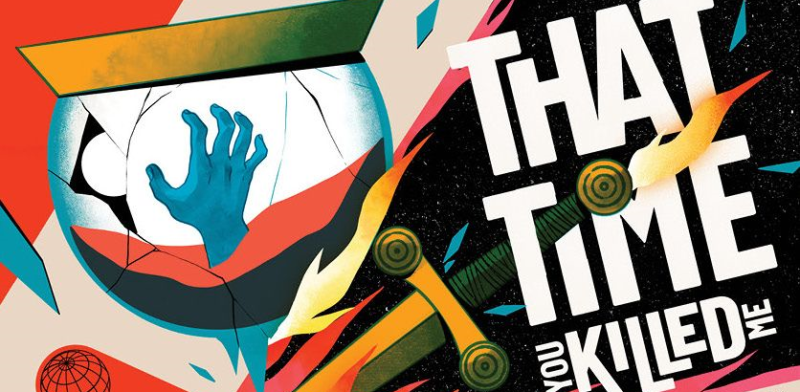
Time travel is like paprika. There’s a huge difference between a little and a lot. And I say that as a time travel apologist.
Peter C. Hayward’s That Time You Killed Me is all about time travel. If we stretch our metaphor to the breaking point, it’s an entire mountain range of paprika. Fortunately, Hayward has the good sense to dole it out in pinches and scoops rather than shovelfuls. And there’s really no way to talk about it without some minor spoilers.
Touch the Cloth!

As any would-be casino thief can tell you, there are ideas and then there are executions. Hit the Silk!, from the same publisher that brought us Stop the Train!, opens with a sterling idea. Desperate to pay off a major debt, you and a few friends have decided to rob a MONEY PLANE. The heist goes about as well as any MONEY PLANE heist can go, which is to say the engines have been shot out, the pilot is dead, there are bags of money bouncing through the air like startled chickens, and there aren’t enough parachutes for everybody.
And then there’s the execution.

 SPACE-BIFF!