The Space-Biff! Space-Cast! Episode #4: Copycats of Catan

For the first time ever, Dan Thurot is joined by Rob Cramer and special guest Mark Henderson in order to shilly-shally about board game rip-offs, homages, and copycats. Highlight of the week: Settlers of Zarahemla, everyone’s favorite Mormon-themed Catanalike. And at 29:21, join the cast for the inaugural round of the Space-Biff! Space-Cast! Space-Guess!
Be a Dog, Be a Bast

One of the things I most appreciate about Alf Seegert’s work — at least across the slight handful of his games I’ve played — is how he takes very relatable and approachable concepts and transforms them into something more. Take Dingo’s Dreams, for example. It’s bingo, the very same one your grandma plays for day-glo pens with puffy feathers sticking out the end, yet in Seegert’s hands it becomes one of the breeziest light titles of the year. Or Fantastiqa, a deck-building game that embraces its whimsical side with such abandon that it’s hard not to like it.
Heir to the Pharaoh is Doc Seegert’s latest game, and also his greatest by a significant margin. So let’s talk.
Dive, Evade, Scrawl, Erase

There’s something special about real-time games. Whether it’s the team-on-team action of Space Cadets: Dice Duel, the brisk cooperation of Meteor or FUSE, or the nigh-impossible machinations of current reigning champion Space Alert, nothing gets the heart drumming like a game where minutes count. Where seconds count. Stripped out is the freedom to analyze or negotiate or stall. Gone is the mathy higher brain function that dominates so many games. All that remains is panic and reflex.
Captain Sonar grasps what makes real-time games such a thrill. And, calling it right now, it’s not only one of the best real-time games ever made, it’s also one of the best games. Full stop.
Not Exactly an Al Swearengen Simulator

For those of us who fit into the Venn diagram encompassing both those who love board games and those who love Deadwood, Saloon Tycoon seems like a no-brainer. Not only could we get up to our elbows in all the brutality, back-stabbing, and profiteering that goes with the territory, it would also go a long way towards legitimizing our extensive Al Swearengen vocabulary. Ya hoopleheads.
Unfortunately, while I wrote earlier this week about a Kickstarter title that could have used some more publisher oversight but still turned out okay in the end, Saloon Tycoon provides the opposite example. As in, this particular batch of cornbread needed a few more minutes on the stove.
Elsewhere: COIN Frontiers

“Where have you been for the last couple weeks?” you’ve undoubtedly been asking. Wedding, wedding, new baby (not mine), work, school, wedding. That’s where.
Oh, and I’ve also had a few articles published over at Miniature Market’s Review Corner. First up, Michael Barnes and I debated the merits of Cuba Libre as an entry point into the excellent COIN Series, followed by a discussion about our reservations about Falling Sky: The Gallic Revolt Against Caesar, and why despite those reservations it has become my favorite volume of the series. Meanwhile, I also reviewed Star Trek: Frontiers. Long story short, it’s Mage Knight in outer space with an extra dose of talking. “Darmok and Jalad at Tanagra,” indeed.
Networkcrawler

Everything I know about running a broadcast television network I pretty much learned from broadcast television. Which is great! Who better to learn from than the creators of content themselves, after all. Thus, I went into The Networks expecting to totally 30 Rock it.
We’ll All Float On Okay

If I were forced to identify the unifying “aesthetic” of a Ryan Laukat game — and avoided using actual, you know, aesthetics, the bold colors and whimsical fantasy creations that populate his worlds — it would be that the creator of Red Raven Games has carved a niche out for himself by making games that seem a lot like other games, but look and play almost nothing like anything else. City of Iron announces itself as a cube-pusher and deck-builder, then merges those systems in a way that’s reminiscent of precisely nothing. Eight-Minute Empire is a study in minimalism that avoids feeling restrictive. Even Laukat’s forays into worker placement, The Ancient World and Above and Below — which itself echoes older storytelling games like Tales of the Arabian Nights — step to the beat of their own drummer. It’s almost as though Laukat knows these systems exist, but has only read about them in old newspaper articles or printed-out scraps of blog posts that happened to wash up on his desert island.
And to be clear, that’s a good thing. It’s what makes something like Islebound work so well.
Man-Made Climate

Evolution has always been a game of counting calories, though in a different sense than most of us are accustomed to. It’s anything goes all the time, with everyone consuming every last leaf, berry, and scrap of meat they can clamp their jaws around. I’ve both written and spoken about my love for Evolution in the past, but now it’s time to explain why Climate is the pinnacle of the series thus far.
The Space-Biff! Space-Cast! Episode #3: Always Evolving
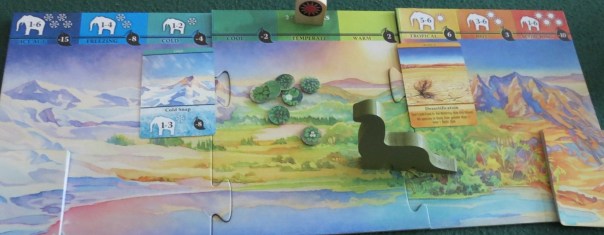
In today’s plus-special episode of the Space-Biff! Space-Cast!, Dan Thurot and Rob Cramer interview Dominic Crapuchettes, designer of Evolution and founder of North Star Games, about how everything is evolving — and we mean everything. Even evolution is evolving.
Vale of Transparency

The land is rotten: the grass brown and brittle, the trees bare and splintered, the fields less fertile than ever before. Unseemly dog-swirls mar the once-spotless walking paths. As one of the druid clans of the Valley of Life, it is your duty to cleanse the land by—
—building decks and playing blackjack, mostly. Sort of. Mostly.

 SPACE-BIFF!