Category Archives: Board Game
Lords of Underdeep

Lords of Waterdeep was pretty great, wasn’t it? Designed from the ground up to hit that sweet spot that would appeal to both newcomers to the worker placement genre and cardboard veterans alike, it saw widespread success for good reason. Anyone who said they didn’t like it was almost assuredly a walking diaper. A used walking diaper.
Tyrants of the Underdark is looking to replicate that success. It’s even set in the same place, at least broadly — Skullport, the shady locale from the Lords of Waterdeep expansion, registers as a tiny blip in Underdark’s sprawling, uh, Underdark. This time, however, the target is deck-building games. And not just any deck-building game, but the chimera sort that splits your time between shuffling your cards and waging war on a map.
Star Trek Done Right

Fifty years ago today — that’s either August 8th, 1966 or stardate 1513.1, depending on how much of a nerd you are — marks the first appearance of the USS Enterprise, as Kirk, Bones, Spock and the rest of the crew grappled with a mystery of hidden identity, a long-dead civilization, and a salt vampire. It was the moment that kicked off the series that would flop, get cancelled, become a hit, and spawn a thousand new episodes, movies, books, games, and imitators.
The difficulty with adapting Star Trek to cardboard has always been that there are nearly as many ideas and topics that encompass the notion of “Star Trek” as there are episodes — that’s 726 across six television series, to be precise. Is it about exploration? Ethics? War? The power of communication? Teamwork? The answer to all of these is, at turns, yes. And many more besides. How do you capture the essence of something that has ambitions on nearly everything?
Star Trek: Ascendancy, however, has not been designed by any old two-bit studio. This is coming from Gale Force Nine, the same people who captured the treachery and violence of Spartacus, the paranoia of Homeland, the tough-guy act of Sons of Anarchy, and the meandering twang of Firefly. And now they’ve done it again. By Grabthar’s Hammer, they’ve done it again.
Dirty Little Shitler

I enjoy plenty of social deduction games. Mafia de Cuba. Spyfall. A Fake Artist Goes to New York. Deception: Murder in Hong Kong. Dark Moon. Homeland. So why is it that the genre has always sounded like a swear word to me?
When I really put my mind to it, the essence of my beef is that I simply don’t enjoy any entries into the genre that feel scripted, where a person’s role or ability informs nearly all of their behavior. I’m talking about stuff like The Resistance: Avalon or One Night Ultimate Werewolf, where everyone else works out these logical identity puzzles while I sit there counting the minutes. The first time is thrilling, but the tenth? Boring. Programmatic, even. Invariably, it feels like we’re just going through the motions as our assigned characters.
Secret Hitler feels a whole lot like Avalon, and yet it sidesteps this issue completely. Let’s look at how.
Salvation: Worth It?

Comparisons can be a tough thing for a board game to weather. Is it fair to compare any particular game to another, especially since people might not have played whatever’s being used as the point of reference? Or would it be unfair to not draw comparisons, failing to trust your audience to understand what you’re talking about and letting them make up their own dang minds?
Take Salvation Road, for instance. It’s easy to compare it to Dead of Winter. They’re both games about scavenging in a post-apocalyptic landscape. They’re both about survival. They both feature a diverse and randomized cast of characters, some better suited to their task than others. Most importantly, despite a pretty lengthy list of differences, they both feel extremely similar.
A Vast Vast Review

The prospect of asymmetry in board games has always been a tricky one, promising great variety and depth while also threatening to overwhelm its participants with — and I believe this is the scientific term — a metric butt-ton of rules. Unlike digital games, which might handle calculations behind the scenes or offer helpful tips whenever you get stuck, in the analog world of board games every single rule must be relayed, parsed, and understood between all players at all times. Or at least most of the time.
Not only is Vast: The Crystal Caverns by Leder Games not an exception to this rule, it’s pretty much the definition. But does that do it a disservice or make it one of the richest games to appear on our table this year? Read on to find out.
The Space-Biff! Space-Cast! Episode #4: Copycats of Catan

For the first time ever, Dan Thurot is joined by Rob Cramer and special guest Mark Henderson in order to shilly-shally about board game rip-offs, homages, and copycats. Highlight of the week: Settlers of Zarahemla, everyone’s favorite Mormon-themed Catanalike. And at 29:21, join the cast for the inaugural round of the Space-Biff! Space-Cast! Space-Guess!
Be a Dog, Be a Bast

One of the things I most appreciate about Alf Seegert’s work — at least across the slight handful of his games I’ve played — is how he takes very relatable and approachable concepts and transforms them into something more. Take Dingo’s Dreams, for example. It’s bingo, the very same one your grandma plays for day-glo pens with puffy feathers sticking out the end, yet in Seegert’s hands it becomes one of the breeziest light titles of the year. Or Fantastiqa, a deck-building game that embraces its whimsical side with such abandon that it’s hard not to like it.
Heir to the Pharaoh is Doc Seegert’s latest game, and also his greatest by a significant margin. So let’s talk.
Dive, Evade, Scrawl, Erase

There’s something special about real-time games. Whether it’s the team-on-team action of Space Cadets: Dice Duel, the brisk cooperation of Meteor or FUSE, or the nigh-impossible machinations of current reigning champion Space Alert, nothing gets the heart drumming like a game where minutes count. Where seconds count. Stripped out is the freedom to analyze or negotiate or stall. Gone is the mathy higher brain function that dominates so many games. All that remains is panic and reflex.
Captain Sonar grasps what makes real-time games such a thrill. And, calling it right now, it’s not only one of the best real-time games ever made, it’s also one of the best games. Full stop.
Not Exactly an Al Swearengen Simulator

For those of us who fit into the Venn diagram encompassing both those who love board games and those who love Deadwood, Saloon Tycoon seems like a no-brainer. Not only could we get up to our elbows in all the brutality, back-stabbing, and profiteering that goes with the territory, it would also go a long way towards legitimizing our extensive Al Swearengen vocabulary. Ya hoopleheads.
Unfortunately, while I wrote earlier this week about a Kickstarter title that could have used some more publisher oversight but still turned out okay in the end, Saloon Tycoon provides the opposite example. As in, this particular batch of cornbread needed a few more minutes on the stove.
Elsewhere: COIN Frontiers
“Where have you been for the last couple weeks?” you’ve undoubtedly been asking. Wedding, wedding, new baby (not mine), work, school, wedding. That’s where.
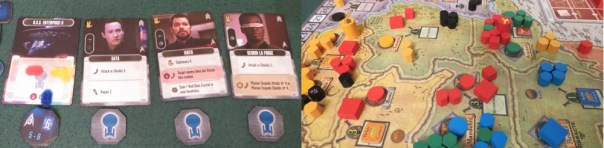
Oh, and I’ve also had a few articles published over at Miniature Market’s Review Corner. First up, Michael Barnes and I debated the merits of Cuba Libre as an entry point into the excellent COIN Series, followed by a discussion about our reservations about Falling Sky: The Gallic Revolt Against Caesar, and why despite those reservations it has become my favorite volume of the series. Meanwhile, I also reviewed Star Trek: Frontiers. Long story short, it’s Mage Knight in outer space with an extra dose of talking. “Darmok and Jalad at Tanagra,” indeed.

 SPACE-BIFF!