Pinnacle, Apex, Apogee, Meridian
Zenith isn’t an easy game to classify. Part set collection, part lane-battler, even part paxgame, it’s full of tight contests and nasty tug-of-wars. (Tugs-of-war?) Really, though, it’s more than the sum of its parts, a strange but wonderful artifact by Grégory Grard and Mathieu Roussel that doesn’t play quite like anything else.
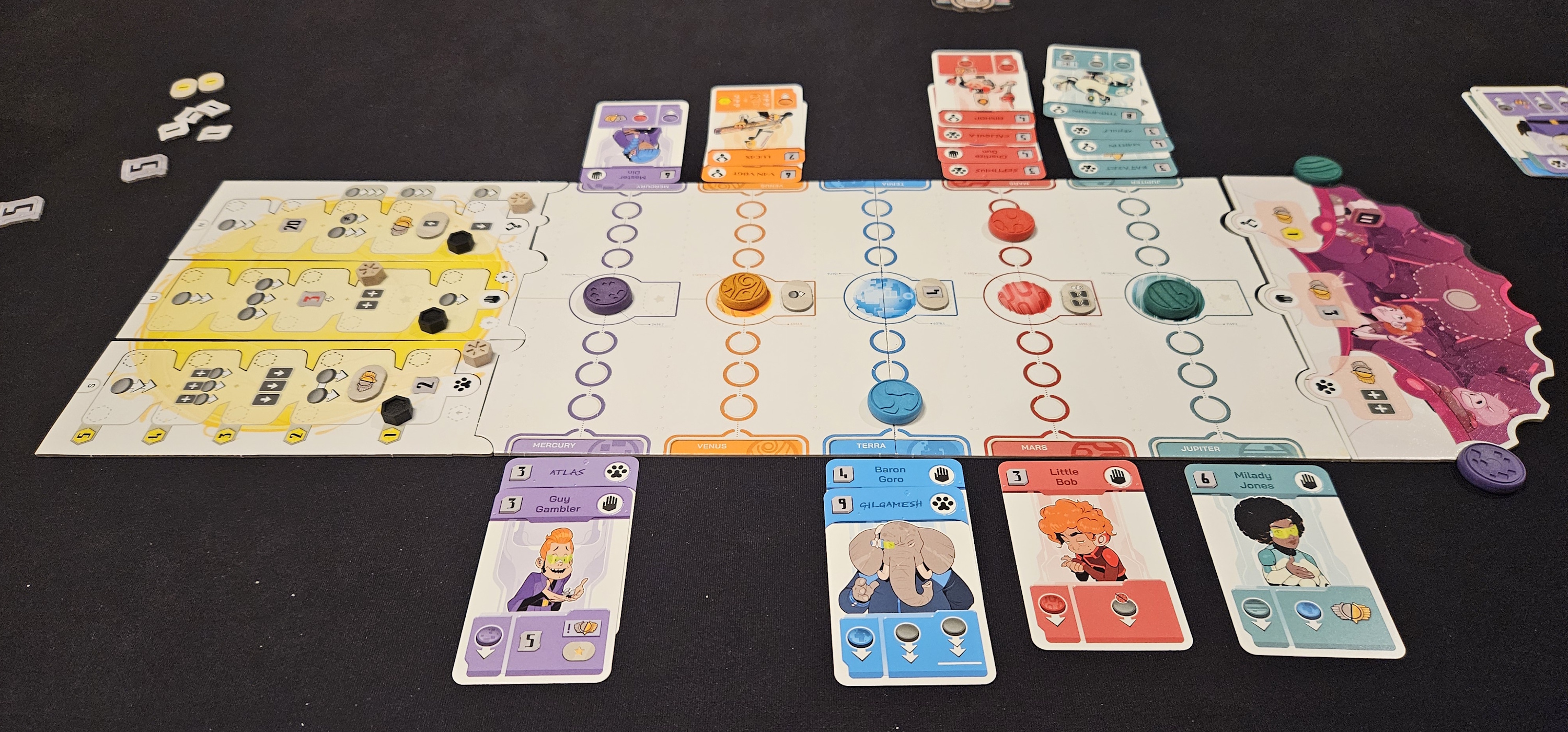
The presence of lanes does not imply a lane-battler. But this might be a lane-battler.
Let me introduce you to the solar system. In the far future, humankind has spread into its… well, not its farthest reaches, but pretty far. All of the inner planets are settled, and Jupiter as well. I would’ve thought we’d beeline to Saturn’s largest moon for all those juicy hydrocarbons, but hey, clearly this isn’t my roadshow.
For one thing, humanity has split into three distinct species. There are humans (filthy baselines), robots (job-stealing clankers), and animods (uplifted animals, the cool kids of the bunch). Furthermore, those three types are spread across five color-coded factions that correspond to the settled planets.
Both type and color matter. Type, because humans, robots, and animals can be spent for different bonuses, and color because while this duel is a knock-down drag-out affair, nobody is willing to leave their favored planet.
Every turn sees you spending a card. Usually one, sometimes more, but never zero. That card can be used in three ways. One, it can be recruited to its home planet as an agent. This is the most common action by far, and it’s one we’ll return to momentarily. Two, it can be discarded to gain a small bonus — some credits, some zenithium (this universe’s unobtainium), or a couple of freebie cards. Three, it can tick your faction along one of three tech trees. Yes, there’s one for animods, one for humans, one for you get the gist.
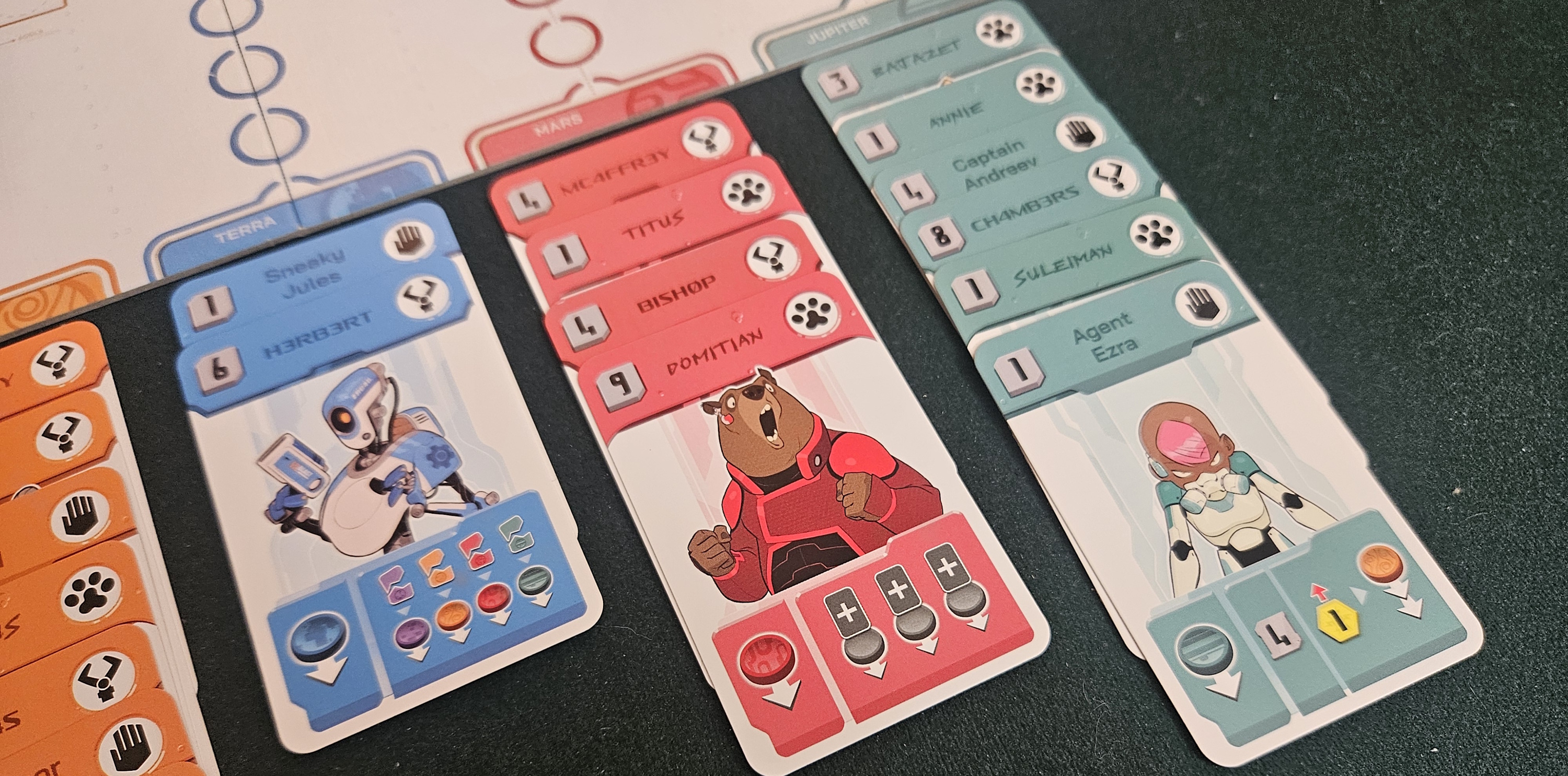
Cards become cheaper thanks to the presence of other cards.
Each of these possibilities is considerably more interesting than they initially sound.
Take, for example, those tech trees. Early on, the perks offered here are fairly minor. Two credits for animod research? That’s downright unethical! But each step along a tech tree awards not only its current bonus, but every single bonus you’ve already gained. The second level, then, influences two planets and gives you that pair of credits. Level three does the same, plus steals a trio of cards. Level four does everything plus shifts even more planets. Benefits scale in such a way that those meager early offerings suddenly look like smart investments.
Or there’s the whole “discard a card for some resources” option. This is the dump action, right? What you do when you don’t have anything better going? And, sure, it is that. But it’s also a chance to claim the badge. And the badge is a big deal because it’s the one thing in the game that will increase your hand size. Normally, upon completing your turn, you draw to four cards. With the badge, you draw to five. If you claim the badge while already holding the badge, you flip it to its upgraded size. Now you draw to six cards. In a game where mining the shared deck for powerful agents is a significant part of the strategy, that’s a potentially game-swinging advantage. Suddenly, the dump action is considerable. Even necessary.
Then there’s the big one. Playing a card to the main board. This always pulls the corresponding planet toward you, engaging in the tug-of-war that is Zenith’s principal contest. Your overall goal is to secure a certain number of planets. The exact quantity is variable. Three of the same planet, four different planets, or five mixed planets. That’s a win. There’s no escaping the need to play agents to the middle section, then. The more the better.
But even this action is smarter than it first appears. For one thing, cards are expensive. Not all of them, obviously. There are a few that cost only one or two credits. But some cost, say, ten credits. That’s a lot of scratch. But every agent costs one fewer credit for every card already in its planet slot. This means there’s a sharp ramp in what players can afford. Early on, there’s nothing stopping you from playing a powerful card. It’s just that it might wipe out your finances. With a few cards in that slot, however, things get affordable fast. It isn’t long before the big guys come out swinging, and often.
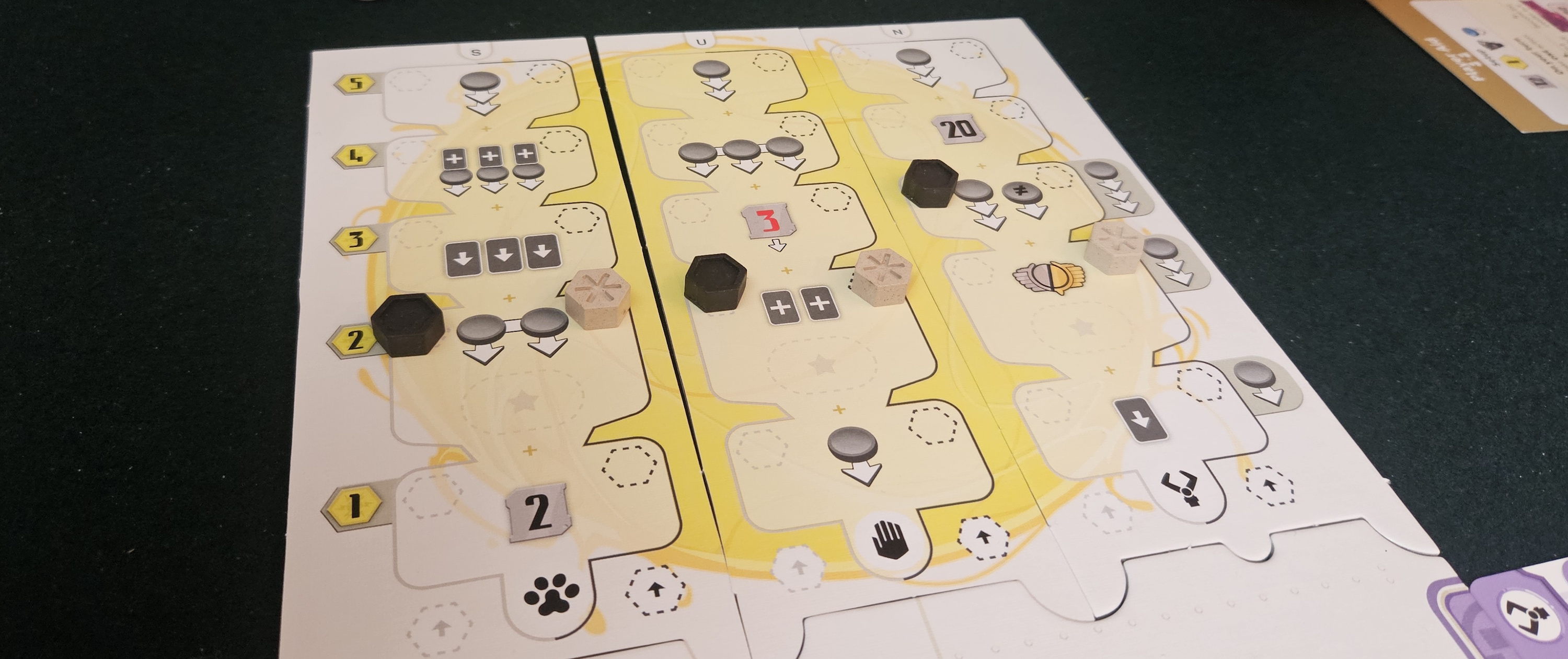
The tech tree is… fine.
The protein in this particular salad is that everything in Zenith is something of a Shepard tone, always ascending, always jangling both players’ nerves. To put it more blandly, this is about as good as multi-use cards get. Even a crummy draw can provide an advantage somewhere, if only because anything can be thrown away for a few resources and access to the game’s principal means of drawing more and better cards.
Its sense of escalation is truly something to behold, especially once the contest really gets going. I mentioned that Zenith bears some resemblance to paxgames, and that’s true whether or not Grard and Roussel have ever played one. That’s entirely thanks to the way cards are allowed to flex their powers. There are some wild abilities hidden in the deck, game-hinging swings and economic powerhouses and free techs and everything else, although the strongest require some preparation before they’re affordable. Not only in terms of cash, though, sure, there’s always cash. But also in the sense that some require you to be holding the badge, or to shift planets according to certain limitations, or yield a crucial resource to your opponent before triggering that card’s most potent ability.
This is what makes Zenith special. Or at least it’s one more brick in the powerhouse of its specialness. As a game, it’s full of genuinely hard decisions. How to spend cards. When to spend them. Where to spend them. Whether to be proactive or reactive. How to best undermine the engine your rival is assembling piston by piston.
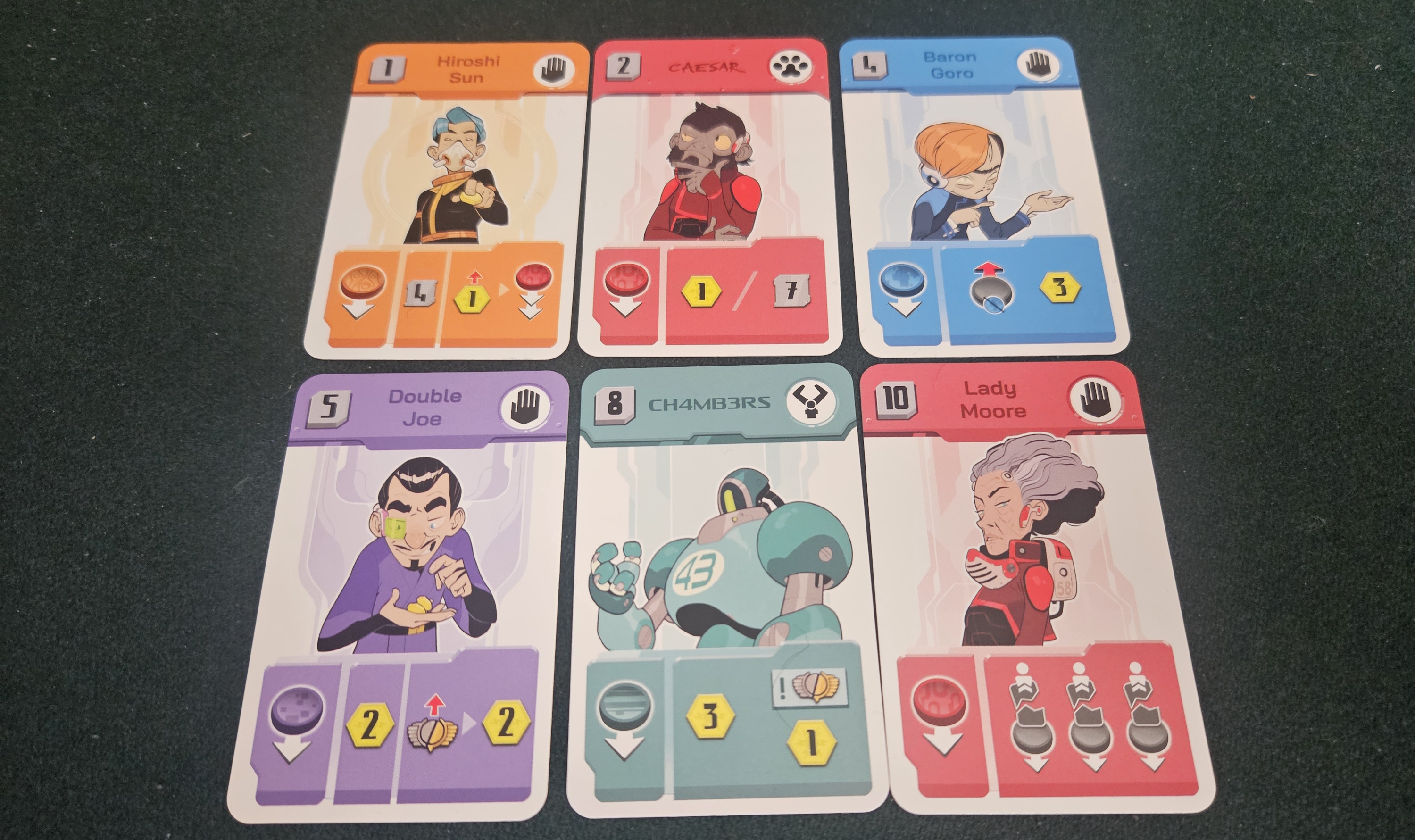
Just a few of the game’s many cards.
If I went dredging for downsides, I suppose I would say that this openness means it’s easy to get lost a bit. More than once, I’ve watched somebody — usually myself — flub a session because they were so focused on getting more resources or moving up the tech tree that they lost sight of the ground war. Similarly, I don’t much care for the tech tree. Its look, more than its actual utility. Zenith is a handsome game, but its appeal lies in its color palette and illustrations rather than its minimalist board, and the three-pronged tech tree, which is pronged for a reason, since you can flip any of its tracks to their opposite side for some variety, still comes across as a bit chintzy.
Really, though, this is about as close to my jam as a game can get without breaking the mold. I’ve always had a preference for “falling with style” games, those that hand me a mismatched bag of tools and then ask me to make do with what I’ve got. Construct a biplane with this old rotor, a busted gas-guzzler from an old Ford, and a hyperbaric chamber? You got it, boss.
Zenith excels in this theater. I’m sure some will consider it an issue. There’s no marketplace. Everything is drawn blindly from the deck. This produces a degree of chanciness that can indeed make or break the game, although there are sufficient mitigating tools that I’d be surprised if that happened more than once in a dozen sessions. There’s always some way to get ahead. Stealing cards from your opponent. Shifting up the tech tree. Crud, just grabbing the badge and drawing more cards is a good choice when falling behind. If Zenith weren’t so tight, I’d venture to call it something of a sandbox game. It isn’t quite that, but it carries similar helices in its genetic code.
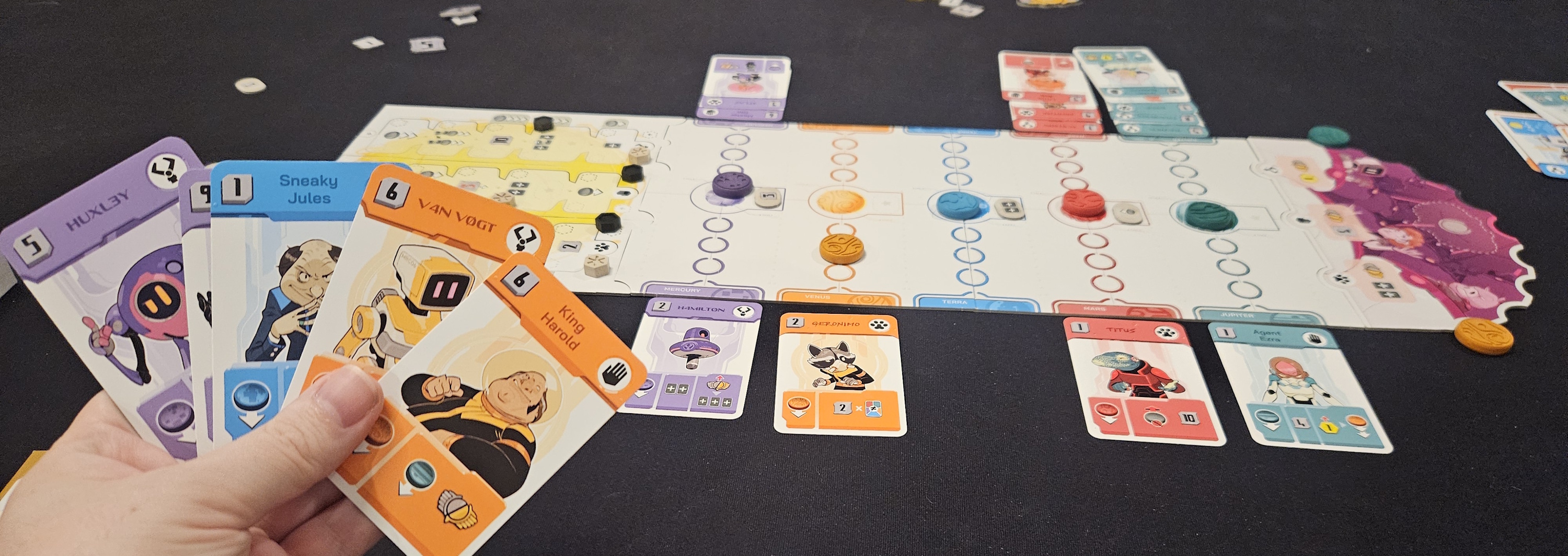
Ah. Lanes. My first love.
Taken as a whole, Zenith feels like a gift from an alternate timeline, one where lane-battlers look very different from ours and multi-use cards are radical innovations rather than perfunctory inclusions. I love this game’s textures, its swings, its vibrant colors, the clarity of its objectives and the ease with which they get lost against the backdrop of the game’s smaller struggles.
Zenith, indeed.
(If what I’m doing at Space-Biff! is valuable to you in some way, please consider dropping by my Patreon campaign or Ko-fi. Right now, supporters can read the next installment in my series Talking About Games, this time tackling the topic of what makes a good list! Naturally, the piece includes a list.)
Posted on June 19, 2026, in Board Game and tagged Board Games, PlayPunk, Zenith. Bookmark the permalink. 13 Comments.


I think you should have mentioned this is a two player game. I didn’t make that assumption until I saw the board and realized there are only two sides and then looked it up. Dividing three and four players onto the two sides doesn’t count as multiplayer because every two player game could then be stretched to say up to four players can play it. Sure, people can share hands in Twilight Struggle so four players can play it, but that’s not what we mean.
Ultimately, when a game is for only two players, I pass.
Speak for yourself. “We” understand that there are plenty of team games out there.
I get that it’s not a 3 player game and it’s crummy that they suggest it as an option.. But only 15% of respondents ‘do not recommend’ the game at 4 players on BGG. Seems like its’ very solid at 4.
My bigger concern is that it doesn’t look like it’s available in the US!
I stand by my original point that a review of a game should disclose if the game’s design is primarily focused on two players. That’s just my opinion. Fine if you don’t care for it.
To be clear, the box itself advertises its play count as 2 or 4. I don’t know who’s responsible for saying 3p is possible on the BGG page.
I could see 1 vs 2 making sense with some houseruling, maybe?
I really like this platform for highlighting games that deserve attention – regardless of our preferred player count. We don’t play many two-player games, but Zenith looks pretty solid.
Zenith is definitely NOT “a 2-player game”. The 4-player team game is as good (if not better, depending on your tastes), as the 2P one. The fact that turns alternate between teams, and not between players, allows for some real shenanigans.
Great review of a great game! Thanks Dan!
This game is so fucking good. Team mode included. I didn’t think it would be from the rules, but it’s a banger. Probably my GOTY for 2025.
my only complaint? I got a bum copy at first with a missing punch board. Oh and some edge cases not succinctly covered in the players aid. Great game!
I have three minor nitpicks, two with the game, one with your post:
And if you do lose it, you spend 1-2 turns not drawing, so the “extra draw” is really more of a temporary benefit – draw 1-2 more cards now, with the understanding it’ll mean drawing 1-2 cards less later – which is the real reason it’s still the “crud” option to grab the badge. It’s giving away tempo for temporarily having more options.
Small correction – page 1 has the win-conditions. I just skipped once I saw the lore segment. Page 9 having just the short notation is still perplexing.