Colossissippi
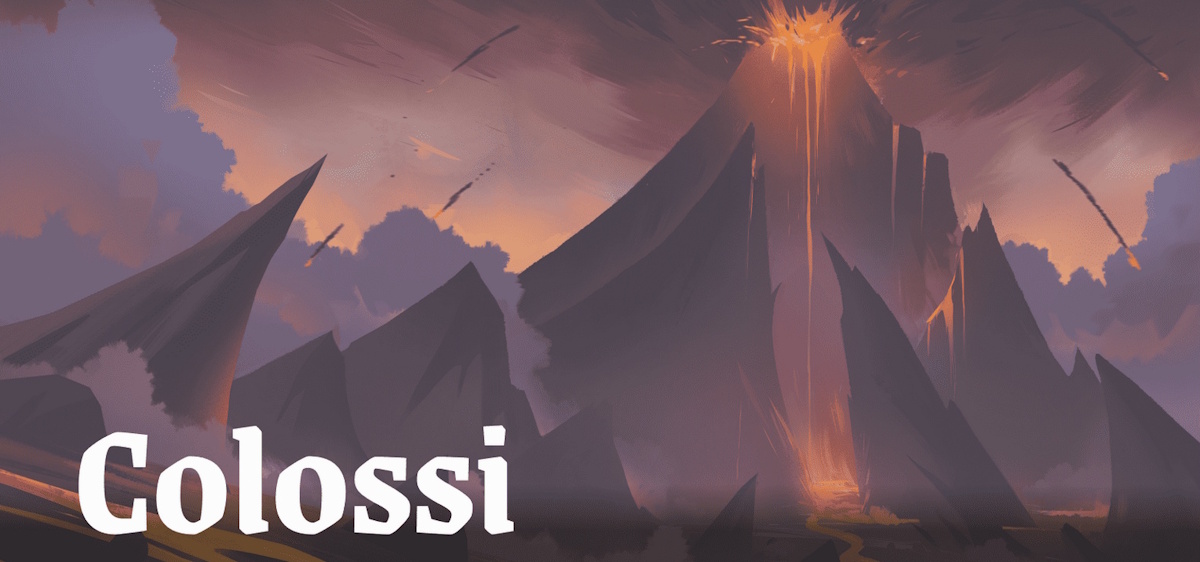
Despite being the creation of John Rudolph Drexler, Colossi reminds me of an early John Clowdus design. At really every point, come to think of it. There’s the shape of the thing: a lane-battler packed with powerful abilities that constantly reform its contests into new shapes. Or its illustrations, here produced by Sean Thurlow, but not all that distant from the brushstrokes that fill Omen: A Reign of War. The form factor is also approximate; the box isn’t tiny, but it isn’t much larger than Omen’s second edition. Even the game’s willingness to surprise feels redolent of one of our hobby’s under-celebrated innovators.
If I wasn’t sufficiently clear, this should be taken as an enormous compliment. Colossi has a few shortcomings — another parallel with certain Clowdus titles — but it’s such a gust of fresh air that I dearly hope Drexler has a few more in the chamber.
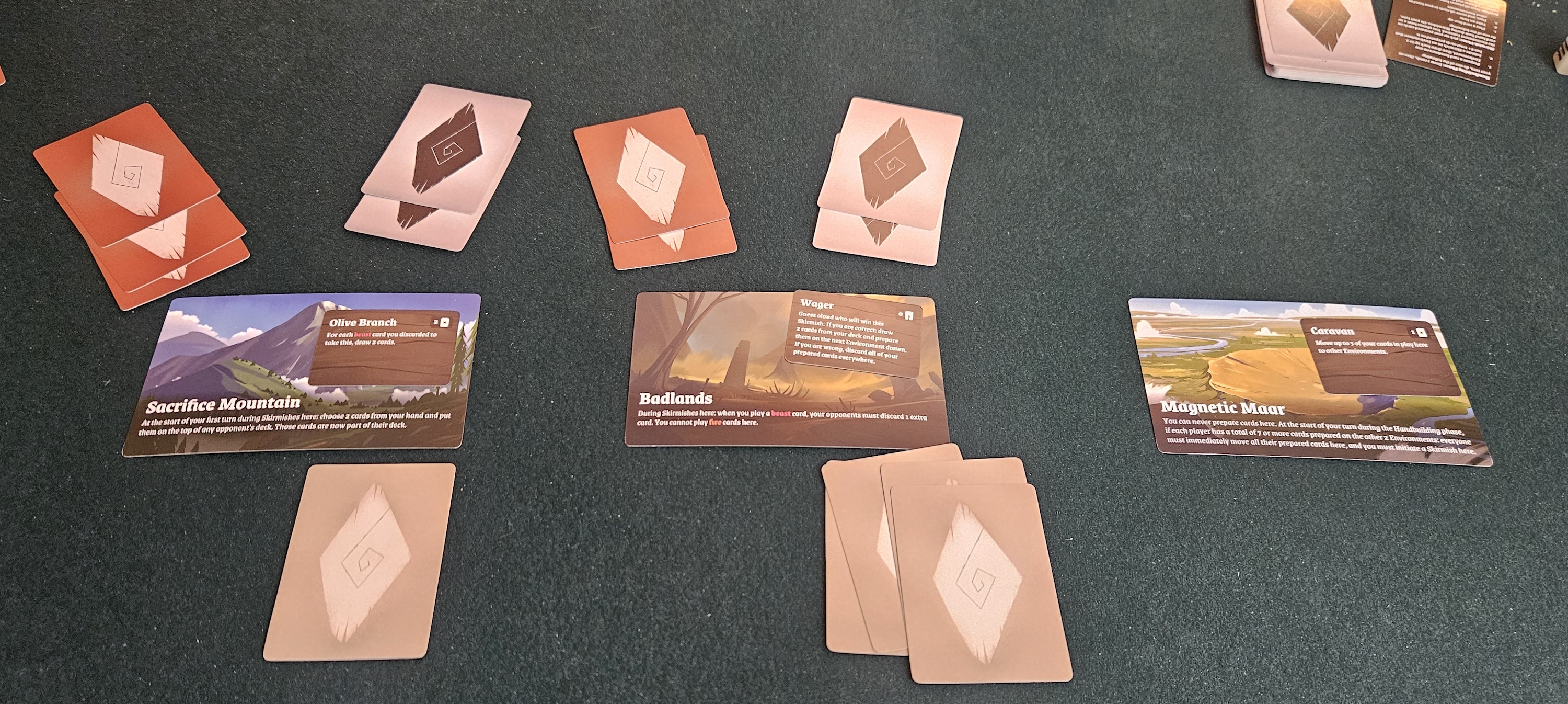
Three lanes.
As mentioned, Colossi is a lane-battler. Through blurred eyes, it might even seem overly familiar. Players are presented with three lanes at any given time, each host to an existential battle. Yawn, am I right?
Except it takes all of five seconds before Colossi drops its own beat. The first riff is that it handles up to four players, and every count is as smooth as the others. The second is that each lane is strikingly different from those to its right or left. This is thanks to the way Drexler builds out each one via a combination of an environment and up to three items.
The former, environments, are the game’s main objective. Win three of them and you’re declared the victor. In addition to that, each one is entirely unique. Some are simple enough, like the Desert, which prohibits water cards from being played into its lane. Others are more transformative, like the Impulse Isle, which turns the usual phased play — one card per player at a time, around and around until everybody passes — into massive plays that have each player deploy every card and ability at once before passing to their neighbor. Or the Chaos Fissure, where everybody is required to prepare an equal number of cards, shuffle them together, and then deal them at random to all participants. Or the Magnetic Maar, a zone where preparing cards is strictly forbidden, forcing players to get creative in order to secure it.
Those last two environments won’t make sense without some explanation. Cardplay in Colossi is broken into two separate but interconnected phases. First, players prepare cards by seeding them face-down into those three lanes. Once an environment meets a threshold of cards, somebody is allowed to trigger a battle there. The game then shifts into its second phase. Everybody adds the cards they’ve prepped in that lane to their hand and then duke it out for control of that single environment. Once that battle is dusted, a new environment is added to the gap and the game returns to the preparation phase.
Back and forth it goes. Preparation, preparation, preparation, preparation, HUGE BATTLE, preparation, preparation, HUGE BATTLE, preparation, preparation…
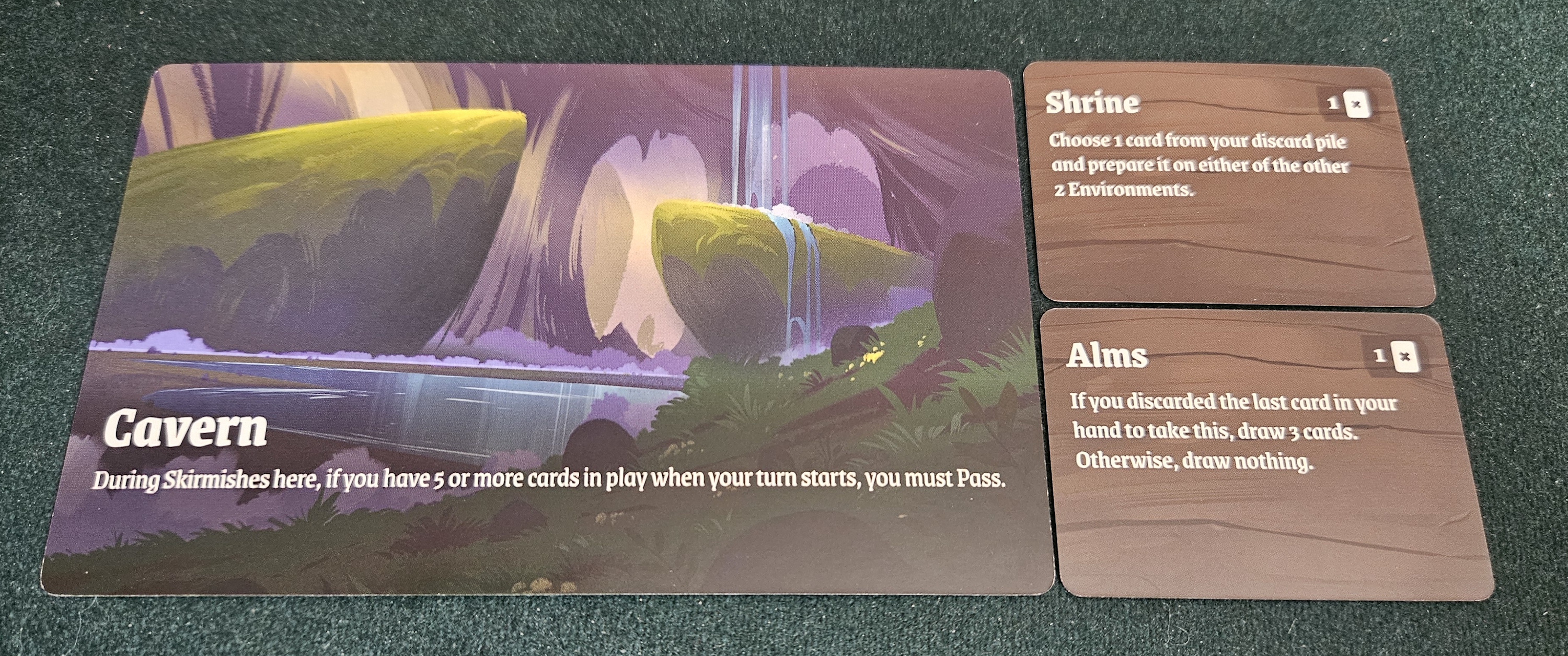
Each lane features both an environment and one to three items.
Along the way, Drexler shows off a number of small touches that elevate Colossi from a good idea to an impressive execution. I mentioned items. Each environment hosts one to three of the things, depending on how far the game has progressed. Rather than deploying a card into a battle, you’re allowed to discard something from your hand to claim these babies. Like the larger environments, they’re transformative in their own right, adding perks or adjusting the parameters of the current fight.
Of course, none of this would spark to life without the right selection of powers. Here Colossi flexes a more familiar muscle to fans of the genre, starting everyone off with an identical deck of twenty-four cards that deforms as the session progresses. First-timers may find the selection intimidating at first, especially since the myriad types cancel or boost one another like a seven-pronged Roshambo. Divine Gifts add more cards to your hand. Electricity makes Divine Gifts more expensive to play and is empowered by Water. Fire is powerful and blocks Beasts, but gets nerfed by Water. Beasts mess with rival hands, while Colossi do… all sorts of things. Acolytes grow stronger in bulk.
Your cards, meanwhile, aren’t necessarily going to stay your cards for very long. One of the Colossi, the Curse, wanders over to the opposing side of battle to decrease their strength. Then, like a kid deciding it prefers its neighbor’s house, it sticks around afterward, filling up their deck with a card they probably don’t want. One of the Beasts abducts a rival card into your deck, potentially stealing their best cards outright.
Over the course of a half-dozen or so battles, this gives each deck its own topography. One player becomes weak with Fire, and therefore vulnerable to Beasts, but finds a way to use their multiple Colossi to swing fights their way. Another gains so many Acolytes that their hand becomes a cultist’s paradise, winning through sheer manpower. A third starts lighting everything on Fire and hoping nobody has the necessary bulk of Water cards to douse the flames.
The result is as subtle as it is brash, especially once the table remembers that the battles are just, well, battles. The bigger picture, the war, is what matters here. It’s easy to lose sight of that, especially in the midst of a drawn-out fight. Often, it’s smarter to bait an opponent into using too many cards, then withdraw to other environments for a jump start on the fight that will soon engulf them as well. But why play it smart when you have a one-in-ten chance to draw exactly the card you need in order to swing this thing?
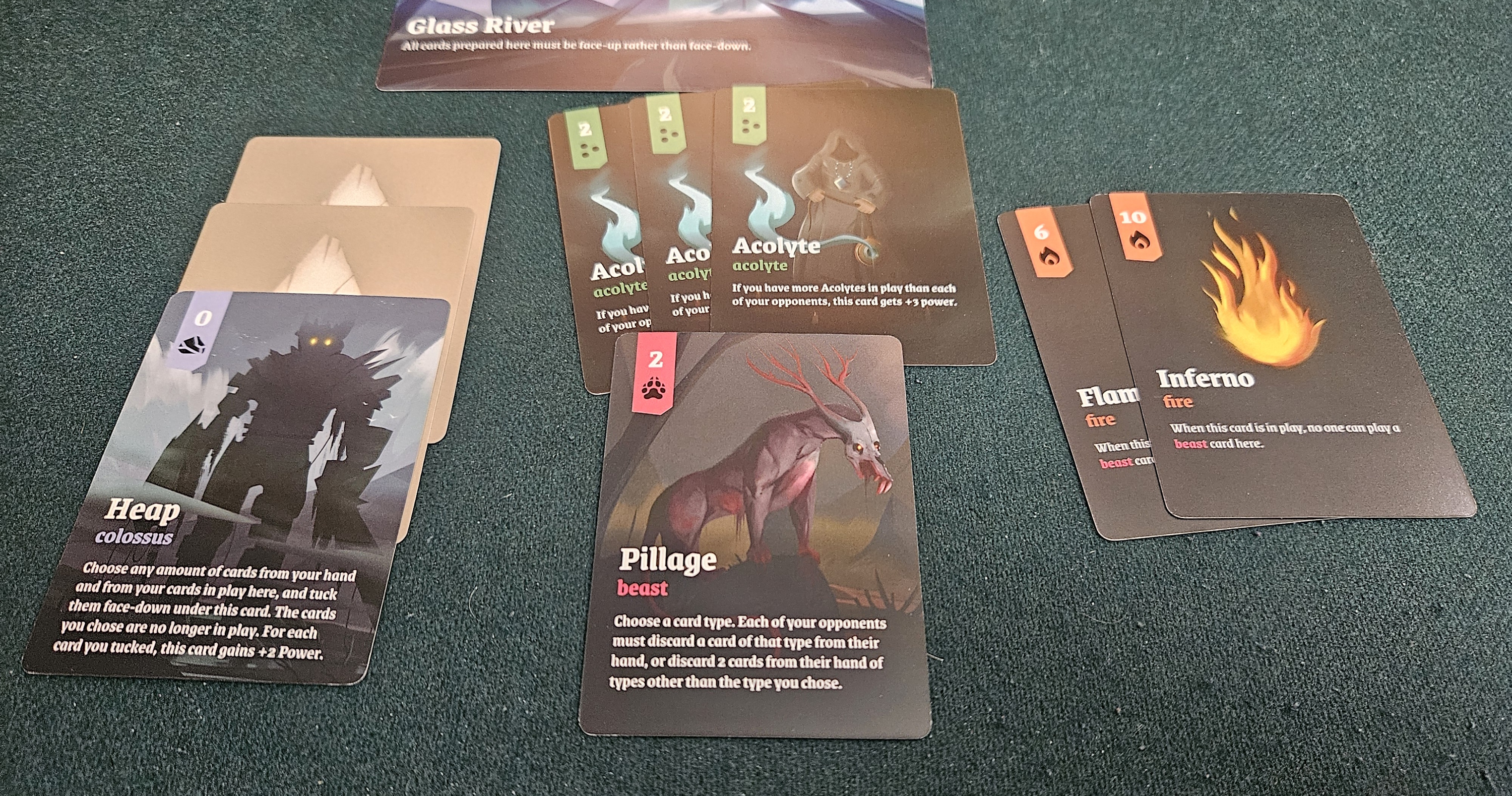
Battles can turn into real pile-ups.
Sure, I have quibbles. Some battles get too summy for their own good, especially once Water starts fudging the value of Fire and Electricity. Certain environments have obnoxious or burdensome effects. Similarly, some of the powers are touch-and-go, especially those that allow someone to draw extra cards in the middle of a fight. Then again, the little imbalances between suits are also what make the game formidable. When somebody drops their Inferno card, everybody notices.
On the whole, Colossi is a superb debut. It’s hard-hitting, vicious, subtle, and so much cleverer than it seems at first glance. More than that, it produces a heretofore unseen take on the lane-battler, one that goes beyond the usual trappings to prove itself a new creature indeed. No — a new colossus.
A complimentary copy of Colossi was provided by the designer/publisher.
(If what I’m doing at Space-Biff! is valuable to you in some way, please consider dropping by my Patreon campaign or Ko-fi. Right now, supporters can read my first-quarter update of 2026: the best board games, movies, books, and more!)
Posted on June 4, 2026, in Board Game and tagged Board Games, Catacombian, Colossi. Bookmark the permalink. 2 Comments.


Well, you had me at “reminds me of an early John Clowdus design” – I guess I gotta track this down…
It doesn’t seem too hard! You can find it over on their site: https://catacombian.com/colossi