Not Your Daddy’s Blackbeard

I no longer think of Volko Ruhnke as a man, but as a machine purpose-built for stamping out novel conflict simulations. COIN, Levy & Campaign, that older one where the terrorists have the efficacy of ’90s movie baddies, and now Hunt for Blackbeard, an unexpected romp that’s as much about setting the record straight as it is about blasting pirates with grapeshot. I now know more about Blackbeard than at any point in my life. Which is to say, I know a lot less, given the man’s outsized legend.
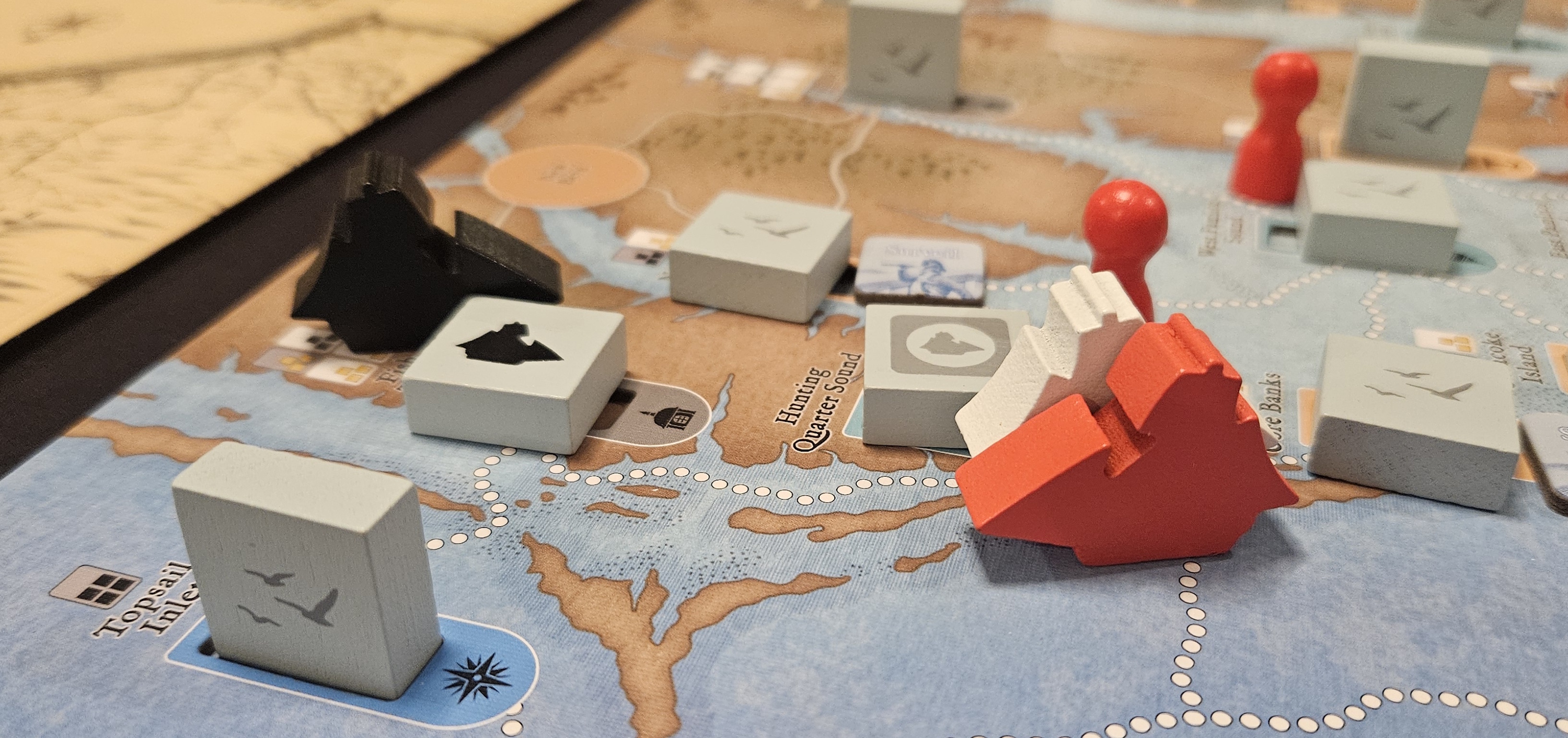
Afore ye vast, starboard lubbers!
Almost everything we know about Blackbeard is wrong, or at least embellished from later sources seeking to cash in on the pirate’s notoriety. That he learned his trade under the legendary Captain Hornigold — unconfirmed. That he braided his hair with smoking fuses — not exactly the sort of fire hazard a man who worked with gunpowder would accept. That he murdered a swath across three seas — well, there was some murder, that’s true. But not as much as previously reported. Not when a pirate’s work required most crews to throw down their arms.
If anything, the Edward Thatch we come to know in Hunt for Blackbeard is something of a sad sack, at least when placed alongside his outsized legend. His great vessel has been stripped. His plunder has been sold down to its last few barrels and crates. His crew has been reduced to a couple dozen hands. Even his most infamous companions are on the outs; Stede Bonnet’s surviving crewmen are likely informers rather than allies, and Israel Hands, Blackbeard’s long-time second in command, may soon be sent on a doomed mission to allow the captain to claim his portion of their remaining goods.
Some of these details are relegated to the historical notes, and this, being a production from Fort Circle Games, provides excellent timelines and essays. But the diminished status of the infamous captain is on display right there on the board as well. For one thing, there’s the scope of the hunt. Confined to the sounds, towns, and islands of North Carolina, this pursuit is leagues away from the Caribbean waters that usually dominate pirate yarns. And then there’s the scale. Blackbeard’s fleet has become one ship, the Adventure, ill-fitted and undercrewed. His pursuers have only two ships, both of them relatively small, plus a band of hunters who travel by land to check the colony’s towns and inlets. These are, in a sense, an invading force, commissioned and outfitted by the governor of Virginia. But as invading forces go, sending bounty hunters from one colony into another isn’t an excursion into foreign territory.
For his part, Thatch behaves more like a cornered rat than a pirate king. Hunt for Blackbeard opens with the pirate standing at an intersection. Rather than expend the resources to hunt down every last offender, the Crown has offered a pardon to all who will renounce the pirate’s life. Most in the colonies have already accepted. Thatch, too, has taken the offer, only to return to the sea to seize some easy plunder. Now the hunters are coming for him, and while he has relative shelter in North Carolina thanks to his largesse with colony officials, the ensuing game of cat and mouse has the mood of a deepening sunset rather than a crescendo.
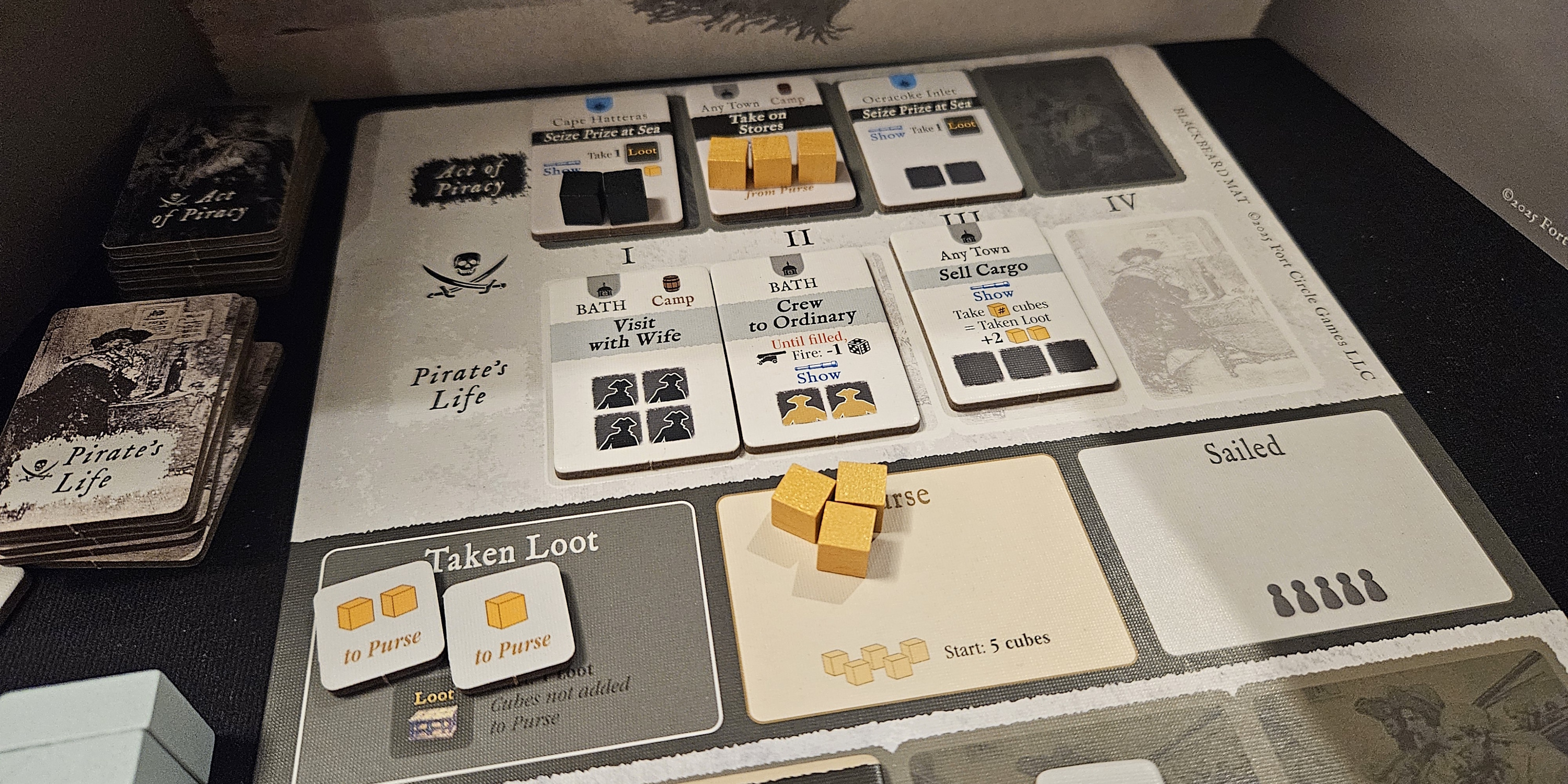
Blackbeard tends to his retirement… or continues his piratical career.
There are two sides in Hunt for Blackbeard, hunter and hunted, but Ruhnke’s virtuosity at game design clutters and blurs those roles.
Both sides, for instance, are gluttonous for information. In the case of the Hunters, that means Blackbeard’s location — whether that of the famed captain, his lieutenant, or the camp he might periodically visit to resupply or lick his wounds. But for Blackbeard, word of his pursuers’ deeds is every bit as precious. The Hunters are always visible on the map, but how far their reach has extended, where their informants have told them to search, or whether they have a particular stretch of the sea under surveillance, those details may be concealed or laid bare depending on context and choice.
The same goes for the question of which side is hunting whom. Nominally, the Hunters are, well, the hunters. As soon as they’ve outfitted their vessels, they depart from Virginia and begin the chase. But all the while, Blackbeard is laying preparations of his own. Looting vessels, preparing the Adventure, buying off witnesses. When the time comes for the spark to touch powder, it’s entirely possible that Blackbeard will sink the competition.
What Ruhnke produces, then, is a double-blind game of entrapment. First there’s the race. Blackbeard hurries to gain or spend his treasure, whether to reestablish himself as a great pirate captain or to secure another pardon. The Hunters hustle to outfit their vessels before the trail goes cold. But then, over the course of the ensuing rounds, the fierce dance between predators.
Perhaps the most surprising thing about Hunt for Blackbeard is its speed. The game only lasts four rounds. And these aren’t the drawn-out bullet-point-ridden rounds of something like Here I Stand. While there are still bullet points to tick off, the phases pass at a brisk pace, bouncing between sides so rapidly that there’s hardly a moment of downtime. First, the Hunters interview informants, giving them a glimpse at Blackbeard’s potential location — a step that requires Blackbeard to avert his gaze, lest he learn what the Hunters have gleaned. Second, Blackbeard spends his time preparing his ship, sailing, and planning any piratical activities. Again someone must close their eyes, although it’s the Hunter player this time. After that, the Hunters take their turn proper, moving their ships and perhaps picking up their quarry’s trail. Only then does Blackbeard actually accomplish any pirating, a step that may well have been interrupted by the arrival of the Hunters.
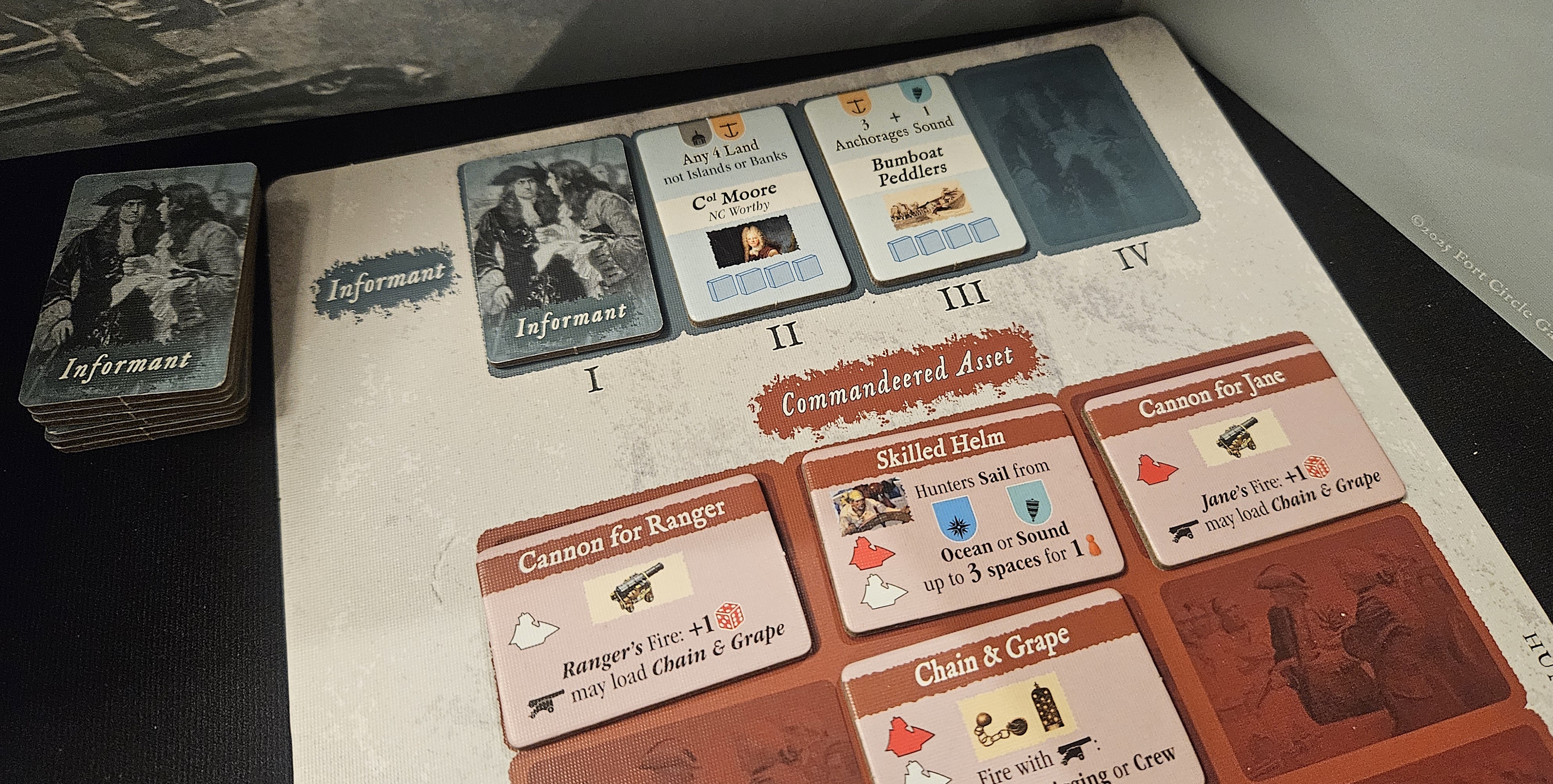
The hunters balance preparation against the need to depart early.
Playing through these steps, a few thoughts spring to mind.
First, there’s an essential tactility to Hunt for Blackbeard. The actions themselves are brief, but the need to physically turn the blocks gives every movement a sense of growing unease. When I played digitally, the entire session took perhaps a third of the duration, but in its haste lost its sense of place. It’s one thing to click an icon; another entirely to hover one’s fingertips over the block, stomach knotted into a fist as you try to deduce whether an earlier clatter had come from here or there, or was perhaps your opponent shifting a few components as a ruse. This process elongates the game, but is necessary: touching the pieces, straining your senses for clues, seeing the shadows cast by those monolithic blocks and wondering whether they conceal a trace of your foe’s passage or a flock of passing gulls, these are as much components in the game’s telling as the rules or the wooden ships.
As much as Ruhnke excels at designing macro-level systems, he still has yet to create a compelling method for resolving combat. Perhaps the game’s biggest disappointment is the moment of battle, when, after all those preparations, both sides roll a couple dice to see who hits the higher number. It’s fitting, I suppose, given the chanciness of naval combat. The historical Blackbeard managed to rake one of his pursuers with grapeshot, effectively removing their ship from the fight, before the trap was sprung and he was overwhelmed during a boarding action. But after all those steps and countersteps — after that dance! — it wouldn’t have gone amiss to put some showmanship into the last struggle. What could have been a wall of thunder instead comes across as a puff of smoke.
Lastly, however, the game leaves me in awe of the way board game excel at representing history. I’ve read about Blackbeard. Not a lot. Just enough to know we don’t know much. But it wasn’t until seeing it rendered this way that I understood some of the words on the page. The intimacy of the space. The smallness of a man whose legend has outgrown him and now nips at his heels. The small invasion of a neighboring colony, one governor determined to rid himself of a pest that his peer next door has decided to indulge. Piracy was always caught up in the history of empires, and nowhere is that clearer than here, with official pardons and corrupt commissioners in the balance, populated by enemies and victims, but also imperial troops crowding into spaces that were once open, with safe havens where an infamous pirate acted as a patron rather than a danger to be cut out with the point of a saber. To play this game is to grasp the history a little more tightly.
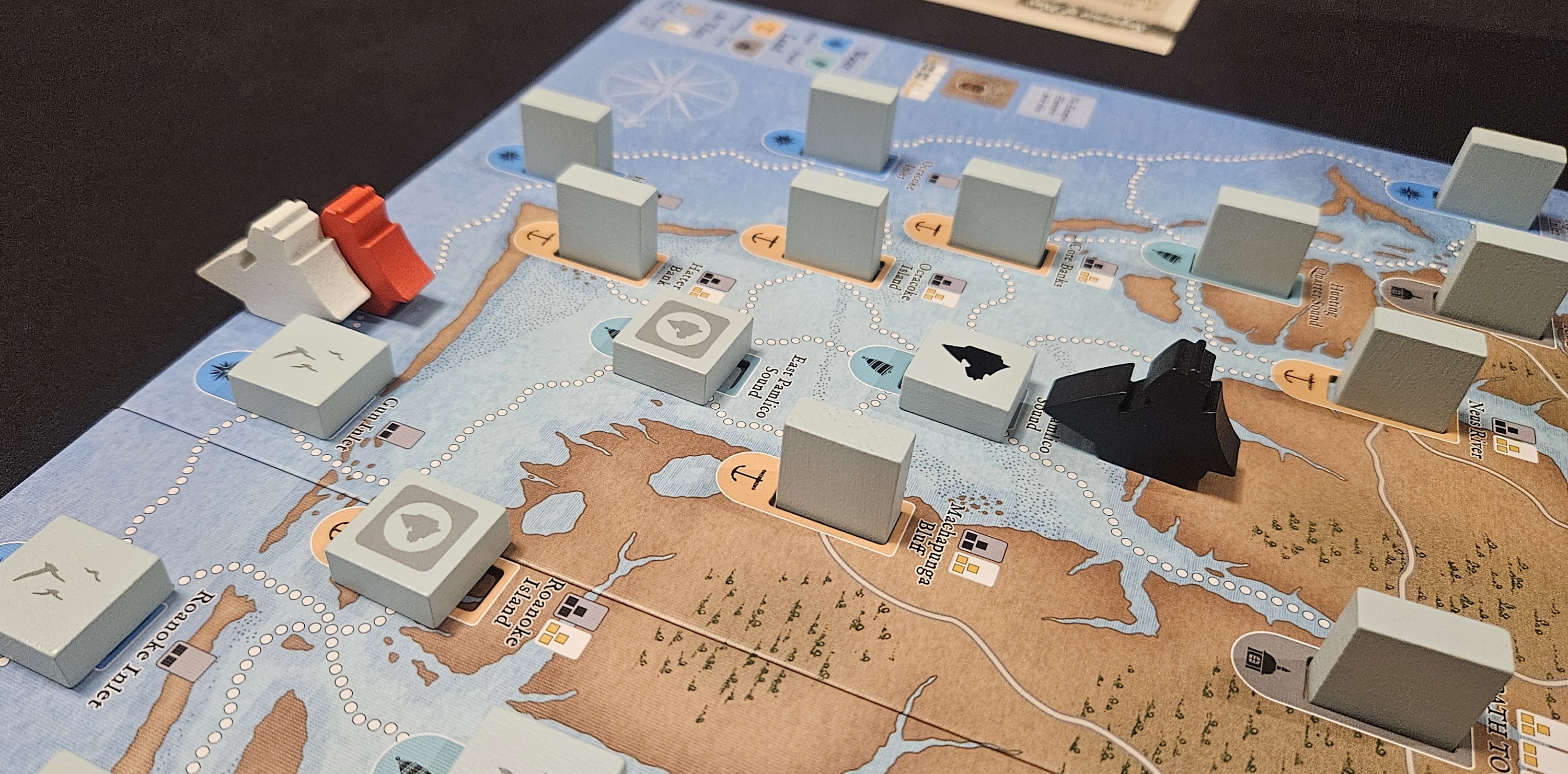
The hide-and-seek nature of the game is well done.
Is it disappointing that Hunt for Blackbeard operates better as history than as a plaything? Oh, maybe. A little bit. Especially when the game concludes with a wet fuse rather than a discharged cannon, I can’t help but feel some letdown.
But I’m impressed with the trappings that surround that climactic battle. Once again, Ruhnke has created a system that will hopefully earn emulation; once again, Fort Circle has crafted an enviable representation of American history, one that complicates and deepens its subject matter rather than frocking him in smoking fuses.
A complimentary copy of Hunt for Blackbeard was provided by the publisher.
(If what I’m doing at Space-Biff! is valuable to you in some way, please consider dropping by my Patreon campaign or Ko-fi. Right now, supporters can read my first-quarter update of 2026: the best board games, movies, books, and more!)
Posted on May 6, 2026, in Board Game and tagged Board Games, Fort Circle Games, Hunt for Blackbeard, Volko Ruhnke. Bookmark the permalink. 3 Comments.


I appreciate the piece, but I can’t in good conscience enjoy games by someone who would work for the CIA. It’s a personal thing but I have my limits.
Glad to hear this system has its charms! I’ve been eyeing up Coast Watchers and Drachen, the Recon series that seem to be mechanical sequels in all but name, but wondered if the “now you look away, now me” might overstay its welcome
Oh, I imagine it could prove wearying for some. But I don’t mind resting my eyes now and then. 😉