It’s Always the Ides of March Somewhere

I would describe my feelings toward Regicide as “appreciation,” despite it finding dedicated fans all around me. For years it was in regular rotation on my wife’s phone; my sister-in-law bought the fancy custom deck rather than just using a generic deck of playing cards. My own interest had more to do with the game as an act of repurposement: the clever casting of face cards as mad royals who needed to be put down, the suits transformed into character classes for blocking attacks or repairing injuries.
Regicide Legacy, designed by the same trio as the original — Paul Abrahams, Luke Badger, and Andy Richdale — is very nearly the exact opposite of the original game, at least in terms of form factor. Where the previous Regicide could be played with any old deck scrounged from a vacation bag, this edition is something of a throwback. It’s a genuine legacy title, for one thing: torn cards, stickers, micro-expansions, all of it. Its cooperative/solitaire campaign is generous. Moreover, it’s hard, significantly harder than is the norm in our current obliging hobby. It isn’t uncommon for a chapter to take two, three, half a dozen tries before your band of mercenaries is permitted to move on to their next target.
Now that I’ve wrapped it up, I can squarely say that the ordeal was thrilling, brilliant, and exhausting.
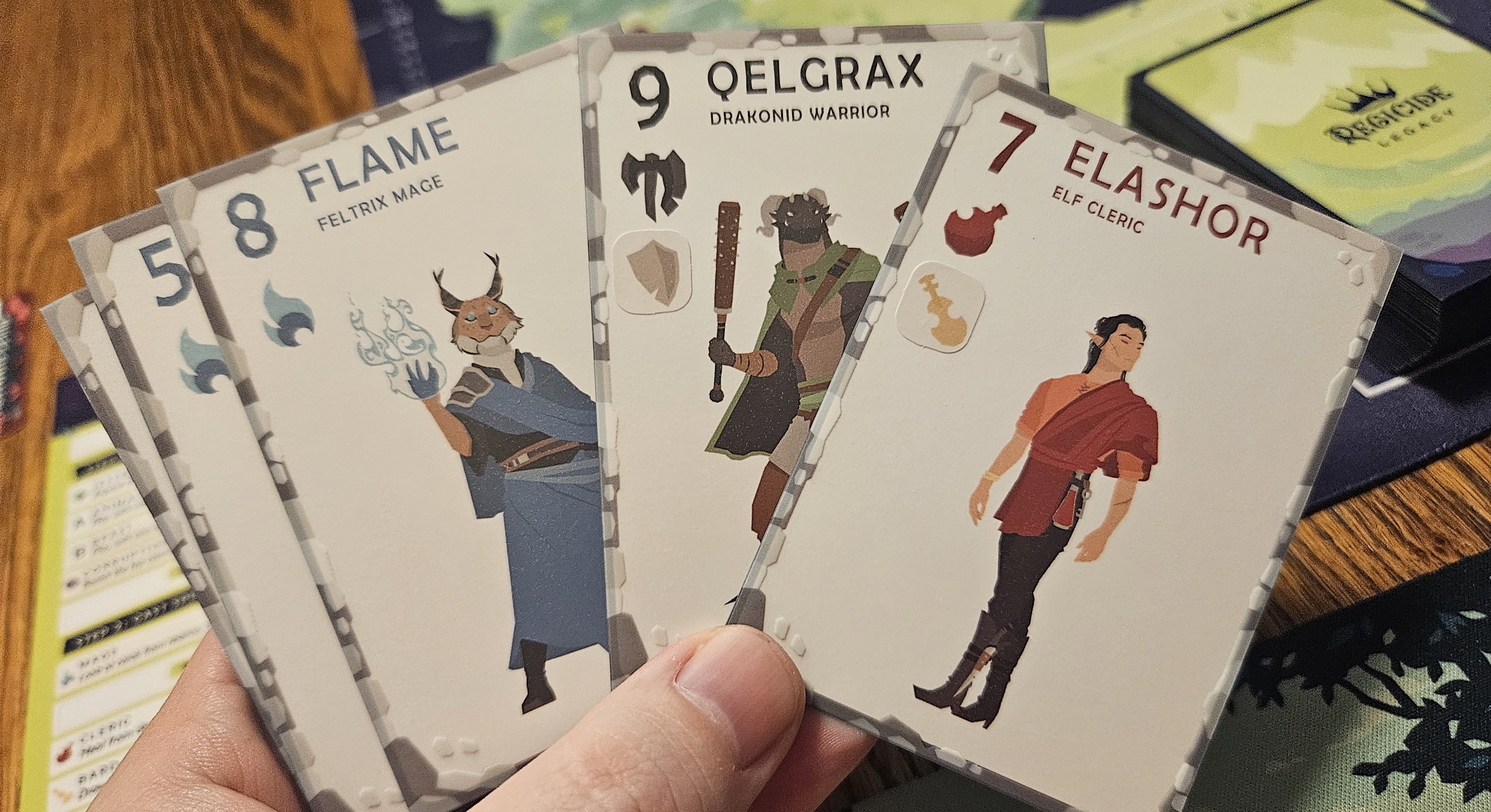
Hey there. We spotted you from across the bar and liked your vibes.
If you haven’t played the original Regicide… first, maybe give it a try. The rules are freely available, and as noted earlier you can play with a deck of cards that costs five bucks at the supermarket. That’s if you don’t have one handy already.
Regicide Legacy begins with Regicide. As in, its first chapter is the base game with only the slightest of modifications. Your crew, a band of adventurers, comprises the forty non-face cards of an ordinary playing deck, plus perhaps one or two goblins depending on player count. Their strength ranges from one (for an ace) to ten, across four classes that have been given their own iconography rather than repeating the regular French suits.
The face cards, meanwhile, become a deck of targets. First you’ll face the jacks, then the queens, then the kings, ideally lining them up for the guillotine. This is no easy feat. Each royal has a sturdy pool of health points, and punches back after each attack, requiring you to spend cards from your hand to absorb the blow.
The cardplay is impressive. Depending on your chosen attacker, your crew avails themselves of an ability. Warriors deal double damage to your target. Paladins block return damage. Clerics cycle discards back into your deck, which Bards then use to refill everybody’s hands. There’s a life cycle to this process. Some cards can be paired, such as aces, here styled as animal companions, or duplicate ranks whose strength would sum to ten or less. Success demands a delicate balance, between offense and defense, between healing and aggression, between risk and caution.
It’s pretty much inevitable that you will lose.
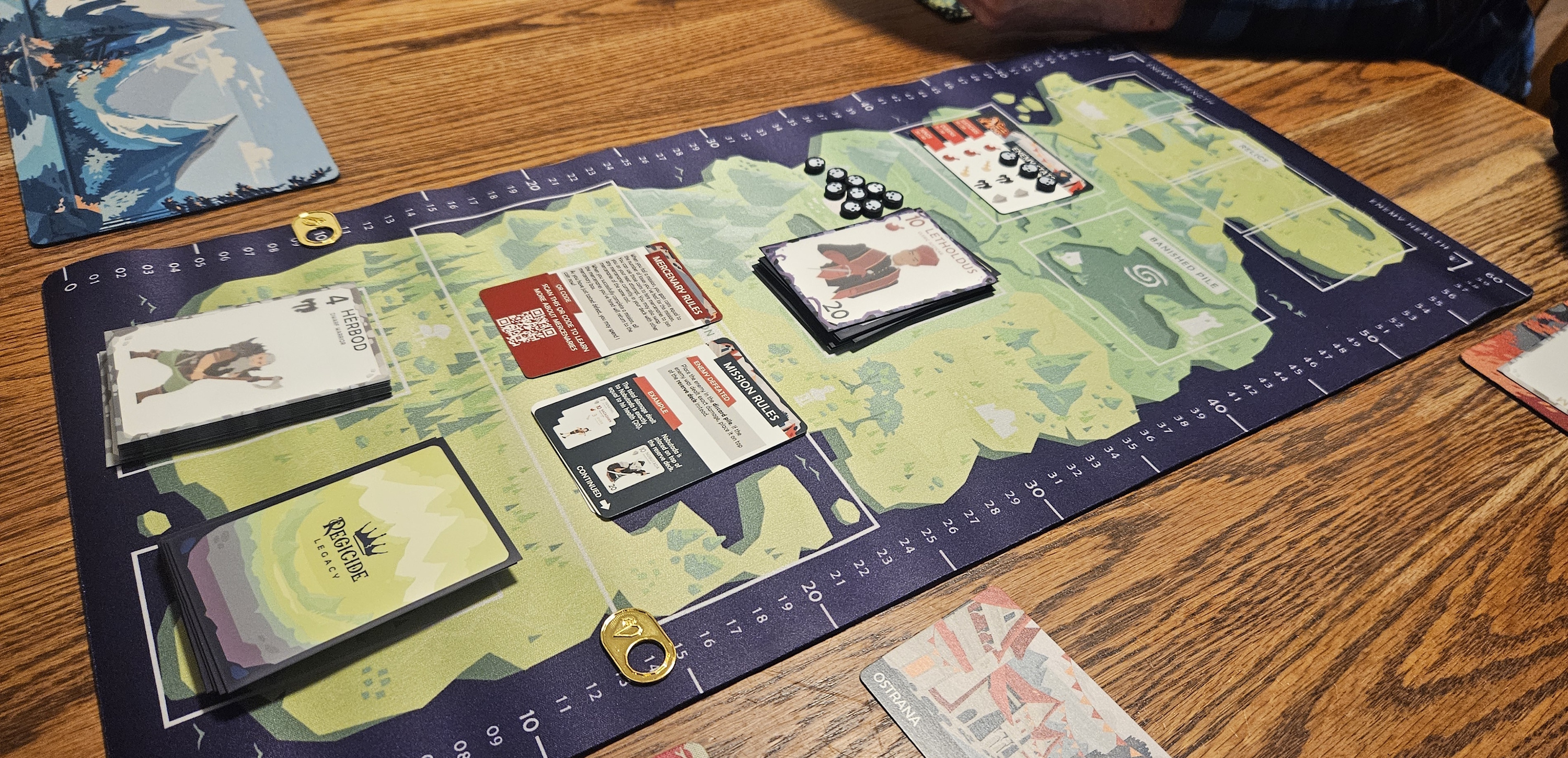
In contrast to the original Regicide, Regicide Legacy is all premium.
That inaugural failure, though, demonstrates the ways that Regicide Legacy intends to depart from its predecessor. Rather than shuffling the cards and giving it another try, you’re invited to open the first of the set’s many boxes. Within, you discover mercenaries: multi-rank cards that can be readily paired with more of their peers than usual, heavy hitters, maybe an extra goblin or two. Each merc has a cost in its corner. One loss means you have one gold to spend.
So you buy a card, add it to your deck, and take another stab at toppling the divine right of kings.
Again, failure is largely inevitable. It’s just a little less inevitable than before. Second loss, two gold. You grab a couple new fighters. Shuffle. Again.
Another loss. That’s three more gold. Now your company is becoming noticeably tougher. Maybe you were struggling with damage output; some extra Warriors will make up the difference. Or perhaps you found it difficult to manage your hand; that’s where Clerics and Bards come in. Whatever your particular weakness, there’s a patch for it.
At some point, the odds turn in your favor. Inside the first chapter box there is a sealed booster pack with its own instructions. Your mercenaries depart. New cards are introduced. Another chapter presents a new set of bosses, each tougher than the last.
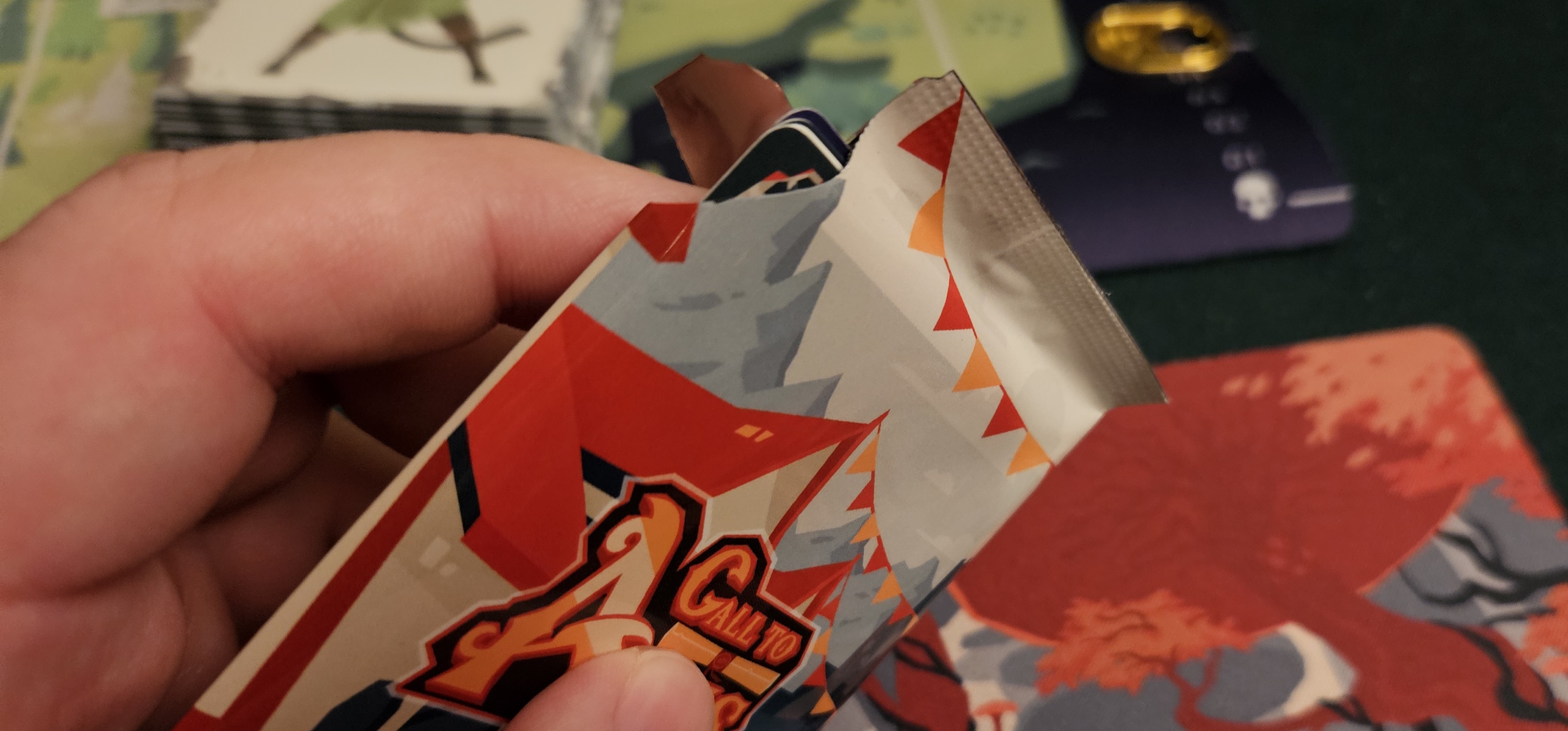
Opening the post-game expansion pack.
Along the way, a few things become apparent.
First, Regicide Legacy wants you to succeed. Even if only belatedly, after spending heaps of gold on up-powered mercenaries who round out your company’s deficiencies. Where the original game bordered on the misanthropic, booting you back to the beginning at even the slightest trip, the ability to pad your deck with repeat failures is a wonderful tool. Some make it easier to pair cards, or add wild aces, or, eventually, strip even the toughest bosses of their natural immunities to your character abilities.
Next, Regicide Legacy earns that second ligature. This is a legacy game through and through. In its earlier stages, this means variable card sleeves. To offer only the lightest of spoilers, the members of your company can become corrupted, adorning themselves in the thorn-framed sleeves usually reserved for royals, and incurring a penalty when played. Not long after that, you’ll encounter more transformative effects. Stickers that dual-class cards, minigames for randomly determining which character succumbs to a story beat, and, yes, eventually the dreaded moment that was so transgressive back in Risk Legacy, the command to rid yourself a card for good.
Go ahead. Tear it up. Don’t let your squeamishness show. Don’t let your fingers tremble. Don’t check how much the reset box costs. Uh oh. You looked. That’s as much as, like, fifteen decks of playing cards. But who would buy that many playing cards? You’re here for the drama, baby, and there’s no drama quite like drama that inflicts lasting damage.
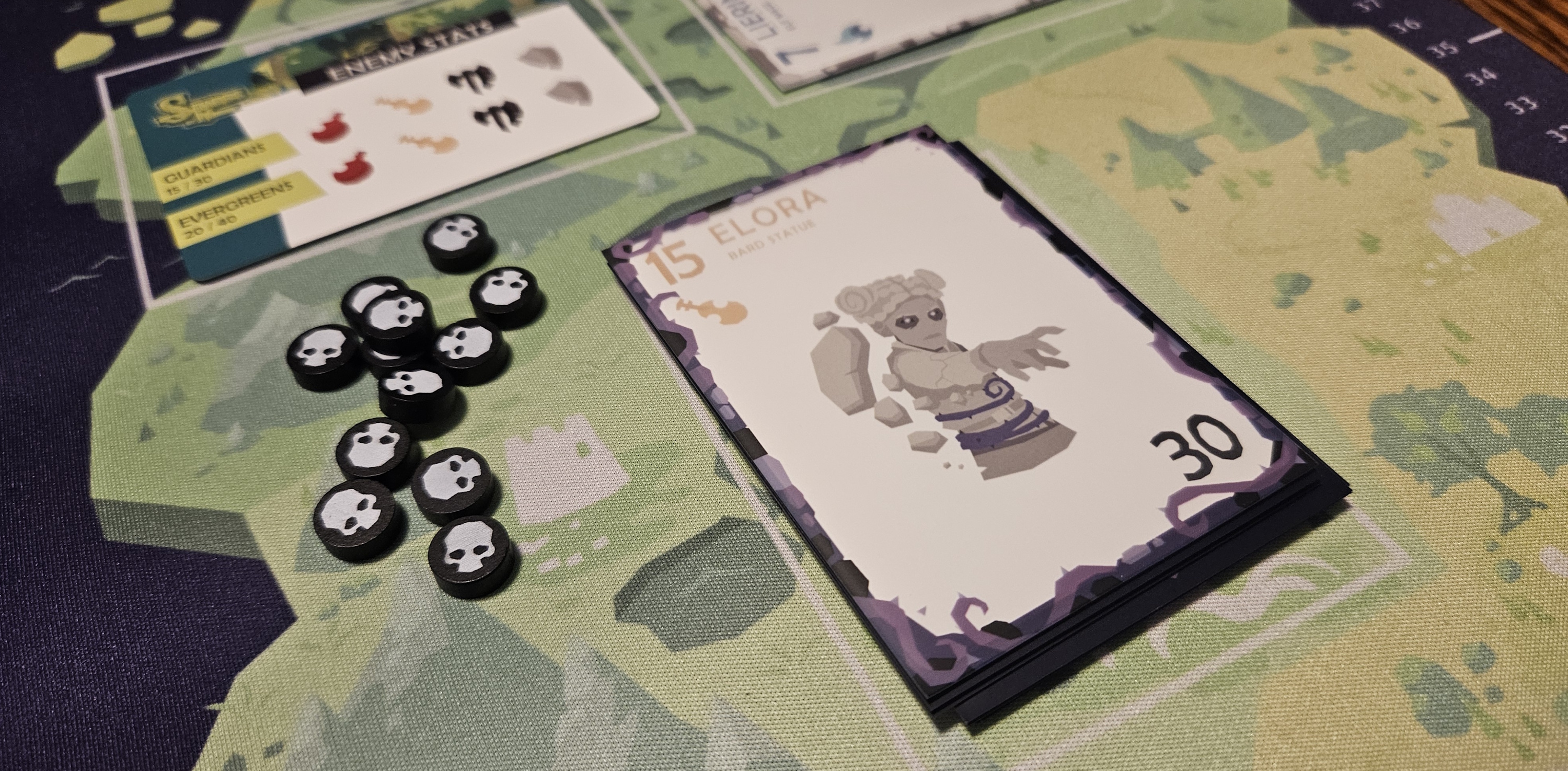
Each boss presents its own conundrums.
The main highlight is the procession of new character classes that are added to your ever-expanding band. To the original four — the original six if you count animal companions and goblin jesters — there’s enough to more than double the roster. I won’t spoil the surprise, but the way your deck morphs from one thing into something else entirely is quite the sight to behold. There’s wild magic to be uncovered, risky operators who might help or hinder your goals, heroes who always seem to show up in the nick of time, and complicated figures who require constant reminders.
Because Regicide Legacy, already a tangled, difficult game, only grows more tangled and more difficult as additional chapters are unlocked. More complicated, too. Sequencing matters. The subtle distinctions between two defensive classes matter. Whether cards are discarded or banished, which abilities a boss blocks, how cards are shifted across the board in this particular scenario — everything matters.
In our case, we played nearly the entire campaign four-handed. There was me, of course, plus my wife and sister-in-law. I doubt I would have survived by excluding the fanatics. We were also joined by my mother-in-law, a veteran of countless trick-takers. Her inclusion highlighted both the game’s strengths and its weaknesses.
Strengths first. Across the duration of the campaign, Regicide Legacy held our interest. Even my mother-in-law’s interest. Even when we were tired from battering ourselves against a particularly difficult chapter. (The worst offender, we discovered, had been nerfed post-release.) At our weekly dinner, the group was eager to see what came next. Not so much in the story, which is the usual fantasy muddle of proper nouns. But in the interplay of cards and abilities. In the composition of our deck. In which sticker would be appended to which character. In the developing shape of the thing.
But these strengths are attended by problems. Foremost, that Regicide Legacy soon gets too big for its britches. My mother-in-law spent the back half of the campaign showing her hand to whichever daughter was seated beside her, effectively requiring someone to play two hands simultaneously. She recalled the starting classes well enough, and even remembered a few of the later outliers. But as for the distinction between a Mage and a Reaver or between a Druid and a Chanter, no player aid was sufficient to fill every gap.
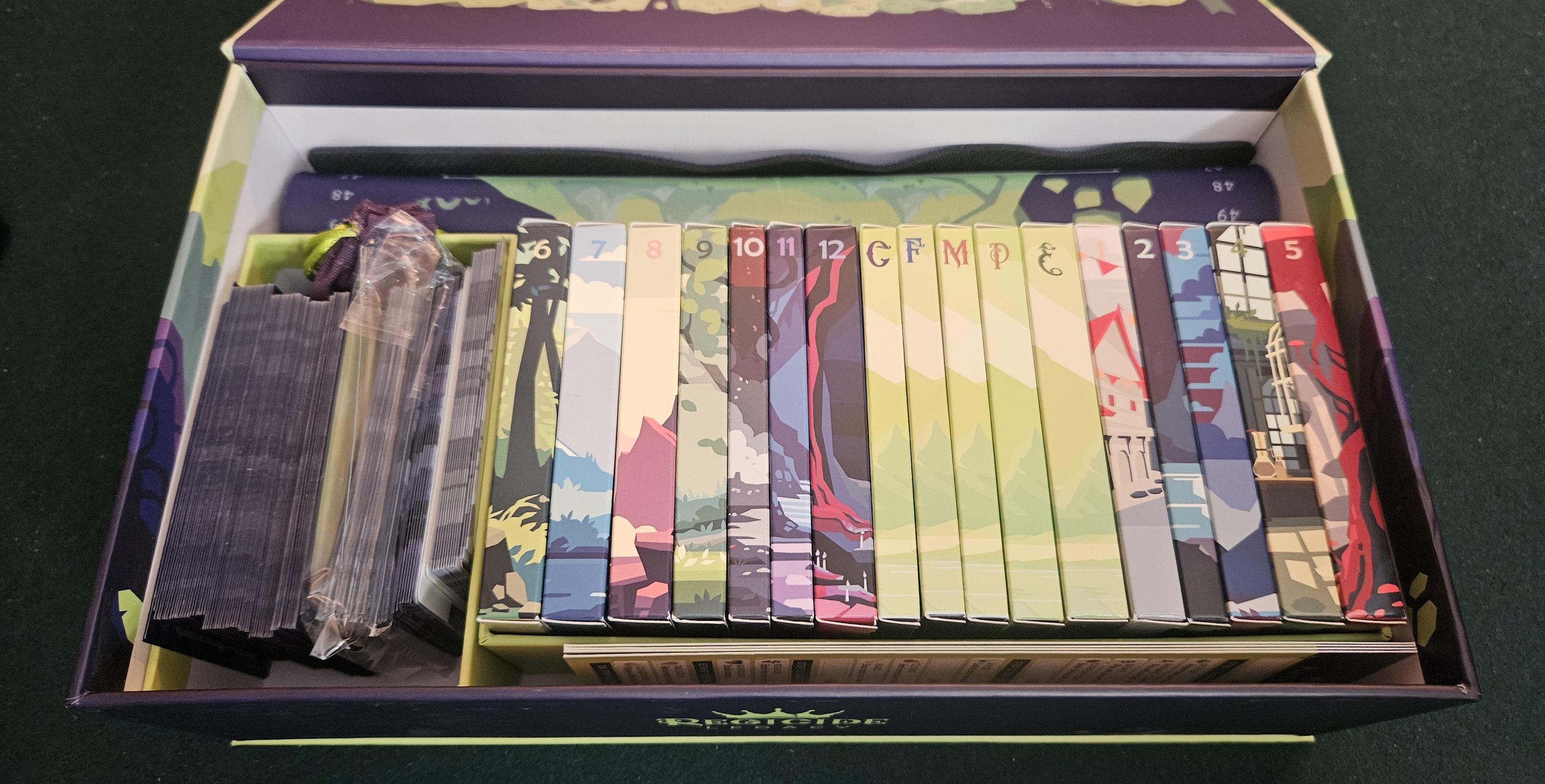
That’s one packed box.
Perhaps this sounds like an issue of age. To some degree, it was, as my mother-in-law would freely admit. But even those of us inured to modern hobby games and RPG classes and this particular brand of cardplay sometimes found our minds snowed in by the game’s avalanche of intersecting triggers. It isn’t only the character classes; there are also the bosses to consider, plus the special rules that govern this chapter, plus, often, the lingering rules from last week’s session, finally cemented in time to be discarded with the previous tuckbox. Most of the time, I had to run the turn-by-turn action, and even then it wasn’t uncommon for someone to stab back that my reminder necessitated a counter-reminder because of such-and-such character or some lingering effect from the scenario instructions.
Is it too much? We finished the campaign. We survived. We succeeded. But we also stumbled along the way. Sometimes we realized two rounds later that we’d flubbed a rule earlier. More than once, we restarted a session altogether, the rules suddenly clear where previously they had been opaque.
Personally, this process was many things. Frustrating at times; exhausting at others.
But it was exciting, too, and exciting in a way that very few games have been before. We developed favorites — dual-classed Elashor, Vegarian the Vegetarian, my crush Lierin — and groaned at the appearance of others — Dinky, may you be damned to the underworld for eternity for how often you have betrayed us. We laughed a lot, especially when a new boss crushed us to powder, or when somebody stared at the problem before them, eyes glazed over, only for someone to recall the exact rule that would save us from a doomed situation.
The remaining question is whether we’ll return. Some of us already have; my sister-in-law has launched her second campaign with another group, spreading the good word to unwitting converts. There’s an entire post-game to tackle, justification for the potential waste of a discarded core box, and I can confirm that it’s a smart system, randomly doling out enemies and modifiers and boons that will test the hardy company that was forged over the previous thirty battles.
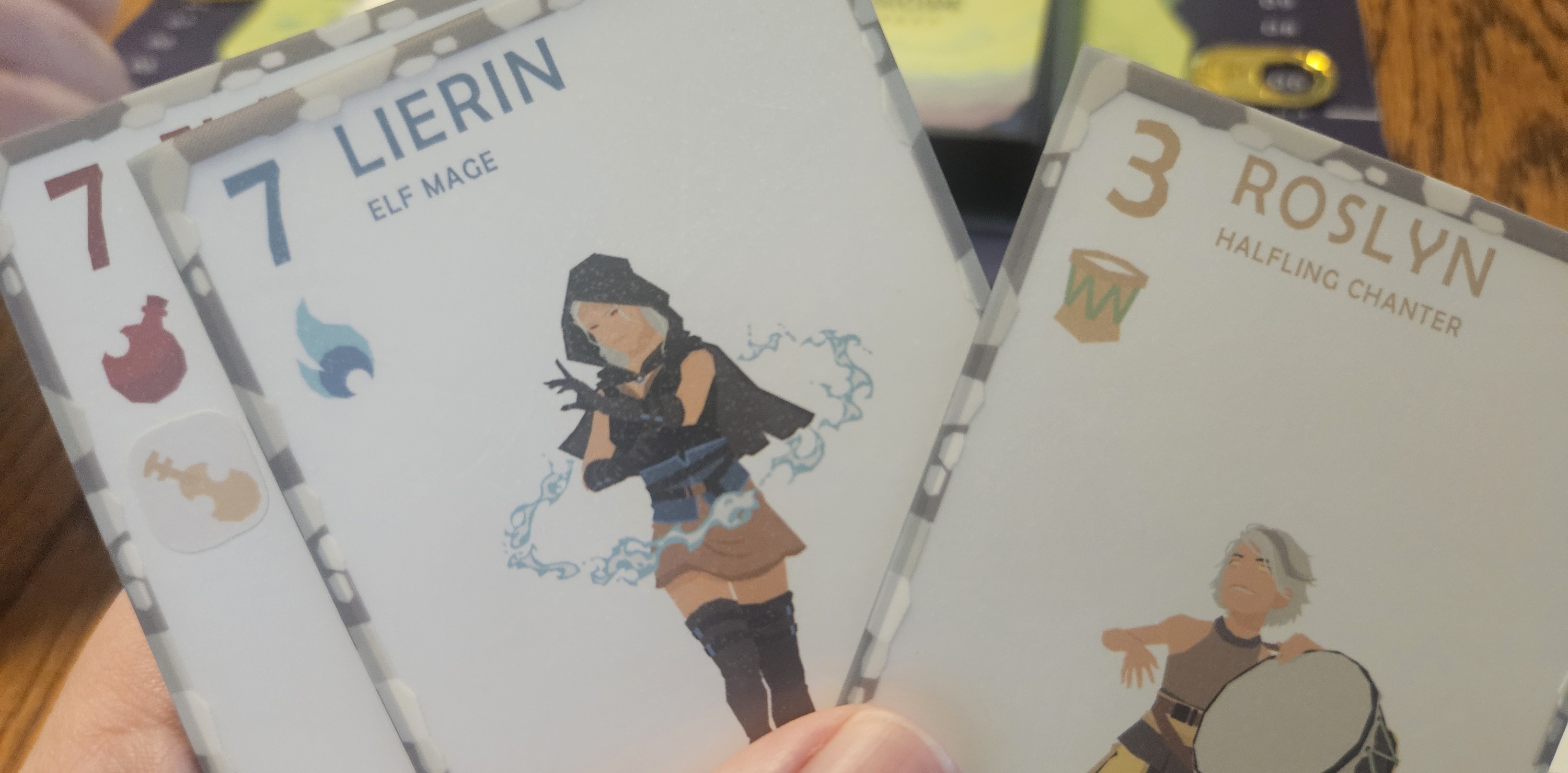
Lierin is my Canadian girlfriend you’ve never met.
So. Will we? Return, that is?
I don’t know. Maybe someday. I plan to keep the box, despite my doubts that we’ll remember the class abilities if we go more than a month without a session. Even if we don’t, I can’t help but regard Regicide Legacy with fondness. I can’t remember a single story beat from the narrative. But the stories it told above the table — the way our deck transformed along with our aptitude as players, the inside jokes we developed, the characters whose named we pronounced five different ways — those are worth keeping around. That’s the real legacy here. That’s what makes me consider Regicide Legacy such an unlikely success. Torn cards? Stickers? Psh. I’m only interested in the stickers of the soul. The torn cards of our feelings.
And with those strained metaphors, I think that’s enough Regicide Legacy for one sitting.
A complimentary copy of Regicide Legacy was provided by the publisher.
(If what I’m doing at Space-Biff! is valuable to you in some way, please consider dropping by my Patreon campaign or Ko-fi. Right now, supporters can read my first-quarter update of 2026: the best board games, movies, books, and more!)
Posted on May 5, 2026, in Board Game and tagged Alone Time, Badgers from Mars, Board Games, Regicide, Regicide Legacy. Bookmark the permalink. 5 Comments.


It’s been a while since I’ve played a legacy game. I may have to give this one a go. The original is so good, and I’m intrigued by all the content to explore with this version of the game. Just look at all those boxes!
Boxes without number…
(Okay, the number is seventeen. Still, lots of boxes.)
Yeah well, “She’s So High” is a great song!
It does have a tendency to stick in the ear. Like a Ceti Eel.
I’m glad they upped the difficulty. My biggest gripe with the original Regidice is that my group demolished the game in an hour and something and there was no willingness to ever get back to it. It was far too easy.