Blog Archives
From Dud to Dude

If we’ve learned any one thing about Scott Almes and Gamelyn Games’ Tiny Epic series now that we’ve reached the fourth entry — the previous ones being Kingdoms, Defenders, and Galaxies — it’s that they’ve got a lot of heart. Maybe even more heart than bite, sometimes, maybe.
It isn’t that they aren’t tiny, because sure, on a particular scale they’re downright microscopic. And it isn’t that they aren’t epic; when a word has lost all meaning, there’s no reason to keep championing it. Rather, it’s that they live up to their pitch. They’re portable, functional, and for being so compact and workmanlike they’re also decently good times when you don’t have a whole evening to burn.
The problem with that theory is that Tiny Epic Western is actually the sort of game I might play as a non-filler.
It’s an Illusionerion, Michael
In a lot of ways, the greatest feat of Trickerion: Legends of Illusion is that it highlights precisely why Kickstarter works as a platform for independent game ideas. Set in a city that just can’t get enough of magic and magicians, this original design by first-timers Richard Amann and Viktor Peter is all about the thrill of putting yourself out there, the joy of pulling off that impossible illusion, and the frustration that settles in at the bottom of your stomach when you watch your rival pull off that vanishing elephant trick before you. It’s also a risky project, complex and deep and occasionally infuriating. So let’s talk.
In Space, No One Can Hear You Roll

In Deep Space D-6, a solo dice game that wears its influences on its sleeve, my first victory came while helming the Halcyon. Time warps, space pirates, even the lure of cosmic existentialism and the dreaded Ouroboros station couldn’t stop me. Everything space had to throw at me, and I chewed it up and spat it right back in space’s pimply face. And it was only my first try.
I was dumbfounded. Was this it? Had I reached the edge of space so easily? Had I made some mistake? Was I even now trapped within the swaddled interior of cosmic existentialism itself, unwilling to see the boundaries of the dream?
The answer to all of these questions was no. I’d played correctly. I’d defeated space. But that was only aboard the Halcyon, the galactic equivalent of a bike with eight sets of training wheels trailing off its sides. The Athena Mk. II would not prove such a tender lover.
Hamilcar, Not Hannibal
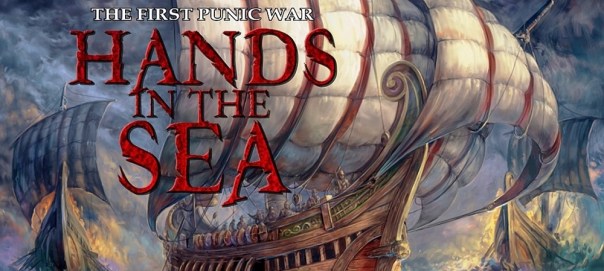
At its height, the Carthaginian Empire was enormous. Encompassing much of northern Africa, swaths of modern-day Spain, Corsica and Sardinia, even a toehold on the jewel of the Mediterranean that was Sicily, they were one of the world’s great maritime powers — a true thalassocracy, their navy indomitable at sea — until the scrappy Roman Republic’s unification of the Italian Peninsula put them in a position to challenge Carthage’s authority. The ensuing wars spanned more than a century, and only concluded when the grand city of Carthage was burnt to the ground.
Not only is Hands in the Sea set during the first of these wars — that’s the war of Hamilcar Barca, father of the Hannibal Barca who would brashly march elephants across the Alps in the Second Punic War — it also contains some history of its own. Riffing on Martin Wallace’s innovative A Few Acres of Snow, this is Daniel Berger’s attempt at taking the system to the next level without resorting to the same fantastical measures that Wallace undertook in Mythotopia. Which is to say, this is a serious game, full of serious people undertaking serious endeavors — and it’s every bit as good as it is serious.
We All Need Control

Elegance is tough.
Think about it. If you want your game to be elegant, it needs to have moving parts, but not so many that it becomes a mess, and what’s there must be well-oiled and purposeful. You’ll need clear winning strategies, but no single strategy that trumps all others. Simplicity, but simplicity with depth.
Control, a game ostensibly about time travelers wrestling to escape a rift in spacetime, is elegant. Unfortunately, most people might not reach the point where they can recognize that.
Dirty Little Shitler

I enjoy plenty of social deduction games. Mafia de Cuba. Spyfall. A Fake Artist Goes to New York. Deception: Murder in Hong Kong. Dark Moon. Homeland. So why is it that the genre has always sounded like a swear word to me?
When I really put my mind to it, the essence of my beef is that I simply don’t enjoy any entries into the genre that feel scripted, where a person’s role or ability informs nearly all of their behavior. I’m talking about stuff like The Resistance: Avalon or One Night Ultimate Werewolf, where everyone else works out these logical identity puzzles while I sit there counting the minutes. The first time is thrilling, but the tenth? Boring. Programmatic, even. Invariably, it feels like we’re just going through the motions as our assigned characters.
Secret Hitler feels a whole lot like Avalon, and yet it sidesteps this issue completely. Let’s look at how.
Salvation: Worth It?

Comparisons can be a tough thing for a board game to weather. Is it fair to compare any particular game to another, especially since people might not have played whatever’s being used as the point of reference? Or would it be unfair to not draw comparisons, failing to trust your audience to understand what you’re talking about and letting them make up their own dang minds?
Take Salvation Road, for instance. It’s easy to compare it to Dead of Winter. They’re both games about scavenging in a post-apocalyptic landscape. They’re both about survival. They both feature a diverse and randomized cast of characters, some better suited to their task than others. Most importantly, despite a pretty lengthy list of differences, they both feel extremely similar.
A Vast Vast Review

The prospect of asymmetry in board games has always been a tricky one, promising great variety and depth while also threatening to overwhelm its participants with — and I believe this is the scientific term — a metric butt-ton of rules. Unlike digital games, which might handle calculations behind the scenes or offer helpful tips whenever you get stuck, in the analog world of board games every single rule must be relayed, parsed, and understood between all players at all times. Or at least most of the time.
Not only is Vast: The Crystal Caverns by Leder Games not an exception to this rule, it’s pretty much the definition. But does that do it a disservice or make it one of the richest games to appear on our table this year? Read on to find out.
Be a Dog, Be a Bast

One of the things I most appreciate about Alf Seegert’s work — at least across the slight handful of his games I’ve played — is how he takes very relatable and approachable concepts and transforms them into something more. Take Dingo’s Dreams, for example. It’s bingo, the very same one your grandma plays for day-glo pens with puffy feathers sticking out the end, yet in Seegert’s hands it becomes one of the breeziest light titles of the year. Or Fantastiqa, a deck-building game that embraces its whimsical side with such abandon that it’s hard not to like it.
Heir to the Pharaoh is Doc Seegert’s latest game, and also his greatest by a significant margin. So let’s talk.
Not Exactly an Al Swearengen Simulator

For those of us who fit into the Venn diagram encompassing both those who love board games and those who love Deadwood, Saloon Tycoon seems like a no-brainer. Not only could we get up to our elbows in all the brutality, back-stabbing, and profiteering that goes with the territory, it would also go a long way towards legitimizing our extensive Al Swearengen vocabulary. Ya hoopleheads.
Unfortunately, while I wrote earlier this week about a Kickstarter title that could have used some more publisher oversight but still turned out okay in the end, Saloon Tycoon provides the opposite example. As in, this particular batch of cornbread needed a few more minutes on the stove.

 SPACE-BIFF!