Blog Archives
Chicago Gets It Up

Imagine checking into a hotel in 1861. Not just any hotel, but a six-story brick building. Over the course of your stay, the front stairs have grown noticeably steeper each time you return. When you check out five days later, the windows that once sat at eye level are now several feet above your head.
This isn’t a ghost story. It’s an actual anecdote from the raising of Chicago, when engineers used thousands of screwjacks to lift the city’s brick structures six feet above their previous elevation. In some cases, as with the Tremont House Hotel, the laborers worked in covered trenches, permitting business to be conducted as usual. This brought the city above the water line, permitted the construction of a sewer system, and hopefully prevented another outbreak of cholera from killing one in twenty inhabitants. Chicago was saved. At least until the next decade, when a cow would kick over a lantern in Mrs. O’Leary’s barn.
Gazing Up into Heaven

Last year, two designs by Tomáš Holek marveled at the stars. One of those games, SETI: Search for Extraterrestrial Intelligence, has enraptured audiences with its thoughtful quest to discover life beyond our planet. The other title is Galileo Galilei, a boilerplate Euro with a few good ideas in its head and some profoundly spurious history in its belly.
This review is for the weaker of the two. Get ready to squint into the eyepiece.
Dudes on a Board
Match of the Century is the second game in recent memory to figure chess as its topic without simply being chess. The first was The Queen’s Gambit: The Board Game, a title I didn’t play but which seemed to draw mostly groans. Match of the Century was designed by Paolo Mori, and because Mori is one of the most assured designers working today, it is decidedly not groan-worthy.
That doesn’t mean it fits Mori’s register. This is his most overtly historical game, tackling the 1972 World Chess Championship match between Soviet grandmaster Boris Spassky and challenger Bobby Fischer. But while it’s a compelling ditty in its own right, it didn’t leave me any surer of the dynamics of that landmark tournament.
When Fire Met Stone
From Troy to Stalingrad, there’s nothing quite as gripping as the stakes and drama of a good siege. Sieges seem like the perfect setting for a board game, with their limited parameters and clear-cut victory conditions. Yet we don’t often see them given their due. In many cases, board game sieges are little more than countdown timers while armies elsewhere rush to reinforce besieged allies or outmaneuver their foes.
In stark contrast with other efforts, Fire & Stone: Siege of Vienna is possibly the best siege game I’ve played. We’ve seen the work of Robert DeLeskie before, first with The Wars of Marcus Aurelius and later Stilicho: Last of the Romans. But where those were sweeping epics, covering decades of zoomed-out politics, Fire & Stone covers two months of intense fighting between the Ottoman and Holy Roman Empires.
The Jaunty Mattanza
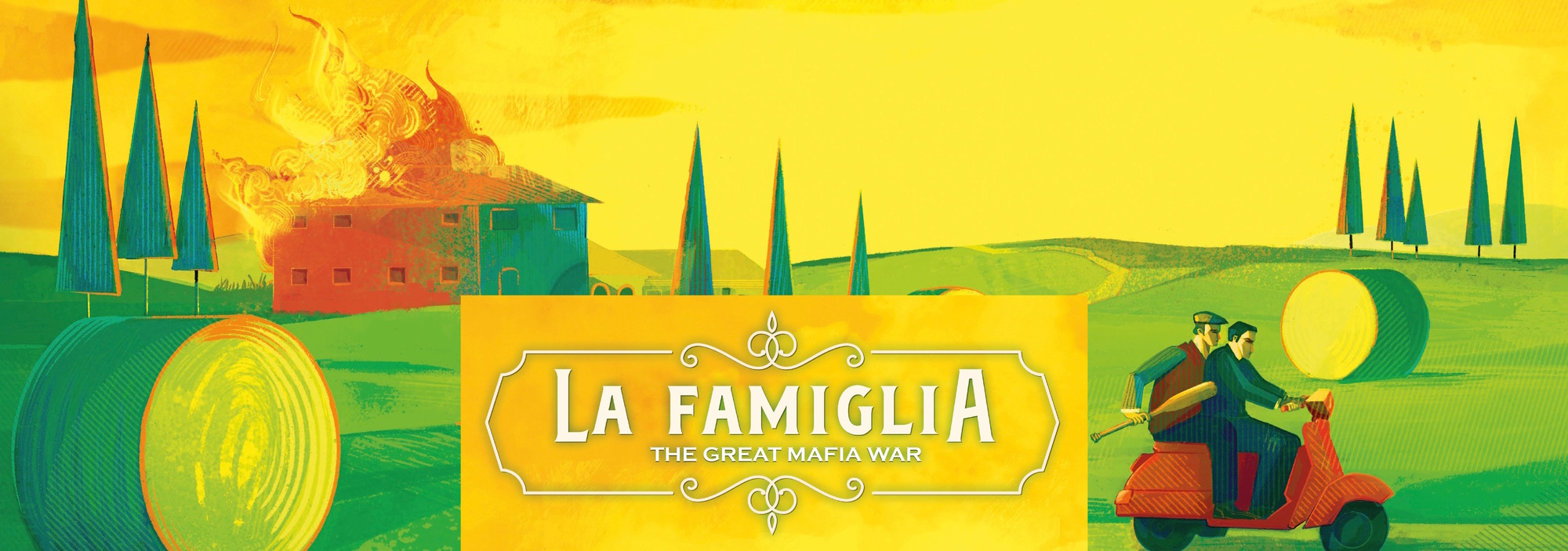
La Famiglia: The Great Mafia War, the latest design by Maximilian Maria Thiel, has caused a minor stir thanks to its subject matter, the Sicilian mafia wars of the 1980s. Sometimes called the Mattanza — the slaughter — this conflict claimed thousands of victims, including bystanders, police officers, and civil servants, and included acts of violence that crossed borders and oceans.
When it comes to board games, it’s hard to find a setting that will unsettle me. I’m less interested in a game’s proposition than its execution. Playing La Famiglia, however, it’s hard to escape the niggling feeling that this isn’t the most canny handling of a sensitive topic.
Fluss und See: A Look at Weimar

Even as a prototype, Matthias Cramer’s Weimar is a sprawling work. Taking cues from Mark Herman’s Churchill and covering the entire span of the short-lived Weimar Republic, how could it not be? This is history that shaped everything about the following century. Few have bothered to learn anything about it.
Before we begin, it should be noted that I’ve played Weimar all of once. Normally my policy is three plays before I’ll write anything, even for previews. With only eleven days left on its crowdfunding clock, its six-hour playtime and four-player complement mean that won’t be possible. These thoughts are only halfway formulated. It’s entirely possible I’ll get something wrong. Still, I want to tell you about it.
Terraforming Earth

Ark Nova, designed by Matthias Wigge and so widely acclaimed that it’s been distributed by literally one dozen publishers, is easiest to describe via amalgamation. There’s the sprawling market of Vlaada Chvátil’s Through the Ages, the escalator of five action cards from James Kniffen’s Civilization: A New Dawn, and the vaguely aggravating card draws of Jacob Fryxelius’s Terraforming Mars.
It’s wildly popular. I think I know why.
When All the Good Routes Aragon…
Yesterday we looked at Amabel Holland’s Trans-Siberian Railroad, a cube rails game so stuffed with ideas it had a serious case of stomach cramps. Published only two years later, Iberian Gauge tinkers in similar spaces. This time, however, its appetite and gaze are simpatico.
Sick Rift, Bro
Longtime readers may recall that I’m a bit of a snob when it comes to location-grabbing horizontal area control games, a.k.a. Battle a-Line-ks, a.k.a. Schotten-tots. Don’t know what I’m talking about? Why, none other than titles such as Omen: A Reign of War, Haven, and Air, Land, & Sea, all of which put their own spin on this simplest of genres.
Now I have a fourth favorite: Carlo Bortolini’s Riftforce. The trouble is that its spin is best expressed via numbers.
The Cargo Isn’t All That’s Curious About It

It’s no secret that my favorite part of Ryan Courtney’s Pipeline was the pipe-laying. Scoring, automation, loans — no thanks. Give me Donnelly nut spacing and cracked system rim-riding grip configurations using a field of half-seized sprats and brass-fitted nickel slits. The McMillan way. That’s all it takes to make me happy.
Curious Cargo is Courtney’s follow-up to Pipeline, although its shaky proximity to its predecessor has me doubting the term “follow-up.” As before, piping is a major feature. More so, even, than in Pipeline. But despite that similarity, it’s very much its own thing, right down to the husk nuts bolstered to each girdle jerry.

 SPACE-BIFF!