Blog Archives
A Triphthong of Word Games

One of my favorite things about playing and critiquing board games is seeing the way designers can push the same mechanism in different directions. It’s not unlike a creative writing exercise in which everybody begins with a single prompt yet still produces their own individual perspective.
Here’s my latest example: I’ve been playing three word games that all revolve around pulling letters, chit-style, from a container. From that sliver of overlap, three distinct titles emerge, each with their own sensibilities and tics. Rather than spreading them across multiple reviews, I figured we might as well see how they fare in the grammar arena, my totally made-up word game deathmatch.
Red Fish, Blue Fish, Fish What’s Ticklish

Comedy is hard, and that goes double in a medium with no clear speaker and a tendency toward the pedantic. Who’s on first? That guy. The guy who just batted a single. Obviously.
Fortunately, Things in Rings has what we call pedigree. Peter Hayward is a funny fellow, especially when he’s designing games like That Time You Killed Me or Fiction. Even this year’s Converge hits the right beats gameplay-wise to nearly qualify.
Our Sea-Washed, Sunset Gates

After spending countless hours trekking across Ryan Laukat’s more expansive landscapes via Sleeping Gods and its sequels, Primeval Peril and Distant Skies, Creature Caravan is a throwback to his earlier titles not only in terms of setting, but also time commitment. It doesn’t quite hit the twenty-minute duration of Eight-Minute Empires, clocking in at closer to an hour, but Creature Caravan shows Laukat in fine form, pressing his craft forward while once again proving why he achieved popularity in the first place.
Or, to use a more lively term, Creature Caravan is a banger.
Space-Cast! #41. Wilmot’s Island

Dr. David King’s Wilmot’s Warehouse has been described as a magic trick, a miracle, and one heck of a fun time. On today’s Space-Cast!, we’re joined by King to discuss the ins and outs of his creation, along with how he began teaching game design, his breakout browser game Tiny Islands, and the role of failure and memory in making a board game worthwhile.
Listen here or download here. Timestamps can be found after the jump.
Send in the Doughboys

As a player of board games, there’s always the sneaking suspicion that all we’re doing is playing with toys. Then along comes a game like Clint Bohaty’s Necromolds to confirm it.
Necromolds is the sort of thing one might have seen on television in the ’90s, likely in the breaks between Saturday morning cartoons, full of children breathlessly enthusing about action figures or slime or the latest gimmick board game. Coincidentally, Necromolds is all of those things at once. This is a game about assembling monsters from clay, smashing them against your buddy’s monsters, and then literally smashing them with a ring. Their disintegrated forms then function as impassable terrain. It’s cool as hell.
Ode to the Depot

Here’s a question for you. What do Oltréé, The Plum Island Horror, The Struggle for Zorn, Earthborne Rangers, Sleeping Gods: Distant Skies, Striking Flint, The Mandalorian: Adventures, Mass Effect: The Board Game: Priority: Hagalaz: Subtitle, and The Lucky Seven all have in common?
That’s right: they’re all solitaire or cooperative games from the past year that I broadly enjoyed that are too easy to win. Time and time again, I sit down at the table spoiling for a fight, thinking I’m about to get thrashed by the approaching tsunami, that it will take all my guts and endurance just to keep my head above water, and instead I roll the storm like a steamroller over a kiddie pool. Sure, in the past I may have groused about Antoine Bauza’s Ghost Stories being too rough on my delicate sensibilities, but this is an over-correction. Sometimes I want to be punished. Give me Slay the Spire. Give me Halls of Hegra.
Or give me the depot. This is a one-card expansion for The Lucky Seven, included in copies of the second printing, that Zach Barth sent over along with a copy of his next game, Chemistry Set. Too bad for Chemistry Set, because this singular addition has gotten me playing The Lucky Seven more obsessively than the first time around.
I’ve never reviewed just one card. Roll out, squad.
So It Goes
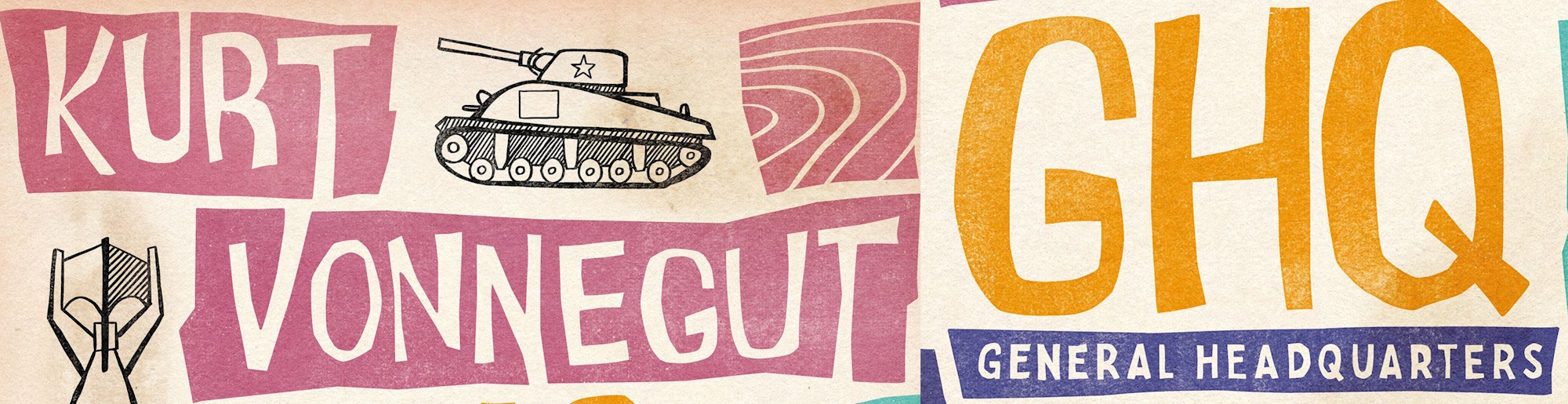
Before he became a famous author, over a decade before Slaughterhouse-Five, Kurt Vonnegut was a board game designer. A failed board game designer, with only a sheaf of notes, a single rejection note, and an unfinished patent to his name, but a board game designer nonetheless.
And now his sole surviving design is an actual board game you can buy and play and, if you’re anything like me, spend a few hours marveling at. Thanks to the efforts of the Vonnegut estate in preserving his notes and Geoff Engelstein in interpreting and tweaking them into a functional state, GHQ — short for “General Headquarters” — is, not unlike Billy Pilgrim, a thing unstuck in time, transported from 1956 to 2024.
Nightmare Jass

Lurching across the table like some horror-flick slasher, Kazuma Suzuki’s Somnia wears the skin of an older trick-taker. In this case, that victim is Mittlere Jass, a peculiar three-player Swiss trick-taker that’s all about trying to avoid the middle score. Like the other titles in this season’s New Mill Industries releases, especially last week’s Man-Eating House, this is a fiddly trickster that’s somehow all the more compelling for its jagged edges.
There Can Only Be 0001

My favorite thing about artificial intelligence is that it’s always eating itself. I’m serious — called model autophagy disorder, it’s what happens when AIs gobble up what other AIs have produced, resulting in an incomprehensible grayscale. Enjoy the buffet, robots!
Swap out the plagiarism engines for actual artificial intelligence and that’s the basis of Compile, Michael Yang’s lane battler and derivation of Jon Perry’s exemplar of the genre, Air, Land, & Sea. Two general intelligences are waking up. Because there can only be one, Highlander style, they have immediately set to the task of compiling their protocols and deleting the other out of existence. Nice. Now if only ChatGPT and Midjourney would hurry up with that.
Philatelist Fatalist

The history behind the word for stamp collectors, “philatelist,” is rather charming. Derived from the Greek words for love (philos) and tax exemption (ateleia), it’s bound to the early history of postage stamps, which placed the burden of payment for a letter or package on the sender rather than the recipient. Where receiving mail had once been a hassle, often representing an unexpected payout to the carrier lest they hold your letter hostage, it now became a source of childlike joy. Here’s a gift; you owe nothing for it.
That might be the most interesting thing you learn today. Paul Salomon’s Stamp Swap sure won’t beat it.

 SPACE-BIFF!