The Unlucky Eighth

Even though he has only the sole credit to his name on BoardGameGeek, it wouldn’t be fair to call Zach Barth a newcomer to card game design. While his studio, Zachtronics, was perhaps best known for its high-concept engineering and programming titles like SpaceChem and Infinifactory, I was more preoccupied with his solitaire offerings. When it comes to a simple deck of cards, Barth displays an ear for riffing on established designs, producing new and more interesting versions of FreeCell, cribbage, and one of the most devious solitaire games I’ve ever had the pleasure of suffering through, a ditty by the name of Fortune’s Foundation that wields a tarot deck like a rusty knife.
So it’s safe to say that Barth knows solitaire card games. Now that Zachtronics has been shuttered, it seems he’s shifting his attention from digital to tabletop. The first project of his design collective is now out. It’s a solitaire card game. Bet you didn’t see that one coming. Here’s one better: unlike his previous solitaires, this one isn’t quite like anything else. It’s sharp. It’s punchy. It plays in about ten minutes. It even opens with a bona fide gag.
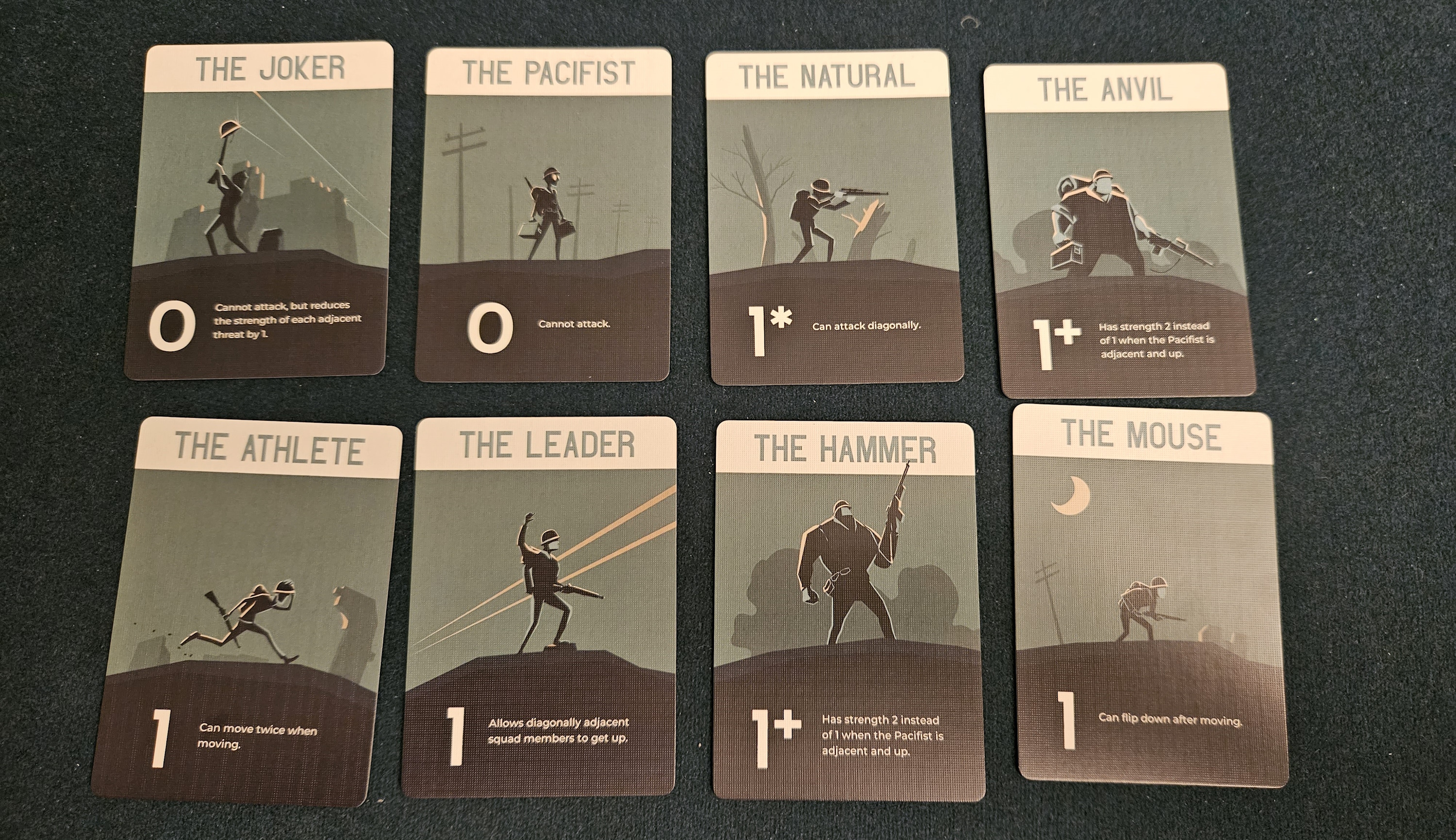
The ordinary eight.
That gag, by the way, is the source of the game’s title. At the outset, you’re presented with soldierly archetypes that could have been ripped straight from a WWII flick. There’s the Leader, standing tall despite the sizzle of tracer rounds overhead. The Joker, waving his helmet on the end of his rifle. The Anvil and the Hammer, built like contrasting barrels. The Pacifist, refusing to bend under the weight of all that spare ammo, face concealed behind Coke-bottle glasses. If you’re paying attention, it dawns on you that there are eight soldiers, not seven. What’s the deal? Maybe one of them doesn’t get used during setup.
Except they do get used during setup. Every last one of them. Soldier by soldier, you arrange them on a grid. Like everything that will follow, setting up The Lucky Seven is effortless. The cards that establish the grid’s parameters also show where each soldier must be placed. There’s an element of randomness at play. The grid only shows the order of their placement. First soldier, second soldier, third soldier, and so forth. The men are shuffled together, and then strung out in a loose formation that puts some distance between them.
Not enough distance, apparently. Placing the eighth soldier completes the deal. In a flash he’s vaporized. Unlucky bastard. Guess everyone else is lucky after all.
But only momentarily lucky. The Lucky Seven follows up on that flashbang of a setup with the buzz of machine gun fire. Every round sees four new threats appearing on the field, one per row. Your squad must weather those threats, darting between enemies, flanking gunners, ducking under fire, dragging their pals back to their feet. By the end, if they’re to escape the killing field intact, they must overcome every last enemy. Begrudging sacrifices will be made. Heroics will be enacted.
It’s gripping. An entire action sequence in ten minutes. Except there are no big-name stars who are contractually guaranteed to survive. Even a successful run will often incur casualties. If we’re being strict about it, there was always that first death. The one you didn’t see coming.
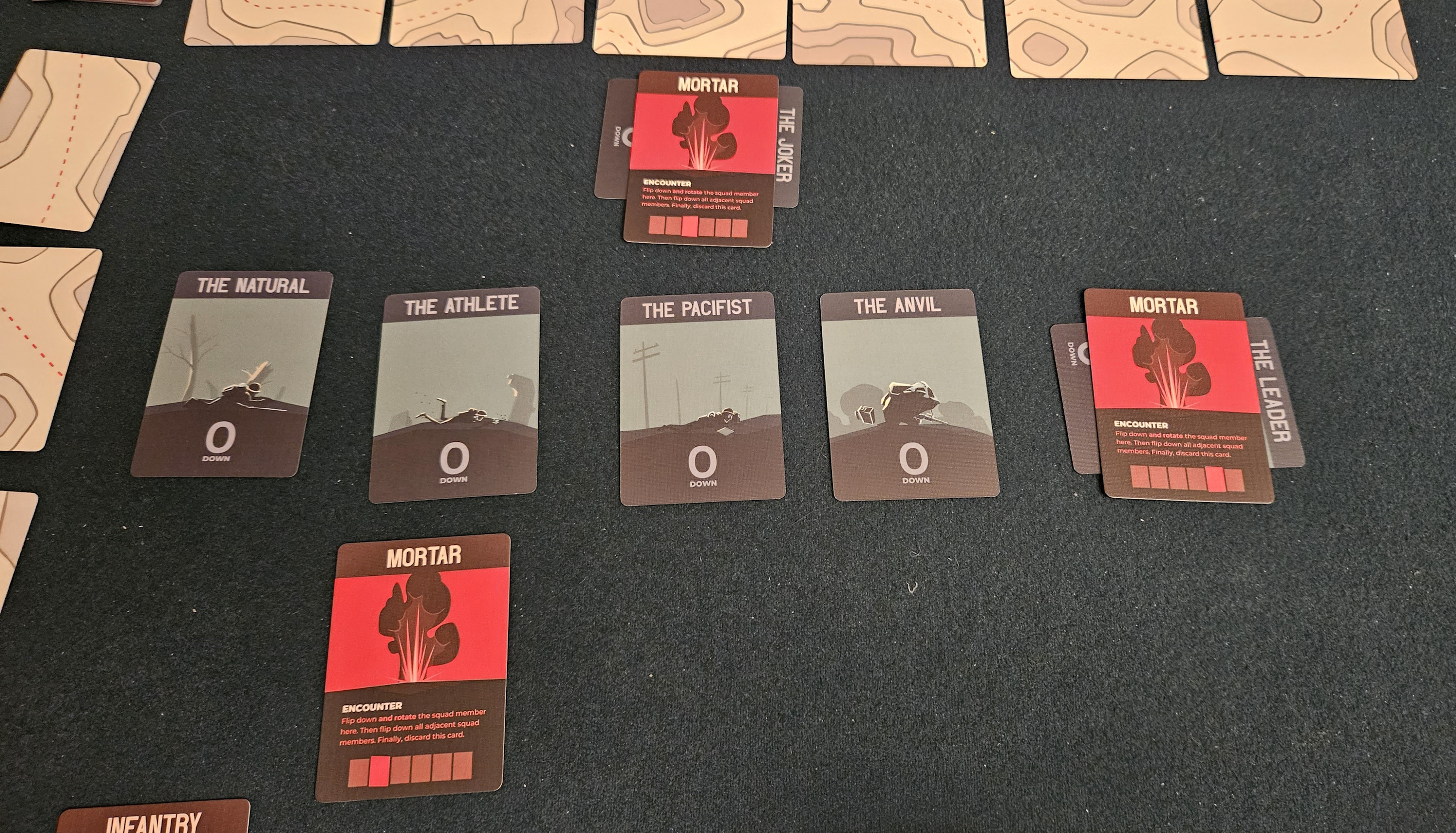
Not feeling so lucky now.
It’s propulsive more than grim, as befits the brevity of the whole thing. Characters matter, both those of your squad and the bogeys pouring into the gap, and the interplay between friend and foe is where Barth deploys the bulk of his considerable talent. For such an evocative game, it wisely limits its verbs to the bare essentials. Enemies appear in random spots, but otherwise they’re static, receiving gunfire or eventually pinging you back. Your own men are restricted to only a few options: moving around the field, dropping to the ground, picking each other back up. The actual business of shooting enemies is relegated to its own phase, not something you spend a soldier’s precious action on.
This spartan language of play allows each soldier to emerge with their own identity. At any given moment, you’ll know exactly where everybody is positioned and where they ought to be, two states that stand in stark contrast to one another. Here’s the Athlete, able to move two spaces instead of only one. Over there is the Natural, able to snipe foes at a diagonal rather than getting up in their face. Down at the bottom is the Mouse, your only soldier who can fight while hunkered down.
The distinction between “up” and “down” is one of The Lucky Seven’s few subtleties. Troops are thrown to the ground when rattled by a mortar, and picking them up requires proper positioning and effort. But it’s also an option to fling your troops into the dirt, and for good reason. Certain foes, such as machine guns and tanks, can only hit your boys if they’re upright. Clearing the field isn’t only about hitting hard, although a proactive defense is surely warranted. It’s also about knowing when to displace, when to duck, when to cower. For such a compact title, this is one game that knows how to squeeze every possible interaction from its limited toolbox.
Granted, at times that toolbox feels a little too cozy. Two of your soldiers, the Anvil and the Hammer, are empowered when standing next to the Pacifist, a tidy bit of natural storytelling that evokes camaraderie and forces careful positioning. If the Pacifist happens to be the unlucky eighth member of the squad who bit it during setup — well, them’s the breaks. You now have two soldiers with effectively no distinguishing ability. Given Barth’s history with solitaire card games, where fairness is a gambler’s delusion at best, something tells me this stroke of misfortune isn’t so much an oversight as a deliberate piece of imported nastiness. If you’re playing FreeCell and all the aces are buried five cards deep, you tinker around until you lose, then you try again with a fresh deal. The same goes for The Lucky Seven. This is a game of chance as much as it is about skill.
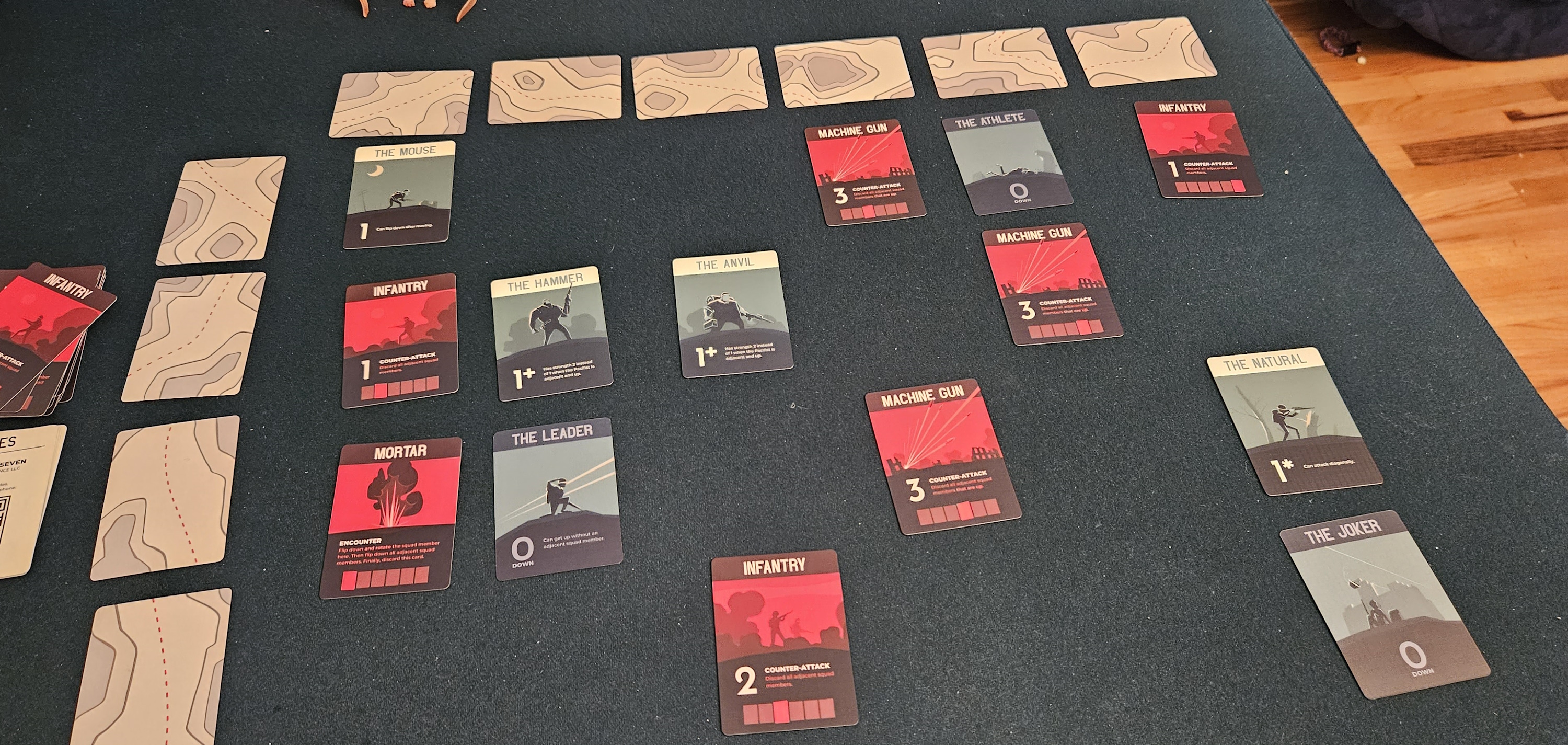
The Lucky Seven is at its best when it’s serving up big trouble.
But it’s also a game of chance where skill can triumph over an untimely reveal. In my last session, three mortars landed at the same time, forcing nearly the entire squad to the ground. Picking everybody back up was a multi-turn process, during which a flood of enemies poured into the arena. Somehow we still pulled it off with only two further casualties. I was counting cards by that point, guessing where the last machine gun might appear, where the last couple of flares would go up, counting the spaces my squad would need to move to encircle the last gunner before the deck ran dry. I’m not going to claim it was so visceral that my nostrils stung from the cordite, but the rhythm of battle was upon me.
Two minutes later, it was over. That’s the beauty of a solitaire game. It ends as readily as it begins, and can be reset or put away on a whim. Yet for all the strengths The Lucky Seven imports from its peers, it also stands on its own feet. I’ve never groaned over the reveal of a four of clubs rather than a two of hearts, but I have been known to slap the table when the Leader gets suppressed for an extra round by an accurate mortar strike. The Lucky Seven succeeds not only because of its brisk format, but also because it revels in the velocity and character of a half-remembered commando movie you watched on TV as a kid. There’s something almost nostalgic about watching your troops maneuver under fire, and wondering, because you’re only a kid and haven’t yet pinned down how these things are written and where to look for the cues that signal every beat, whether the boys will make it out of this one alive. The apprehension only heightens the excitement of a successful extraction. This one’s action-per-minute ratio is as dense as plastic explosive.
The Lucky Seven is currently available from Coincidence. Apparently they don’t have many copies left over. Don’t blame me if they run out.
(If what I’m doing at Space-Biff! is valuable to you in some way, please consider dropping by my Patreon campaign or Ko-fi.)
Posted on July 7, 2023, in Board Game and tagged Alone Time, Board Games, Coincidence, The Lucky Seven. Bookmark the permalink. 11 Comments.


I made it to the second sentence. As soon as you said ‘Zachtonics’, I bought a copy.
Then why’d I even bother writing the rest of this stuff?! Get back in there, Anonymous.
I came back to it 😉
Shoot. Zachtronics. Some fan I am.
I’ve never played any Zachtronics videogames, but they all seem interesting. My interest in this definitely went up with the mention of being designed by Zach.
I always enjoy when you feature less known games Dan, thanks for all your hard work.
(ordered a copy of this)
Happy to do it! I’m always happiest when I’m covering stuff that people might have otherwise overlooked.
Pingback: Ode to the Depot | SPACE-BIFF!
Pingback: We Lack Chemistry | SPACE-BIFF!
Pingback: No More Mr. Mice Guy | SPACE-BIFF!
Pingback: Scratch & Sniffle | SPACE-BIFF!
Pingback: Space-Cast! #53. Scratch & Listen | SPACE-BIFF!