Advancement Tracks
Genre is a funny thing. What counts as a western, for example? Or noir? Is there a tipping point between horror and action-horror? Do genres inform our artistic decisions, or are they labels we slap onto things to arrange them into tidy boxes?
Even though it hasn’t officially hit retail yet, Jamey Stegmaier’s Tapestry has already proven divisive. Right there beneath its title, it announces its intentions. A Civilization Game, it says, front-loading expectations with a whole lot of history. But if it’s a civilization game, it’s certainly an unorthodox one. Some have called it an evolution. Others seem to consider it a misfire. As someone who’s deeply interested in “alternate” civgames, those that seek to portray the sweep of human experience in ways that haven’t been endlessly rehashed, I’ve picked my side. I’ll put it this way: if civgames were westerns, Tapestry would be Cowboys & Aliens.
Barker Placement: A Look at The Grand Carnival

Back in March I wrote about the seven best prototypes of SaltCon, including my personal favorite, The Grand Museum by Rob Cramer. You might remember Rob as the designer of the very silly wallet game Turbo Drift. Or maybe you don’t, because wallet games are tiny and often overlooked among the slew of big releases that clog up the headlines every month.
Well, fate is a strange thing, and not only because it doesn’t exist. After some retooling and a whole lot of development, The Grand Museum is back as The Grand Carnival, it’s better in nearly every way, and I’m here to tell you about it.
Hollow Is Right
As much as I appreciate asymmetry, not every game needs its sides to adhere to different rules. But as long as you’re going for it, there are worse pitches than Skulk Hollow. Basically, it’s man versus monster — except the men are foxes and the monsters are ten-story behemoths reminiscent of Shadow of the Colossus, including the “clamber up their short hairs to stab them in the soft spots” part.
I’ll say this for Skulk Hollow: ambition isn’t its problem.
More Vaster, Less Vastish

What I most appreciated about Vast: The Crystal Caverns was its improbable intermarriage of two ideas. The first was its dungeon, generated in roguelike fashion from a generous stack of tiles, producing a sprawling cavern filled with perils and plunder. The other idea was deep, even idolatrous asymmetry. Far more than the possibility of the multiple heroes offered by so many other dungeon crawls. Rather, it was an all-inclusive medley of characters and play styles. The knight versus the dragon, but also the sneaky thief, a pack of suicidal goblins, and even the haunted cavern itself, all working at cross-purposes.
Just as Vast beget Root, Cole Wehrle’s more approachable take on rabid asymmetry, so too does Patrick Leder’s Vast: The Mysterious Manor emerge from a paradigm established by Root. Which is really just a fancy-pants way of saying that this is a kinder, friendlier Vast — when it comes to learning the rules, at least.
Four Cutting Boards

One of the hallmarks of abstract games is their low barrier of entry. Easy to learn, difficult to master, as you nerds love to say.
Manolis Vranas and Jamie Sajdak’s Shobu — which Google Translate informs me means “processing unit,” although I have no idea how they got that from the kanji for “victory” and “defeat” — is so easy that its three rules are printed on the back of the box. How delightfully brazen! Which is why, although I’m usually loathe to list a game’s rules, I’m going to teach you how to play Shobu right this instant.
Perambulating in Burano
Every so often, a game comes along that makes you say, “Well, that was charming.” Maybe that sounds like faint praise. Fair enough. Often it is.
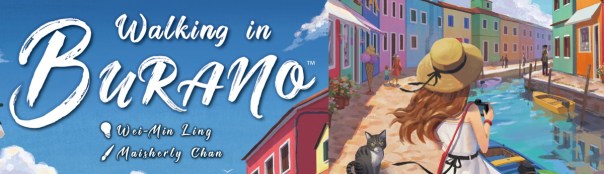
Not in Walking in Burano, designed by Wei-Min Ling and illustrated by Maisherly Chan. This thing walks the line between charming and chewy just enough that I’ll forgive its first player marker being a cat standee.
Mollified

Working my way through the recent catalog of design collective Prospero Hall — including the rather good Jaws and How to Rob a Bank — I’ve been struck by just how different each title is from its peers. Until Horrified. In this one, the spin is that each play features two or three of the game’s six unique monsters, resulting in dozens of possible combinations and interactions. You know, much like last year’s Villainous.
Except when you get right down to it, Horrified is its own beast. For one thing, it’s a cooperative game. For another… well, let’s talk.
Theodolite Not Included
If you’re anything like me, your attitude toward the roll-and-write genre has charted a course from, “Oh, this is neat, and we can all play at the same time!” to “Hm, is this a way of tricking me into showing my work on my seventh-grade algebra homework?” to “Okay, that’s enough of these things.” At first I wondered how long a pad of 100 sheets could possibly last. What a fool I was to think it would stop there.
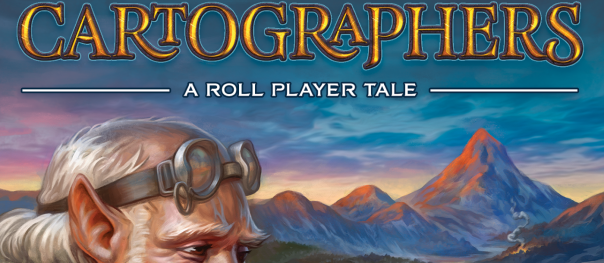
That said, Cartographers may be the first R&W since Welcome To that hasn’t driven me to mindless groaning.
Yippee-Ki-Nope
There’s a well-known quandary in wargames where designers grapple with the accuracy of their own simulations. How closely should a game hew to its historical outcome? Should both sides be equally able to win a conflict, or should the same historical inevitability that ruled yesteryear also rule the game sitting before you on the table? Which better captures the spirit of an event, its true outcome or the uncertainty that rattled within the heads of its actors?
Unless your name is Jake Peralta, Die Hard isn’t history. Still, its cardboard adaptation, Die Hard: The Nakatomi Heist: Board Game, raises similar questions.
Two Minds About Super Punch Fighter

Did you know that Brock Poulsen and Dan Thurot originally bonded over their shared love of Plaid Hat Games’ Summoner Wars? It’s true. Which is why this month’s Two Minds About… is such a meeting of the minds. Welcome to Super Punch Fighter, one of the latest titles from Plaid Hat.
Brock: Tabletop gamers are an opinionated bunch. Ask a group of us our favorite things about the hobby, and you’re likely to hear a lot of tactile answers: The riffle of a deck of cards. A well-written rulebook. The fresh cardboard smell of a new game.
Occasionally, though, this celebration gets weaponized as proof that board games are better than video games. It’s a silly war for which the stakes could simply not be lower. Yet Super Punch Fighter, from Robert Klotz and Plaid Hat Games, tries to bring peace to those warring factions.
Dan: Because it’s a board game of a video game of a fighting game?
Brock: Right. So maybe they’re bringing pain, rather than peace? You’ve reviewed a few fighting games on Space-Biff, including BattleCON and my personal favorite, EXCEED. What do you think are key factors to make a brawler successful?

 SPACE-BIFF!