Category Archives: Board Game
D.B.W.G.: A Look at G.I.F.T.

Look, I love weird social games. How else could Bemused earn a spot as one of my favorite titles of all time? So when G.I.F.T. starts talking about attending an afterlife tea party, meeting the gods of life and death, and being forced to entertain them by stringing silly sentences together in order to stitch your body back together, I’m there. This getup isn’t even particularly illogical. Why shouldn’t a deity want you to debase yourself by assembling preposterous acrostics? Have you seen the world we live in? Makes sense as far as I’m concerned.
But that’s the elevator pitch. In practice, however… let’s get into it.
Betray Me Twice, Shame On Me
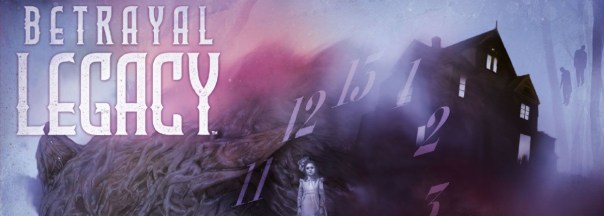
If you’ve been in this hobby long enough — or even if you haven’t — you’ve likely heard of Betrayal at House on the Hill. As an elevator pitch, it’s exactly the sort of thing that non-nerds might say appeals to actual-nerds. A mansion cobbled together from random tiles, scattershot with flipped cards and flavor text, and boasting a crescendo wherein somebody is transformed into one of oh so many monsters and pitted against their former fellows. Infinite games in one! You’ll never need another!
And now there’s a legacy version. Like a haunted carnival, the fun might never stop. They did say it was supposed to be horrific.
Dolt

There’s nothing wrong with the idea that robots might one day enter the arena and wage battle for their own amusement; far better, at least, than them forcing us into the ring. In the distant future of Volt, it seems that our species has been shuffled offstage with the reverence usually reserved for a soggy box of yesterday’s banana peels. With no one left to conquer, the bots have turned their attentions inward. It’s only logical.
Instead, my issue with Volt is that I drew more enjoyment from the crafting of the above paragraph than any of my time spent in the game’s company.
We Meet Again, Cabbagehead

He may be terrifying, but that doesn’t mean Mr. Cabbagehead doesn’t have enthusiasms. Farming his cousins, for example, followed by a village-wide exhibition of their corpses and a pale supper of their crisp flesh. Such is life for a ghastly were-vegetable.
In the three years since I reviewed Todd Sanders’ Mr. Cabbagehead’s Garden, everybody’s favorite sentient leafy green has grown up. Now he’s got a publisher, a posh production, and even a two-player mode. Guess he sufficiently impressed Eudora Brassica after all.
Choice Amidst Chaos: Imperius

It isn’t reasonable to expect that you’ll master Grand Rodiek’s Imperius on the first play. Crud, I’ve written about it twice before — once as Solstice, again as a preview — and still I’m uncovering new tricks. For example, the “lose to Adam even when I’m ahead by ten points” trick.
Let me explain it for you. Then you too can be a professional Imperator.
Tokyo Jambalaya

I have a rule here on Space-Biff! that I take rather seriously, that I always play a game at least three times before I evaluate it. Tokyo Jidohanbaiki is one of the few times I’ll be making an exception. It isn’t a single game, for one thing. Rather, it’s a compilation of eighteen minigames, across multiple player counts, play lengths, genres, designers, and even one that requires you to own another game as a prerequisite. Fifty-four plays and another purchase in order to write about a box that I keep mistaking for gum? No thanks.
But the bigger issue is that, despite being spearheaded by Jordan Draper, an up-and-comer with a captivating eye for design, Tokyo Jidohanbaiki is also an example of why collaborative efforts so often fall flat.
Good Goodcritters

There’s no joy quite as pure as ripping off your friends. Sadly, I never got around to playing Tiefe Taschen, Fabien Zimmermann’s previous friend ripper-offer. Fortunately, thanks to the appearance of Goodcritters, there’s no need. This thing is lean and punchy. Exactly how I like my frivolous time wasters.
The Dry-Erase Smudge Marks the Spot

Tim Curry has been captured! His treasure lies buried somewhere on the island. Gonzo, Rizzo the Rat, and that bemulleted blonde kid — professional pirates all, a real festival of conviviality — are racing to figure out Tim Curry’s clues and unearth the gold. That’s right, it’s Robert Louis Stevenson’s Treasure Island, a book that I’ve absolutely read. And in cardboard form, it may feature fewer musical numbers than the original, but it’s also a sublime deduction game.
Most of the time, anyway.
A Zero-Star Review of The Estates

I don’t usually assign scores, but The Estates deserves zero stars. That’s right. Zero. As in nothing. Even harsher, I’ll award its predecessor, the decade-old Neue Heimat, negative eight points. Just for being German. Yeah, I went there.
But here’s the thing: when it comes to The Estates, that’s a stupendously flattering score. Come on down and I’ll explain why.
Pax Polemical

Phil Eklund’s Pax Series has always sparked controversy, although never to the extremes of Pax Emancipation. Its mere announcement prompted concerns ranging from the assumption that it would defend the practice of slavery (it doesn’t) to wondering if Phil’s libertarian worldview would color the game’s approach to history (duh). The game itself was almost secondary.
In person, there’s nothing secondary about it. Pax Emancipation stomps into the room with all the bashfulness of a rhinoceros, demands everybody’s attention, and proudly proclaims its views on a whole range of topics. And then, like an actual rhinoceros, it makes a big steaming mess on your carpet.

 SPACE-BIFF!