Indie Midnight
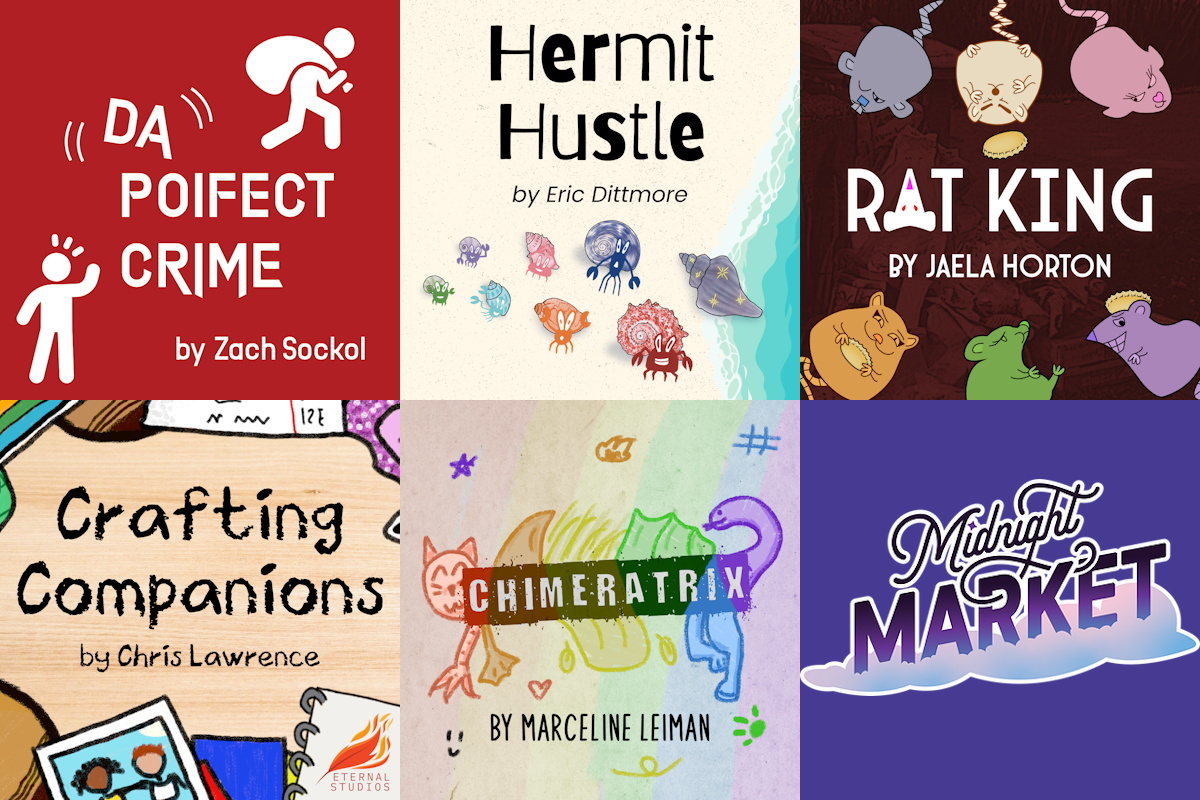
Unless it tips into hubris, I happen to love ambition. Here’s an example: Lunarpunk Games, which has thus far served as a bite-sized imprint helmed by Matt Hocker and Xoe Allred, publishing small idiosyncratic titles like Conviction, Color Jam, and Vibes, is launching an online midnight market tonight. Five games in limited quantities, all from different designers, all playable with up to six people, all ultra weird. Step aside AllPlay. Watch your ass, Bitewing. Lunarpunk is stomping up the slide, and there isn’t anything you can do about it.
Naturally, I’m here with a micro-review of each title. Buckle up. Here’s the skinny. The scoops. The jams.
Engaging in some bad behavior.
Da Poifect Crime
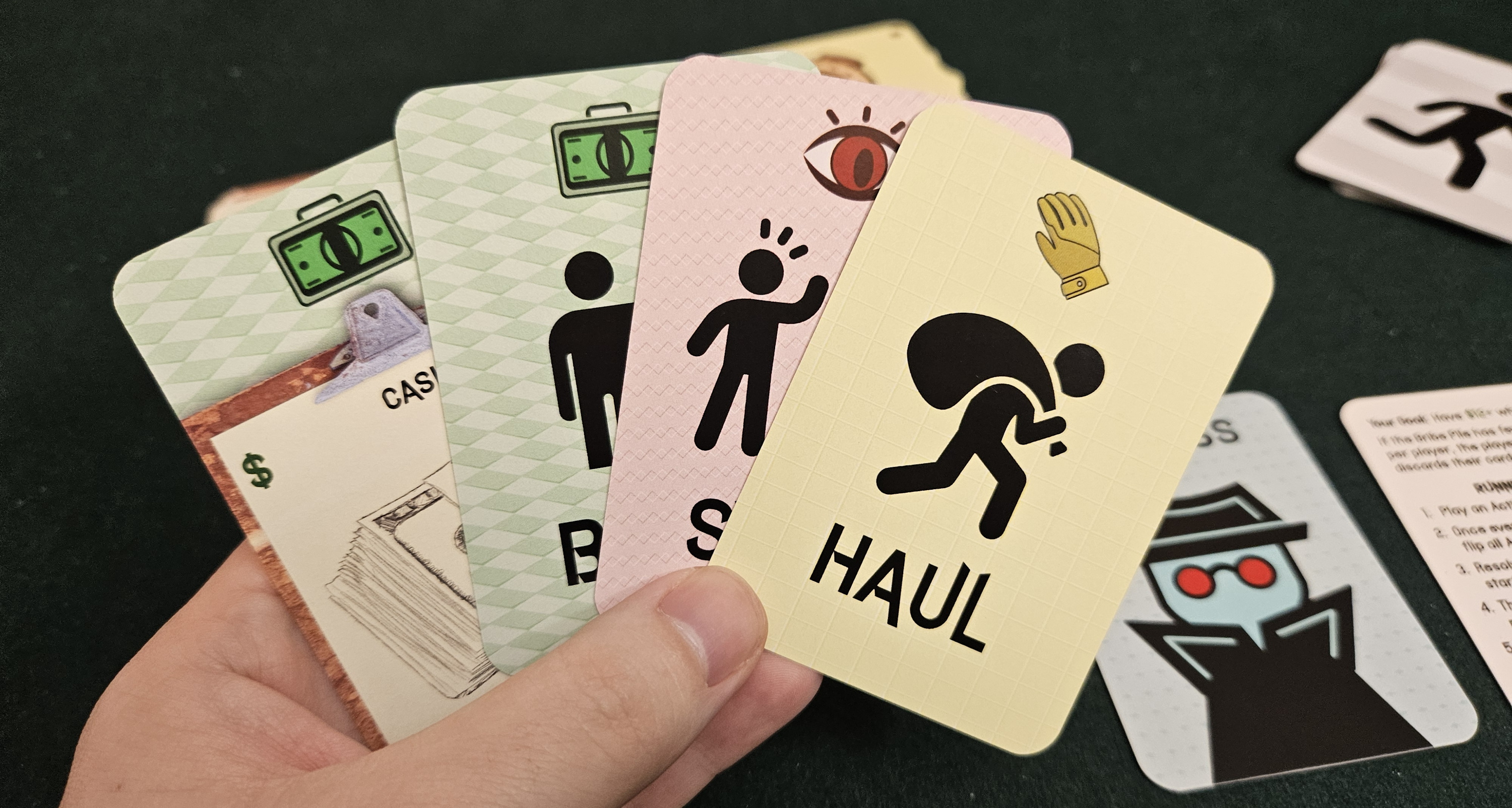
Ever had the dark urge to knock over your local credit union? Not even a different one, but your very own branch, the one where all the tellers know you by name and voice, because for whatever reason you’re always chatty when depositing checks? Uh, me neither. Da Poifect Crime, by Zach Sockol, is about robbing a bank, but doing so very badly. The vault is full of cards. Most are cash, in denominations of ones, twos, and threes, but there are also special loot cards that might be worth a lot or a little, and could change the rules on the fly.
Being a criminal, and keeping company with other criminals, means that nobody at the table is especially trustworthy. In theory, there’s enough in the vault for everyone at the table to escape with enough loot to retire in leisure. It’s only a matter of getting out with twelve money icons on the cards in your hand. Oh, and bribing the guards so that they don’t pinch whichever criminal has the most cash.
In practice, nothing goes according to plan. And really, it’s your own crew’s fault. Each turn, everybody assigns an action, whether hauling loot from the vault to your hand, bribing the guards, or stealing from your fellow criminals and/or the bribe pile. It’s important to mix up your approach. Too much hauling risks spillage, diminishing the cards in the vault, while stealing tends to make enemies, whether of your fellow criminals or the guards you’re paying to look the other way.
There have been countless riffs on the Prisoner’s Dilemma, and Da Poifect Crime illuminates why the thought experiment is evergreen. The concept is simple. Three possible actions. Straightforward goal. Clear incentives. Despite that, the social space is fearfully wide. Even the slightest misstep can feel catastrophic.
Cracking the vault.
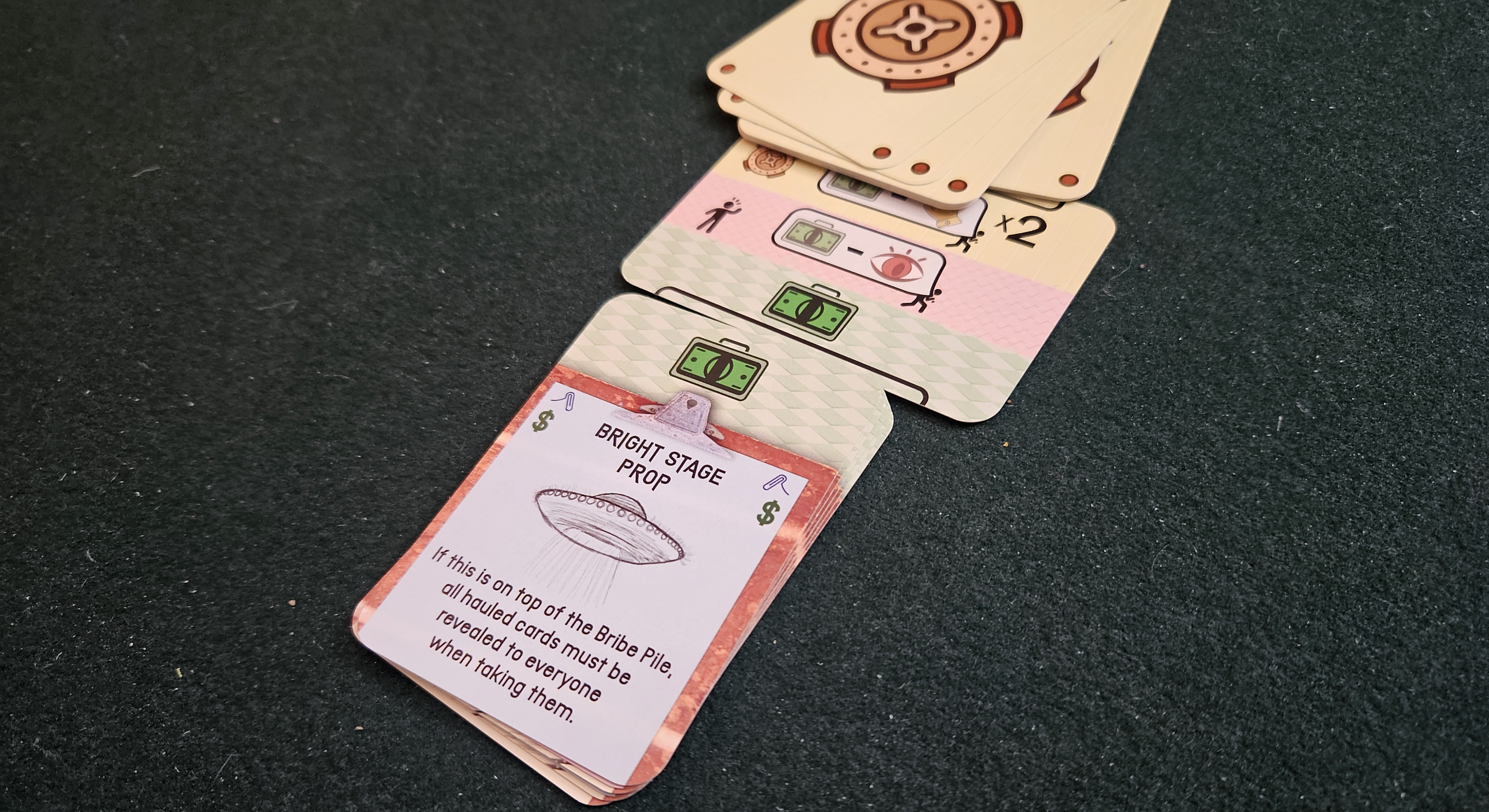
What really makes it interesting is the special loot. You might, for instance, recover a small safe from the vault. When you bribe with it, you can discard any number of cards from your hand. Which might sound counterintuitive, but it’s a great way to drop your card count down to the point where nobody can steal from you. Or there’s the fragile vase; when someone steals it, it breaks. Take that, co-conspirator! The precious mirror lets you look at another player’s hand. The still-wet masterpiece wrecks your chances of winning if the guards aren’t sufficiently bribed. There are heaps of possibilities, but only a few appear each heist.
I will say, Da Poifect Crime is a little too mathy and sequence-bound for my tastes. Turn order matters a lot, and two of the three actions are tied to a little equation. This isn’t difficult math, obviously, but tallying dollar symbols minus haul and steal symbols, especially when those icons are spread across the table, slows the procedure for what would otherwise be a lightning-quick game.
On the whole, I would label this the weakest of the quintet, although it’s still enough of an odd duck that it’s worth playing with the right crowd. In particular, it leverages the multi-victor angle to great effect. There’s nothing quite like the promise of the entire gang — or most of them — getting away with the crime, only for everyone to behave like such a backstabbing bastard that everybody winds up in the slammer.
Crabs!
Hermit Hustle
During molting season, hermit crabs often engage in “vacancy chains,” arranging themselves in such an orderly queue that they might as well be British, and then swapping out shells for the next-largest option. Eric Dittmore’s Adulting was one of last year’s best indie games; now Hermit Hustle turns those carcinized chains into fodder for a bunch of friends to out-upgrade one another.
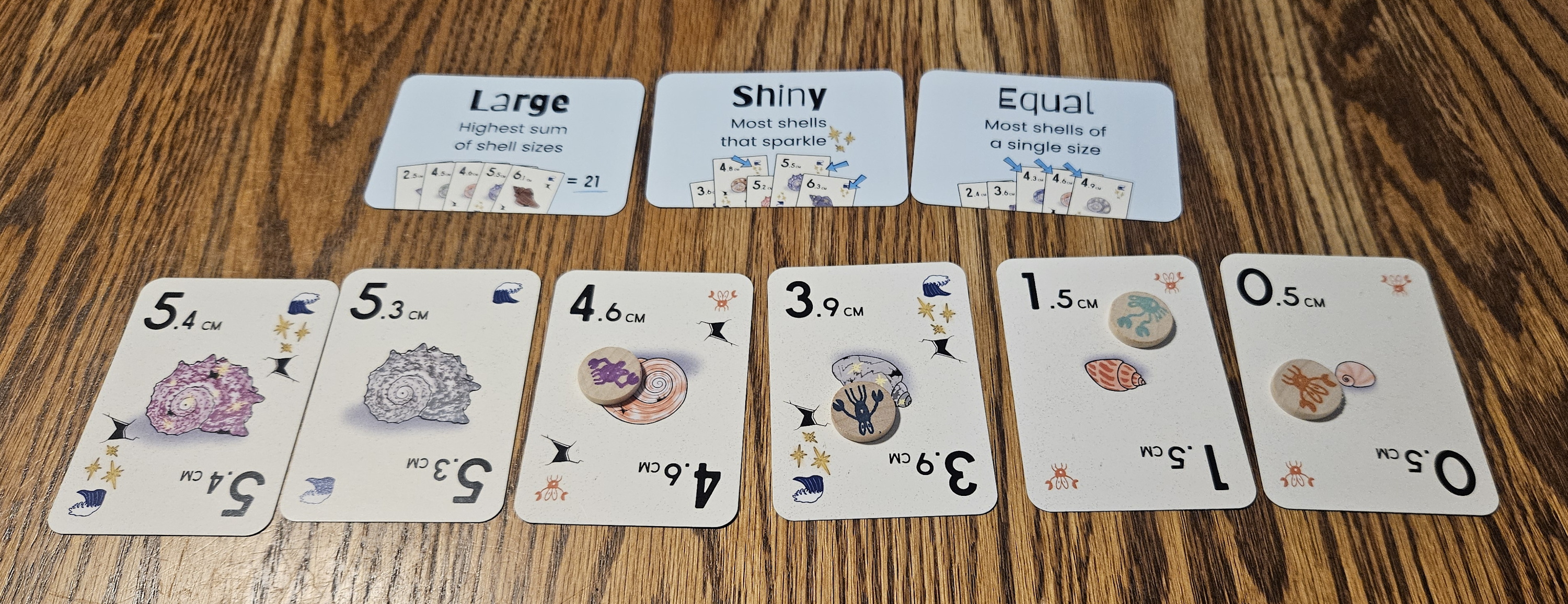
The gist is as orderly as those crab queues. Everybody at the table has a hand of cards, each showing a different size of shell. Two new shells are revealed from the ocean. Then everybody simultaneously plays a shell from their hands, lines them up in order of increasing size, and shifts upward. Repeat a few times and there you have it: Hermit Hustle.
While Hermit Hustle isn’t too preoccupied with winning, it does provide objectives. Each session offers three “crab dreams” that you hope to accomplish. Perhaps your hermit crab dreams of inhabiting shiny shells, or shells without chips and cracks, or owning a garage full of shells of equal value. Maybe they’re thrifty hermit crabs, in which case they want to take shells from the other crabs in their chain rather than those washing in from the ocean. The orderly hermit crab hopes to make a run of shell ranks. That sort of thing. The rulebook says it isn’t a big deal if you don’t accomplish a crab dream, but let’s be real here. Hermit crabs are the least chill of the anomuran decapods. Do you think they’d accept victor-agnosticism? I sure don’t.
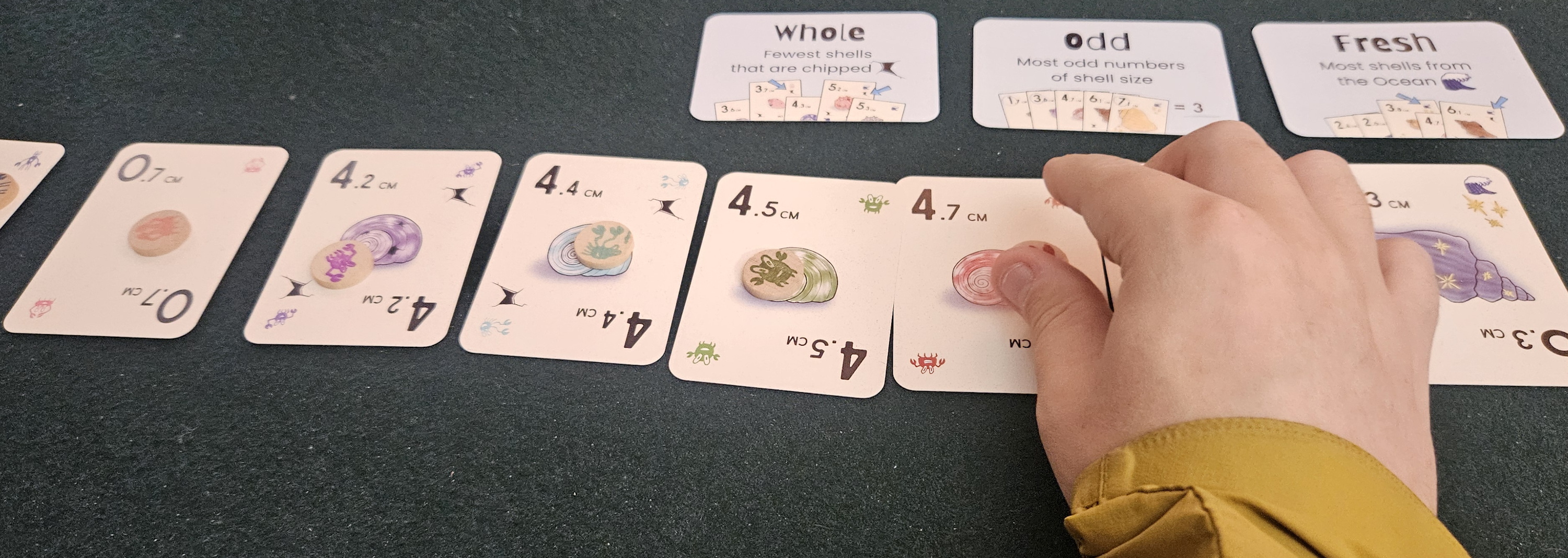
Crabs! On a different table!
The vibe of Hermit Hustle, unlike that of its protagonists, is chill in the extreme. There’s room for the occasional darn-it but not much beyond that. Certainly it’s antithetical to dropping f-bombs. You play some shell cards, move some cute crab tokens, and get reassured that winning doesn’t matter. I might even offer it as a nice cooldown title in between harsher sessions.
Then again, the other adult members of my group weren’t enamored. Some of that is suspicion for the absence of a victory state, which victorless titles are still striving to overcome. But it’s also the game’s general insouciance. It’s less a game you play or master, or even explore, than one you observe. My kids announced loudly that they didn’t understand it, but they declared that they had a nice time swapping shells.
Which is fine, as these things go. There’s still something to be said for its therapeutic potential. But this is the second title from the Lunarpunk Midnight Market that didn’t land as soundly on my table. Fortunately, the others are more interesting.
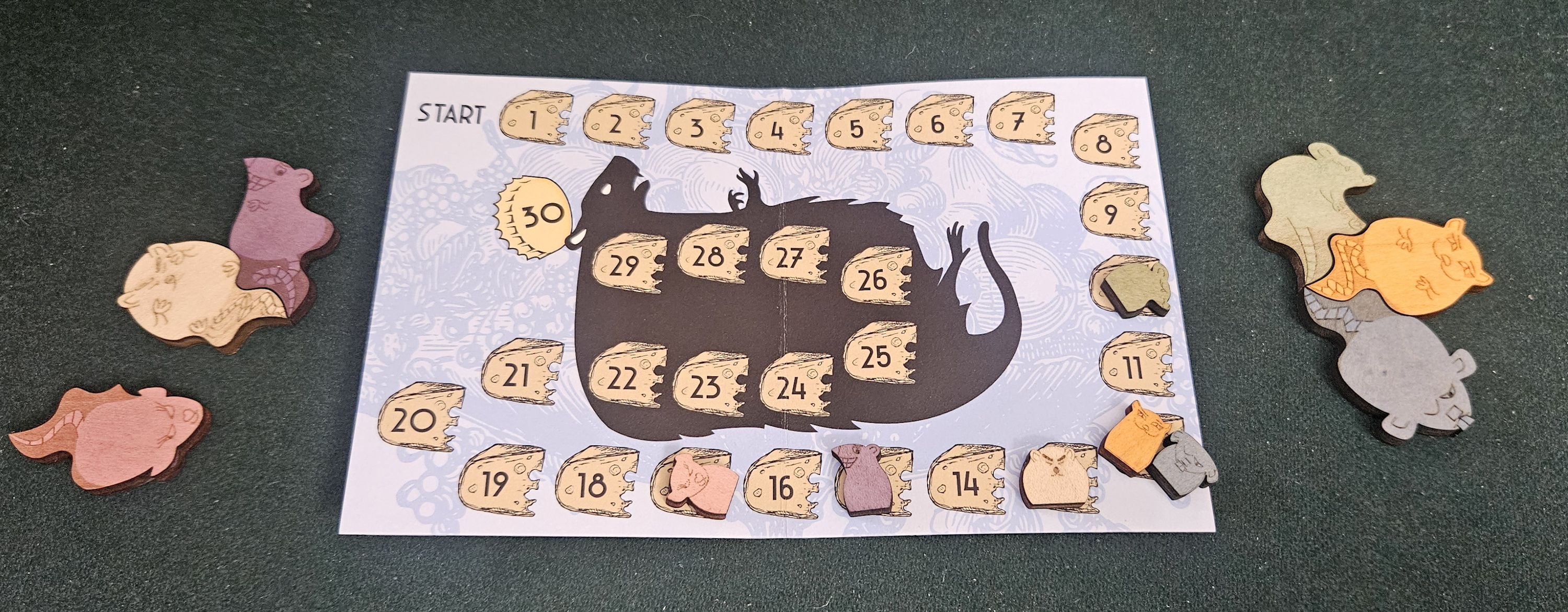
Aw rats. All tangled up.
Rat King
Sometimes, when rats swarm, their tails will get tangled together. If enough rats are thus snared, and should die together in a sort of horrible wreath, that is a rat king. Which gives Jaela Horton’s Rat King a grim undercurrent. Doubly so because knotted rats are its central selling point.
It works like this. Your goal, as a rat, is to reach 30 weight. You do this by visiting various locales to consume the food lardered within. There’s some ornamentation to this process, such as two tiers of cards — which, colorfully, you’re supposed to announce with either one or two squeaks — lending the game a shade of our old friend the Prisoner’s Dilemma.
The centerpiece, however, arrives when two or more rats visit the same destination. These rats then become entwined, both physically on the table using the cutest rats ever tail-tied together, and in terms of the ensuing gameplay. Tangled rats share their food, splitting it right down the middle if possible, and with the scrawniest rat breaking any ties. They also discard all but the highest card played by their shared number. This can be a boon, especially in the game’s mid-stages, after players have discarded some cards and the guessing is a little easier. But it robs the paired players of any chance for a truly gluttonous meal, those rare moments when you slip through everybody else’s plays to nab six or eight food for yourself.
The other hitch is that getting out of a tangle is the most “expensive” option in the game, action-wise. Each player has a “slip free!” card, but playing it means you’ll eat no food at all. In a tangle, it’s your ongoing hope that some other rat will expend the calories to escape, leaving you free to continue gnawing at the feast.
Meanwhile, a full rat king — all players in a single knot — means everyone dies together.
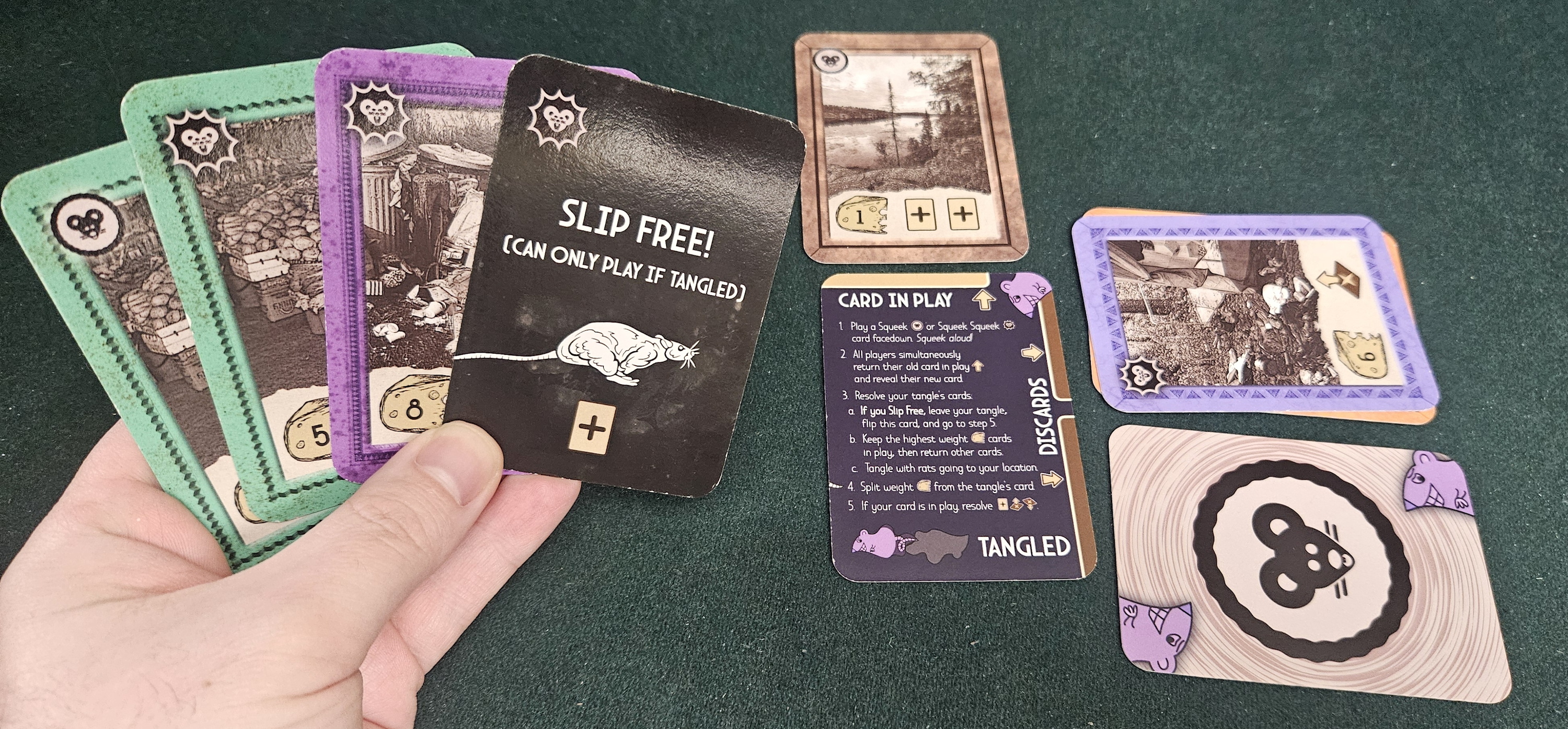
Should I untangle or nah?
First, the downside: Rat King is itself slightly tangled, especially in terms of procedure. Knowing the sequence of events (discarded duplicates, slipped-free rats, shared food, card actions) is essential to the process. It’s easy to slip up, at least until you’ve internalized the game’s logic.
Once mastered, Rat King is quite the thing, comedic and grim and expert at studying its horrific incentives. It reminds me, obliquely, of Scott King’s The Hedgehog’s Dilemma, which also paired and de-paired players, not to mention threatened corporate failure, to great effect. Rat King approaches the question from an entirely different direction, and isn’t quite as sturdy as that title, but the waters are similar.
But what carves it out as the first big success of the collection is the presentation. The wooden rats with their perfectly-fitted tails. The sepia locales that evoke raw caloric intake and little else. The card actions, which present little barbs even for rats that successfully slip through the crowd. It’s a smart game, one enriched by little touches that weren’t strictly necessary but which deepen its shades of gray until they’re stark outlines in a dim room.
The next two are even better.
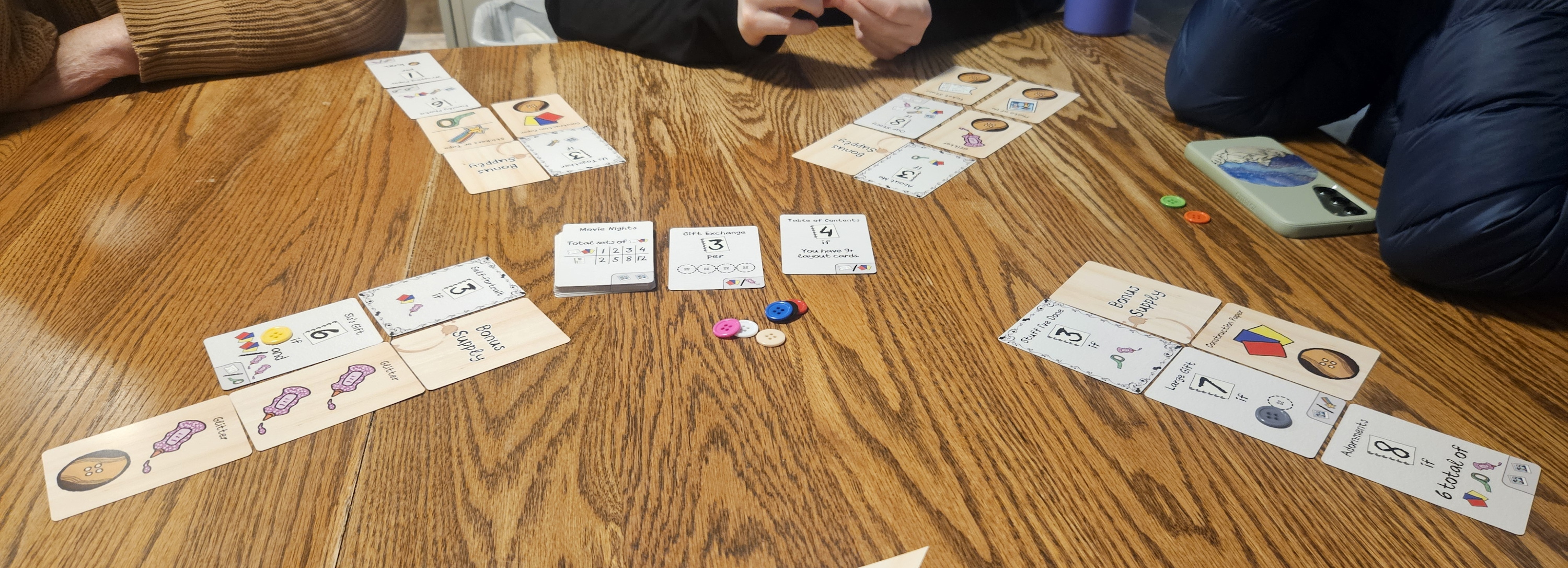
Scrapbooking as a family.
Crafting Companions
Chris Lawrence likes to break brains with unusual play formats, as we’ve seen with both Propaganda (take pictures of battlefields!) and Coupon Clipper (clip coupons with kindergarten scissors!). Crafting Companions is probably the brain-breakiest of the bunch, usually eliciting a sigh-like “Ooohhh” halfway into the first session.
Notionally, everyone at the table is engaged in the serious business of scrapbooking, a cutthroat endeavor if ever there was one. Already, though, Lawrence includes maybe one of my favorite concessions to new players — and I mean ever — by allowing each player to select their own difficulty level. If you’re new, you’re trying to arrange 35 scrapbook pages. Basically, victory points from cards. Everyone else is also allowed to pick either 40 or 45 pages. It’s a great trick that blunts a first-timer’s disadvantage or a veteran’s familiarity with the cards, and does so without actually changing anything.
From there, players get to drafting cards from the center of the table. In the style of Point Salad, these either provide resources — glitter glue and family photos and ticket stubs and everything else that scrapbooking’s violence is built of — or scoring conditions. In the latter case, that might be something like “My First Sticker,” worth 5 pages if you have a sticker symbol and some glitter glue, or “Moments,” if you have six total photos, ticket stubs, and stickers.
But here’s the genius bit. After drafting the card and choosing which side to use, you place it either to your left or right. It now sits in a shared column with your neighbor, and also contributes its resources or page-count to them as well.
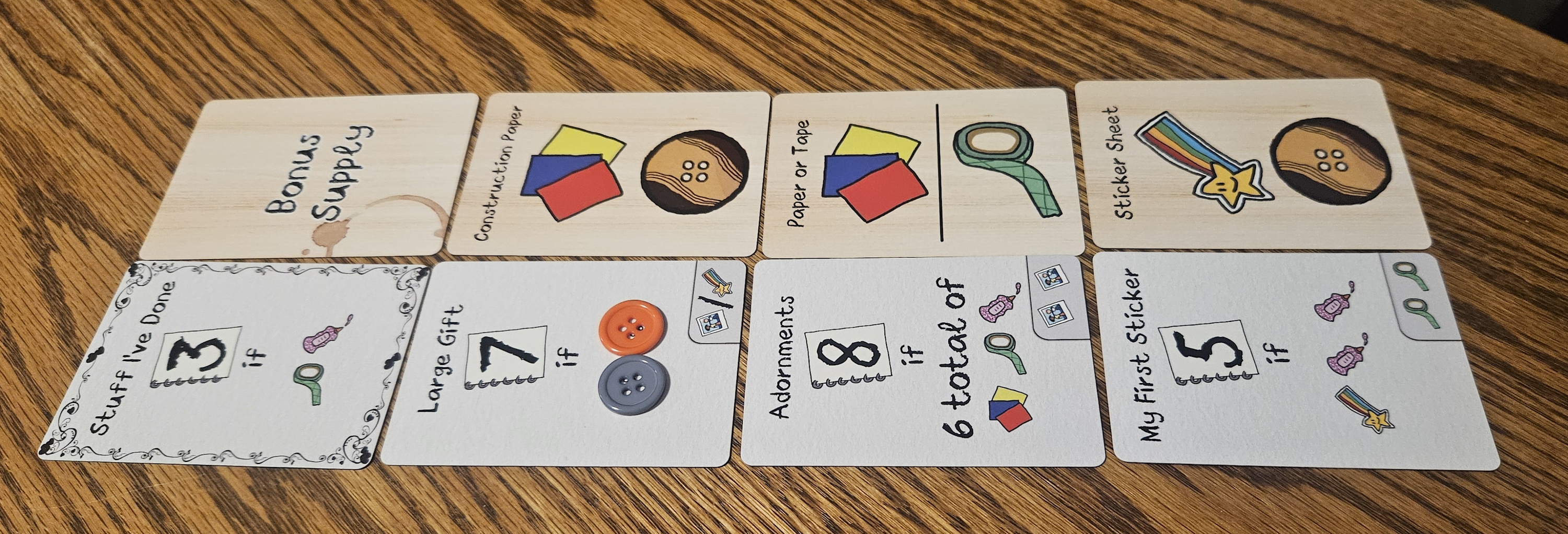
One of your two shared tableaus.
The implications are so far-reaching that they stop being implications anymore. Crafting Companions is simultaneously cooperative and bitterly competitive. When you play a generous resource card to one of those shared columns, or better yet a goal your neighbor already meets the conditions to accomplish, you’re a hero. But when you slap down a page they’ll never be able to use? Hoo boy. You better be ready to weather a glare.
It helps that Crafting Companions is tough. Even on its easiest level, completing 35 pages is no easy task. Every game in this collection explores social ambiguity: nonranked placements, semi-cooperative play, that sort of thing. But nowhere is that ambiguity sharper than here, where every single card is either a helping hand or a jab below the belt to one of your neighbors.
Are there downsides? Mostly that people almost never get it at first. Also, the cards are limited at the top player count; there are enough, but I’d rather see a few extra to ensure the final players have a full draft rather than picking from the one or two leftovers.
But those are incredibly minor compared to what Crafting Companions does well. This game is sharp, sharp, sharp. Certainly sharper than the scissors that came with Coupon Clipper, I’ll tell you that. Sharp enough to nip some fingers and test some friendships.
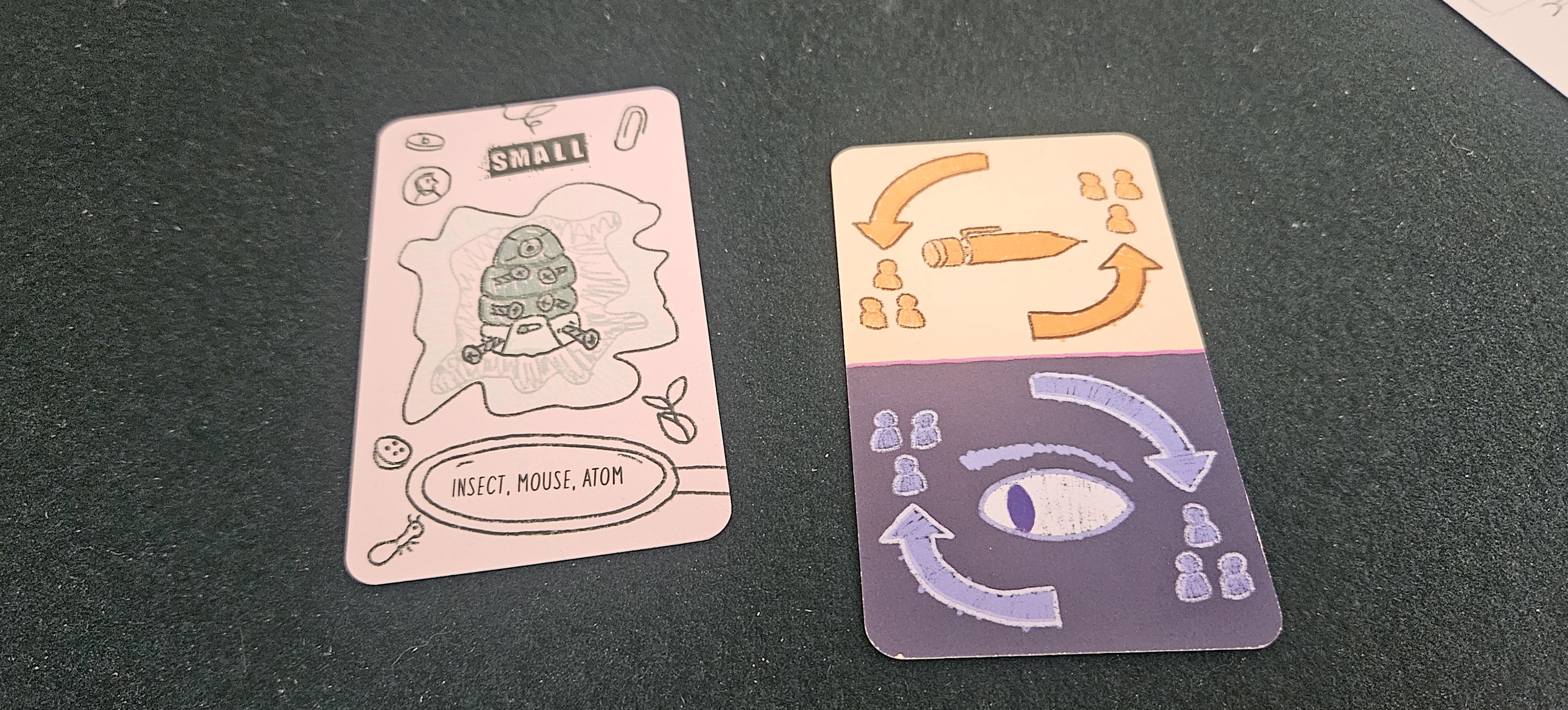
Get drawin’, kid.
Chimeratrix
Chimeratrix, designed by small-game wunderkind Marceline Leiman (High Tide, Dino Racer), is not a trick-taker, no matter how its title sounds. Rather, this is one of the shrewdest, laugh-out-loudest drawing and guessing games I’ve played. Even if someone at the table is terrible at drawing. Especially then.
You are a chimera. Every round provides a prompt; you provide the specific noun(s) by jotting them onto your personal 3×5″ card. For example, if the card prompts you with “large,” you might write “hippo.” Or “skyscraper.” Or “gigantic frickin’ blimp.” These cards will then be passed, hidden, to other players, who put them face-up but still unseen in front of them, like any number of tavern guessing games.
To figure out the word on your card, you draw a picture. Everyone does. Using the three words to your right or left, depending on the round. So now you’re drawing, perhaps, a “hippo skyscraper blimp.”
What happens next is a masterpiece of eliminative logic. By looking at the drawings of your peers, you strip away the possibilities. There’s a hippo. There’s a blimp. There’s a… dump truck? Am I a dump truck?
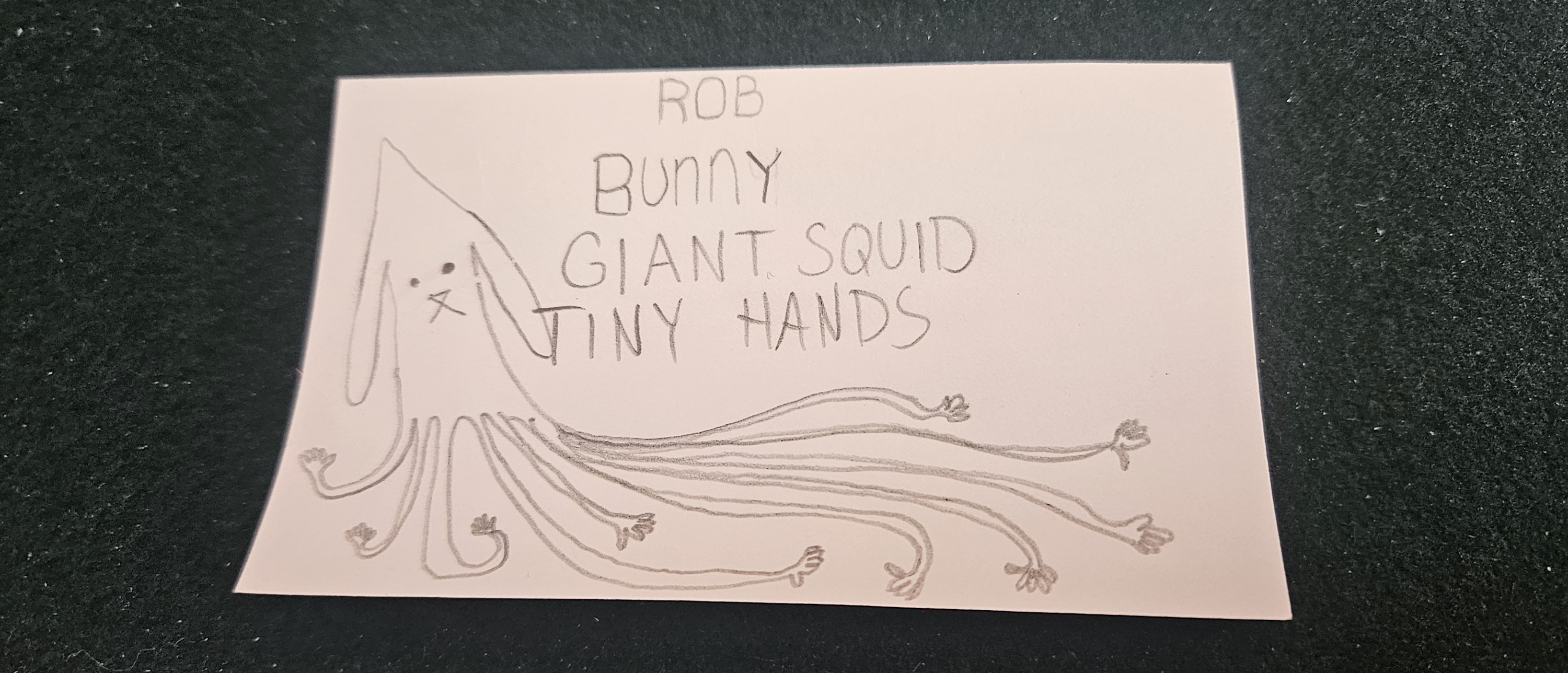
My friend Rob’s secret identity.
This is already clever, but it’s what comes next that makes Chimeratrix special. When you guess correctly, you jot that noun onto your permanent character card. Over the course of multiple rounds, this establishes your identity, which you’re invited to sketch as one final drawing. You can see one above: my friend Rob realized he was a bunny (from the “Cutie” prompt), a giant squid (“Danger”), and had tiny hands (“Small”). This is now his identity. Forever. Or at least until his biological fluidity leaves him altered yet again. Probably the next time we break out the game.
I suppose I should say that there’s some brittleness to Chimeratrix. Duplicate nouns sorta bust the proceedings, and when it comes to picking words there’s a sweet spot between clever enough and too clever. It behooves players to operate with a degree of grace, giving someone a win even when they’re off by a little bit. Of course, there’s some wiggle room there, because how close is close enough to count? I dunno. Adjudicate as you see fit. I’m not your dad.
There are other little touches, but they’re almost as ancillary as Rob’s tiny hands. Leiman includes a deck of event cards to shake up the proceedings. These are a nice addition, but not strictly necessary. Not like Xoe Allred’s incredible illustrations of the prompt cards, anyway, which serve as the game’s sole art and perfect examples for those who aren’t sure how to draw a chimera.
Chimeratrix is something special. I’m tempted to linger over its inherent queerness, the way it gazes at bodies and identities as changeable but still as recognizably belonging to their owners. Honestly, though, I’m wary to do so. Not for fear of pushback. But because this is a micro-review, which really wouldn’t do it justice. So, bottom line: Chimeratrix is wonderful. Wonderful and weird and full of bright moments.
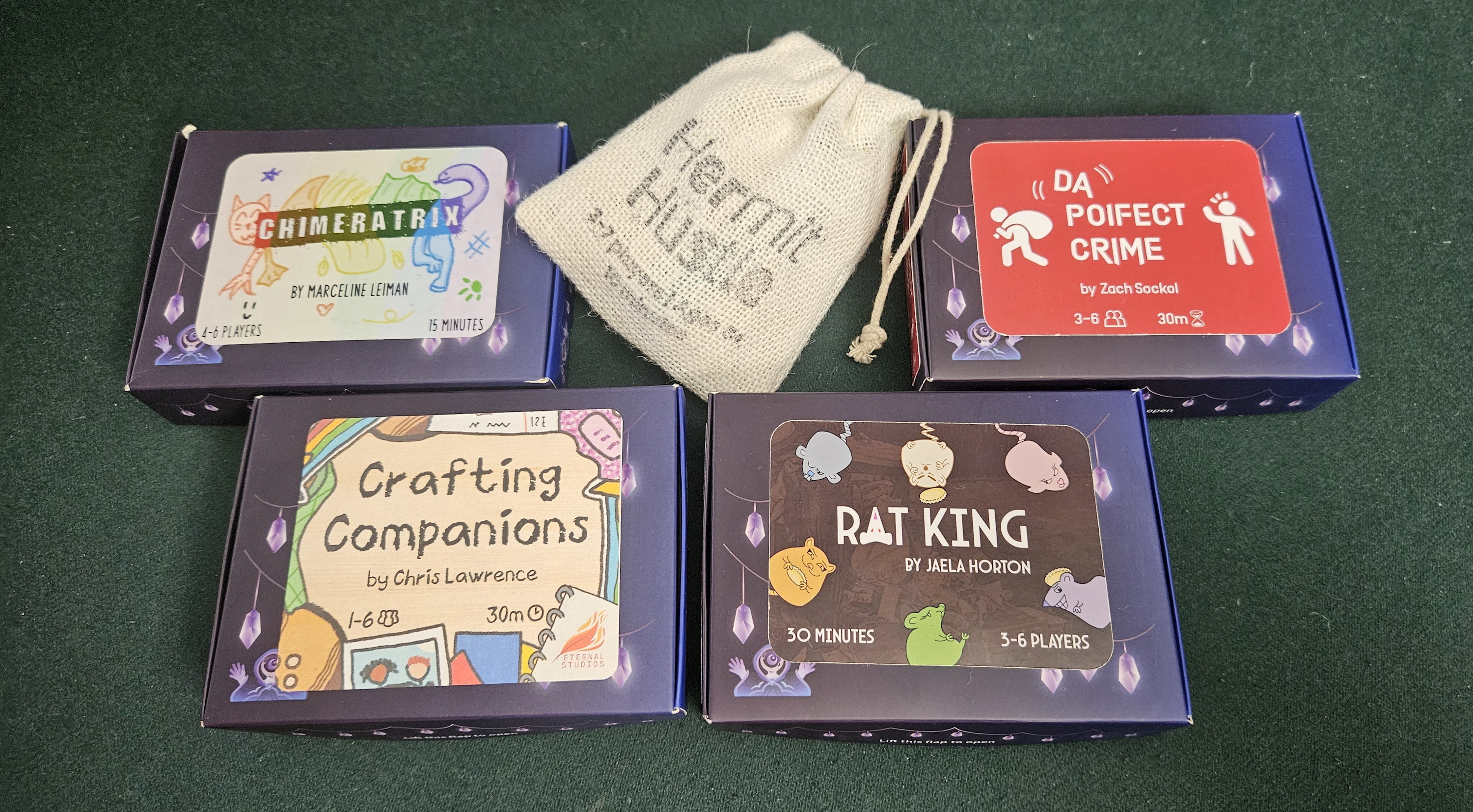
Hark! An chimera!
Really, that could describe the entire collection. I have my favorites, but there’s a goblinesque tricksterism to the entire set that leaves me feeling affectionate even toward the ones that didn’t totally land for me. I’ve always appreciated games and designers that toy with the status quo, and these games, with their strange social spheres and wobbly win conditions and purposeful ambiguities, exemplify that playfulness.
Complimentary copies of the Lunarpunk Midnight Market titles were provided by the publisher.
(If what I’m doing at Space-Biff! is valuable to you in some way, please consider dropping by my Patreon campaign or Ko-fi. Right now, my third-quarter newsletter is open to all.)
Posted on November 26, 2026, in Board Game and tagged Board Games, Chimeratrix, Crafting Companions, Da Poifect Crime, Hermit Hustle, Lunarpunk Games, Rat King. Bookmark the permalink. Leave a comment.


Leave a comment
Comments 0