Trap, Neuter, Rub Tummy
I had never considered the problem of feral domestic cats until I was asked to check in on an elderly woman in rural Montana. Her home was a single-wide trailer with broken windows and a kicked-out hole at the base of the door. Entering the home, we gagged at the smell. Dozens of cats lived within, climbing in and out of the house at will. Decaying elderly cats, spry mid-aged cats, infant kittens. When our host asked us to sit on the couch, I had to shift a hollow-seeming cat out of the way, only to realize mid-handling that its shape was the sunkenness of a creature that had passed sometime in the not-so-recent past.
Domestic cats are considered one of the worst invasive species in the world, contributing to the collapse of ecosystems as cats deplete local wildlife. Community Cats is a solitaire game designed by Manda Shafer for this year’s Indie Games Night Market at PaxU, and it highlights one effort to manage feral colonies: trap-neuter-return programs.
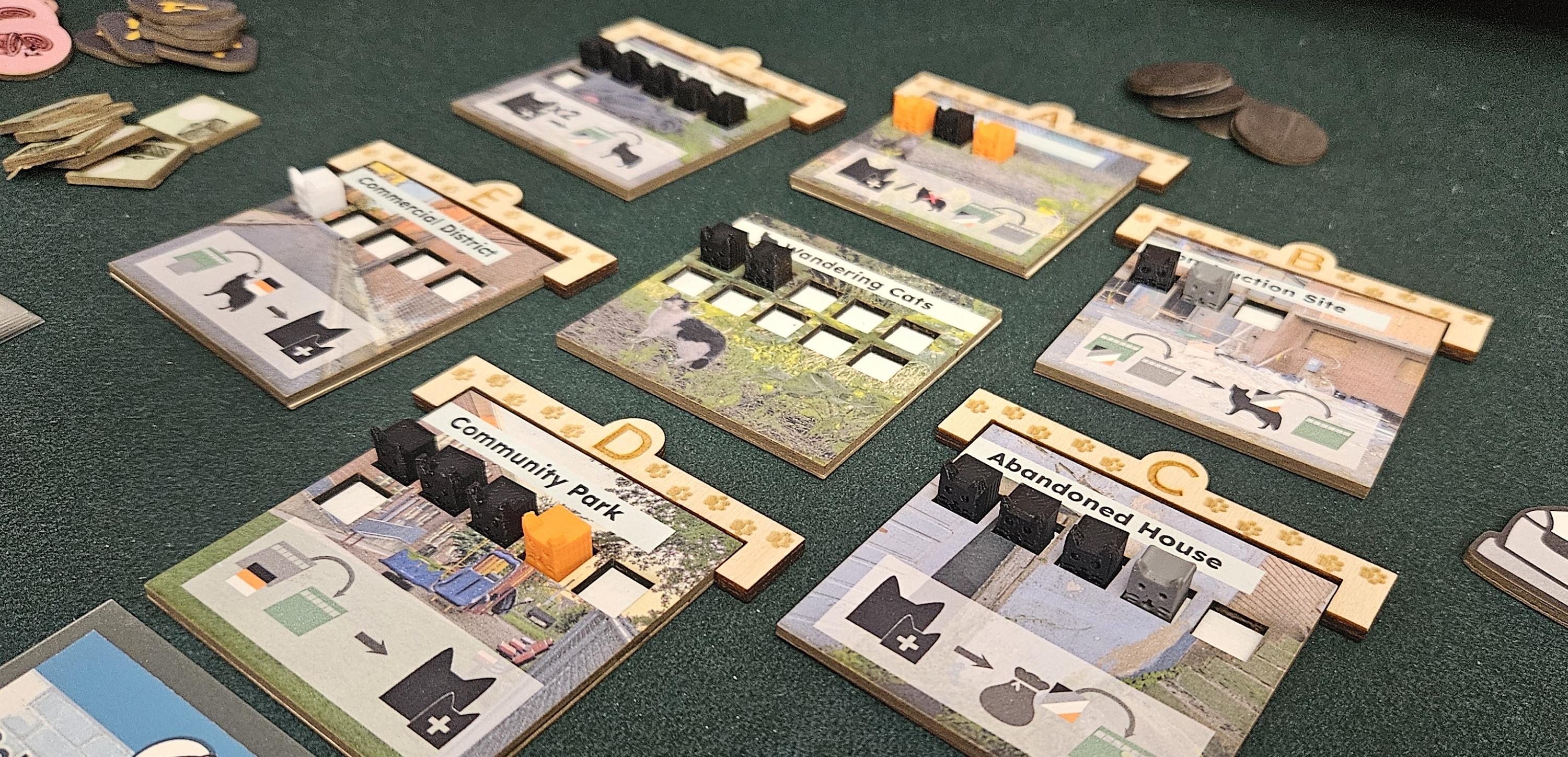
Different colonies have their own behaviors.
Trap-neuter-release refers to the process of… well, it’s pretty much right there in the name. Feral cats are live-trapped, transported to veterinary clinics to receive shots, have parasites removed, and be neutered or spayed, and then returned to their origin to rejoin their colony as a healthier, non-reproducing cat.
In Community Cats, this functions somewhat like a reverse Pandemic. When the game begins, there are already heaps of cats on the board, populating six locations plus a spillover of “wandering” cats, any of which can shift from one area to the other depending on the instructions on that particular location. Feral cats come in three varieties. Black cats are the baseline. Orange cats are aggressive, making them somewhat more difficult to trap. And white cats are sociable, ready to be put up for adoption after some care. As these cats are captured and returned, they’re replaced with gray cats. Which are really the same cats, just neutered and treated.
One of the first little touches that makes Community Cats such a surprise is the way Shafer transforms the board into a living space. When locations activate, they don’t merely populate with additional cats. For one thing, spaces only populate if there are two fertile cats in the same space. Over time, the feline population grows more manageable or spirals out of control depending on your actions. Leave a spot untrapped for too long and it will fill up with cats, spilling over to the wandering pool and possibly even terminating the game. On the other hand, managed colonies will become more stable.
Most of the time, that is. Because each location has other behaviors as well. A lone cat from behind the bakery always wanders off in search of adventure. At the vehicle depot, cats go wandering clockwise. The substation is dangerous and might subtract a treated cat. If you’re lucky enough to have the church parking lot, little church ladies will adopt sociable cats outright.
These traits fit together like gears and levers, turning the board into an ever-shifting problem. It’s a far cry from the usual Pandemic formula, where the spaces are interchangeable, but made manageable by the fact that there are only seven locations to worry about.
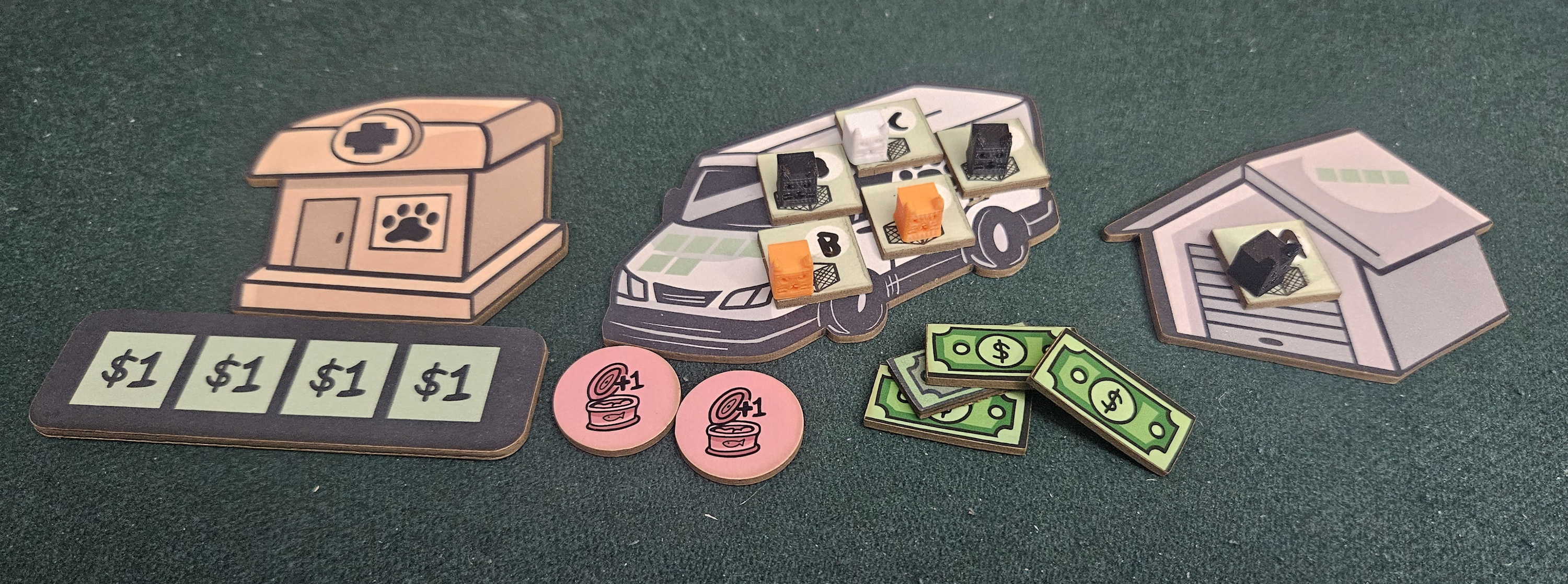
The tools of TNR.
As for your part, Community Cats offers a range of tools. Each turn gives you a few time units and some cash. You buy better equipment, then head into town to catch cats. This is handled by a simple roll of the dice. More traps means more dice, but also increases the odds of trapping too many cats. Anything over your capacity to treat at the clinic will be returned. And because cats are clever little boogers, this in turn makes it harder to catch cats at that location.
The tools of your trade are simple but effective. You start with a car, but a van would let you carry more traps. Food makes it easier to catch felines, while a garage houses any extra population for a turn before having to return cats to their colonies. There’s an employee who can socialize cats or herd their populations around town; a powerful boon, but one that requires income each turn. There’s even an electronic drop-trap that guarantees you’ll catch an ornery cat. The main cost is the extra time it takes to sit around until the culprit wanders into the trap.
Little by little, your capabilities expand. A bigger clinic, more traps, a wider array of mitigations for when things go wrong. The event card that begins each round is presented as a positive development rather than a downside. Maybe a local volunteer pledges to manage a colony, making it easier to trap its cats. Or somebody will donate a bigger vehicle. It’s optimistic and warm-hearted, and I found myself eagerly looking forward to each reveal rather than dreading the flipped card.
This isn’t to imply that the game is easy. Community Cats can be played with random locations or one of a number of scenarios, and there are challenges aplenty. It’s just that those challenges arise from the aleatory nature of the problem rather than the event cards. In one session, someone has passed away and left a litter of untreated cats in their abandoned house. I got a little ghost-whiff of cat urine from that one. In another, donations are down, forcing you to scrimp on new equipment and prioritize adoptions. There’s enough variety to return for a solid half-dozen visits even after the locations, events, and upgrades have grown familiar.
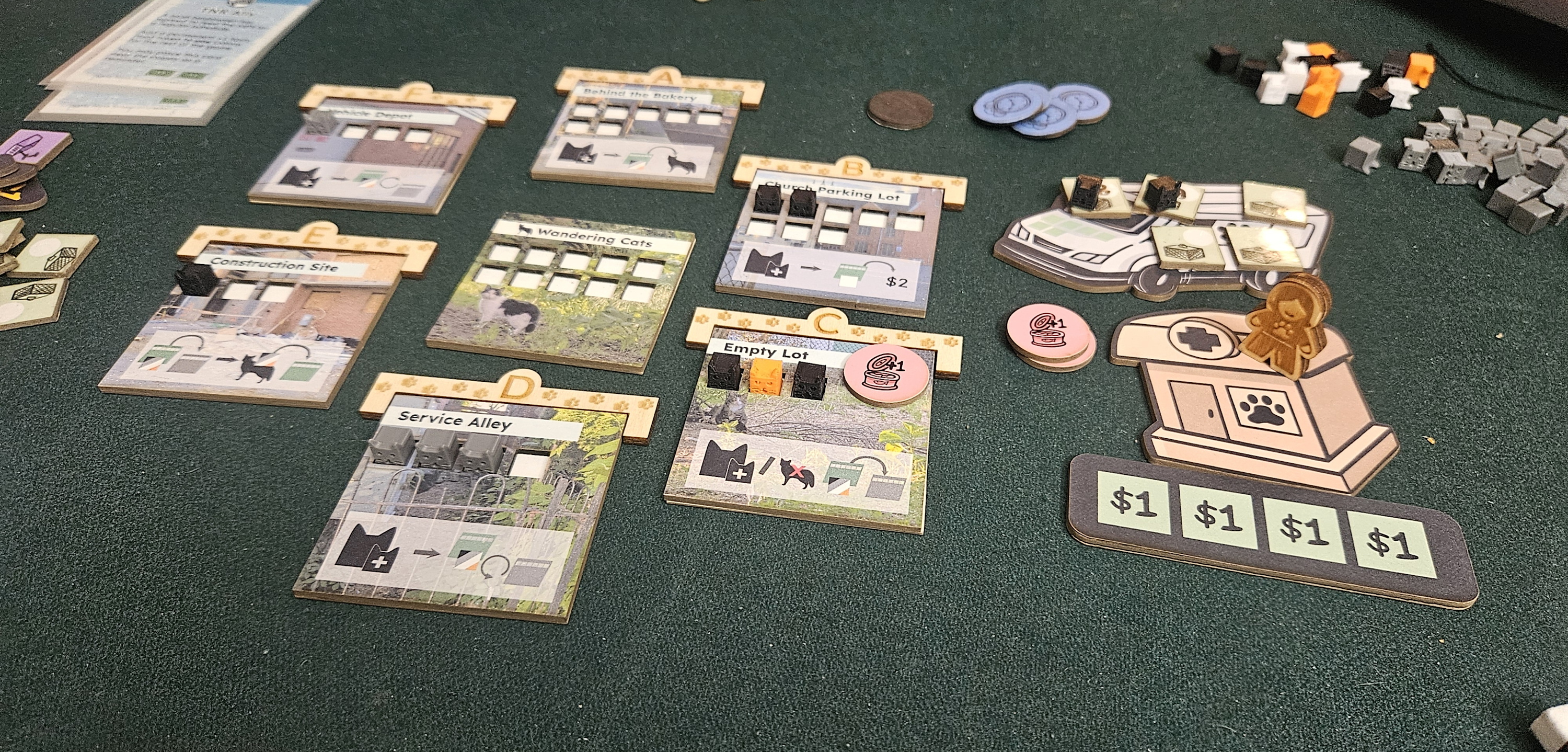
The neighborhood of Community Cats.
It does eventually grow familiar, perhaps even too familiar to differentiate one session from the next, although that’s only me saying that this solitaire game doesn’t have an infinite lifespan.
Then again, I’m not of the mind that it needs to last forever to be worthwhile. As a production, Community Cats has plenty to recommend it. The handmade components are one draw, whether it’s the dual-layer locations that have been carefully fitted together, the dry-erase traps for marking where to return each cat, or the 3D-printed feline with their spiky little ears that make them slightly perilous to pull from the bag. Even this old fart found himself charmed.
It helps, too, that the gameplay lands in that sweet spot between compelling and relatable. I don’t know the first thing about TNR. From the limited reading I’ve done, it sounds like there’s some debate over whether these procedures really reduce feral cat populations, but there’s broad agreement that healthy cat colonies are less aggressive and less likely to spread diseases to humans. Community Cats joins the recent spate of activist-minded board games that aren’t a drag to play.
Quite the contrary. My seven-year-old cat-lover has taken to playing alongside me, an activity suited to the game’s solitaire nature, and while she doesn’t understand the intricacies of every rule, the tendons between the game’s setting and its mechanisms are sturdy enough that she grasps what we’re doing. And the game illustrates some of the hurdles associated with trap-neuter-return programs, such as the need for sound financial planning, the crossover between colony care and adoption, and the fact that there are too many dang cats in the service alley and they’re killing all our birds. When my kiddo spots a cat in our neighborhood and wonders aloud if we could follow it to its colony, I can see her mind making those essential connections between the theoretical and the real.
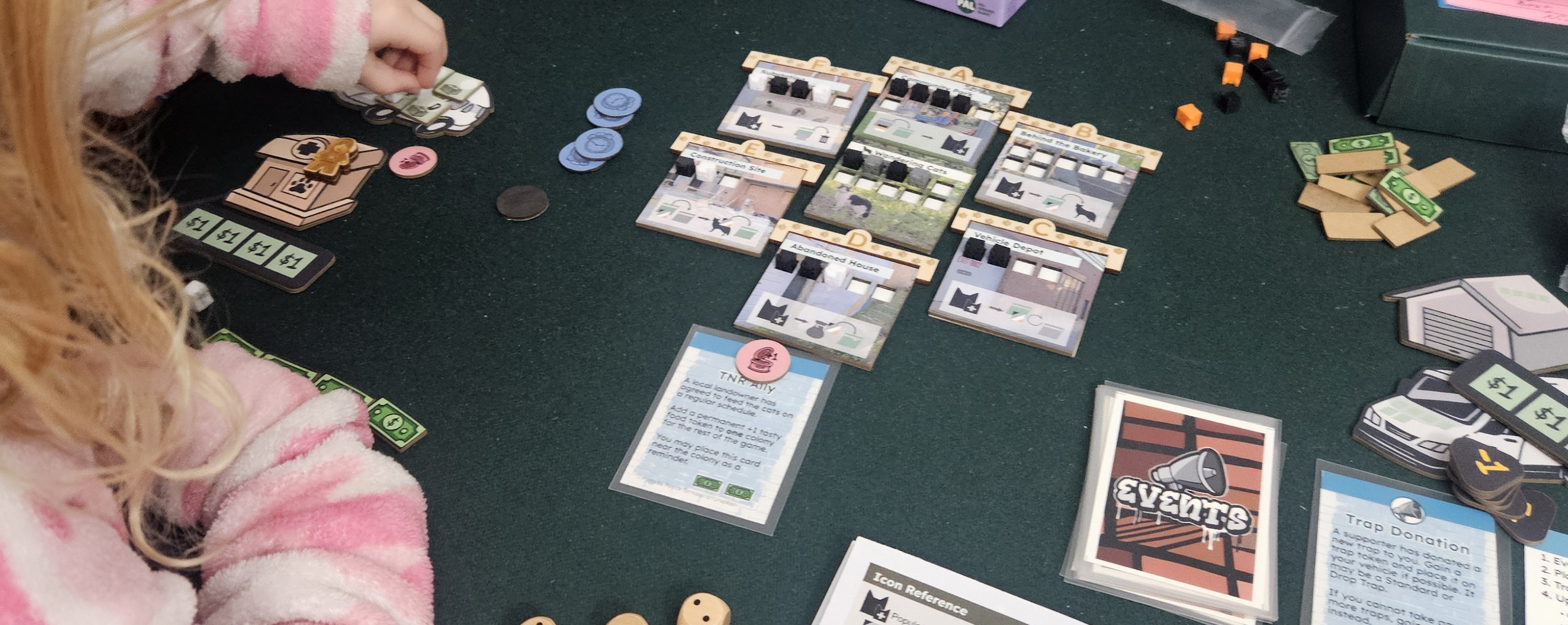
My seven-year-old has announced that Community Cats is now her game.
When you get right down to it, Community Cats is a sterling example of why I’m interested in games of this stripe. Not only independent games, but games that are trying to draw those connections. As a plaything, it’s smart; as a reminder that our neighborhoods are a little more complex than we usually notice, it’s unparalleled. Somehow, I now see cats everywhere I look.
A complimentary copy of Community Cats was provided by the designer.
(If what I’m doing at Space-Biff! is valuable to you in some way, please consider dropping by my Patreon campaign or Ko-fi. Right now, my third-quarter newsletter is open to all.)
Posted on November 24, 2026, in Board Game and tagged Alone Time, Board Games, Community Cats, Indie Games Night Market. Bookmark the permalink. Leave a comment.


Leave a comment
Comments 0