Mooks
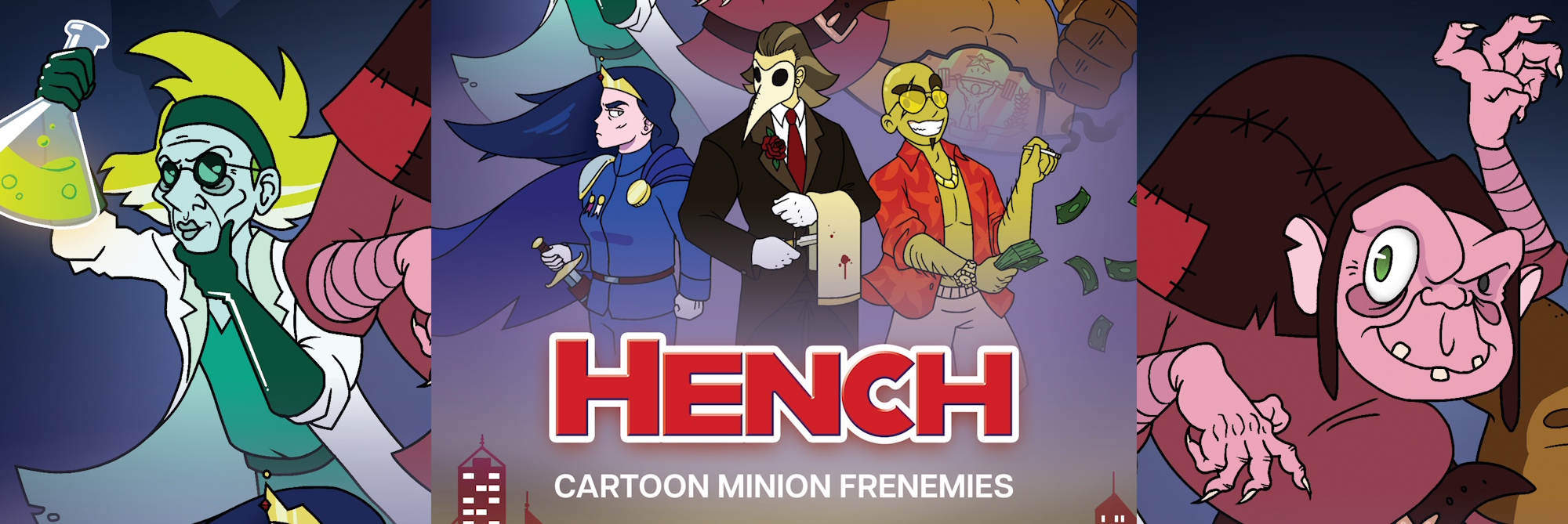
Hench is a strange, lovely beast. It’s as far as it gets from Edward Damon’s previous title, Rex Regnat, and not only because its Saturday morning cartoon vibe is a sharp contrast with that game’s public domain portraiture. They operate in distinct modes. Where Rex Regnat functioned best when everybody was attentive, Hench is a little sloppier. It’s raucous. It doesn’t mind getting grease on its shirt. It wants to throw stuff against the wall.
Players are, rather obviously, a supervillain’s henchmen. Henchpeople, according to union guidelines. It’s a role that rewards those who steal recognition for the most basic of tasks.
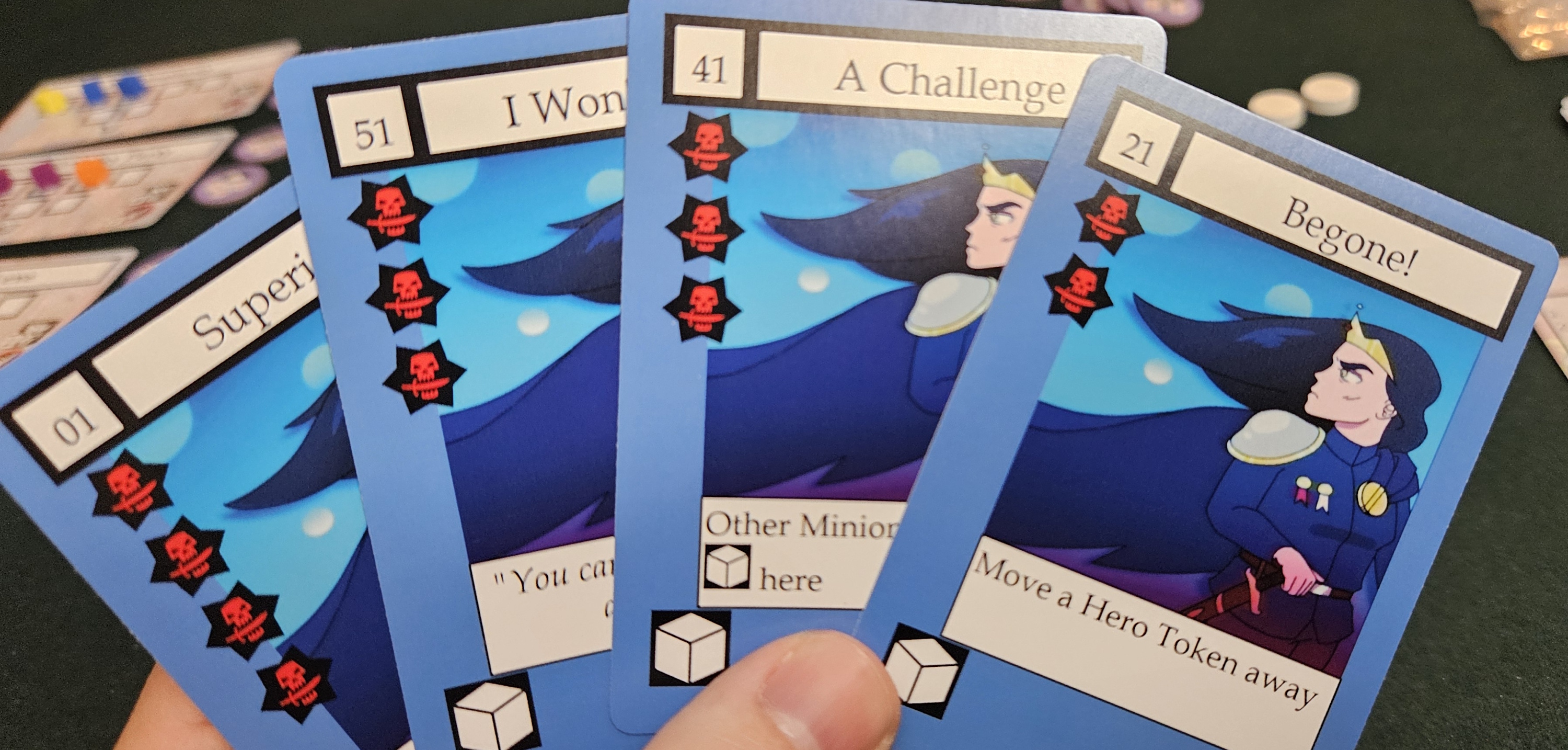
Observe my nefarious deeds.
When you get down to it, Hench is about a single question. Really, it’s the same question that undergirds much of modern society. On the one side, there are tangled and mutually beneficial incentives that allow us to have raspberries in winter and mass transit and airplanes that don’t fall immediately out of the sky. On the other, there’s the need to “get that bag,” as the kids say. To benefit yourself. To stay afloat at everybody else’s expense.
Perhaps Lord Nefarious, your supervillain overboss, is the stand-in for capitalism in this particular arrangement. Because in Hench, it’s necessary to work as a team to succeed. But in order to succeed succeed, you also need to stab that team in the back as often as possible.
Picture this: multiple missions, ranging from the banal (dry-clean the boss’s outfit, bully a child) to the labyrinthine (build a volcano lair, file the evil org’s taxes). Even the most trivial of these tasks requires investment from multiple henchpeople. Especially because those do-gooder heroes are always out foiling your plans, requiring regular confrontations that may well end with your face purpled and swollen, but at least you’ve kept Dr. Hero away from Evilcon East for the week.
But then, the problem. The real problem, because heroes are but the first hurdle on this particular marathon. (Marathons have hurdles now??) Everyone who contributes to a mission will earn Lord Nefarious’s esteem. But whomever contributes last to the task, the mook who’s putting the finishing touches on the job when the overboss slouches around — well, they get more credit than everybody else.
This social conundrum informs everything. Whether you bother to help a fellow henchperson fix the deathray. Whether you intercept a hero on the verge of tanking an objective. How obnoxious — how loud — you become at the table.
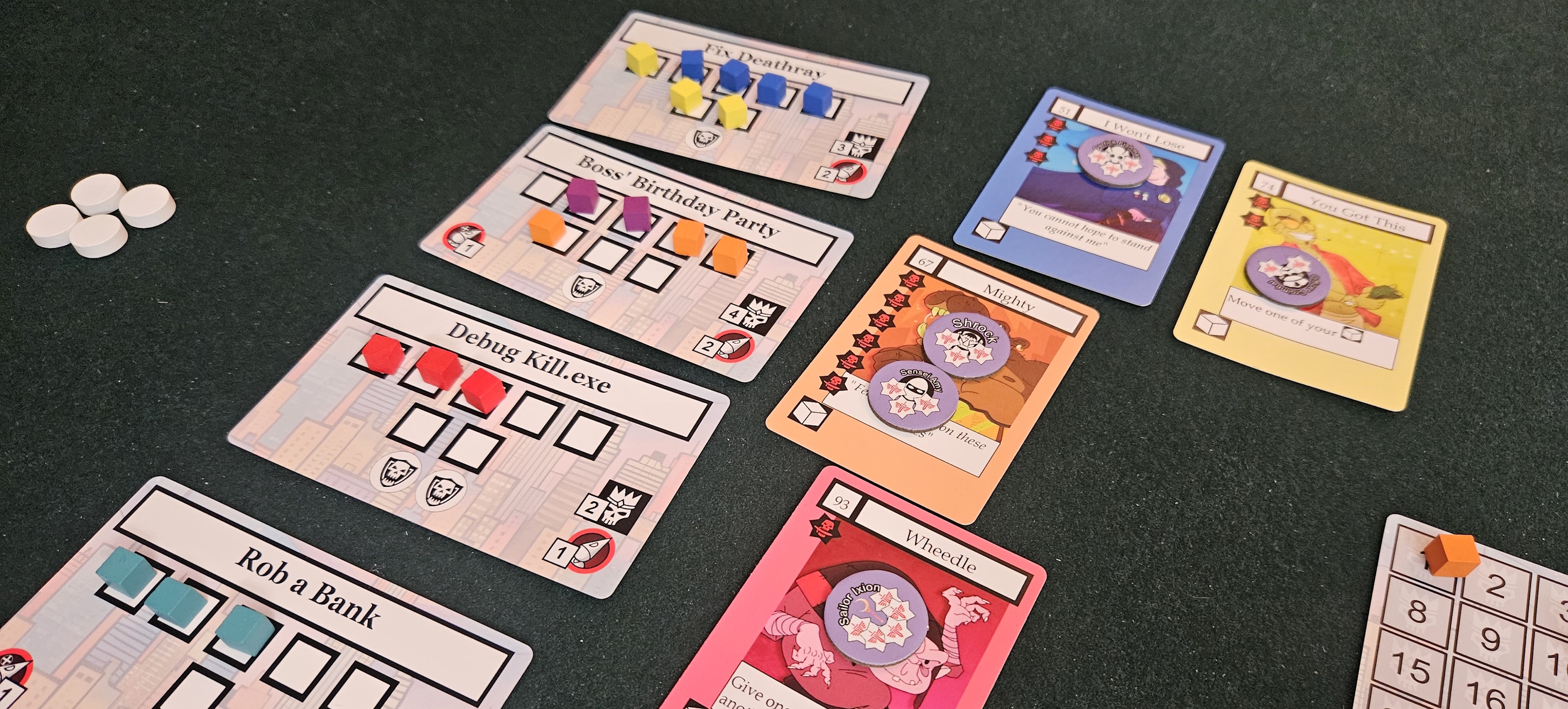
Everything, from the henchpeople to the heroes to the missions, are done in good humor.
For the most part, Damon leaves the answer to this question — really the answers, plural, because there’s no singular way to respond — up to the players. Hench is a restrained design in that regard. Turns, which are simultaneous, consist of picking cards and then, according to their initiative number, playing them to those various jobs. Within that rubric, there’s room to collaborate or to be as snide as possible. Even to sabotage a rival’s mission on the brink of its success. Hench isn’t proscriptive about it.
I will say, the center of this cake is a little doughy, and not only because we baked a saw into its midsection. Whether we’re talking about the missions, the heroes, or the limited henchperson powers, the tuning never feels entirely right. Hench feels like a game that would have benefited from wackier occurrences, the occasional landmine or salt-water taffy, to keep events lively.
The biggest example is the minions. Each character receives a passive ability and a couple of cards with special abilities. For a game with so much potential, it’s a limited approach. Not even the game’s cooldown system, which prevents any henchperson from playing the same one or two cards over and over again, can break its hold. Instead, players tend to play their best three cards over and over again. Some additional tinkering wouldn’t have gone amiss.
Still, I appreciate a design that keeps the focus where it’s due. Hench might not be the best imaginable version of itself, but there’s no denying that its attention never strays. The whole thing takes maybe half an hour, just long enough to let a few interoffice rivalries develop, but not so long that they grow stale. It’s a thought experiment written… not large, but big enough to illustrate its point. There’s no such thing as ethical collaboration under a dark lord. That’s my takeaway.

Nefarious deeds on cooldown.
Or maybe I just like hanging out with these weirdos. To be sure, the cast is colorful, and while their abilities are limited, they each gesture toward a more robust personality. There’s the Worm, who thrives on punishment and thus seeks out minor failures. The Brain, always out-thinking everybody around him. (Or at least imagining he is.) The Brute is a gigantic hippo. I don’t remember its abilities. But being a giant hippo’s got to count for something.
All in all, Hench is a minor but still appealing second act from an exciting up-and-comer. It isn’t as dense or piercing as Damon’s previous title, but still offers a tight half-hour experience that understands the virtue of getting out of its own way. Very much unlike a dark lord, come to think of it.
A complimentary copy of Hench was provided by the designer. It will be available at Pax West next week.
(If what I’m doing at Space-Biff! is valuable to you in some way, please consider dropping by my Patreon campaign or Ko-fi. Right now, supporters can read the next installment in my series Talking About Games, this time tackling the topic of what makes a good list! Naturally, the piece includes a list.)
Posted on August 25, 2026, in Board Game and tagged Board Games, Hench. Bookmark the permalink. 2 Comments.


Oooh, this sounds right up my alley. I wonder if copies will be available after the event? It sounds like it might really sing with a mini expansion pack of a few extra cards.
I believe Ned has said that he’ll be selling copies afterward. If it’s anything like Rex Regnat, it will require a direct email to him.