Battlefields of the Kitchen Table
Under normal circumstances, it might seem a bitter irony that Paolo Mori and Alessandro Zucchini’s partnership will be lauded for Toy Battle over the supernal Battlefields of the Napoleonic Wars. But these are no normal circumstances. Not when Toy Battle is currently up for a Golden Geek alongside its crunchier sibling, which I’m sure has infuriated a certain class of grognard, but strikes me as maybe the perfect encapsulation of that silly award. (If you needed further proof that the Golden Geeks aren’t especially rigorous, my podcast is also up for one. “LOL,” as the kids say.)
It helps, too, that Toy Battle is a tremendous little plaything. I’d even say it’s good in much the same way that Old Boney’s Battlefields is good, threading an uncommon needle between strategy and chance, heft and approachability. Or maybe I’m just saying that because it’s colorful, feels great on the fingertips, and my twelve-year-old can give as good as she gets.
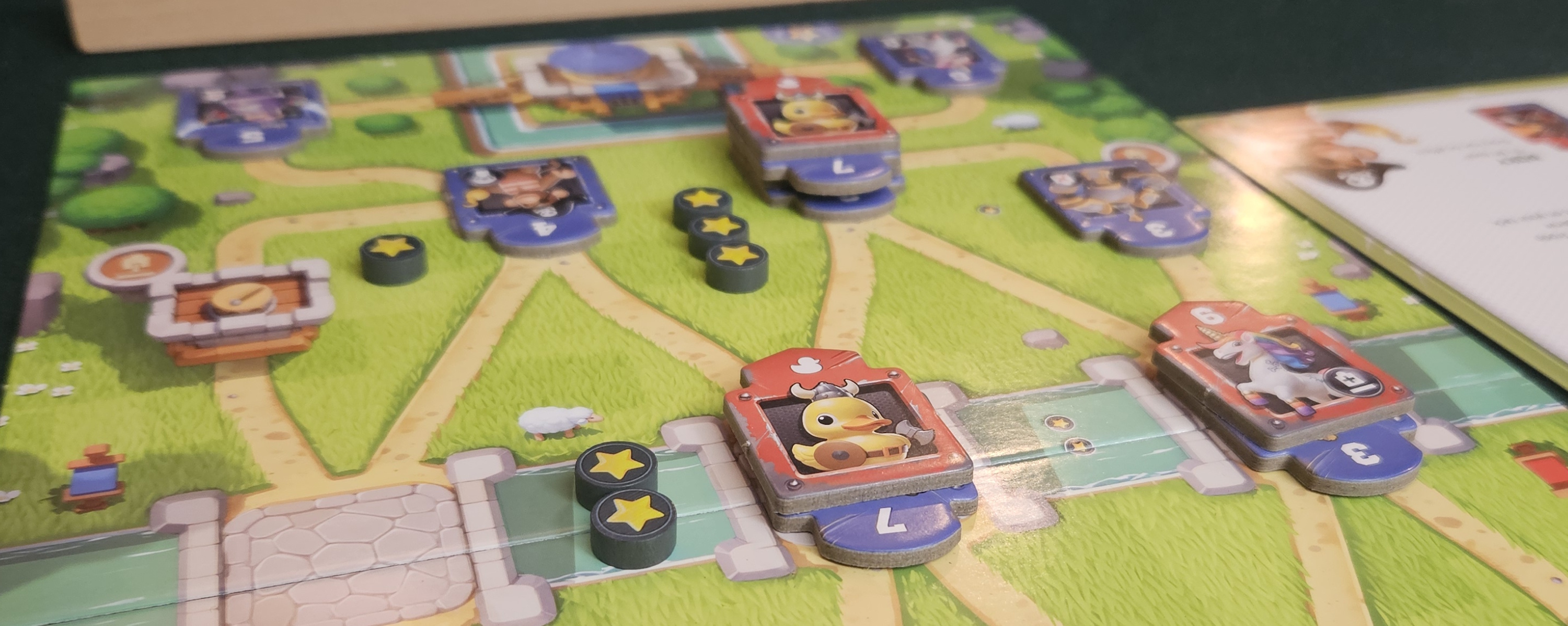
Watch out for Daddy Warducks.
For those who aren’t in the know, Toy Battle is effectively Toy Story 6, a joke that will grow even further out of touch when in a half decade they wheel Tom Hanks and Tim Allen out of the crypt for yet another unexpectedly delightful coming-to-terms with mortality. Basically, the toys have mobilized for war. Why? They are toys. War is their raison d’être.
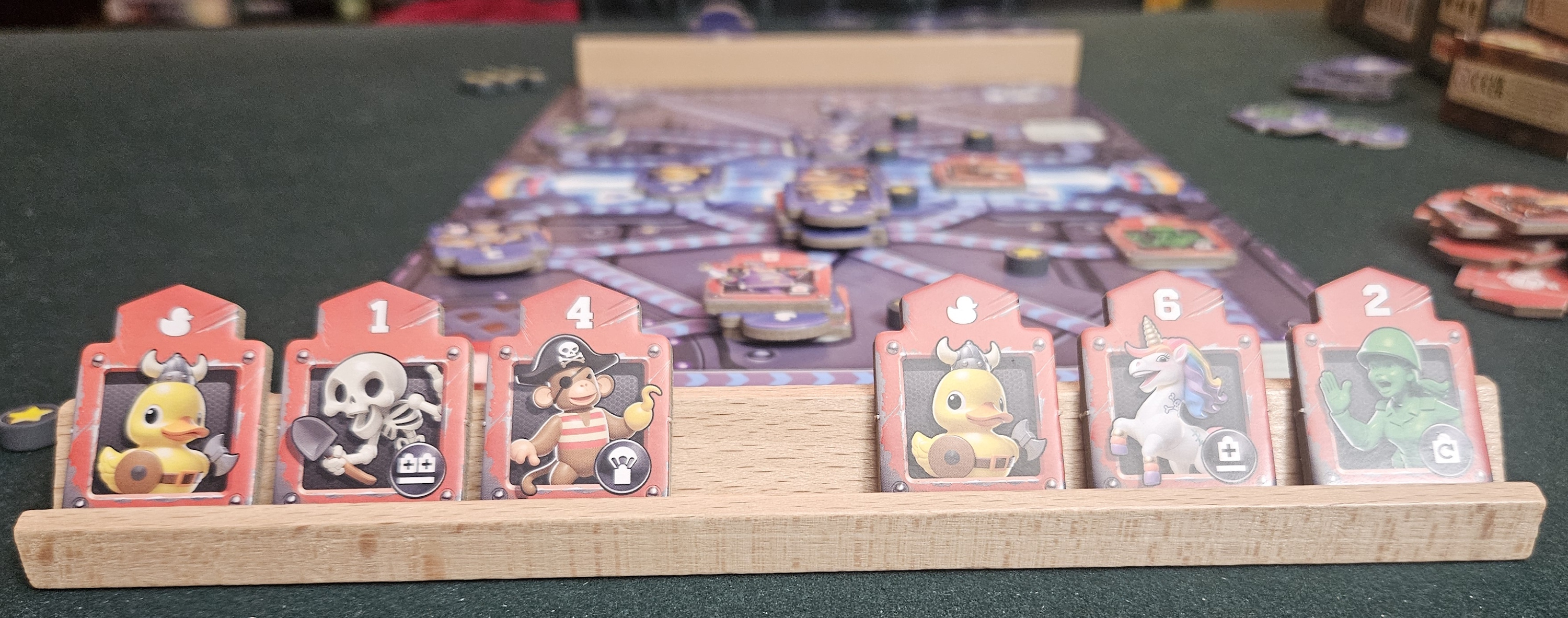
From its very first moments, Mori and Zucchini pack the box — which is surprisingly small — with so many goodies that to call it a toy chest would be appropriate, if far too cute for any self-respecting critic. In addition to two full armies, staffed by mismatched rubber duckies, painted unicorns, green army women, and many others besides, there are eight full maps to wage conflict over. It’s nothing if not generous.
The basic concept is so simple that it would only clutter the game to describe. My six-year-old figured it out from two minutes of standing on the sidelines. But in short, toys can be placed on any space that traces ownership back to your base, but only if their target space is empty or, if occupied, their strength exceeds that of any unit already there. There are two main ways to win, whether by chaining your toys to your opponent’s base or encircling spaces to earn a certain number of star badges. Both approaches are viable, and indeed may prove distractions from their opposite number, prompting little tussles where a rival is so busy with logistics that you merrily gobble enough stars to sweep the rug out from under their feet.
In every case, this feels wonderful. Everything about Toy Battle feels wonderful. Every map has its own special rule, like a cursed cemetery that keeps popping units out of your graveyard or a volcanic jungle where untimely eruptions frighten troops into hasty retreats. The same goes for the units. There are eight types in rotation — with plenty of duplicates, naturally — and there isn’t a single extraneous member in the entire roster. There’s a monkey that paratroops behind enemy lines, a fire-breathing tyrannosaur whose entire thing is that he’s a fire-breathing tyrannosaur, a punch-robot for slaying enemies and a wind-up robot for slaying enemies but in the opponent’s hand rather than the battlefield. Some, like the skeleton, seem brittle until they circle around to being exactly the tool you need for the pickle you’re in at this very moment.
Portrait of a battlefield on fire.
It’s tempting to leave the game there. Toy Battle doesn’t require belaboring. It has that childlike spark to it, the quality that makes me recoil ever so slightly when I see people discussing the breadth of its strategies or the unexpected combinations it permits.
But those are a not-insignificant portion of its elegance. Because while Toy Battle straddles the line between adolescence and adulthood, it doesn’t feel like it was designed for the under-fourteen demographic. Not only for them, at least. There are real considerations here. Logistics, for instance. Having to trace a line back to your base in order to keep the troops rolling out is every bit as relevant here as in a denser wargame, and as prone to disruption, too. I mentioned the airborne monkey, right? These stuffed apes aren’t the toughest grunts in your roster, but as delaying and disrupting tactics, they can’t be beat. There’s also a plastic army woman named Cap’n, whose combat number is the second-lowest in your company, but who permits another unit to be added to the map afterward. She’s effectively her own Red Ball Express, especially if you can deploy multiple copies to swiftly encircle multiple objectives.
In its own way, the game even includes resources and the need to rest your army before another push, though in this case both concepts are represented as the troops in your tray. Most turns consist of placing a unit, but you’ll see plenty of pauses to draw a pair of new tiles. If this were a WWII game with periodic breaks to refuel armor columns, we would laud it for its careful modeling of the operational situation. Instead, you just recruited a rubber ducky that can defeat anything on the table and a unicorn with light reinforcement potential. Special forces and combat engineers, anyone?
Of course, I’m half-joking about the game’s potential as a Serious Battlefield Simulator. The half that’s not joking is the part that believes this to be a surprisingly deep experience despite all appearances, which I hope you don’t think I’m knocking, and its sub-ten-minute duration. For example, I just played a four-minute session on Board Game Arena to make sure I wasn’t misusing a particular piece. I won the session by bum-rushing the enemy base and then hoovering up badges while my opponent scrambled to regain territory. Like everything else in Toy Battle, it felt great. Even the randomness of the draw, while not inconsiderable, is one of the game’s highlights. In this case, I sincerely hope the randomness eased the thrashing I delivered to my foe. It wasn’t your fault, Tristi7. It was the pieces you drew. Promise.
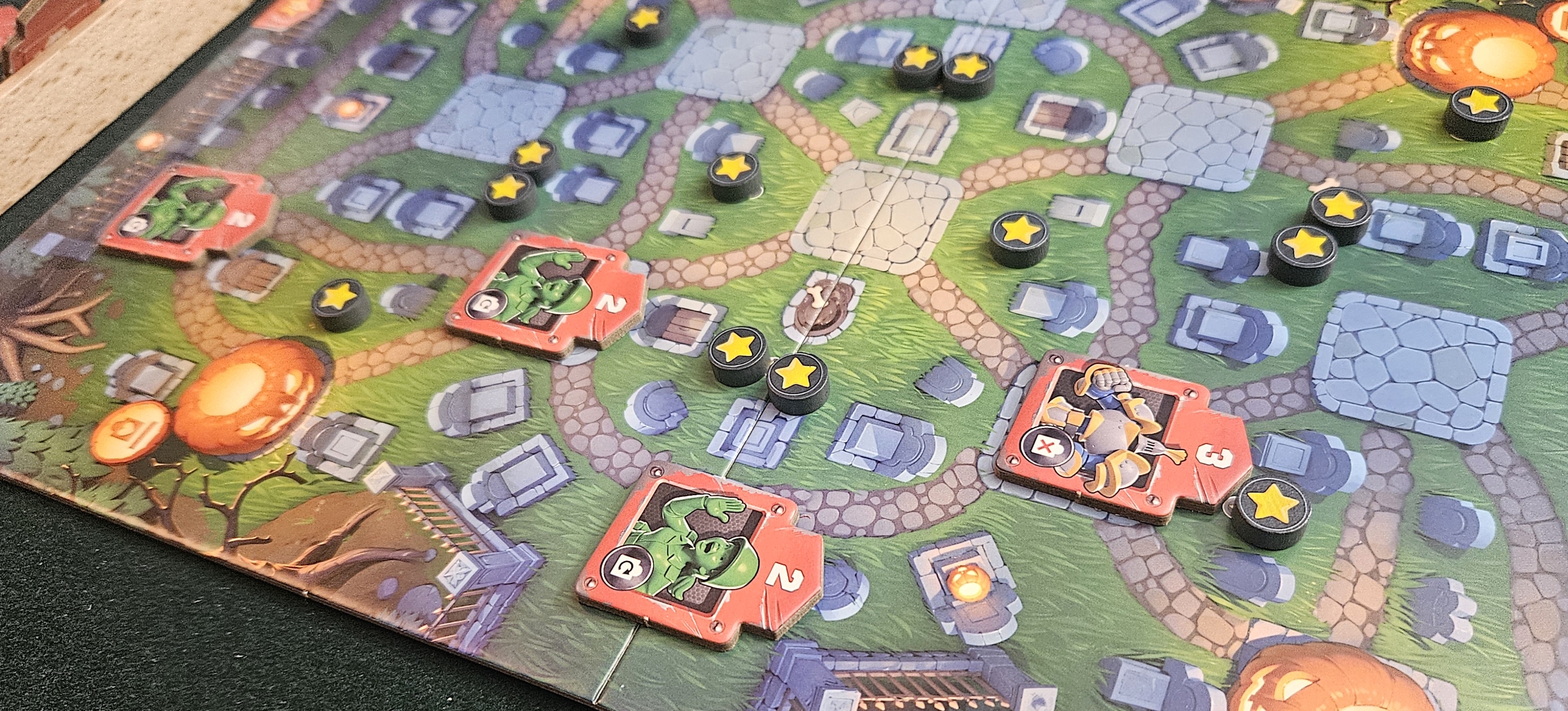
Gulp!
Honestly? I hope Toy Battle sweeps the wargame category in the Golden Geeks. Not out of spite, mind you. Popularity contests serve a special purpose in any hobby, and I don’t begrudge the Golden Geeks for that.
Rather, it’s because Toy Battle is every bit as smart and as forward-thinking as Battlefields of the Napoleonic Wars. It’s a game that feels obvious in retrospect, a perfect little gem that must have always been there, only it took many decades and two veteran designers at the top of their game to fashion one of the best expressions of both childlike delight and groggy combat simulation. This one is perfect. I think I’ll tackle another five-minute session right now.
(If what I’m doing at Space-Biff! is valuable to you in some way, please consider dropping by my Patreon campaign or Ko-fi. Right now, supporters can read my first-quarter update of 2026: the best board games, movies, books, and more!)
Posted on April 29, 2026, in Board Game and tagged Board Games, Repos Production, Toy Battle. Bookmark the permalink. 13 Comments.


Toy Battle is deceptively good.
Definitely. When I saw other people saying it was great, I figured, sure, it’s probably very good. Nope! It’s fantastic.
I hope you win too. You deserve it.
Aw, thank you!
I love Toy Battle. I’m also terrible at Toy Battle!
I don’t know if I’m good at Toy Battle or terrible at Toy Battle, but I’m pretty sure I love Toy Battle too.
When I saw the title, I thought this would be about Little Soldiers from Iello, which is a skirmish game meant to be played on your table (and using objects you might find on a table for terrain).
I like the elegancy and straightforwardness of Blitzkrieg and especially Caesar, but I’m eager to try something with a little more meat to it.
I love all these clever two-player board and card games even if I’m not able to play all of them.
Had a chance to try this and was enchanted. Such a breeze to teach.
Only obstacle is my two player spots are firmly filled by Summoner Wars and Battlefields of the Napoleonic Wars (Paolo Mori and Alessandro Zucchini have certainly had a good year!)
Glad to hear it worked out for you! Mori and Zucchini definitely had a banner year.
Came for the review, stayed for the Céline Sciamma reference.
I really should get around to seeing another of Sciamma’s films!
There are literally no bad options IMO, but YMMV!