One-Hit Wonder
Whether in video games or board games, there’s a certain zen — is it okay to call it zen? — that washes over you when you only have one hit-point left. Now it’s just you and your skills. How smartly you can dodge. How precisely you can block. You become an agent of grace, dancing across the screen or tabletop. The playing field has been leveled. Every mistake is now the same as every other mistake. Just you and your abilities and those key-mappings and—
And now you’re dead.
One-Hit Heroes by AC Atienza and Connor Reid starts from the idea that, well, look, it’s right there in the title. One hit and you’re dead. It’s a fantastic idea. One they fudge a little bit, which is to be expected, and one where the execution sometimes feels a little thinner than it might have. But the idea never stops being fantastic.
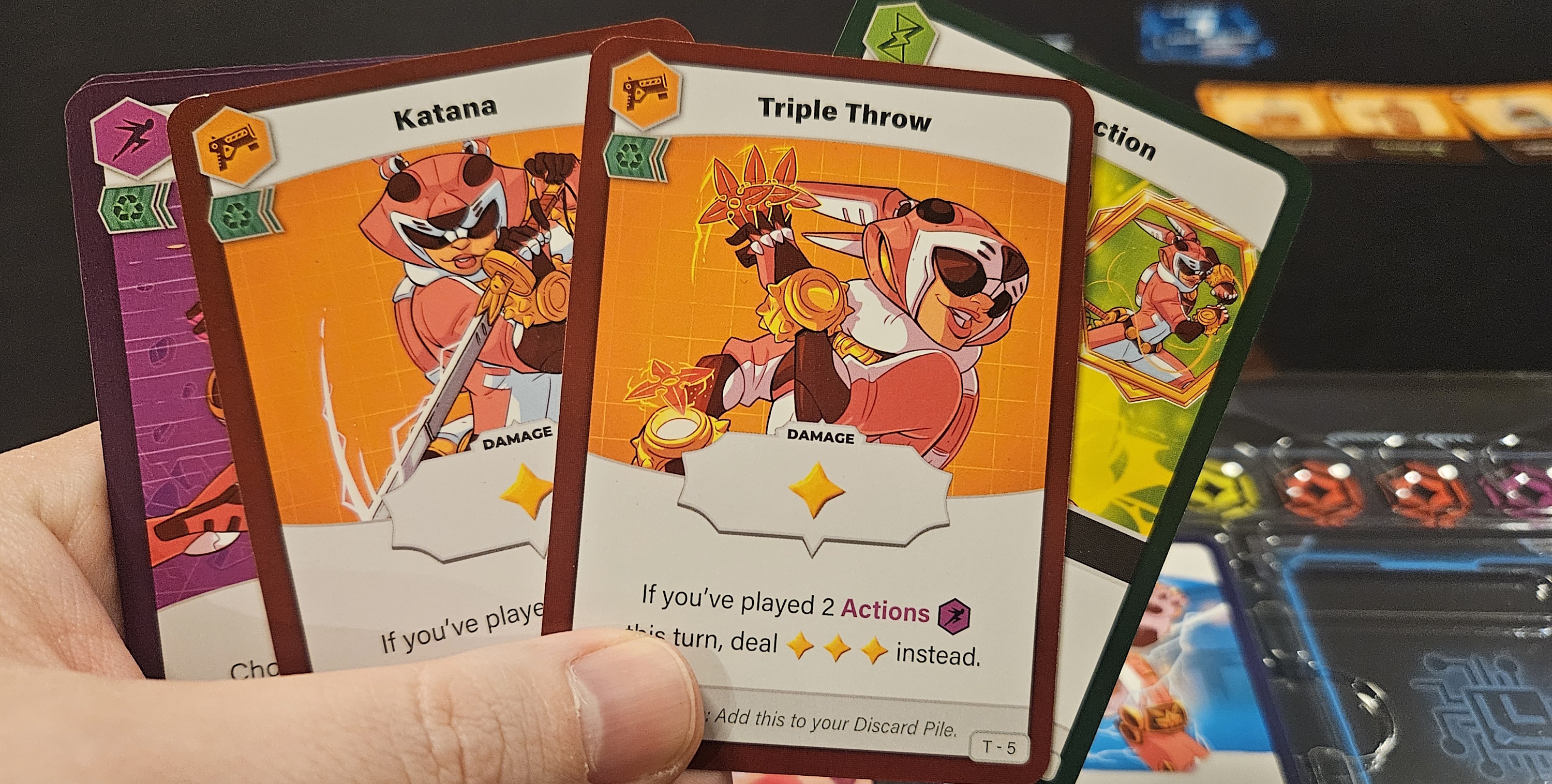
Watch out for the Bunny Ninja.
If you’ve played a board game before, you probably know how it starts. Everybody picks a hero.
Scratch that. First you need to pick how many people to play with. Because the thing about One-Hit Heroes, the seedy underbelly of the whole shebang, is that the box says it accommodates up to four players, but that’s only half correct. At a technical level this thing plays with up to four people, sure. Strictly speaking, it can be played. But at a gameplay level, and more importantly as something satisfying, it’s really optimized for two. That includes solitaire play, which is effectively a dual-handed mode. But with any further heroes than that, it distends and bursts. Best of luck actually getting in a hit when the game’s automated boss keeps stripping everybody of cards before they get another turn in.
Now that that’s out of the way, let’s head back to where we started.
Everybody picks a hero. There are four in the box, each with their own set of cards. One-Hit Heroes is an economical little thing; rather than offering a slew of abilities, everything about the game’s four heroes comes back to their starting decks.
The Bow Slinger, for example, shoots a bunch of arrows. Arrows are bigger than bullets, but in accordance with Hollywood logic their size also means they deal more damage than bullets. That said, they only allow a single shot each. Arrows, unlike bullets, are not reusable. (I know, I know. Just go with it.) So the Bow Slinger is all about a few plinks of high damage, plus an ability to refill his quiver from his burn pile once per battle.
You might think that a Bow Slinger wouldn’t be all that different from a Sniper. But the Sniper, you see, is all about keeping low. Actually, the Sniper is also about dealing damage that isn’t tied directly to weapon cards, instead rolling the hero die to dole out some variable amount of damage. She’s a sneaky character, in other words, but also a squirrelly one. A bit self-serving. Unwilling to stick her neck out.
Or there’s the Bunny Ninja. Yes, the Bunny Ninja. Once again following One-Hit Heroes’ rule of cool, she uses katanas and ninja stars. By the way, they’re rapid-fire and travel faster than bullets, which is why she can chain moves together faster than her companions. The Flame Lancer, meanwhile, is all about heat management. He spends energy to amp up his attacks. Also, he tends to draw a lot of enemy attention. After all, he’s a Flame Lancer. That’s the guy I’d shoot first, too.
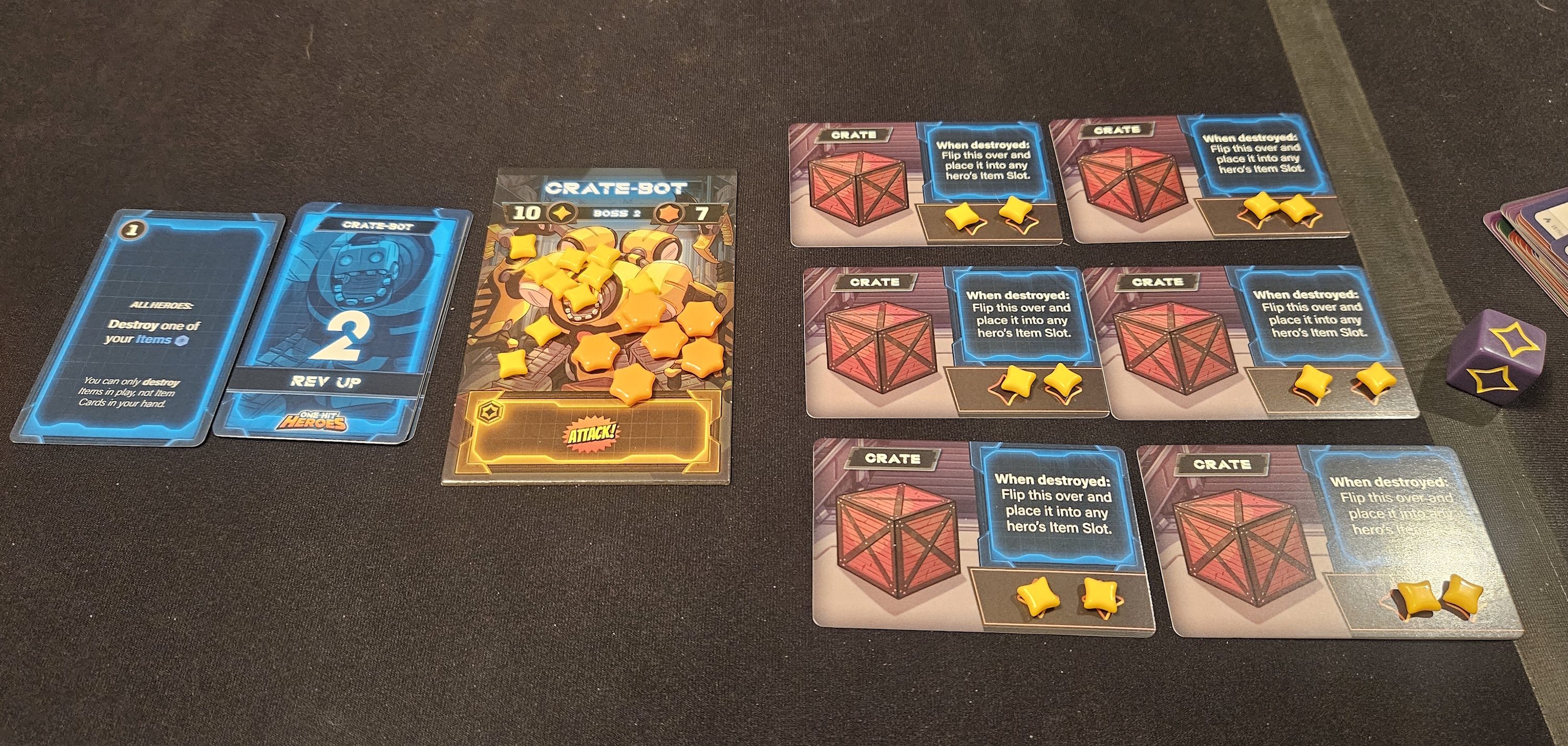
Watch out, it’s Crate-Bot!
The format for the game is that each session is divided into multiple small boss battles. Starting with that initial deck, you face off against an enemy. These are colorful and inventive. One fight will pit you against a gang of robots, each one stepping into the smoking boots whose previous occupant you vacated with fire and arrow and katana. Next you’ll square off against a friendly barkeep who’s trying to drink you under the table, or a crate-bot that hides behind a lot of crates.
These battles function like miniature deck-builder games. Except you aren’t building your deck, not right now; you’re just playing through the dozen or so cards you have at that moment. There are only four types of cards, just enough to provide some texture but not so many that anybody will get lost in their options. Weapons deal damage. Actions do things. Equipment gets equipped and sticks around between rounds. And reactions happen when it isn’t your turn. See? Simple.
The highlight of these battles is the aggro system. Whenever you deal damage to the enemy, you physically remove their hit points — there are two types, light and heavy, which necessitate distinct attacks to remove — and shift them over to your board. The higher your aggro, the more likely it is that the boss will notice you and/or attack you and/or actually deal damage. High aggro is testy, always running the risk of drawing fire. Low aggro isn’t necessarily safe, but it’s safer.
Meanwhile, those bosses are handled by the breeziest possible system, flipping a single card per turn to trigger attacks or tweak your aggro, but you’re vulnerable enough that this is enough to feel alive and threatening. Because, yeah, you only have one hit-point. Fortunately, that hit-point is hidden behind your equipment. At any given time you can have two equipment cards attached to your character. Eventually you might have more in your deck, ready to be equipped. Taking a hit means you either trash a piece of equipment or die. Equipment, then, pulls double-duty as ongoing bonuses and armor. Sometimes both at once, or sometimes as armor that provides a cool bonus when it gets shot off, but always as another crucial piece of your arsenal.
And then, when the battle ends, you get new cards. If this is your first time through this sequence of bosses, you open up little card packs that are themed around the boss you just pummeled. If not, you deal randomly from the stuff you’ve already unlocked. Everybody takes two cards. At its best, this opens up One-Hit Heroes to some surprisingly in-depth conversations about which pieces of kit will complement not only your hero’s playstyle, but also the group at large. Do you need more equipment to block damage? More weapons? Actions for burning off aggro or drawing through your deck? Despite the game’s simplicity, there’s a pleasant breadth of verbs and effects in those cards.
You pick your two starting equipment cards. Shuffle everything else into a new deck. Time for the next boss.
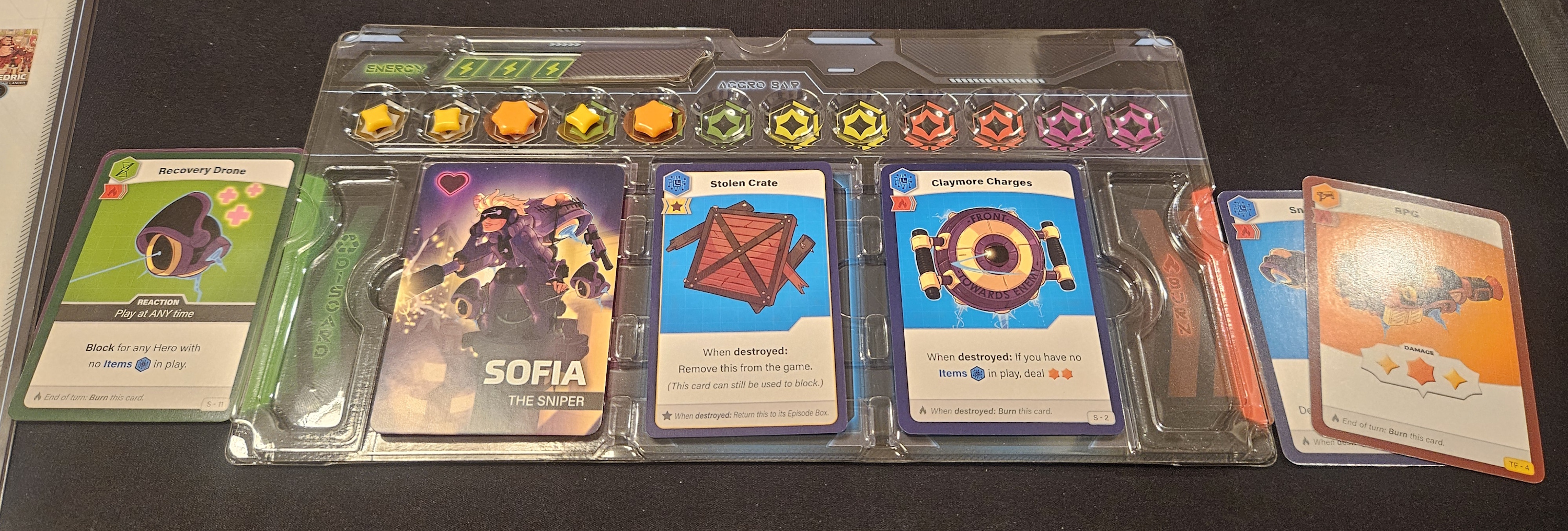
Hitting enemies produces aggro, which attracts counterattacks.
This rhythm is appealing. Battles are short, but not Tag Team short. Maybe ten minutes apiece, plus a few extra minutes for really involved skirmishes. Drafting new tools is similarly brisk, but impactful as well, and you’re flung immediately into the next fight to test out your choices. It’s surprisingly solid. Not because it looked bad on the outside or anything like that, but because we’ve reached the point where there are heaps of these things and most of them don’t stand apart from the crowd. Once it gets moving, One-Hit Heroes feels like a sleek bullet train, always hurtling forward.
The main point in the game’s disfavor — apart from the bald-faced lie that is its player count — is its stinginess. I’ve already invoked Tag Team, Gricha German and Corentin Lebrat’s take on the auto-battler. That game also mashes two heroes together to produce a degree of recombinance, and its central pleasures are found in discovering how to riff its characters off one another. The same is true here, but rather than Tag Team’s ten characters, this box only includes four. As for the bosses, it probably sounds generous to say that there are eight, but the reality is that there are only two groups to defeat, each with four bosses that appear in sequence. Which is another way of saying that there are two levels. That isn’t terrible; there’s room to tinker, especially once you’ve unlocked all the items and start drafting from a wider pool. Better yet, both levels are interesting, with unique challenges aplenty. But it doesn’t work in One-Hit Heroes’ favor that it feels closer to a demo than a full-fledged product.
And “product” is precisely how it feels. This is the sort of game that wants to be sold piecemeal to those who get hooked on its first sampling. I have no idea whether that’s the actual plan, but already there are two smaller sets that add a dedicated (as in non-two-hander) solitaire mode and another string of bosses.
Look, I get it. Margins are thin. But I would have preferred to see a happy middle ground. In part because One-Hit Heroes is good, confronting the player with constant stressors as they struggle to stay alive while also getting in the odd hit and managing their aggro. It’s smart stuff! But in such a saturated industry it’s rare to earn a second impression, and I have my doubts that most players are going to stick with this system long enough to give it another try. With a bit of extra punch in this opening box, I’d be more tempted to return. Instead, I feel like it’s appraising the value of my furniture.
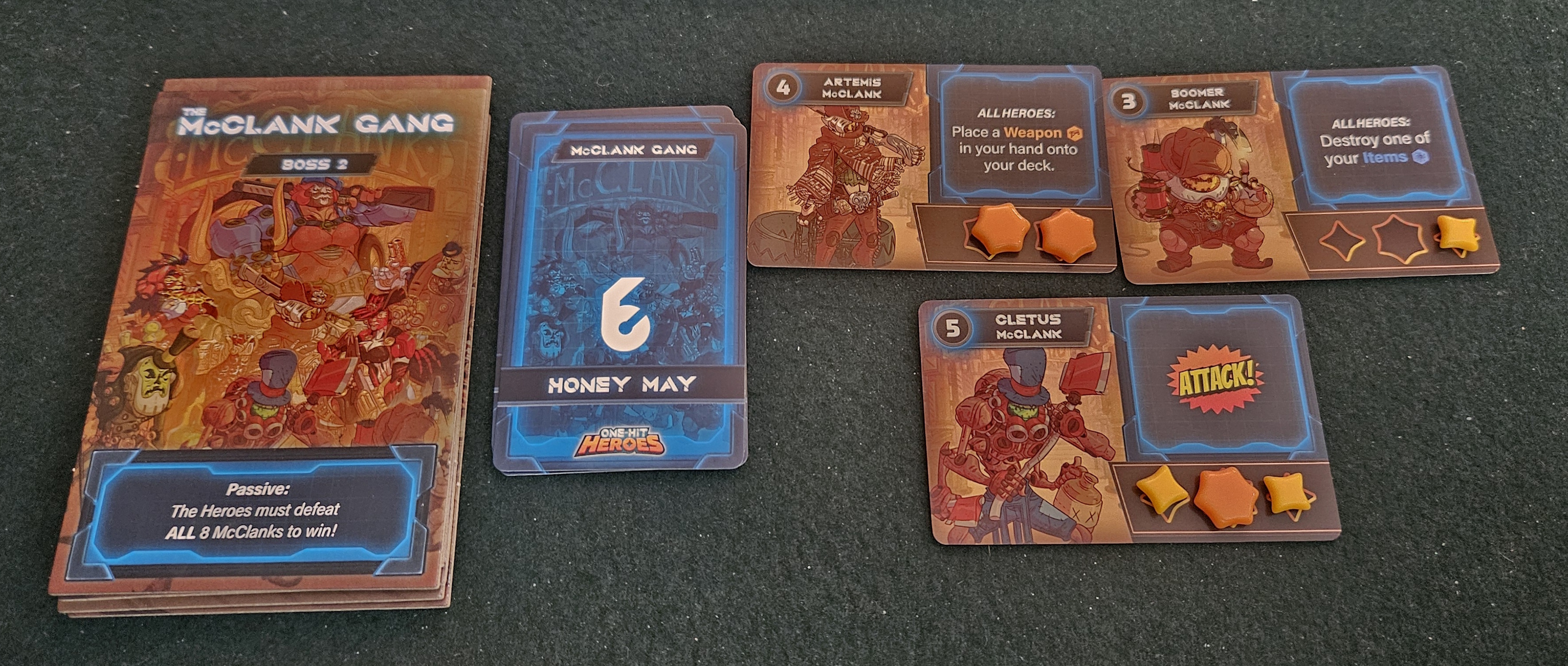
Some of the bosses are tougher than others.
Still, there’s a lot to like here. As a shorter-form boss battler, it stands apart from many of its peers. There’s basically no up-front investment. We pick characters, shuffle a deck, and we’re in the thick of it. Any decisions will come either during the fight itself or once we’ve landed the killing blow. Even then, the choices are pleasantly bite-sized. I just wish it had offered a few additional mouthfuls.
A complimentary copy of One-Hit Heroes was provided by the publisher.
(If what I’m doing at Space-Biff! is valuable to you in some way, please consider dropping by my Patreon campaign or Ko-fi. Right now, supporters can read about which films I watched in 2025, including some brief thoughts on each. That’s 44 movies! That’s a lot, unless you see, like, 45 or more movies in a year!)
Posted on February 2, 2026, in Board Game and tagged Board Games, One-Hit Heroes, Wiggles 3D. Bookmark the permalink. 1 Comment.


Pingback: Flippin’ Mickey | SPACE-BIFF!