The Little Crunch
Ah, the “small civgame,” the brass ring of tabletop design. If Age of Galaxy sounds familiar, that’s because this is the second edition of the tinier-than-you’d expect title from a couple years back. Now, in a somewhat ironic turn, it’s been blown outward.
Some dead space in the box notwithstanding, it’s a suitable alteration. The cards are full-sized! The map and action board feel less like gimmicks! The discs can actually stack on top of each other! This is the very same Age of Galaxy I reviewed positively two years ago, transformed so that it’s much easier to read across the table, with all the upsides and downsides vacuum-sealed for a fresh audience.
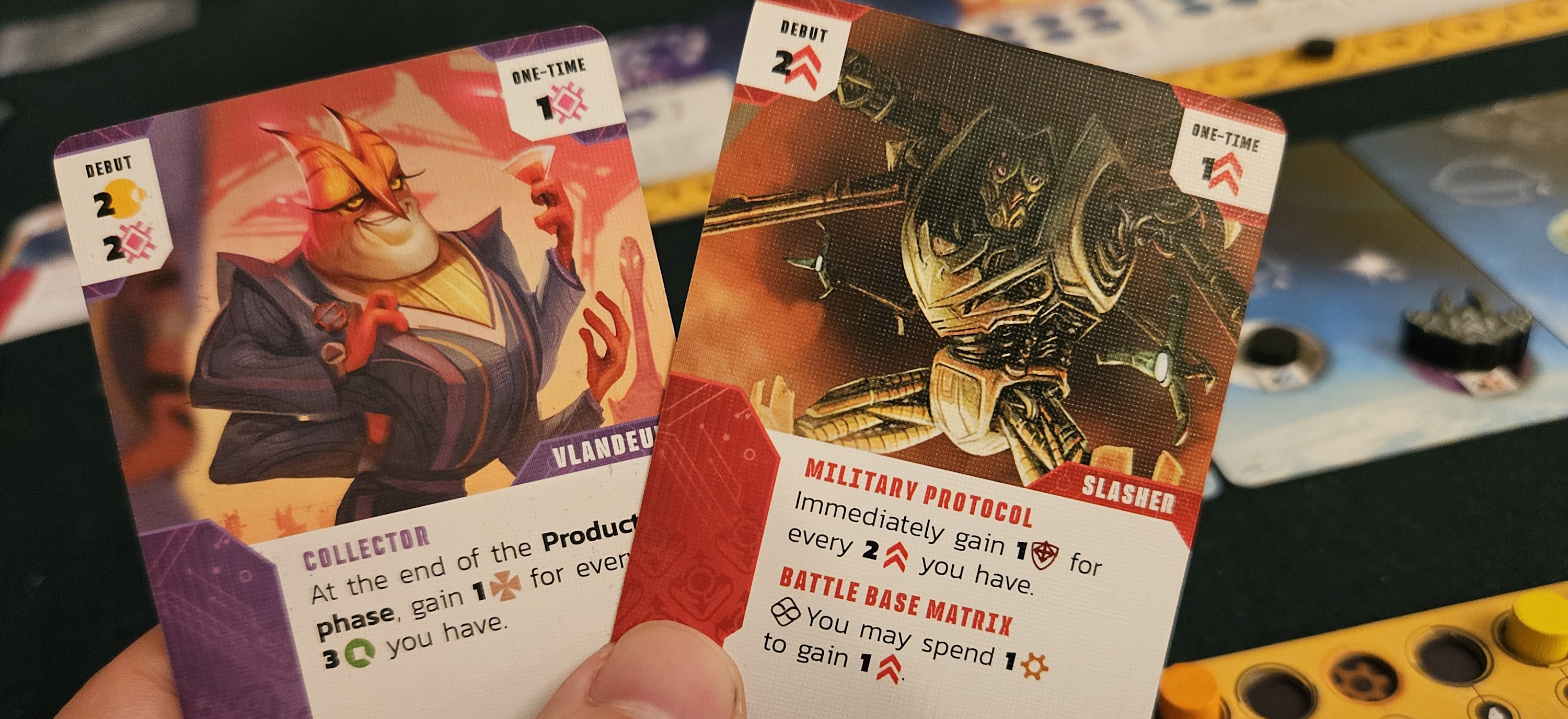
I always prioritize membership for funny bug dudes in my stellar federations.
For those newcomers, Age of Galaxy is a boilerplate space-faring 4X. That isn’t an insult. It’s a mission statement. Like Age of Civilization before it, the original Age of Galaxy was Jeffrey CCH’s attempt to miniaturize that sprawlingest of genres into a compact forty-ish minutes and a box you could slip into your back pocket.
But where many others have tried and failed, usually by spacing too much of the cargo that makes tabletop space opera such an investment, CCH captures the gist of the genre. Here the centerpiece isn’t a hex map — like most of the game’s systems, that’s been streamlined down to its barest form — but rather a deck of forty faction cards. When the game opens, everybody receives seven. Depending on your preferred variant, these can be drafted or drawn-and-done, but either way these seven cards are all you get for the duration of the session.
Believe me, they’ll be enough. Every faction card offers its own little world, pulling n-duty as a unique ability or two, an ideology that may well determine your approach to stellar imperialism, and an indicator of which ecosystem your fledgling federation can safely colonize. That’s if you pick that card as one of your three factions. They can also be discarded for other bonuses, onetime infusions of resources or colonial permission slips or maybe even a last-minute alteration to your empire’s whole ideological axis. That’s a lot. Maybe enough to prove intimidating.
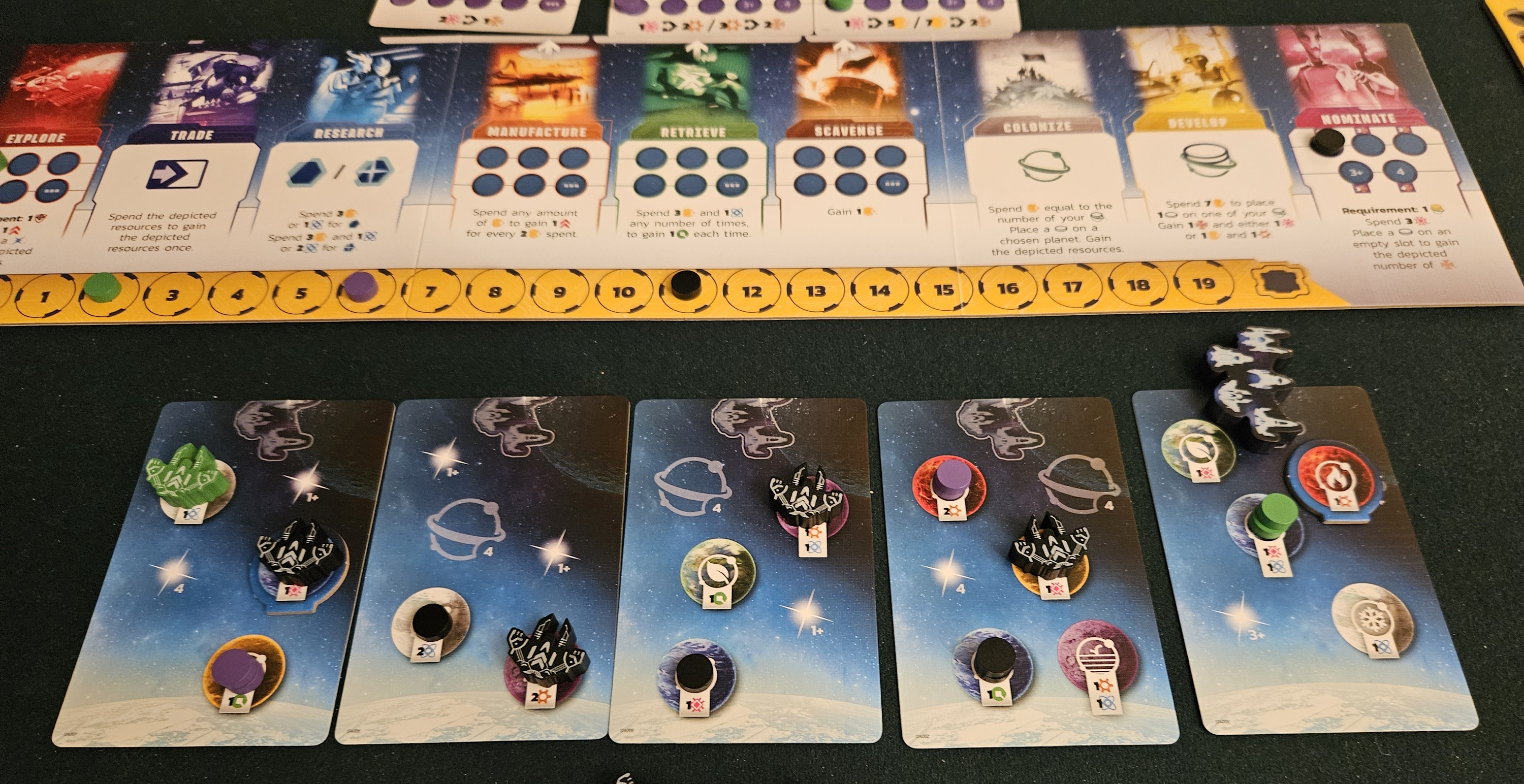
Exploration and action selection are aerodynamic.
I’ll give an example. In one session, you might choose to begin as the Sojourners. These lasses are nomadic, which means whenever they colonize a planet they can pull up roots to research technology or harvest alien relics. They’re also wanderers, earning a tidy pile of credits whenever they take the explore action. These traits mesh well with their ideology as relic hunters. Rather than founding static colonies, they nab extra relics every time they pack up and move.
But one lonely faction doesn’t a stellar alliance make. For that, up to two more of your cards can be played in front of you. This is where Age of Galaxy gets interesting. You might, for instance, decide to pair your Sojourners with the Ichorpion, squishy dudes with yonic foreheads who can mind-zap their opposition into losing galactic influence and swap research for extra relics. That’s a rather heady pairing. What’s more, because the Ichorpion also have the green ideology, your role as a relic hunter is now locked in. Get ready to corner the alien antiquities market!
Except maybe your Sojourners are having trouble with another player’s space bullies and cash illiquidity. In that case, maybe it would be better to round out your alliance with the Bjordolf, space-bears whose ample ships and wartime economy will keep your enemies at bay and the credits flowing. Or the Dhafizah, space-saigas that make it cheaper to retrieve those relics. They won’t handle the enemy spaceships, but since you’re buying relics anyway… Then again, there’s the Mobesus, space-mobsters who can trade away those relics on the black market for wads of cash. This will reduce your innate synergy for relics, but maybe you can churn those credits into a new source of points.
Point is, Age of Galaxy quickly emphasizes the tradeoffs and benefits of those seven cards you drew when the game opened. Since only three factions can be included in your alliance, every addition also closes an airlock. Like many of my favorite games, it’s about cobbling together a functional engine despite the cards’ inherent dissimilarities. Sometimes you’ll spot an obvious synergy. Other times you’ll need to bend the corners to fit the jigsaw together. Either way, the result is a title that’s surprisingly evocative of full-sized space games. I’d even call it flavorful.
You know. To a degree.
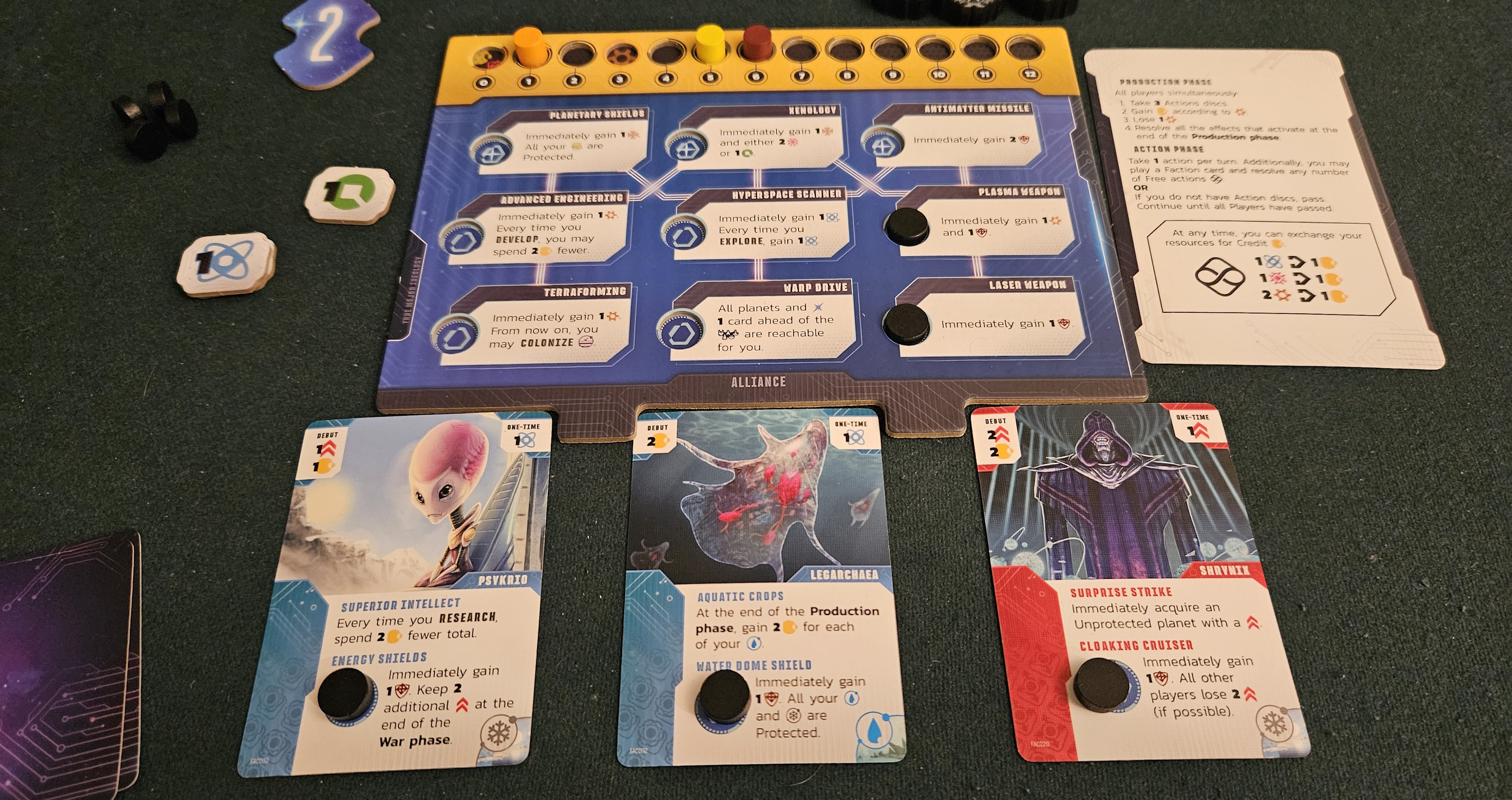
Pretending to be a research civilization.
Where Age of Galaxy stumbles is where the original stumbled. Under the hood, some of the tuning feels off, especially when it comes to the game’s various ideologies. Green earns extra points for relics and red makes violence worthwhile, but others, like yellow and blue, only trigger for developed worlds or advanced technologies, both of which are pricey and limited in number. This isn’t a dealbreaker; if anything, it encourages players to hold onto a card or two to swap ideologies as their strategy takes shape. But it’s still disappointing that these little issues weren’t ironed out with the new edition.
My more enduring concern is tied to the game’s pared-down format. Despite the thrill of building your own alliance — and deciding whether it will be a Federation or a Dominion — some of the genre’s most vivid moments have been rounded out with the reduced playtime. I’ve enjoyed sessions of Twilight Imperium and Star Trek: Ascendancy that will stick in my memory until my gray matter decays to mush. Even a few shorter Clash of Cultures matches are rattling around up there.
But those memories are connected to the sprawling nature of their origins, at least in part. They were culminations of schemes hours in the making, big betrayals that only mattered because they’d held for so long. Age of Galaxy is shorter and easier to table. By a wide margin. A four-hour and many-page margin. But its stakes are smaller as well. It doesn’t help that its social dynamics are smaller than those of its peers. Wars, for example, are quick checks to see who has the most ships, not epic clashes that determine whose maneuvering or social webbing is more robust.
And that’s fine! As a reduction of a big, sweeping genre, Age of Galaxy does a wonderful job of replicating its genre’s beats. Along the way, it necessarily prioritizes some elements over others. On the whole, it does an excellent job of cramming an entire nebula into a bottle. There’s trade, wacky technology, even little golden ages that can double how many actions you take in a round. At the same time, it doesn’t recreate everything. It forges these awe-inspiring alliances, but does so without diplomacy or interaction. It includes exploration and conquest, but not what makes them individually exciting.
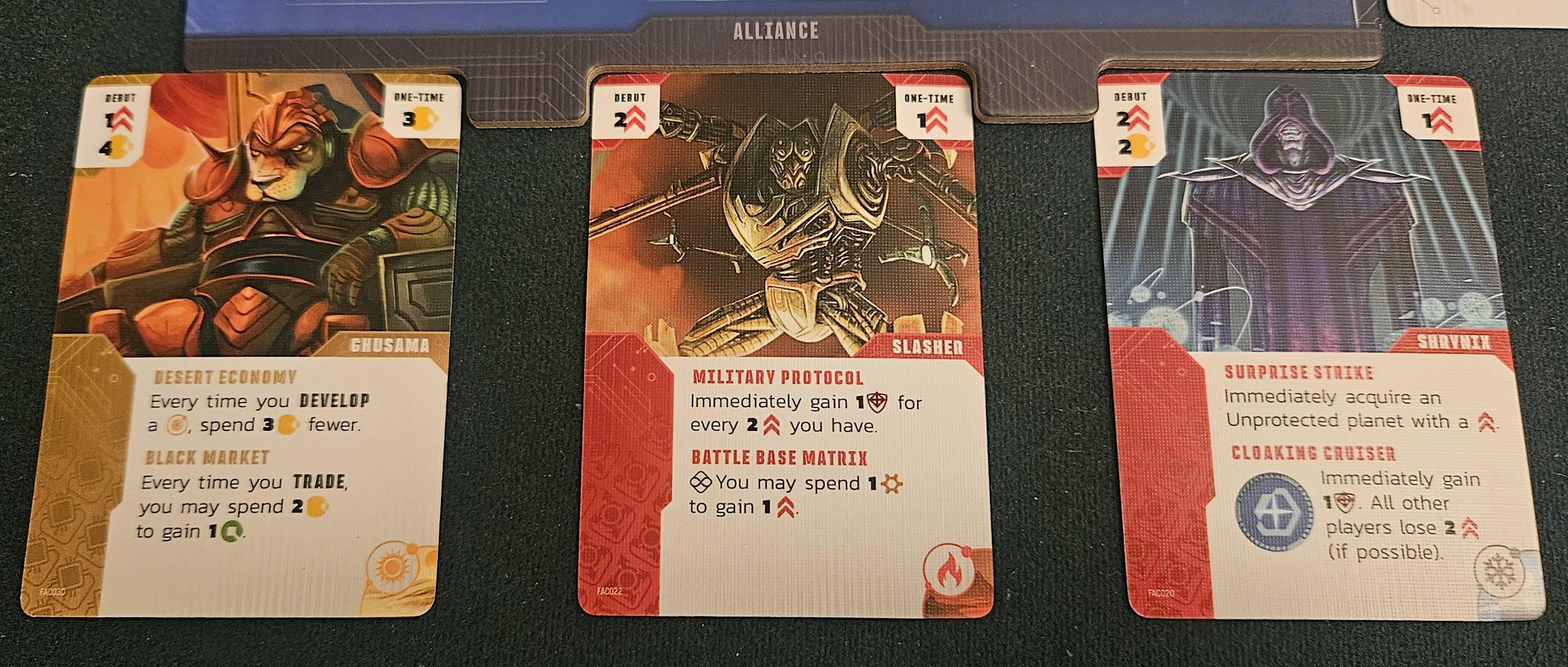
The Dog Lord and his nasty pals.
That’s the point. Age of Galaxy is an excellent reduction, but it never quite escapes its own limitations. The result is a compelling artifact of design first and foremost, and a gripping plaything only second. This is possibly the best 4X-in-a-shoebox yet crafted. But that doesn’t mean it isn’t a coffin-sized experience whittled down until its dimensions could be brushed into that smaller container.
In the meantime, what a thing to witness. There’s an art to game design, an art to adaptation too, and Age of Galaxy is a masterful work of both. Holding those seven factions in my hand produces an enviable peek at the scope of a game many times its size and duration, all that possibility reduced to a single fan of cards. There’s nothing quite like figuring out how to get my space-bugs and space-hounds and space-amoebas to work together. I liked Age of Galaxy two years ago. Today, in this larger format, with its improved visibility and crisper direction, I appreciate it all the better.
A complimentary copy of Age of Galaxy was provided by the publisher.
(If what I’m doing at Space-Biff! is valuable to you in some way, please consider dropping by my Patreon campaign or Ko-fi. Right now, supporters can read my second-quarter update!)
Posted on September 9, 2025, in Board Game and tagged Age of Galaxy, Board Games, Portal Games. Bookmark the permalink. 10 Comments.


sounds like it’s pretty close to the original version, size aside?
Yeah, it’s basically identical. The icons are better and bigger. (Although still imperfect!)
It’s identical, gameplay-wise.
Appreciate you revisiting this review for the new edition, I’ve had my eye on this one. Curious on how you think it compares to Imperium: The Contention, another tiny 4x that you favored and seemed to not be as constrained by its streamlined nature.
Personally, I think Imperium: The Contention is even better. Although I believe it’s still out of print?
one of my grail games. They’ve been talking about MAYBE reprinting, but it sounds like Slay the Spire’s success may have resulted in putting it on the backburner https://boardgamegeek.com/thread/3451219/
Disappointing, but unsurprising. Slay the Spire is very good!
I am disappointed the box is bigger, as this is a great game to grab off the shelf and dash to your mate’s to play. A bigger box is just a pain as this should be a pocket-game.
BUT I do not care. I do not have Ed 1, so getting Ed 2 is a no-brainer. Its a fantastic game you must be mad not to have in your collection.
As for the Age of Galaxy vs Imperium: The Contention, which is the best? Again, I do not care. You get both. Both are great. If one is in print, get it while you can. If the other is not, convince the manufacturer to get it back into print. This is why the scientists invented space for two games on your shelfing (and another reason Age of Galaxy should have been fit-to-size).
Just wondering, how do you decide what reviews to port over to BGG? For instance, the 2nd edition has very few reviews, and this one could certainly help its visibility some :3
I cross-post almost everything, but usually only every few months. I’ll put this over there sometime soon.