Blog Archives
Name Your Zombies
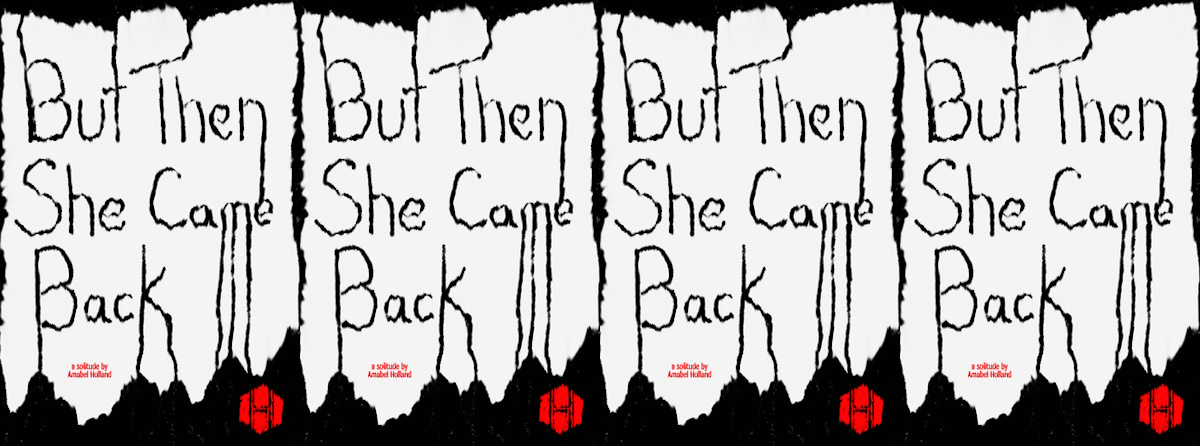
I’ve never been satisfied with the concept of the tone poem. If anything, it feels like a descriptor we resort to when there isn’t anything better at hand. When it comes to But Then She Came Back, the horror board game by Amabel Holland, well, there isn’t anything better at hand. Unlike most of Holland’s oeuvre, it’s an impressionistic lament to the toxic relationships we left behind, probably well after we should have. Very much like some of her work, it’s also a game that gives back what you bring to it.
The Banalities of Yesterday

Growing up Mormon, disdainful opinions about smoking were in plentiful supply. I recall a mother proudly recounting her answer to her daughter’s question about why people smoked. “Some people are on Satan’s side,” she declared.
She was half right. But the wicked were not the smokers — the victims, to use Amabel Holland’s parlance in Doubt Is Our Product. They were the profiteers who killed hundreds of millions for market share. Who peddled tobacco to children and obfuscated the deadliness of cigarettes. Who flooded the zone with bullshit so that ordinary people couldn’t make informed decisions. Who continue to do so, to the tune of eight million dead per year, one million of whom die from secondhand smoke. Textual critics have long held that hell and the devil were invented as a form of cognitive easing, a way to reassure ordinary people who couldn’t square why some of their peers, leaders, and oppressors were so predatory. Surely they were being influenced by a malevolent, otherworldly agent; surely they would receive a fiery judgement at the end of time.
If there’s anybody who makes hell and the devil seem necessary, it’s tobacco executives.
Antiantidisestablishmentarianism

This might shock you, but I don’t actually love big words. Rather than elbowing pneumonoultramicroscopicsilicovolcanoconiosis into a conversation, I prefer short, evocative slashes to anything my readers might need to sound out. Let’s be real for a second: Did you actually say the word in the previous sentence, or did you blip over it like one more nickname for Raskolnikov in Dostoevsky’s Crime and Punishment? Exactly.
Five-Dollar Words, then, is a game that I am unexpectedly terrible at. Designed by Amabel and Mary Holland as the freebie for this year’s Hollandays Sale, it peddles itself as a game for sesquipedalianists and pedants. Better yet, it has a rule that prevents anybody from dragging out antidisestablishmentarianism as their word of choice.
Look Up
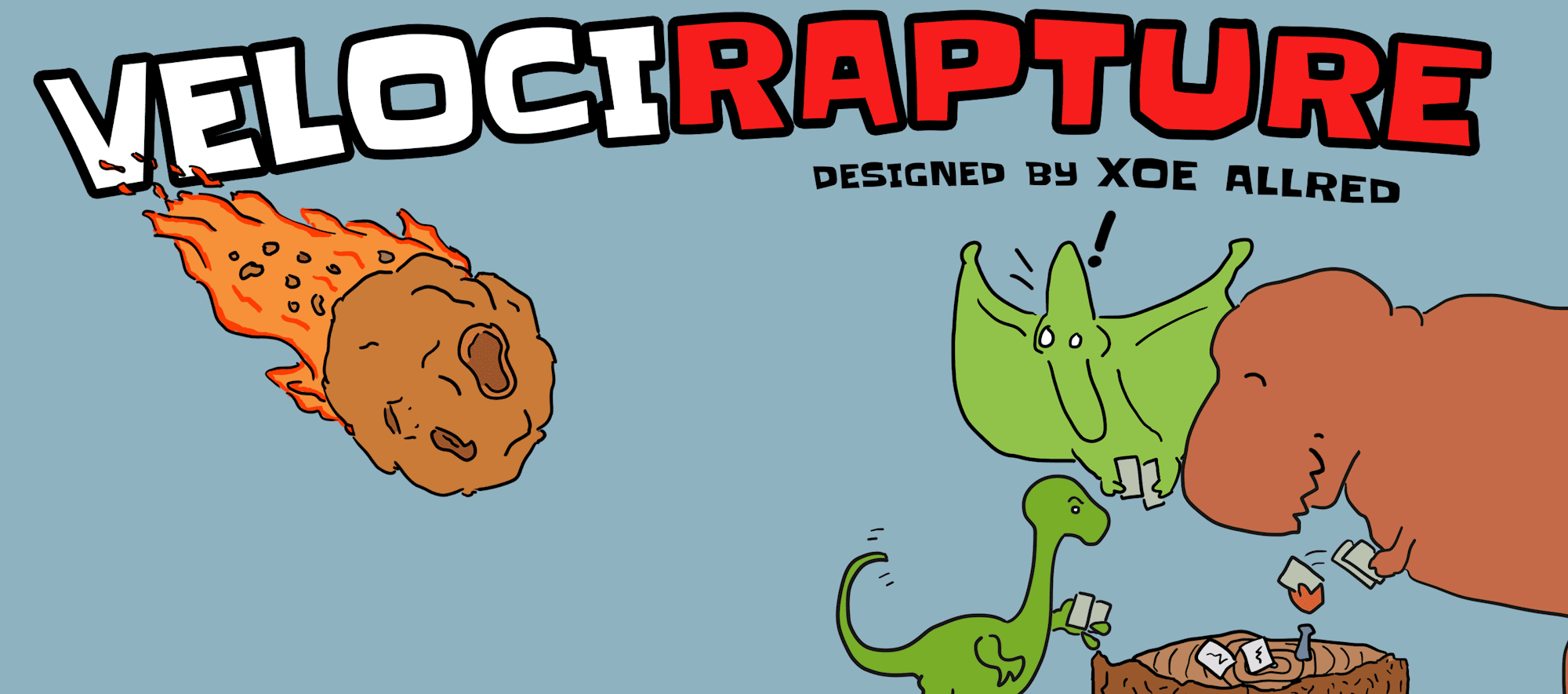
Xoe Allred’s Velocirapture is hard to describe, one suspects by design. There’s a shortcut in games criticism that’s tempting to invoke, wherein anything perplexing gets labeled a “tone poem.” Velocirapture, however, is not a tone poem so much as it is a garbled signal about the all-too-human tendency to talk around a difficult topic.
Here’s the box pitch: A meteor streaks across the Cretaceous sky. Extinction looms. But nobody wants to talk about that. Instead, these dinosaurs intend to play human games until the very end. As pitches go, it’s a knee-slapper. Largely in part because it’s so very recognizable. Just ask every single person who’s suffered from unusual bleeding or a misplaced lump and didn’t schedule a doctor’s visit right away. We are such odd creatures. Apparently, so were the dinosaurs.
You End Up Becoming Yourself

Kaiju Table Battles is one of the most intensely personal games I have ever played. It’s like stumbling across a friend’s open diary and reading a few fervid paragraphs before recognizing the artifact for what it is. The impulse in that moment, in our culture, is to clasp the diary shut, and likewise clasp shut the memory. We shy away from earnestness so readily. How, then, do we respond when the earnestness stands on a stool and demands to be seen?
Amabel Holland has always been a designer who stretches and strains the medium to its absolute boundaries. Kaiju Table Battles takes both to their limit. Maybe beyond the limit. This is a legacy game, envelopes and all, which peels itself apart layer by layer, revealing new diary lines and rubber-suited monsters alike. Along the way, it questions the very foundations of play.
Fossil Industries

It would be a lie to say I love cube rails, but there is a handful I’ve enjoyed more or less, and it’s no coincidence that three of them were designed by Amabel Holland. Dinosaur Gauge, co-designed between Amabel and Mary Holland, is, I hate to break it to you, the least historical of the set. Despite some messiness, that might also mark it as my favorite of the bunch.
Space-Cast! #29. Enduring Snake-Eyes
What’s the commonality between Shackleton’s voyage to the Antarctic, brain hemorrhages, and the virtue of watching R-rated movies? Today, it’s Amabel Holland’s Endurance, a board game about the strength of the human spirit in the face of abject misery. Join Dan and Amabel as we chat about this game’s difficult development, throwing out historical determinism, and why not every game should have a victory condition.
Listen here or download here. Timestamps can be found after the jump.
They Survived
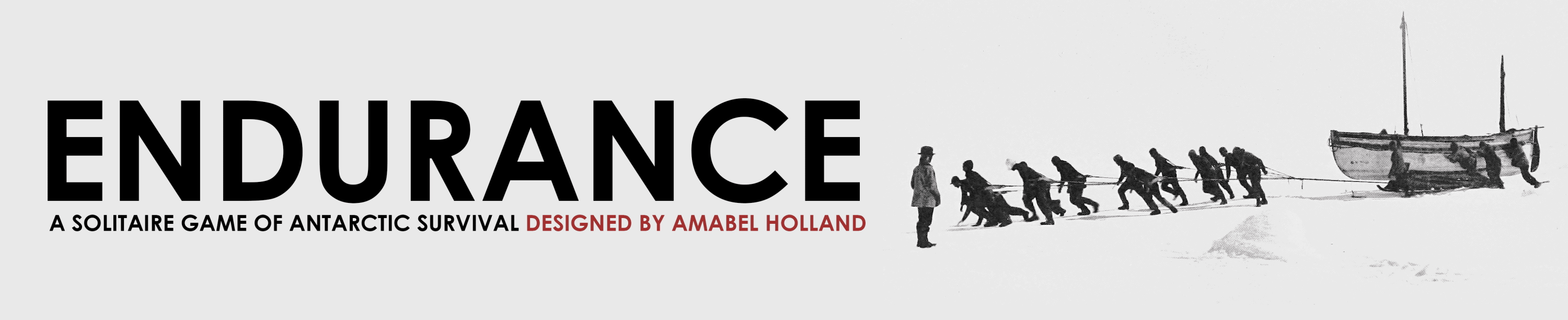
One of the big questions in wargame design is how one ought to simulate the range of possible outcomes. Take the Battle of the Bulge. Should a designer concede to playability by pretending that the German Ardennenfront could turn aside the Allied advance? Or should they instead presume that German victory could only be measured by some other metric, such as days or weeks of delay? Press a little deeper and you get questions about balance and historical determinism. Maybe, just maybe, we can rethink what it means to “win” in the first place.
That’s exactly what Amabel Holland has done with Endurance. Right from the outset, her rulebook warns that the survival of Ernest Shackleton and the twenty-seven members of his crew is not a historical given. Their escape, in her words, was “a fluke.” It shouldn’t have happened. It nearly didn’t happen. Roll the dice a hundred times in a hundred parallel simulations and it might never happen again.
That’s the first thesis behind Endurance, but it isn’t the most essential of them.
Space-Cast! #23. Watch Out! That’s an Amabel!

Once again we’re joined by Amabel Holland. This year, we discuss her forthcoming freebie game Watch Out! That’s a Dracula!, along with legacy games, textually queer games, and a transition in the tone of her work.
Listen over here or download here. Timestamps are after the jump.
Draculas, Frankensteins, Woofmans
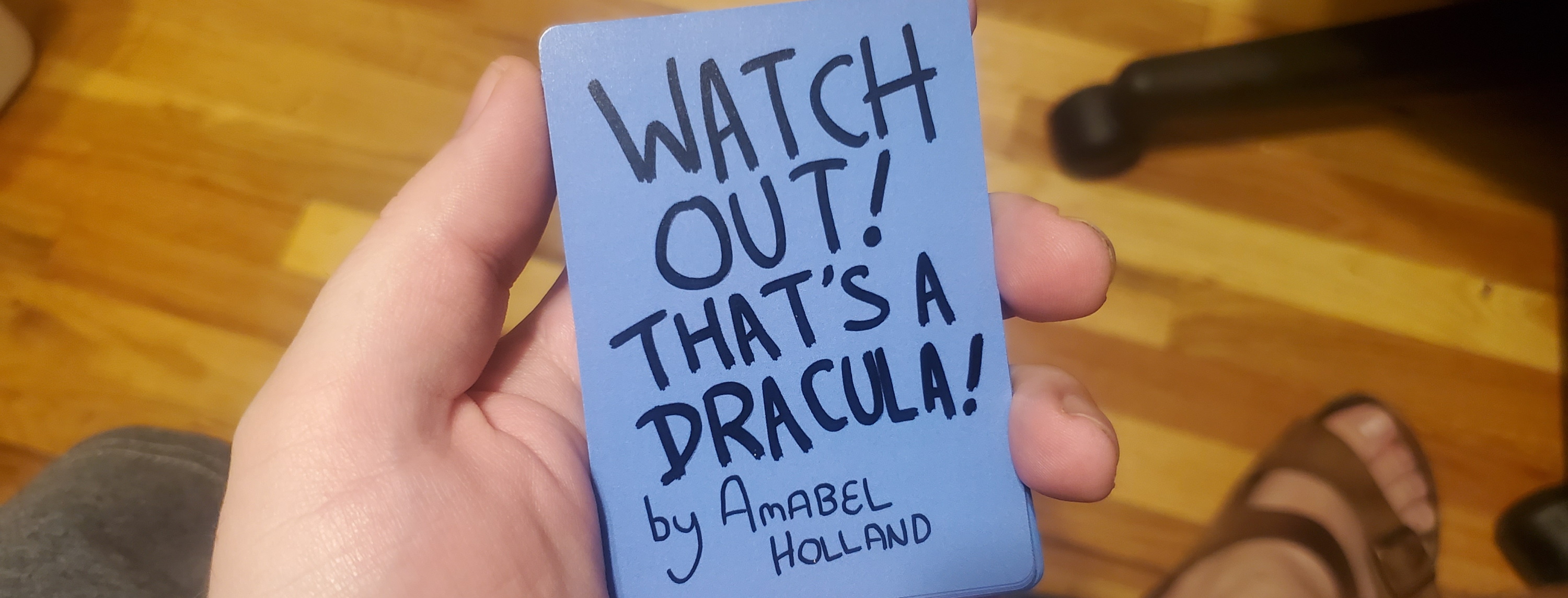
Every year, Amabel Holland designs a freebie game for Hollandspiele’s Hollandays sale. In the past, certain of these freebies have even been among the year’s best.
Watch Out! That’s a Dracula! might be my favorite yet. And not only because it treats Dracula like an absolute doofus.

 SPACE-BIFF!