Blog Archives
Shadows of Malic and Tannin

Longtime followers of Space-Biff! will know that I have a thing for Jim Felli. His designs are weird, wild, and so unlike everything else that “unique” is an understatement. Shadows of Malice was Jim’s first design to see publication. Now it’s getting a second printing. And if I assigned scores, it would land squarely on either a nine or a five.
Let’s talk about that gap.
Satyagraha: The Board Game

The ninth volume of the long-running COIN Series, Bruce Mansfield’s Gandhi: The Decolonization of British India, steps into a setting that likely needs no introduction. What may need clarification is the ways in which it stands apart from the remainder of the series — and how it remains locked in orbit.
Alone in the Arena
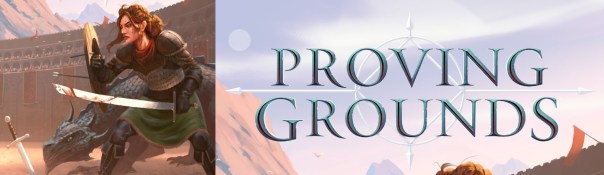
You may have read Teddy Roosevelt’s “The Man in the Arena.” It’s a paragraph about how critics are quivering simpletons compared to the brave souls who actually produce or perform, which of course means it’s my favorite thing ever written. I have a cousin who posts it to my social media timeline at least twice a year. Not sure why. He’s a professional consultant. That’s a fancy way of saying he’s a critic who gets paid. Not sure why you’re beefing on me, cuz.
Anyway. That’s what I kept thinking about while playing Proving Grounds, a solo game about a literal woman in a literal arena.
Abstracts Get Political: Guerrilla Checkers

Welcome back to Abstracts Get Political, the only series that looks at how abstract board games can make ideological points even in the absence of a strong setting! Last time we looked at Suffragetto, a game from over a century ago that served as both an optimistic statement on the winnability of the women’s suffrage movement and a source of funding for the same. Today we’re going in the opposite direction by investigating a title that’s more cynical about the concept of “winning” altogether — Brian Train’s Guerrilla Checkers.
Brian Train is a household name in Château de Thurot, mostly for his work on the COIN Series. With titles such as A Distant Plain and Colonial Twilight in his portfolio, he’s an old hand at modeling asymmetric warfare. But where Train’s other games have considered issues of geography, ethnicity, and even competing notions of “victory,” Guerrilla Checkers reduces the concept to its most essential. Namely, that winning at guerrilla warfare is an issue of stamina.
Jonathan Strange & Mr Butt
Susanna Clarke’s Jonathan Strange & Mr Norrell is a wonderful and (appropriately) strange novel, its meandering plot belying an uncommon thematic density. It never goes quite where you’d expect — an effect supported by footnotes that lend the air of a recovered manuscript — and you can hardly turn the page without encountering one idea subtly folding into another. Englishness versus otherness. The tension between madness and reason. The thin line between friendship and rivalry.
Now it’s a board game. And it’s a terrible shame that apparently nobody involved with this adaptation seems to have read the novel very closely.
Quod Erat Whatum?

I’m going to go out on a limb and say that most of the best auction games are about managing bid inflation. What’s bid inflation, you might ask? Good question. It’s how the value of a good increases over the course of the game. Think of a popular artist’s work in Modern Art. Early on, that artist was unknown and their paintings weren’t worth much. But as they become more and more popular, the value of their work skyrockets. By the last round, everybody is breaking the bank to nab a single painting.
Here’s the proviso: I didn’t say auction games were about bid inflation. I said they were about managing it. After all, if you’re spending all your money on the most popular artist, your profit margins are probably slim. Everybody has their eye on so-and-so’s latest painting. The cheques practically write themselves. It therefore behooves you to dole out your resources more cleverly. Sometimes it’s the bet on second place that both plays it safe and pays big.
Now imagine a game where your pool of money has no ceiling. You can bid anything. Five dollars, yes. Half a million pounds, why not. Sixty trillion yuan, now you’re talking. Welcome to Q.E.
False Equivalence: A Look at Shasn

Let me ask you a serious question. Clear your head, take a deep breath, find your center. Should religious institutions be required to pay taxes? Woah there, cowboy. You have two choices. (A) No. Prayer is an intangible service. (B) Yes. Even God should tremble before the tax collector.
Oh, and just so you know, depending on how you answered, you just outed yourself as either an ultra-capitalist or a showman. And the capitalist answered A.
Welcome to Shasn, one of the most unhinged, perceptive, outlandish, and timely games you might never play.
Abstracts Get Political: Suffragetto

You’ve heard the refrain: abstract games are themeless. That’s what they say. Who’s they? They, man. The forces arrayed against abstract games. Big Cardboard and their flavor text agenda.
Which is why I’m launching a new series about the abstract games that prove them wrong. Abstracts with a point in mind, a statement, a perspective. And they make it without a ten-page backstory, an art budget, or a single line of flavor text. Join the revolution before it sweeps you away.
First up, a game straight out of history. It’s Suffragetto!
Your Thumb on the Scales of History
The civilization genre has always been about gluttony. Think back on all those times you shepherded a civilization from tiny settlement to grand empire. When was having more not a good thing? The success of a game-based civilization is nearly always measured in size, stockpile, quantity, output. Even digital civgames, which occasionally fret over issues like expansion stress or population pressure, nearly always treat these issues as minor debuffs on the national scale, and offer solutions as something you can build, research, or buy. To solve the inflation caused by your treasure fleets, spend extra money on more treasure fleets.
Of course, historical civilizations have no such advantage. Too much gold infused into your economy and it sheds its value. Too many stockpiled resources invites theft and pestilence. Too many cities and your borders stretch until invasion or fragmentation is all but inevitable. A soaring population is a hotbed of plague and strife. Even happiness is a double-edged sword. When low, your people revolt; when high, they grow plump and expect new amusements. It’s easy to forget that Juvenal wasn’t being shrewd when he wrote about “bread and circuses.” He was decrying the complacency of the population. In game terms, Juvenal’s Rome had a maxed-out happiness score. It just so happened that max happiness also spelled significant dings to military readiness and civic duty.
Now let’s talk about Gentes.
Talking About Games: Five Categories

Following up on my previous Patreon-funded essay, we’re talking about the five categories I use when thinking and writing about board games, and how they might help revolutionize games criticism forever. Hey, I’m nothing if not humble.
The seven elements of fiction. That’s where we left off last time. Character, theme, plot, setting, point of view, struggle, and tone. Seven concepts that are almost universally recognizable to anyone who’s completed a primary education, and which concisely break down nearly any story into its component building blocks. Even those who couldn’t list them off the top of their head would almost certainly recognize them if pressed. “What’s a plot?” they would sputter. “What do you mean, What is a plot? It’s what happens in a story. That or a conspiracy, or maybe a division of farmland. Now please step back, street person with an uncanny interest in the seven elements of style.”
At least that’s what happened when I conducted an informal poll downtown.

 SPACE-BIFF!