Blog Archives
Winds of Change, Part Three: Kenya

It’s all too easy to think about colonialism as something that occurred centuries ago, resolved in the dim twilight of history and bearing little import on current interests. But as we examined in our last two entries on Stephen Rangazas’s The British Way, both the Palestinian and Malayan “emergencies,” as they were euphemistically known, are relatively fresh historical atrocities whose reverberations can still be felt today.
The same goes for British imperial behavior in Kenya. Indeed, the imperial incursions into Kenya were a 20th century phenomenon. Missionaries and British corporate interests began settling East Africa in the late 19th century, but the incorporation of the Colony and Protectorate of Kenya only occurred in 1920. Over the next three decades, British abuses reached a fever pitch. It was no surprise when an undermanned and underequipped group of rebels named the Mau Mau began to terrorize the countryside.
The Suns of Malvios

The suns of Malvios are dying.
I haven’t a clue what that means. Evocative, though. I wouldn’t expect any less of Peter C. Hayward. He created That Time You Killed Me, which featured some of my favorite writing in any board game to date. Give me one good sentence over a languid storybook any day.
Converge is the card game equivalent of one good sentence. Maybe four good sentences. This is a Button Shy production, and like all Button Shy productions it’s an 18-card wallet microgame. Except there are three wallets plus a solo mode, and they can be mixed and matched. Purists might argue that this pushes it past some self-imposed boundary of microgamedom. Good thing I’m no purist, because Converge is possibly the best microgame I’ve had the pleasure of playing.
Never Home

There’s a common misconception that “light” means “good for non-gamers,” with the flawed corollary that the lighter a game, the better it is for newcomers.
Forever Home, designed by Lottie and Jack Hazell, has exactly the right setting for drawing in the curious. As the operator of a dog shelter, it’s your task to train your doggos for placement into welcoming homes. It’s a lovely concept. The trouble is that it’s so light as to be insubstantial.
Space-Cast! #34. Bees & Dragons

Which is more unexpected, science-fiction bees or realistic dragons? For today’s episode, we’re joined by Connie Vogelmann to discuss that very issue. In addition to discussing Apiary and Wyrmspan, we also dig into how these games came to be, the benefits of grounding a setting, and the behavioral biology of leaving negative ratings on a game one hasn’t played.
Listen here or download here. Timestamps can be found after the jump.
Dragons Greater and Lesser

It’s an odd thing to say, given that Connie Vogelmann’s spinoff of Elizabeth Hargrave’s Wingspan is about fictional creatures rather than real-world birds, but Wyrmspan benefits from its sense of grounding.
Yeah, yeah, I know. But it’s true. Wingspan, which I’ve always had a fondness for, requires some degree of acceptance. You’re arranging its avian wildlife into three rows that represent… sanctuaries? Bird-watches? Meals? I couldn’t tell you. By contrast, Wyrmspan settles into a fiction of carving dragon nests into a primeval mountain. You feed the beasts, fill their hoards, raise their hatchlings. It’s every bit as pleasant and appealing as Wingspan, but heftier and more established.
Also, it sends my ten-year-old into paroxysms of joy. So there’s that.
Baconator

Where last year jump-started my appreciation for trick-taking games, perhaps 2024 is the year I’ll bumble into an adjacent genre: the shedding game. I’ve played a handful over the past few weeks, dominated by designer Sean Ross. My launching point for this introduction has been Bacon, one of his more recent shedders.
I Prefer Henotheist, Actually
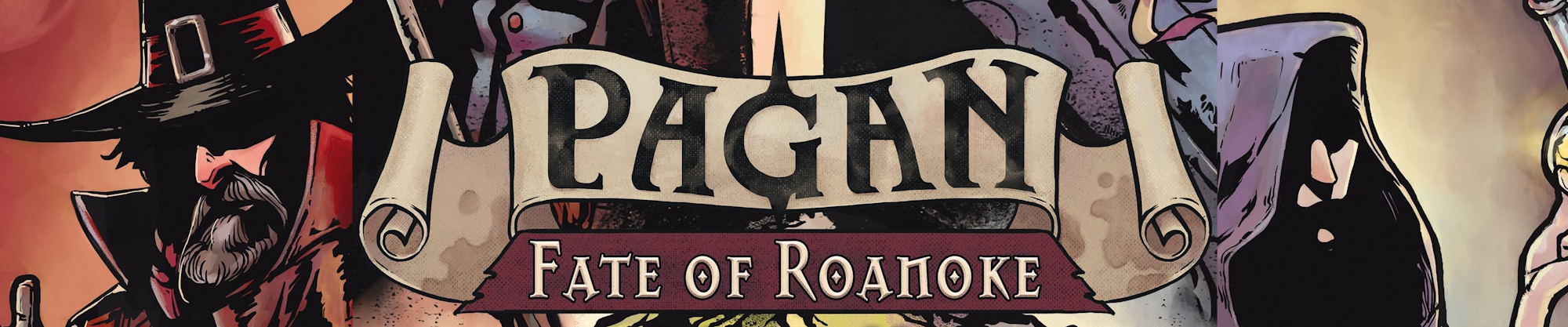
When the Witch Hunter bangs on my door to accuse me of paganism, I hope he won’t mind listening to some internal debate over whether that’s a suitable designation. I prefer to think of myself as a monolatrist, you see. Maybe a henotheist. I’m torn, really, over how to identify my relationship to these heathen deities that adorn my home. We don’t insist on labels like your mainstream god.
Pagan: Fate of Roanoke is positioned to ask such questions. Designed by Kasper Kjær Christiansen and Kåre Storgaard, Pagan places itself not only on the physical frontier, but also along the raggedy edge of our theological understanding. Only rather than debating the finer points of ecclesiastical law, two players are caught up in an existential debate over whether the colony should be forcibly stripped from the landscape via magic. That’s right, it’s a New World religious debate. No knowledge of Latin required!
No Franks!

I can’t tell whether Empire’s End, the latest game by John Clair, is trying to invoke the end of the Roman Empire, the Bronze Age Collapse, or a theoretical crumbling of the fleet from Space Base. Given the skinny cards, perhaps it’s the latter. I wouldn’t be surprised to discover that this game’s genesis arose from the former.
Which isn’t to say they’re especially alike. Space Base was an engine-builder with dice. Empire’s End is an engine-builder that occasionally explodes in your face due to No Thanks!-style auctions.
Little Gerties All the Way Down

It seems the Crossroads Series has settled into a groove. It’s certainly been a journey. From the selfish besieged colonists of Dead of Winter to the, uh, whatever they were in Gen7, to the lovable pirates of Forgotten Waters, these games have never sat still for long.
Freelancers, designed by Donald Shults but drawing upon Plaid Hat’s wide-ranging stable of talent, is the first time the series has felt like a repeat. Set in an Adventure Time-styled landscape that doesn’t seem to know the apocalypse has already happened, players embody a team of do-gooders who don’t seem capable of doing much good. And it’s such a riotous good time that it gets away with being a very bad game indeed.
The Better Part of Valor

The Battle of Hegra Fortress saw 250 Norwegian volunteers holding off a Wehrmacht battalion for the better part of a month. It was a comparatively minor engagement in the grand scheme of the Second World War, but the unexpected success of the defenders against overwhelming numbers, artillery and air bombardments, and the weather itself became a symbolic victory for Norway.
Petter Schanke Olsen’s version of the battle, Halls of Hegra, turns to modern mechanisms and systems to immortalize the battle. The result is exceptional craftsmanship, a depictin of warfare that goes far beyond the customary in its portrayal of courage under fire.

 SPACE-BIFF!