Winds of Change, Part One: Palestine

If you’re invested in historical board games, you’ve probably heard about Phil Eklund’s infamous essay defending British colonialism. Personally, the backlash against that essay was a pleasant surprise. Perhaps I had become numb to imperial apologetic. To me, the essay was merely the latest impressionable perspective in a century that had been meticulously prepared for selective memory. The notion that the British Empire was a gentle overlord has been a constant drumbeat across its tenure, from its earliest adventures in the New World to its participation in my generation’s quagmires in the Near East and Central Asia. Where other empires were vicious taskmasters, so the story goes, the British were invested in winning the hearts and minds of their colonial subjects.
That’s precisely the topic behind The British Way by Stephen Rangazas. This is the first official spinoff of Volkho Ruhnke’s now-formidable COIN Series. Rather than tackling a single conflict, The British Way functions as a folio series in a single box, covering four wars from 1945 to 1960. It has quickly become my favorite expression of the system. Which is why I intend to cover each of its conflicts separately. Today we’re looking at the first battle of the era: the Jewish insurgency against British rule in Mandatory Palestine.
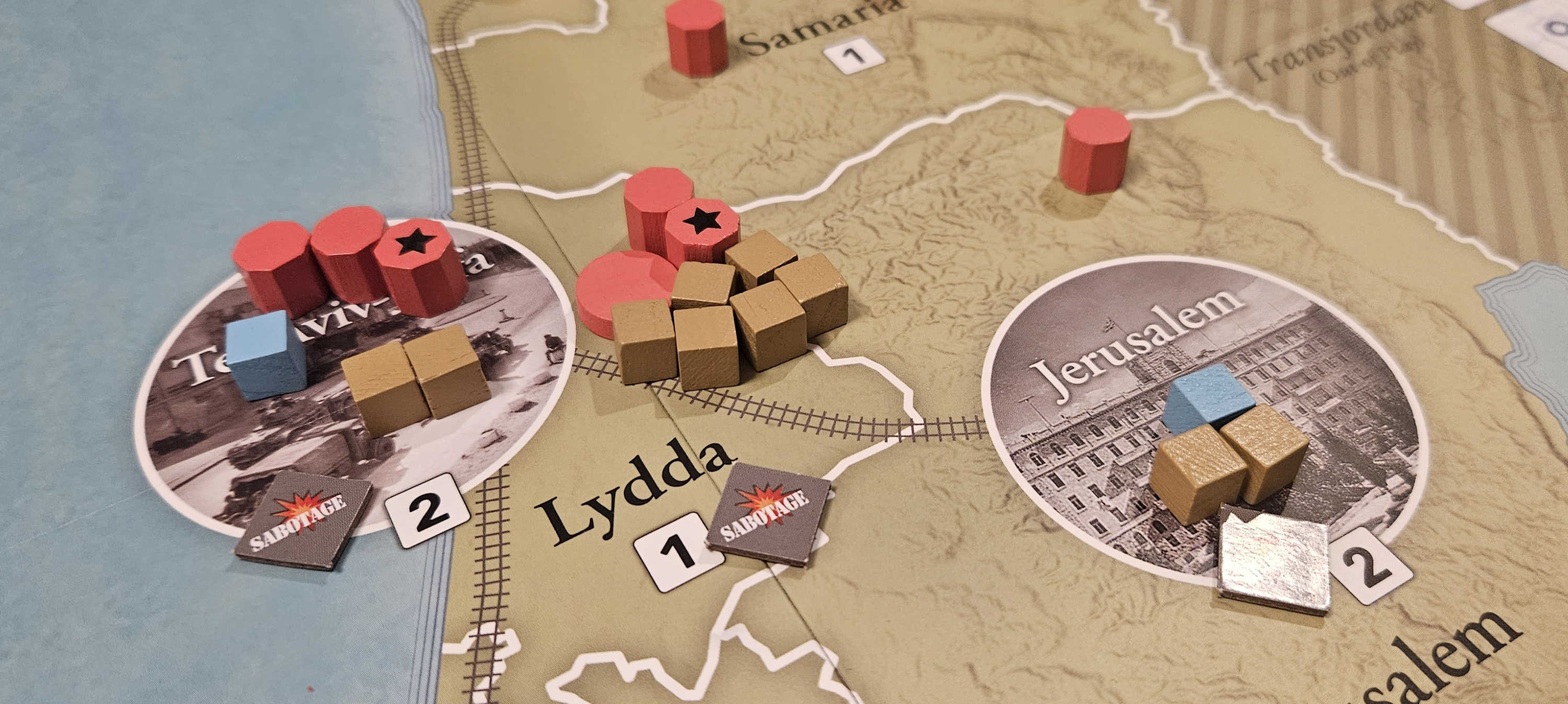
British forces clash with Irgun around Tel Aviv.
You would think the British Empire would be riding high now that the Second World War has ended. You would think. But the war has taken its toll, both at home and abroad. The economy only limps along thanks to American loans, and the armed forces are spread thin trying to reestablish control over far-flung territories and tattered lines of communication. Many of the Empire’s subaltern subjects had set aside their differences in the face of the Axis threat, but Germany and Japan have been broken. Many fought proudly alongside their colonial masters, gaining experience in arms and partisan tactics, not to mention earning the respect of their British peers. Surely the Empire would reward their efforts in defeating global fascism?
For many, however, the Empire was already proving forgetful. Mere months before the start of WWII, the British government had issued the White Paper of 1939, a statement of policy that tried to walk the tightrope between the promises they had made back in the First World War. The Empire had double-dipped, offering to carve out two distinct national entities within the boundaries of Syria, one for the Arab population in exchange for their support against the Ottoman Empire and another for the global Jewish community, which Britain hoped would help bring the United States into the war and stabilize the borders of revolution-torn Russia. For the duration of the war against Nazism, the issue was largely tabled. But with the horrors of the Holocaust now public knowledge, Zionist arguments were more urgent; hundreds of thousands of Jewish refugees needed resettlement as quickly as possible, and proposals to place them elsewhere — say, Eastern Europe, the site of previous pogroms — were untenable. On the flipside, the native Arab population was none too happy with the constant stream of hostile immigrants into their promised homeland. The British Empire had bargained itself into a corner.
Their response was to sit on the problem.
This is the first thesis of Rangazas’ The British Way. When the Palestine scenario opens, the British Empire is in a holding pattern. Half a million Jews have settled in Palestine already, but the incoming Labour government has decided to restrict immigration. Refugees from across the world are detained in holding camps or, in some cases, returned to their point of origin. Far from embodying the “hearts and minds” ideal, the Empire is determined to stuff cotton in its ears and dismiss its detractors as terrorists.
In this regard, Rangazas threads an especially narrow needle — and this is no wealth-justifying “Needle Gate of Jerusalem” myth. Like all of the scenarios in The British Way, this is a two-player take on the COIN System, one indebted both to Brian Train’s Colonial Twilight and Fred Serval’s forthcoming A Gest of Robin Hood. There were three historical Jewish resistance movements against the British in Palestine, but players adopt the role of the Irgun, an offshoot of the more legitimate (and much larger) Haganah, but one that’s more efficacious than the smaller and more violent Lehi. Rangazas does little to varnish their reputation. The Irgun are terrorists; they bomb not only iron railways but also occupied carriages and hotels, rob banks and raid arms caches, and ruthlessly threaten anyone who collaborates with their occupiers. By the end of the conflict, they will be hanging kidnapped sergeants in eucalyptus groves. That said, there is a reason for this violence. The Irgun, indeed the entire Jewish Agency, have been shut out of the possibility of dialogue. When people’s words go unheard, they turn to their fists.
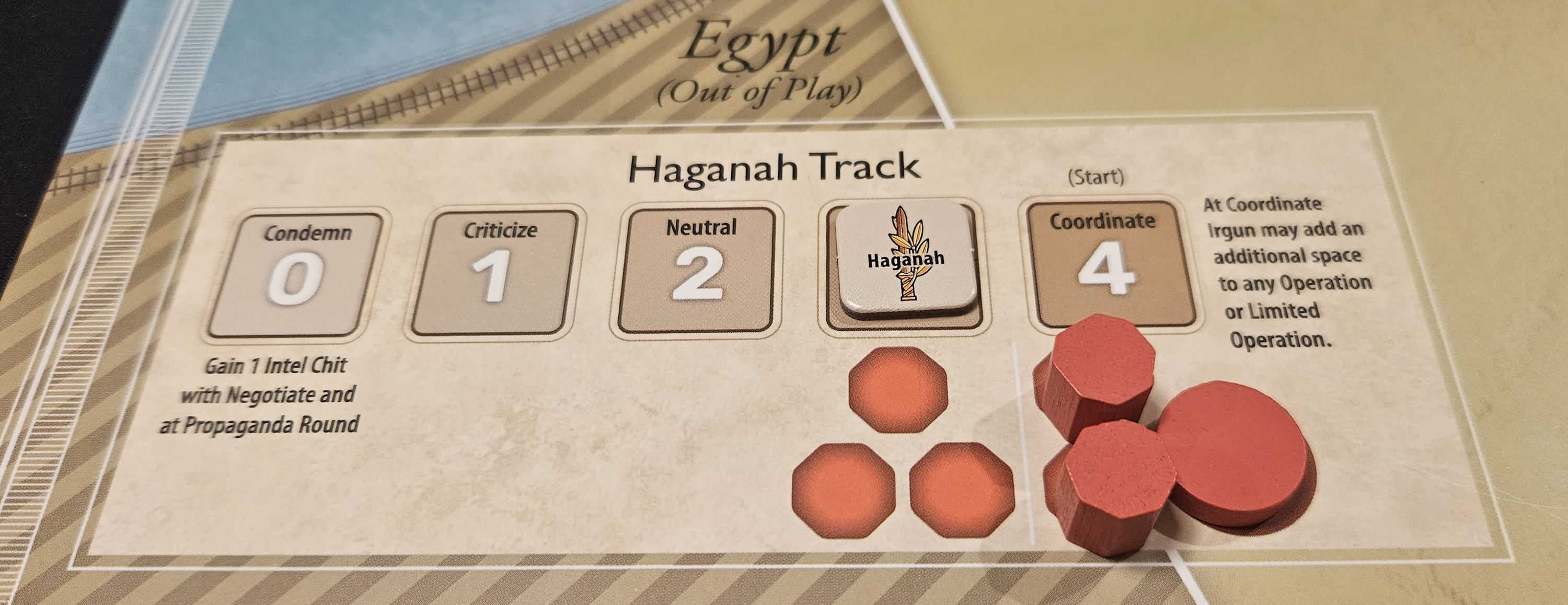
The Irgun court the support of the Haganah.
As befits the geographical squeeze that is Palestine, the map is claustrophobic. There are only three major urban centers, Jerusalem and Tel Aviv and Haifa. These are linked by vulnerable railways. Each of the scenarios in The British Way centers another aspect of the COIN Series; here that aspect is lines of communication. This is a suitable focal point. Not only did the Irgun go out of their way to derail British shipments and destroy bridges, but the entire region was effectively one switch in the ocean-spanning network that was the Empire itself. Britain’s interest in the region is not extractive; there are no economic zones or resources to safeguard. Rather, this is but one gateway to the Suez Canal and the colonies beyond.
Consequently, the scenario doesn’t bother to depict resources at all. There is none of the fiddling with cash that marks other volumes in the series. Instead, both factions are operationally limited by other means. The Irgun were simply too compartmentalized to worry about wider funding. Here, their main limitation comes in two forms. The first is arms caches. These are analogous but distinct from the bases that are customary in the COIN Series, only appearing on the map when plundered from the British, and then acting as hubs for recruitment and sabotage. The second is their relationship with the Haganah. When they have their elder brother’s support, they can perform operations in an extra location per turn. Demonstrating too much leeway through acts of terror, however, will see the Irgun’s support ebbing and eventually giving way to more intel for the British.
That intel, by the way, is the Empire’s limiting factor. British security forces increasingly isolated themselves from the local populace, constructing fortified zones to prevent further casualties. These so-called “Bevingrads,” named after the foreign secretary Ernest Bevin who denied Jewish refugees entry into Palestine, reduced their casualties but made it impossible for officials to develop ties to the local community. British operations are testy affairs, often taking place across a limited geography or only having a minor effect. They can mitigate this by spending intel chits to increase their coverage or uncover hidden Irgun cells more readily. But these snippets of intelligence are difficult to come by, requiring dedicated efforts that the historical British didn’t bother to invest.
That’s but the first failing of Empire. I’ve criticized the COIN Series in the past for being somewhat “blank,” in that the series prizes operational procedure over ideological cause and effect. One unfortunate byproduct of this blankness is a tendency to identify more with the plight and objectives of counter-insurgent forces than those squatting in mountains and jungles. Which is one thing when the insurgent is a cartel goon, but another entirely when the dominant regime is an oppressive enterprise that treats international opinion as little more than an gadfly to be occasionally shooed away.
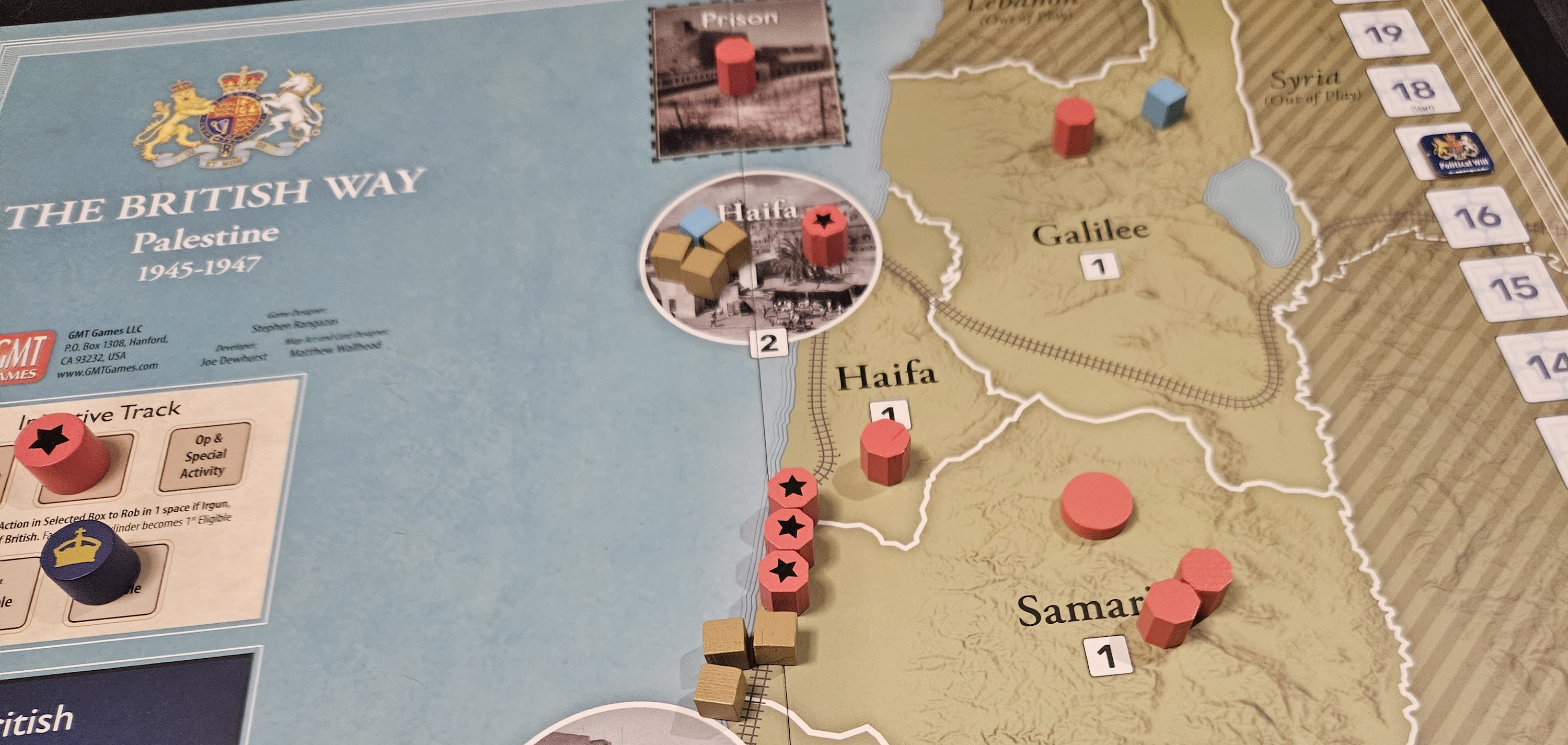
Lines of communication are crucial to the British.
Rangazas is on surer footing. The British Way encodes its interpretation of history directly into its operational language. Not only are the British entirely uninterested in learning what their captive hearts and minds are feeling and thinking, but their entire operational approach is a backfire waiting to happen. Their sweep-and-clear techniques emphasize mass detention without trial, sapping Irgun manpower but also directly undercutting their own political will to remain in-country. Their punishments are collective rather than acute, enforcing citywide curfews that become ready fodder for propaganda by the Irgun. Even their basic patrols protect lines of communication without bothering to secure the allegiance of the local population. Every other title in the series emphasizes the idea of support versus opposition. In Palestine, there’s no such thing. Indeed, the whole map functions as though it’s in opposition to the British regime by default. The British can only deploy in territories they command by brute force, but still require uninterrupted infrastructure in the form of police and absent Irgun whenever they want to repair sabotage or terror.
As a game, this reduces The British Way: Palestine to COIN at its purest. Players never worry about resources or support. Thanks to the streamlined initiative system, both sides act every turn, each operation and event declaring their priorities and future turn order. Yet it rarely feels gamey the way other volumes do. Because turns are lightning fast and the entire game wraps up in around an hour, there’s very little room for filler. Every action matters. Sometimes a whole lot.
This streamlined approach also crystallizes the game’s argument. The British Way depicted here is not a steady stewardship of hearts and minds. It begins with neglect for the needs of the local population; later, once that population has been radicalized, their newfound intransigence is countered with violence toward both combatants and noncombatants alike. The Jewish insurgency succeeded after its own acts of breathtaking violence blew apart the King David Hotel and strung up British officers. These acts were often retaliatory, sometimes even preventative, as when kidnapped soldiers were flogged in response to the treatment of Jewish prisoners at Acre. They succeeded in humiliating the British and threatening their global prestige. Of course, this didn’t occur in isolation; the Empire’s line of communication through Palestine became less crucial after the withdrawal of the British Raj from India, and pressure from the international community was growing more severe as boatloads of refugees were turned away.
Soon, though, the success of this insurgency inspired others to follow. Menachem Begin, one of the Irgun’s principal leaders, chronicled the organization’s growth and tactics in The Revolt, a book that has been studied by such far-ranging recipients as Nelson Mandela and al-Qaeda. That’s one of the overriding problems with the British approach. By disregarding the local populace so completely, they’ve created a scenario where their only winning move is also a losing proposition.
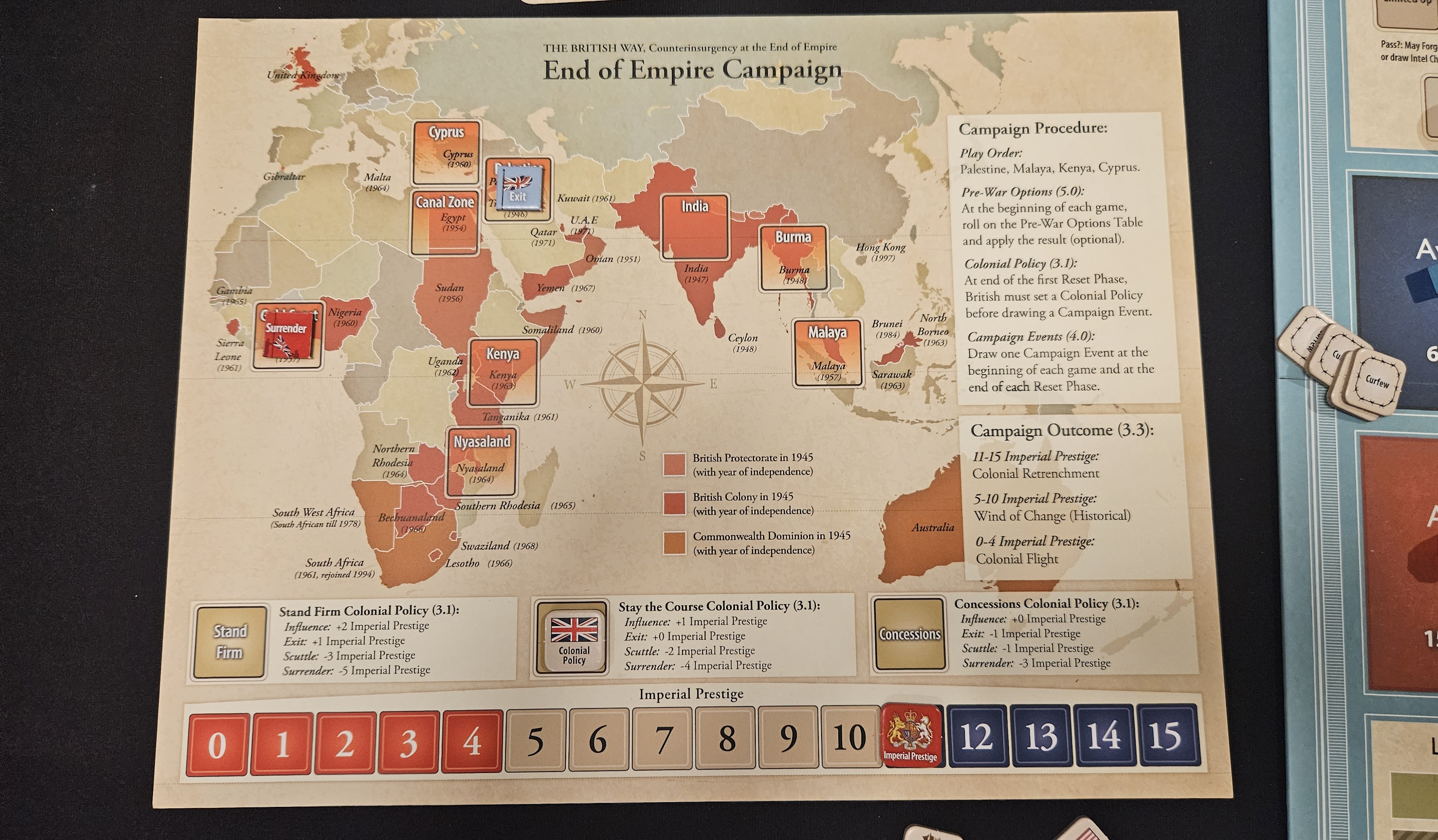
A mixed result for the British Empire.
There’s a final detail to consider. Instead of assessing these colonial wars in isolation, Rangazas includes the option to string them together into a full campaign. This confronts the British player with additional considerations and tells a wider tale than that of a single insurgency, and does so without adding much in the way of rules. In our campaign, while the emergency in Palestine was sowing the seeds for the coming century of conflict in the Near East, I was unexpectedly presented with an uprising on the Gold Coast. I declined to send troops. They had their hands full policing my railroads and cracking down on Jerusalem. As a consequence, my overall imperial prestige ticked downward, stirring the first whispers of change on the wind.
Because already, the Jewish insurgency had inspired other subaltern populations to take their shot. That’s the topic of the next scenario, which takes us through the Suez Canal and beyond the boundaries of the Raj itself. And the British are determined to learn all the wrong lessons from their withdrawal from Palestine.
(If what I’m doing at Space-Biff! is valuable to you in some way, please consider dropping by my Patreon campaign or Ko-fi.)
A complimentary copy was provided.
Posted on October 10, 2023, in Board Game and tagged Board Games, COIN Series, GMT Games, The British Way. Bookmark the permalink. 31 Comments.


“It has quickly become my favorite expression of the system”.
Agreed.
Thanks for the great review. I have been sitting on the fence on this one because I have the impression the Palestine scenario totally ignores the fact that there were arabs too living there, which gives me queasy feeling. Would you say I am correct in this? I only read the living rules and the card names, so of course I might be missing something. But I think the myth that “Palestine was an empty land” as Ilan Pappe would say, is both damaging and too widespread. I don’t want to start any kind of debate here, but for myself, I would play this more happily if the game acknowledges that Palestine in 1947 was not only British and Jews…
Dan might have his own take on this, but as the developer of the game I just wanted to say that it is something the designer and I spent a long time discussing, and we certainly didn’t mean to imply anything like “Palestine was an empty land”. The issue is that the tight scope and focus of the game didn’t really allow for any meaningful involvement of Palestinian Arab groups, particularly at the scale depicted by the game (with two players only, and focusing specifically on the post-WW2 Irgun campaign against the British, rather than the broader political debates). In the period covered (1945-1947) many of the militant Palestinian Arab groups were still recovering from the 1936-1939 revolt, and in some cases intentionally conserving their strength until after the British announced that they were leaving. There is a brief note about this at the start of the rulebook, and the designer is interested in re-using the same map for a prequel game that would cover the 1936-1939 Arab revolt in Palestine (we included some future proofing on the map with this in mind, such as the double naming of the “Tel Aviv-Jaffa” City space and the labeling of bordering countries to act as future playable spaces). There is no doubt much more that could be said about this decision, and I fully understand your concern, but hopefully this gives you some sense of why we took this approach with the game.
Great question. The rulebook acknowledges the presence of Arabs in Palestine, but that’s mostly limited to noting that the British learned (or failed to learn) from the previous Arab uprising and that upon their exit from the country conflict and ethnic cleansing broke out between Jewish and Arab communities almost immediately.
Of course, that’s easy to overlook. Many folks will never read the essays. In terms of the game’s on-the-board simulation, this is very much about British vs. Irgun. Even, for instance, the wider Yishuv is not modeled.
I can’t say whether that’s “enough” for anyone. Honestly, I can’t even decide whether it’s enough for me. Personally, I’m always interested in the tensions found in this series, especially around framing. What gets included in the frame, what gets left out, and so forth. But I do think that, in this case, the focus is more on correcting British colonial mythmaking and propaganda than in clarifying Jewish-Arab relations. We can draw parallels to today, if we like, and those parallels might even be trenchant. But that’s not the rhetorical function of the game.
Thanks Dan and Joe for the thoughtful replies. I understand and agree that COIN has always involved very specific framings, for example by sometimes adding factions that were not so important historically in order to have the canonical four. I get that the focus of this multi-pack is to show the different ways in which the British empire dealt with insurgencies in its twilight, by contrasting different examples. I feel very much attracted to this new conception of COIN, and want to support it. I look forward to Dan’s review of the other scenarios in the multipack.
I also very much look forward to such a prequel game about the arab revolt in Palestine.
The history of Palestine is extremely rich. The British only get there at the tail end of things. In 1922, the population of Palestine was around 760,000 of which 89 percent was Arab. It certainly was not empty. Thanks to the British colonial presence and later an agreement called the Haavara between Hitler and the Zionist Federation (who had their own, lets call them problematic views, on what to do with Arabs) the Jewish population rose to 31 percent. So it was far from only British and Jews, both of whose presence was seen by the indigenous Arab population as a foreign imposition.
The absence of Arabs from this game also makes me feel a little uneasy. But much of that unease comes from a concern about whether only simulating the Irgun-British conflict really captures the dynamics that led to British withdrawal or says anything interesting about the conflict. Much of what the Irgun was responding to was British immigration policy, and the game seems not to say much about how this drove the conflict, or British constraints on policy that determined their approach. Alongside this, you had inter-community tension and conflict, again driven by the continued immigration of Jewish refugees, failed negotiations between Arab and Jewish, and British concern around the impact of allowing ongoing Jewish migration to Palestine on wider relations with the Arabs. All of these factors ultimately contributed to Britain ‘passing the buck’ on the ‘Palestine situation’ to the UN.
None of this seems to my mind to lend itself to the relatively simple bilateral insurgent-counterinsurgency dynamics and victory conditions this multipack simulates. In this context, the central thesis of the game, and the bits that players can actually control seem like a massive simplification of the factors that led to British withdrawal. Then again, all games ultimately simplify, and I suspect that the designers would say that this multipack is about British counterinsurgency tactics at the end of empire, rather than trying to be a full on simulation of the end of British Mandatory Palestine, so I am probably being unfair in making these comments. I should probably also point out that I don’t have any clear ideas about how you would make a game that captured these wider dynamics!
In case this comes across as overly negative, I ought to add that on the whole, I have really enjoyed playing the other games in The British Way. Taken as a whole, the multipack offers a really interesting thesis (and I love the comparative politics angle to the collection), as well as being a fresh and streamlined iteration of the COIN system. Malaya has leapfrogged Colonial Twilight as my on ramp for teaching any players who are new to COIN.
I just want to say that I really appreciate your thoughtful critique here, and I think that you raise some important points about the potential limitations of the COIN system (and perhaps any single game on such a complex geopolitical moment). This is exactly the kind of serious engagement that Stephen and I were hoping for with the multipack!
With respect, Dan, do you think now is the time for this particular review?
Yes.
And thank you for that. I find it very difficult when complex situations are treated simplistically and we have a tendency to do so. And we are doing it this week more than ever. So thank you for not doing that and publishing this.
I have enjoyed this first foray in the “multi-pack” format, although I confess I was a little disappointed that the other locations on the campaign map wouldn’t have included gameplay. The sub-genre of two-player COIN games is really starting to mature with some great titles/eras, and I’m looking forward to the future entries in the series.
Great review, Dan.
Yeah. I had to extrapolate a little bit; when the campaign event card for the Gold Coast came up, I marked that region as “surrender” because I hadn’t sent any troops. It would have been nifty if there were more formal rules around the extra spaces.
I’ve really enjoyed this series, it’s a lot more dynamic than other COIN games, nearly every turn sees large changes in the board state. And the games play so fast! Not to mention some interesting history which I knew next to nothing about, this is a great addition to the series.
I am very much looking forward to the sequel about ‘The Guerilla Generation’ in Latin America.
You would not believe how eager I am to play that one.
Given the terrible position they’re in, and their equally terrible responses historically, I’m curious how the British “win” in the game and how ahistorical such a thing looks. Or, and I should have asked this first perhaps, how does the game judge what happened historically?
Winning: Unlike other COINs, victory is determined via a track that gauges the Empire’s current political will. It starts out near the top, and can be improved as the Empire destroys Irgun arms caches or keeps railways and cities secure until propaganda rounds. However, it will drop bit by bit if those lines of communication and cities are sabotaged or terrorized. The Irgun can win prematurely if they bottom out the Empire’s political will. In the campaign there are four possible outcomes, depending on whether the English persist in Palestine, exit gracefully, or are forced out. It’s very likely that they will leave the region, but whether they do so with their reputation intact is the bigger question.
The game, as far as I’ve interpreted it correctly, regards the Empire’s departure as damaging to their global image. But I might be misunderstanding what you mean by “judge.”
To add to what Dan said, even the best campaign result for the British (“Influence”) doesn’t necessarily mean that they will remain permanently, but rather that they will be able to leave with a sympathetic government in place and the means to exert a lasting influence in the region. The details differ in each scenario, but in general the conflicts are meant to be framed as being about the terms and speed of British departure, rather than whether they will leave at all (but we could perhaps have been more explicit about what these outcomes mean). In Palestine an Influence result might mean that the British are able to negotiate a more gradual departure that is less harmful to their international prestige and regional relationships, and perhaps allows them to maintain military basing rights (as they did in Cyprus).
Thanks Joe and Dan for the extra information!
Dan,
The post below is a question, not a rant and for sure not an attempt to shut anything down. I’m just too wordy in the times of stress.
As a long time reader and occasional correspondent, I have to ask: considering the timing and the content, what good were you aiming to bring?
As a person not impartial to both the subject and the ongoing war, who is still trying to stay sane, I’m not sure I understand.
Yes I’m glad that it’s possible to talk about the mandate and early post mandate times in this way. Yes, now, after reading the review and the comments from others I want to buy and play the game even more.
But as for the timing it somehow doesn’t bring anything but pain when I’m trying to reflect on what is happening now to a lot of involved people, me, my family and friends included. I would think that maybe we were amongst the ones to reflect, but it’s not going to reach anyone now.
There’s an entire laundry list of reasons I decided to write this piece despite the timing of world events. But if I had to pick just one, as I watch the international community repeat the simplistic rhetoric that led us headlong into two quagmires that left hundreds of thousands dead, as far-right commentators unite to celebrate colonialism as having done more good than harm, as our institutions embrace propaganda over history, as we watch grief morph into vengeance, it’s that collective punishments are always, always wrong.
Thank you for taking the time to respond so quickly and thoroughly.
Maybe I’m not the target audience for this timing, nor are the people close to me? We’re discussing the vast majority who are far removed from any (more so American) radical right and who want this conflict to end as soon as possible, since the cost is too high for everyone.
As for mass punishment, I hope that anyone with recent memory will know it hasn’t achieved meaningful results in the region.
I don’t think anyone in that part of the globe has fond memories of the mandate.
I’ll send you an email later, perhaps we can continue the conversation there.
“Rangazas is on surer footing. The British Way encodes its interpretation of history directly into its operational language.”
I wonder if this might be off putting to many fans of the COIN series. I know I’ve always enjoyed that blankness. It is its own argument in a way. When I win as the government in Colonial Twilight it’s with a sense that I’ve only just hung on in an absurd situation, with the candle still burning at both ends. One also can’t help but cringe when taking actions like Resettlement, Pyrrhic victories to say the least. Similarly in Andean Abyss and Cuba Libre I’ve found similar emergent conclusions, which grow from that blankness.
The idea that the game is going to proselytize at me feels a little patronizing, and immediately puts my back up; even if I agree with the position taken. That said, having read the rule book, Rangazas appears to have done this quite skillfully. With a game that creates a similar space for experience and objective modeling in the playing of it.
I have reserved the remarks by then, when the rapes and dead bodies of Israeli civilians were still being counted.
A year later, with hostages still being murdered and tortured, I still kept the silence.
With rocket fire from most of the neighboring (and far) nations raining on my family and friends – I still kept this out.
A year and a half later, with pogroms waged in Amsterdam, for the first time in over half a century, with animals crying for jewish blood and crying out to endorse Holocaust, it might be a good time to call it enough of a cool down.
Now I have re-read the review again. Hoping that the pain it caused was just an echo of the pain that had been growing, worsening since that October 2023. Pain that brought all those stories from the grandparents back to life, to the every day experience of expecting an attack, to hatred thrown in the face by passersby, to the boiling acid of those who just yesterday were fellow liberal-minded people.
And yet the text is full of allusions of Israel being an Imperial Power, a magnificent colonizer with the home base… wait, there is remote Island where you can reap the rewards – and the only home base is here, in the corner with the back to the wall, 10 millions Israelis attacked by 500 millions of ‘neighbors’. But of course this is not mentioned between all the snarky comments and the pulpit lecturing. And again the same equalizing twists make it sound like it was ‘just like the other side today’ – unless you know the policies, the reactions and the rest of the history that while mentioned, is mentioned enough to make it obscure for the reader who hasn’t read a single book on the history of the region.
You are disgusting, Dan. Your highbrow attitude is not a sign of enlightenment or wisdom. It’s the same homeopathic intellectualism of ‘well, we might be a better race after all’ of the 1930s that endorsed the camps. It’s the same judgmental attitude that did not allow ships to dock, forcing people back to their death. It’s the same beastly, inexcusable blindness that never caught up with people who took ‘free’ property taken out of dead jewish hands.
I would love to say that you got the president that you deserve. That the history will judge or some other hopeful phoresy will restore the justice. Yet there is no justice in history, only the survival. And you and your buddies will happy carry on, endorsing each other ‘helping’ the humanity while you throw the mud in the face of the only people who would not hit you in the name of their gods. Have fun seeing your children trying to criticize Islam or whatever force will be less civilized in conversations and getting beaten to a blood pulp in a few decades. Because you helped to establish the norm. Because you endorsed what happens outside the region, making it somehow acceptable. And damn you and your soul for seeing and not realizing (or even elating) to what happens to us in this another spiral of the longest hatred.
I’m about as terminally online as it gets, Jewish, have studied in Israel etc… and this is one of the most unhinged comments I’ve read in I don’t know how long. Seek help. You are not in good health.
Pingback: Winds of Change, Part Two: Malaya | SPACE-BIFF!
Pingback: Best Week 2023! Making Memories! | SPACE-BIFF!
Pingback: Winds of Change, Part Three: Kenya | SPACE-BIFF!
Pingback: Winds of Change, Part Four: Cyprus | SPACE-BIFF!
Pingback: From Grave to Cradle | SPACE-BIFF!
Pingback: Infinite Gest | SPACE-BIFF!