Blog Archives
Space-Cast! #36. How to Invest in Solar
The climate crisis! That’s a dour topic, isn’t it? Today we’re joined by Matteo Menapace and Matt Leacock to discuss Daybreak, their board game about world governments coming together to combat climate change. Along the way we discuss cardboard incentives, producing board games without plastic, and why optimism is necessary when thinking about big problems.
Listen here or download here. Timestamps can be found after the jump.
Heliotropes

Three and a half hours into our most recent play of Bloodstones, I turned to the five other players sitting at my living room table. “I just wanted to say,” I began, in the tone of a hard-bitten battlefield commander trapped in Bastogne during the Battle of the Bulge. “There is nobody I would rather share this ordeal with than all of you.” And then we laughed the laugh of soldiers who had spent too many weeks cowering at the bottom of foxholes.
Bloodstones is the latest title by Martin Wallace, a designer who has produced some of my favorite games of all time. It’s an impressive production, with multiple cloth maps, six unique factions, and oh so many bags filled with wonderfully clacky tiles. Between pedigree and production, it’s an easy sell.
I can’t stand it.
Island in the Sun

Spirit Island. What a game. R. Eric Reuss’s masterpiece has been around long enough that it’s become a staple of the discourse, a counterpoint to all those colonial settings that dominate game store shelves. Seven years ago I called it the anti-Catan. It’s still that and more besides. Nowadays I think of it less as a subaltern revenge fantasy (although it qualifies) or a deified avatar of conservationism (it’s that too) and more as a lament. If only there were gods, it cries. Even if they were gods that didn’t think much of us and might trample over us in their enthusiasm to preserve their creation, there would be comfort in knowing that some power, any power, cared enough about the trees and the beaches to keep them around a little longer.
Reuss’s latest iteration of the game, Horizons of Spirit Island, is a downscaled version that swaps plastic for cardboard and lowers both the player count and the complexity. It’s Spirit Island for book stores and Target, in other words. Even in a reduced format, it’s fantastic.
Everything Minus the Zamboni

I had no idea what to expect going into the second edition of Trick Shot. Not only because I don’t know the first thing about hockey, but also because I was operating under the assumption that it was a dexterity game.
Here’s the good news: Trick Shot may not let me hurl around a puck by flicking it with a tiny hockey stick, but it doesn’t need to. Designed by Artyom Nichipurov, creator of the stellar Guards of Atlantis, this is even better than my assumptions led me to expect.
Almost Me

It could happen to anyone. Your band of adventurers hit the tavern too hard last night. When you woke up, every member of your party was accused of a different heinous crime. For some reason we’re presuming you didn’t commit the deeds in question. Before the queen tosses your sodden bones in the clank, you’ll need to clear your good (eh) name. It’s detectin’ time.
That’s the premise behind Almost Innocent, Philippe Attali’s cooperative deduction game, which is best described as aggressively fine.
Pax Partying

It hasn’t been all that long since Matilda Simonsson wowed me with Turncoats, her handmade game of hidden influence and third-party warfare. Now she’s back with a more ambitious — not to mention riskier — follow-up in the form of Pax Penning. As its title suggests, this is a riff on the venerable (and thorny) Pax Series, importing crucial details and framing, right down to the clarifying footnotes in the rulebook.
But it’s something more than that. While Pax Penning is identifiably Pax, it’s also a more intricate take on the ideas Simonsson explored in Turncoats. This is a game of tenuous alliances, unexpected turns, and riding the changing winds of politics. And that’s before we excavate how it reveals uncommon depths of history via the language of play.
AMBLE
I own a pocket watch from Stratford-upon-Avon, a trinket I picked up to commemorate viewing Macbeth at the Royal Shakespeare Theater. It’s a gorgeous little thing, clasped in silver, its open face and back revealing the clockwork precision within. Everything has a purpose: the hairspring that stores tension, the jagged teeth of the escapement wheel that tick out the seconds, the gems that cap the gears to minimize friction. Sometimes I wind it up just to set all those pieces in motion.
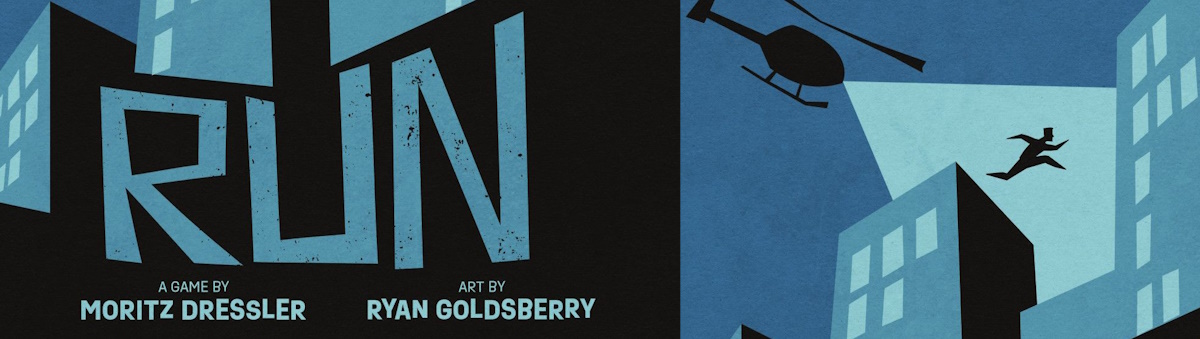
RUN, a hidden movement game by Moritz Dressler, reminds me of that pocket watch. As an object of mechanical fascination, there’s nothing quite like it. Everything has its proper place. It ticks smoothly.
But it’s also pointless. An artifact, a curiosity, rather than something I’m going to actually carry around.
Kinfire. Not That One.

Every time I mention I’m playing Kevin Wilson’s Kinfire, somebody asks if it’s really as big and intimidating as they’ve heard. This sparks a clarification: the Kinfire in question is Kinfire Delve, which is considerably smaller than Kinfire Chronicles, the latter of which is so sprawling and so expensive that it would probably be compromising for me to even glance at the thing.
No, Kinfire Delve — specifically Vainglory’s Grotto, the first of three proposed releases in the Delve line — is neither big nor intimidating. To the contrary, it’s compact and easy. Both solitaire and with two players, it’s as smooth as they come. Maybe too smooth. But only by a scooch.
Winds of Change, Part Four: Cyprus

This is how The British Way ends: not with a bang but a whimper. Of the four scenarios in Stephen Rangazas’s vivisection of 20th-century British colonialism, Cyprus is the briefest and least rules-heavy inclusion, a suitable outcome for a conflict that was comparatively minor when contrasted with the counterinsurgencies of Palestine, Malaya, and Kenya. Exhausted by colonial occupations across the globe, the British Empire was spread too thinly to enact a full response. Instead, it elected to utilize the lessons of occupations past to sway international opinion and brutalize the insurgents into surrender.
As we will see, the outcome proved unsatisfactory to everybody.
Choose Your Own Cardventure
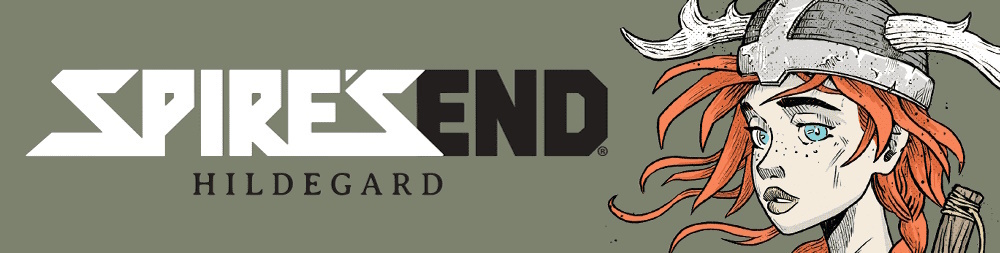
I spend a weird amount of time thinking about narrative in board games. So maybe it isn’t a surprise that I was drawn to Hildegard, the second entry in Greg Favro’s Spire’s End series, in which the obvious touchstone is choose-your-own-adventure books. You know, those things everybody cheated through as a kid.

 SPACE-BIFF!