Blog Archives
Sini in Reverse

The best things about Inis have almost nothing to do with its Celtic-Irish mythology. Almost. Much like how the best things about Cyclades and Kemet — both of which are also dudes-on-a-map games from Matagot — have almost nothing to do with their Greek or Egyptian mythologies.
In fact, at first glance Inis doesn’t seem like your usual dudes-on-a-map affair at all. It’s got dudes, sure. And a map. And the dudes are on the map. But when it comes right down to it, this is a game about king-making that features a whole lot of actual king-making. And in this rare case, that’s a great thing.
Wet Ocean, Dry Erase
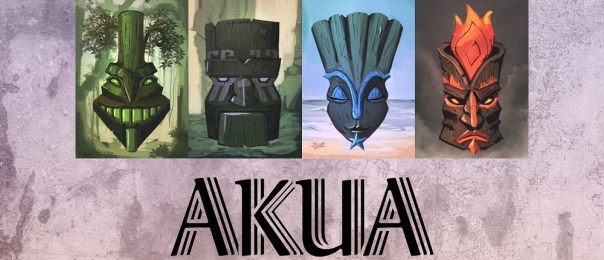
What happens when Small Box Games ditches the small boxes entirely? Probably something like Akua, John Clowdus’s first foray into the silicone polymer-reeking world of dry erase games. It comes on only two sheets, one for the board and another to explain the game, and even trusts that you’ll have a few different colors of dry erase markers sitting in a drawer somewhere.
And yet, for all its sparsity of components, Akua is anything but straightforward.
Neither Merchants Nor Marauders

Merchants & Marauders was a great big sandbox of fun. It fully embraced the go-anywhere, do-anything joy of life as a sea captain. Did you want to quietly sail between ports, getting rich on clever trades? Fine, fine. Or did you want to make enemies of the Spanish, tackle a treasure galleon, and raid everyone down to their piratical pantaloons? Even better.
Merchants & Marauders: Broadsides is not that.
Two Minds about Warfighter

Every so often — very rarely — Dan is wrong about a game. I know, it came as a surprise to him too. Which is why today we’re featuring a conversation between Dan and guest contributor Brock Poulsen. The topic: Warfighter by Dan Verssen Games. One for, one against. There can only be one with the correct opinion. Two men enter, one man is wrong.
You get the idea.
Exceedingly Excellent

BattleCON is one of my favorite game systems. Ever. If I were to compile a Top Ten list — which I haven’t and probably won’t, so don’t ask — then Devastation of Indines would almost undoubtedly be right near the top. It’s incredible.
Perhaps for that reason, Exceed almost goes out of its way to look like a pretender to the throne. Or is that an usurper of the throne? Either way, D. Brad Talton Jr.’s other fighting-game simulator seems intended to sit quietly alongside its predecessor despite looking so similar that the cards might have been swapped at birth. Exceed bills itself as a lighter alternative to the cerebral brain-crunching and jaw-busting fun of BattleCON, right down to the fact that it ships in smaller, more affordable boxes. Whether it’s better, on the other hand, is the tougher call. So tough that I’ve had my hands on a review copy for about nine months and haven’t yet come out and said it.
Well, I’m saying it now: Exceed is better than BattleCON. And yet it isn’t something I feel I can wholeheartedly recommend. How’s that for a quandary?
The Ariadne Punctuation

If you were to tell me that you’d designed a cooperative stealth game about breaking out of some impenetrable locale, saturated with guards who moved according to programmed logic that I had to evaluate and preempt, and that much of the gameplay revolved around gradually uncovering the layout of the map and assembling codes to break through certain critical areas, my first reaction would be to ask why I’m not just playing more Burgle Bros. Because Burgle Bros. is a lot of fun and — bonus! — it already exists.
The Daedalus Sentence now also exists. And in some ways, that’s all I want to say about it.
Crack Carcassonne

Everybody’s heard of Carcassonne, right? No, not the French city, smart-ass. The board game. That’s all we talk about here. Catch up.
Anyway, it’s perfectly pleasant. Put down some tiles, build some roads and castles, maybe there’s the occasional chapel. When you put down your little meeple guys, they earn points from all those cheerful little features of geography. Now imagine that but in real-time, everyone rushing to put tiles down, fumbling over themselves to fill in an open space, while still coming up with a coherent strategy. It sounds like madness, yeah?
Well, sure, it is a bit bonkers. But since this is a game from Christophe Boelinger, creator of Archipelago, it somehow works like a charm.
Let Slip the Trogs of War

Cry Havoc, a triple-header by Grant Rodiek, Michał Oracz, and Michał Walczak, wants to be one of the coolest things you’ve ever heard about. Hell, it’d like your ears to bleed when you hear just how cool it is. Soldiers dropping from orbit, rampaging machines who’ve never heard of the Turing Test and couldn’t care less, four-armed knockoffs of either the Eldar or Protoss — depending on which you think is a better representation of the ancient grumpy alien trope — and muscle-bound idiots who care for nothing so much as pumping their arms in the air to the catchy beat of “Girls Just Wanna Have Fun.” Cry Havoc has all that and more.
But instead of dripping honey into your ears, there are precisely two things I want to say about Cry Havoc. Just two. Not three, not one. Two.
Strawberry Pluckin’

Everybody knows the Great Wall was built to prevent the barbarian hordes from plundering the imperial garden’s strawberries, and thank goodness Imperial Harvest isn’t too caught up in politically-motivated historical propaganda to deny the obvious. One side wants royal strawberries, the other side wants royal strawberries; there ain’t enough royal strawberries for the both of ’em.
Cue one of the weirdest gaming experiences I’ve had this year. And I’ve played Zimby Mojo.
Neuroshima Forever

Interrupt me if this is a spoiler, but it’s the factions that do it. Can a review be spoiled? If so, I just spoiled myself.
Neuroshima Hex has been a thing for a while now. Ten years, in fact. When it first appeared on the scene, Portal Games was much smaller than it is now, and Michał Oracz was just beginning to show his prodigy-levels of cleverness at creating distinct factions. In essence, Neuroshima Hex was the broadside that started the war. After all, this was before his wonderful Theseus: The Dark Orbit and the brand-new Cry Havoc, both of which are all about the way their various factions intersect, clash, and resolve their differences. Usually by shooting or eating each other. Sometimes both.
Now it’s ten years later and Neuroshima Hex is still going strong. And I’m going to tell you why it’s the raddest abstract tile-laying game on the market.

 SPACE-BIFF!