Hapless Mortals
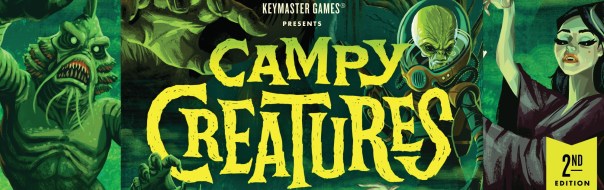
When it comes to blurbs, Campy Creatures knows how to pitch. You’re a mad scientist, see? Hoping to do eeeevil experiments, right? So your plan is to kidnap as many mortals as possible, m’kay? Except there are other mad scientists also capturing mortals, and they also have a similar roster of campy creatures doing their bidding, so you need to make sure your campy creatures outperform their campy creatures, ya dig?
Sure thing, Campy Creatures. I dig.
Forward to the Past

There’s an old adage I just made up about how you shouldn’t play a favorite designer’s games in reverse, as the process will only result in disappointment. After being totally smitten by Jon Perry’s Air, Land, & Sea, I was immediately drawn to his previous game, Time Barons. Perry co-created this one with Derek Yu, whose name you might recognize from I’m O.K., in which you murder and urinate on video game designers in order to poke fun at anti-game crusader and huckster attorney Jack Thompson. If only Yu’s lesser-known Spelunky had been his defining work instead.
Anyway. I’m happy to announce that my old adage isn’t worth beans. Time Barons rules. With some considerable provisos.
Let’s Solve a Mystery (Wizard)
Have you heard of GMT Games’ P500 Program? Imagine Kickstarter before Kickstarter was a twinkle in its grandpappy’s eye. Every so often GMT releases a list of games, all of which are up for preorder. If a game gets enough orders — I’ll give you one guess how many — it goes into production and eventually springs forth fully-baked, minus errata and countersheet errors.
“Wait, wait,” I hear you saying. “Doesn’t GMT Games pretty much just do wargamey stuff? That header doesn’t look wargamey. Not even a little bit.”
Very astute of you to notice! That’s because Mystery Wizard, by Aiden Giuffre, Jackson Warley, and Zachary Eberhart is indeed the most incongruous thing to ever appear on GMT’s P500 list. Unsurprisingly for a publisher focused on entirely different fare, it’s hovering at a mere 300 orders. I’m here to tell you why that number should jump forward.
Flick That Fleet
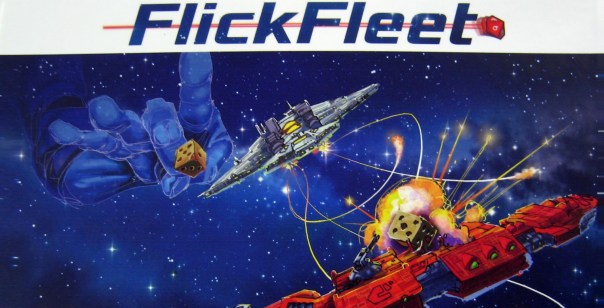
Every so often a game fully realizes the dual promise and limitations of Kickstarter. Ambitious, but not overly so. Weird, in that there isn’t anything quite like it. Underbaked, in that it never really received much of a look from anyone outside of the project, at least nobody whose actual job is to advise why certain elements needed extra polish. Visionary, because the game’s creators might have ignored such advice had it been given in the first place.
Jackson Pope and Paul Willcox’s FlickFleet is that game. And I’m smitten.
Park Yourself Down

My favorite moment in Parks is when I decided to collect only the parks I’ve actually visited. Turns out, I’ve been to a lot of national parks. My family was like that: big SUV, too-small travel trailer, a desire to “rough it” without nailing down a single tent peg. So I quit picking the easiest of Parks’ parks and started grabbing only those I recognized from personal experience. My home state alone permitted a wide array — Arches, Capitol Reef, Bryce Canyon, Zion. Farther afield I grabbed Mesa Verde, Yellowstone, Badlands, Grand Canyon, Yosemite, Haleakalā. Not enough that it was easy. Just enough to provide a challenge.
If it sounds like I’m damning Parks with faint praise, you’re darn tootin’.
Shadows of Malic and Tannin

Longtime followers of Space-Biff! will know that I have a thing for Jim Felli. His designs are weird, wild, and so unlike everything else that “unique” is an understatement. Shadows of Malice was Jim’s first design to see publication. Now it’s getting a second printing. And if I assigned scores, it would land squarely on either a nine or a five.
Let’s talk about that gap.
Satyagraha: The Board Game

The ninth volume of the long-running COIN Series, Bruce Mansfield’s Gandhi: The Decolonization of British India, steps into a setting that likely needs no introduction. What may need clarification is the ways in which it stands apart from the remainder of the series — and how it remains locked in orbit.
Alone in the Arena
You may have read Teddy Roosevelt’s “The Man in the Arena.” It’s a paragraph about how critics are quivering simpletons compared to the brave souls who actually produce or perform, which of course means it’s my favorite thing ever written. I have a cousin who posts it to my social media timeline at least twice a year. Not sure why. He’s a professional consultant. That’s a fancy way of saying he’s a critic who gets paid. Not sure why you’re beefing on me, cuz.
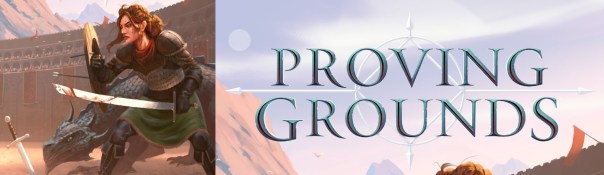
Anyway. That’s what I kept thinking about while playing Proving Grounds, a solo game about a literal woman in a literal arena.
Abstracts Get Political: Guerrilla Checkers

Welcome back to Abstracts Get Political, the only series that looks at how abstract board games can make ideological points even in the absence of a strong setting! Last time we looked at Suffragetto, a game from over a century ago that served as both an optimistic statement on the winnability of the women’s suffrage movement and a source of funding for the same. Today we’re going in the opposite direction by investigating a title that’s more cynical about the concept of “winning” altogether — Brian Train’s Guerrilla Checkers.
Brian Train is a household name in Château de Thurot, mostly for his work on the COIN Series. With titles such as A Distant Plain and Colonial Twilight in his portfolio, he’s an old hand at modeling asymmetric warfare. But where Train’s other games have considered issues of geography, ethnicity, and even competing notions of “victory,” Guerrilla Checkers reduces the concept to its most essential. Namely, that winning at guerrilla warfare is an issue of stamina.
Jonathan Strange & Mr Butt
Susanna Clarke’s Jonathan Strange & Mr Norrell is a wonderful and (appropriately) strange novel, its meandering plot belying an uncommon thematic density. It never goes quite where you’d expect — an effect supported by footnotes that lend the air of a recovered manuscript — and you can hardly turn the page without encountering one idea subtly folding into another. Englishness versus otherness. The tension between madness and reason. The thin line between friendship and rivalry.
Now it’s a board game. And it’s a terrible shame that apparently nobody involved with this adaptation seems to have read the novel very closely.

 SPACE-BIFF!