Best Week 2019! The Raconteurs!

It wouldn’t be a good year without at least a handful of games that know how to spin a yarn. Like any good storyteller, these understand that while the destination matters, the journey is the more important portion. Also like a good storyteller, nobody would describe them as “tight.” To be frank, some of these are flabs. Some have sharp edges. They make mistakes some folks argue should have been eliminated from board games centuries ago.
Not me. The joy of these games is found in the stories they tell. Sharp edges? Psh. You know what has sharp edges? Books, baby.
Best Week 2019! The Aesthetes!
Another day, another fraction of Best Week come and gone. Gone, too, are countless possible categories. To tell you the truth, the process of sorting these lists is so tricky that I’ve considered defaulting to “prettiest games.” Problem is, have you seen games these days? They’re crazy. Entire mountains of colorful plastic. Louvre-worthy art out the wazoo. One of the handsomest games of 2019 wasn’t even eligible for consideration because it was an unreleased prototype.
Which is why today’s victors are more than merely pretty. These are the titles where visuals are the gameplay. Where your decisions are based largely upon the visual information spread before you. In many cases, the math takes a backseat to the arrangement and spacing of the pieces. And often, this visual shorthand prompts both a synesthetic reflex and unexpected consequences.
Best Week 2019! The Inveiglers!
Ah. Welcome. The wheel has turned once again, my friend. Here we stand upon the precipice of a new year. Let us then consider the best games of 2019. There is no better time for looking backward than when we look forward.
Today is a celebration of the charmers, the dashers, the titles you could bring home to mom and not worry about getting asked whether you’ve had your immunizations. It isn’t that they’re soft, although it’s true enough that some of these palms haven’t been worn rough by hard labor. Rather, they’re enticing. These are the games designed to appeal to weathered gamers and pine-scented newcomers alike. They beckon. Oh, how they beckon.
Making Waves

Longtime readers may recall my appreciation for the solipsistic hellscape that is human language, the inefficient and ambiguous transfer of information generated by whistling air between slabs of meat, often followed by transcribing those whistles via pigment or pixels, and rarely wholly understood by those on the receiving end. Truly, we are the aliens. See also Dixit, Mysterium, and Codenames for a heightened sense of foreignness within your own skin.
This holiday season I’ve discovered a new inducer of existential angst. Co-designed by Alex Hague, Justin Vickers, and Wolfgang Warsch (best known for it’s-a-game The Mind), this one is called Wavelength. And when I’m pondering the Cartesian isolation of my reasoning mind from the remainder of this universe, my time with it has very nearly approached enjoyable.
Everything but Luxembourg

If you want a design’s corners sanded smooth, Tom Russell isn’t your man. For a perfect example, look no further than his recent game about the Peace of Westphalia. The version you learned in high school was likely abridged: Westphalia concluded the Thirty Years’ and Eighty Years’ Wars, hammered out the first inklings of international state sovereignty, and upheld that one Latin phrase from the Peace of Augsburg that you forgot by the time the test rolled around. Three points. With an introduction and conclusion, that’s exactly enough for a standard five-paragraph essay.
But Russell isn’t writing a five-paragraph essay. His Westphalia is molded after the complicated historical version of events, the one that featured over a hundred delegations that never met at the same time, yet still wheedled over the table while stabbing each other under it. Why? Because they were terribly in debt. So it goes. This is history with its corners left unsanded. Eight million dead, years of prevarication, and all because everybody’s credit cards were maxed out.
In order to depict this dire state of affairs, Russell doesn’t divide his players into one hundred delegations. He doesn’t even require more than two hours. Instead, he presents a negotiation game that’s both spare and expansive, clunky and elegant. And it all begins with the setup.
Alone with My Palm (Island)
I’m a sucker for portable card games and a double-sucker for those that can be played without a surface. Never mind that I’ll never find myself in a situation where I’ll actually want to play one. In the car? Motion sickness. On an airplane? Tray table. Eating a meal on the airplane? Then I’m eating, you goofball, not playing a card game. Standing in the Fantasy Flight line at Gen Con? Never again.
But I made a promise to my grandfather that I would find the perfect surfaceless card game, so I grabbed Palm Island and gave it a few plays, all within approximately two meters of a clean tabletop. Still, it felt good to do right by old gramps. He died never having owned a table. The real tragedy was not knowing where to set all the food everybody sent over.
Oh, right, Palm Island. Let’s talk about that instead.
The Future of Pax, the Future of Us
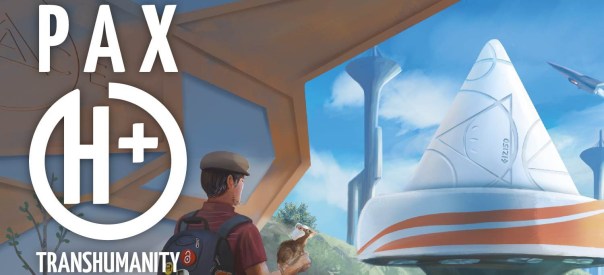
The Pax Series has always been a treasure trove for those who could spend their entire night clicking on blue words in Wikipedia. It might be the impact of Mormon timber on Mexican politics, Bukharan Jews upsetting the commercial balance of Afghanistan, Isabella of Castile’s nuptials unleashing her noted repressiveness, or how Immanuel Kant’s lofty ideals don’t ship much beef when it comes to the practical business of manumitting slaves. These are more than names on cards. They’re gameplay effects, watersheds, even inside jokes. History’s peculiarities as a box of toys, as a magnifying glass, as a polemic, as a gentle ribbing.
With Matt Eklund’s Pax Transhumanity trading the historical for the speculative, it seemed natural to ask whether it could retain its sense of wonder, reverence, and playfulness for the triumphs and foibles of the past. Turns out, there was no cause for doubt. The strengths of the series are not only present, but emphasized, resulting in one of the most important science-fiction board games ever crafted. And it has everything to do with how it uses those cards to tell unexpected — and even profound — stories about where our species might go from here.
Talking About Games: Positivity, Negativity

Where the first four parts of Talking About Games focused on the words employed by board game reviewers and players, we now zoom into the stratosphere with the haste of an eagle diving at a plump squirrel. That’s right, I’m talking big picture. For the next few months, we’ll be talking about criticism more broadly — what it is, what it’s good for, and the biggie, why it is. Important, I mean. Critical, if wordplay is your jam.
Today, our topic is positivity and negativity. And it came about because of two happenings that made me ask why I bother writing about board games in the first place.
Rise of Ecosgustus

Because it is the ken of board game critics to reduce every design to “It’s just this one game plus this other thing,” it would be easy to dismiss John Clair’s Ecos: First Continent as just Paolo Mori’s Rise of Augustus plus a map. That would be doing it a disservice. For one thing, although Augustus and Ecos share a heritage that stretches all the way back to Adam and Bingo, in practice there’s enough consanguinity between them to make their intermarriage technically legal in at least three states. You do you, you crazy lovebirds.
The real issue, however, is that Ecos is so damnably playable. If I were in a bad mood, I might almost call it cynical. Instead, let’s go with insidious.
Hot Alien-on-Alien Action
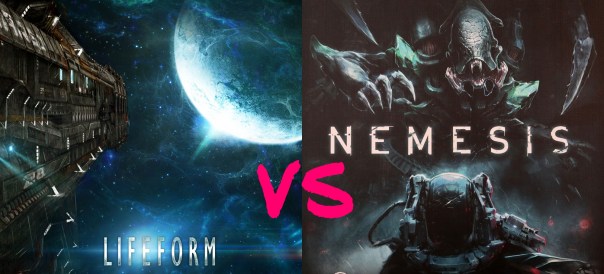
I didn’t actually watch Alien as a kid. Worse: my friends described it to me on the playground. It has been said that nothing is more terrifying than the unknown. That’s preposterous. It’s the half-known that’ll keep you up at night. To grub-form Dan, nothing was more terrifying than the prospect of Alien. Not even, when I finally got up the nerve to view it, the film itself.
Over the past month, I’ve played two separate releases that attempt to adapt the breathless horror that was initially brought to life by Ridley Scott and given an uncomfortable phallic pulse by H.R. Giger. And even though they’re remarkably similar in some ways, one of these games is among the year’s best while the other is merely fine.

 SPACE-BIFF!