Fireflop
Yesterday we looked at €uro Crisis, a sharp-toothed economic game from Doppeldenkspiele with one heck of a political system and a jaw-unhinging dose of satire. Despite some reservations, I appreciated its unexpected edges and depth of play.
Its follow-up title, Claudio Bierig’s Plutocracy, rockets the financial power plays into the far reaches of the solar system. Unfortunately, despite being given infinite wiggle room, it largely sticks to one corner.
€laborate Banality

There’s this devastating moment in one of my favorite shows of all time, Mr. Robot. This character, a banker, describes the day he and other high-level executives decided to cover up evidence that one of their factories was leaking toxic chemicals. Speaking to the daughter of an employee who died from leukemia caused by that leak, this banker details how rather than going public with the information, the company decided to stash some money for a possible future lawsuit. Any settlement today would be paid from a fraction of the interest earned on that investment.
In a show packed with bombastic conspiracies, it’s an understated moment. This particular coverup wasn’t about controlling the world. It was the banality of regarding human beings as risks to be managed, item lines to be balanced, expenditures to be weighed against other expenditures.
€uro Crisis, whose designer only goes by “Galgor,” and published by Doppeldenkspiele — to give you some sense of what’s to come, that translates to “Doublethink Games” — also isn’t about controlling the world. It’s about financial crises and the people who profit from them. And it cranks the banality up to eleven.
The Trance of Trick-Taking

Longtime readers know my blind spots. Trick-taking is a big one. My wife grew up with trick-takers. They were a regular family activity, so she learned their rhythm: the subtle tells, the contrasting modes of pressure and conservation and cooperation, the possibility of someone running away with a hand. When we try a new trick-taker, it doesn’t matter how different or innovative or oddball it happens to be — she settles back in like it’s the same game she’s played a hundred times before.
Shamans, the trick-taking game by Cédrick Chaboussit, falls into the oddball category. But despite a few departures from the normal template, it’s the first time I’ve slipped into the trancelike mindset of the trick-taker.
Gargling Brack

At some point the board game industry’s collective designers are going to stage a riot if we keep saying “It’s no Root.”
So let’s set that aside for now. Despite being published by Leder Games, illustrated by the inimitable Kyle Ferrin, and featuring four (mostly) asymmetrical factions of anthropomorphic animals fighting for control of its seascape — and despite some vaguely philosophical undertones — Greg Loring-Albright’s Ahoy is very much its own beast.
For one thing, it isn’t a hit.
Clank! Again!

I have mixed feelings about Clank! — and that’s a sentence that would sound much less dramatic without the obligatory exclamation mark. When I wrote about it way back in 2017, my stance veered wildly between “This is an approachable and clever hybrid deck-building game” and “This feels deeply artificial, and also there are way too many dead turns.” I haven’t touched its offshoots: no Clank! In! Space!, no expansions, not even the legacy-game version. Ask me what designer Paul Dennen has been up to and I’ll excitedly tell you about Dune: Imperium instead.
In a way, that remoteness gives Clank! Catacombs the air of a reunion. Not a high school reunion, and certainly not a creepy polygamist ancestors reunion. Rather, a reunion with an old friend — more of an acquaintance, really — who’s become way cooler than you remember.
Or Hog

Video game board game board games are an odd duck. I don’t mean board game adaptations of video games; I mean board game adaptations of video game board games. It hasn’t been that long since The Witcher 3: Wild Hunt included a ditty called Gwent. It was an absurd thing, impossible within the fiction of the game. Who exactly served as the Continent’s version of Wizards of the Coast? Were tournaments sponsored by Radovid the Stern? Were inks and cardstock imported from Nilfgaard? Did the Lodge of Sorceresses settle issues of power creep? To everybody’s surprise, Gwent had solid bones, perhaps because it drew from superior titles like Condottiere. Now you can play Gwent on its own. It even has two standalone story games.
Orlog goes the other direction. As a dice game, if feels right at home in the world of Assassin’s Creed Valhalla. What’s more natural than Vikings rolling some tombstones? Apart from sticking axes into Northumbrian levies or braiding each other’s beards, that is.
Too bad this adaptation is as cynical as they come.
Ophthalmology Is Not an Option
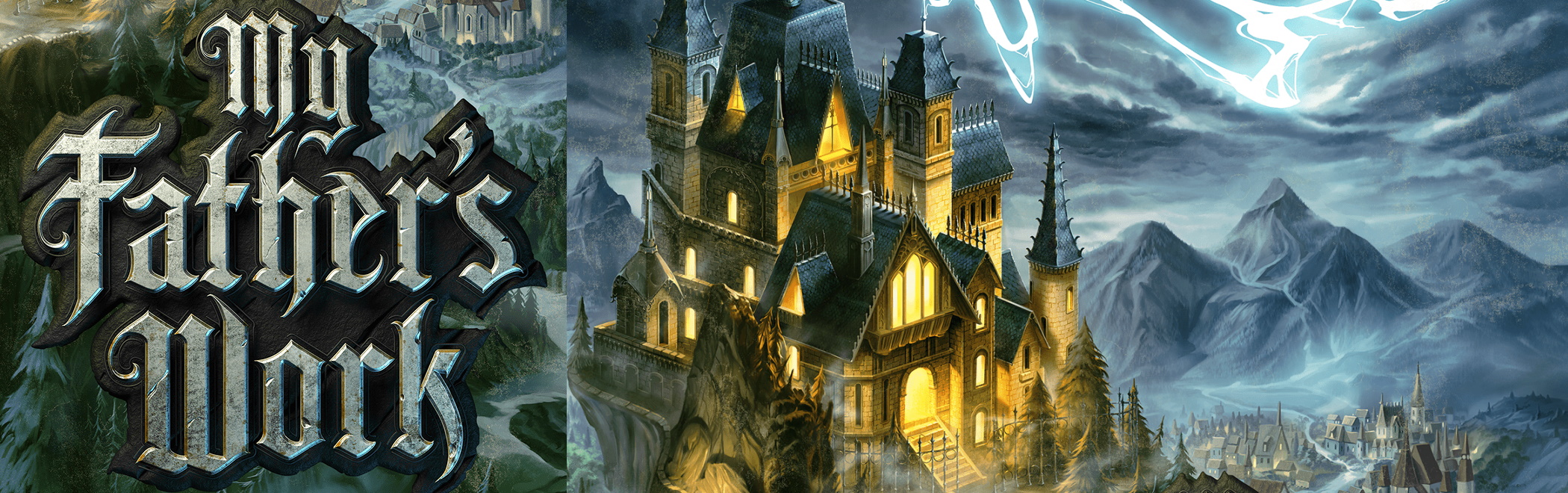
T.C. Petty III’s My Father’s Work is the sort of game that gets called “thematic.” Shiny with chrome, bursting with colorful verbs and adjectives, and narrated via an app, it’s the latest title to blur the distinction between storybook and plaything.
But it’s also thematic in the more universal sense: that it contains themes. Actual honest-to-goodness themes of obsession, selfishness, generational trauma, and the bewildering hilarity that tends to accompany the macabre. It’s a rare game that strives for commentary; this one could constitute an entire shelf’s worth of literary references.
Musée de Deckbuilder
Not every game is about the same thing. Take deck-builders. In many cases, maybe even most cases, deck-builders are about merciless optimization and combo-building. You start with a deck of cards. One by one, you add better cards and prune away the dead weight. Sometimes your final deck will be even leaner than what you began with. At the very least, it will perform to greater heights.
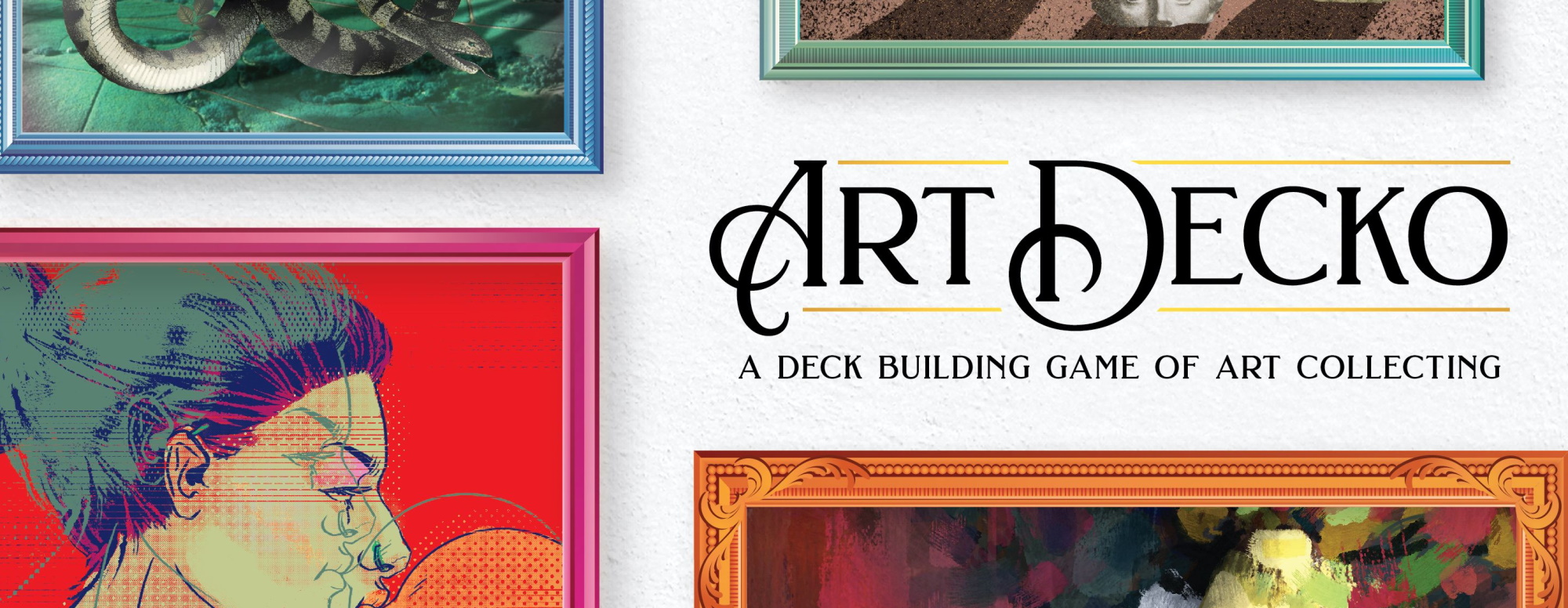
Ta-Te Wu’s Art Decko is a deck-builder, but that doesn’t mean it’s about either optimization or combos. Rather, it’s about process. Flow. The act of shuffling and moving cards, watching those cards grow in value and power, and then shuffling and moving them again. It’s a peculiar sort of deck-builder. It might be too clever for its own good.
Risa Ascending

I wasn’t expecting to play Star Trek: Ascendancy again anytime soon. We played it last year for my sister-in-law’s birthday. She’s a Trekkie. Or a Trekker. Whichever one won the convention wars. It was a big seven-player session. We counted ourselves satisfied with what in 2016 and again in 2017 I called one of the few games to really understand Star Trek.
Then, out of nowhere, I heard from Gale Force Nine. The last two expansions were coming my way. “This takes the faction count up to ten,” they said. “Time to arrange another massive session with your friends.” They didn’t say that last part. With a game this big, it’s implied.
So that’s what we did. Out of nine possible seats, we filled eight. With some fast-forwarding of the early turns, and minus lunch, the whole thing lasted six hours. And while we had a grand time (for the most part), it felt not unlike watching the last episode of The Next Generation as a kid again. A fitting sendoff, and all the more bittersweet for it. There will be other Star Treks. But this one is finished. Let’s talk about the finale.
Gentlemen of Fortune
Pirates are all the rage. Something must be in the water. Brine. Rum. Scurvy.
Dead Reckoning is John D. Clair’s attempt to leach the lemon juice from our water supply. Don’t take that as an insult. It’s a scurvy joke. Because scurvy is caused by vitamin-C deficiency. To keep their gums from becoming bleeding pits, sailors would drink lemon juice. It’s also where we get “limey,” because the British Navy forced its sailors to drink lime juice, except lime juice doesn’t have enough vitamin-C to offset scurvy, so ha ha, the British Navy was drinking lime juice for nothing.
What were we talking about? Oh, right. Dead Reckoning.

 SPACE-BIFF!