Category Archives: Board Game
Pinball Mathlete

When it comes to modern roll-and-write games, one of the system’s most effective tools is the possibility of a shared roll between players. It’s the sharing that matters. Chance still dictates your opportunities. The roll may even be “unfair.” But because it’s shared alike, everybody is on equal footing. At least, until players apply the roll in different ways and begin reaping the effects.
Super-Skill Pinball uses the same trick. Two dice are rolled and everybody makes do with the same results. But two things set it apart. One, it was designed by Geoff Engelstein, the guy who formalized the idea of input and output luck in board games. No surprise that it’s brimming with clever applications of chance. And two, because, again, it was designed by Engelstein, it feels way more like pinball than it has any right to.
The Goat Will Carry On
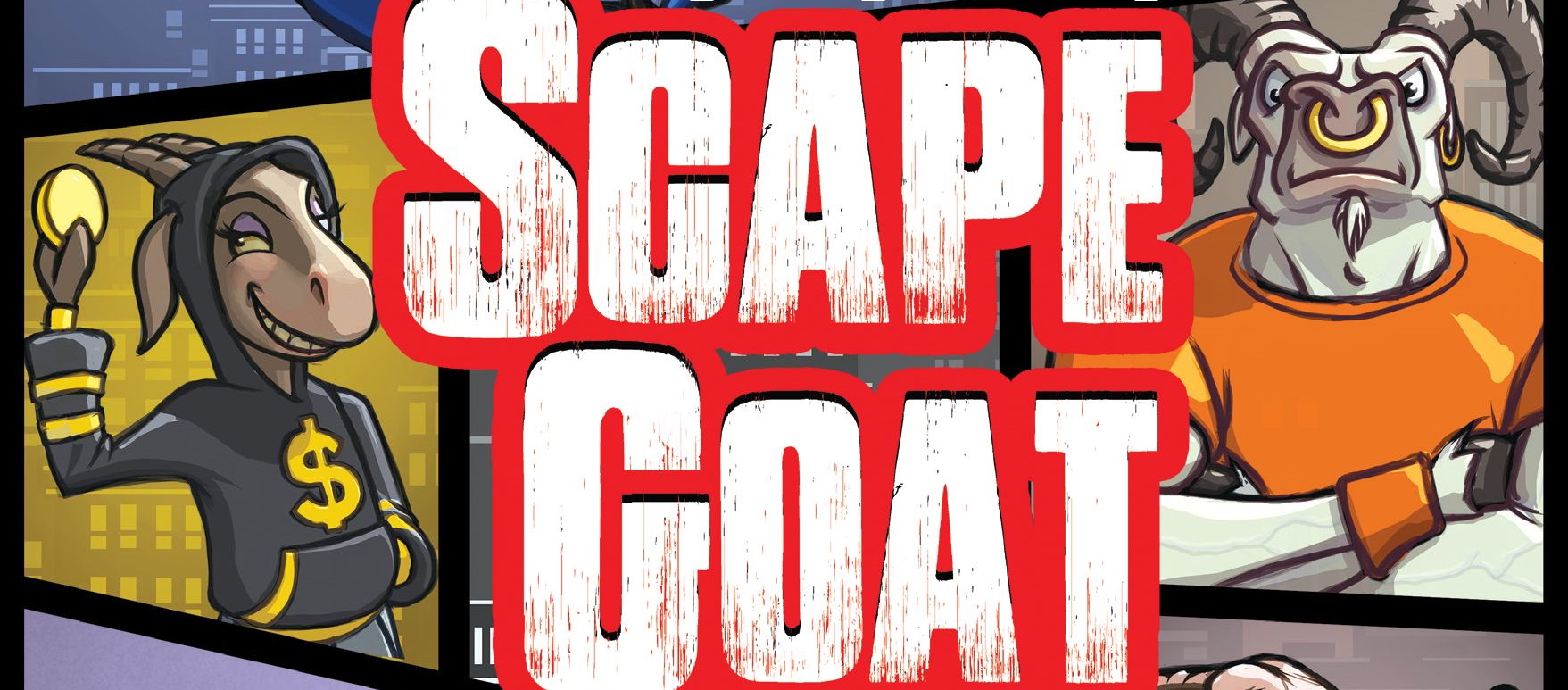
There’s nothing wrong with puns. That said, if your game prominently features one on the front cover its box, I’m less likely to pick it up. Scape Goat has two. “Goat milk?” and “Someone’s goat to take the fall.” I couldn’t bring myself to look at the back.
So how did it wind up here? Two words: Jon. Perry. Co-designer of Time Barons and designer of Air, Land, & Sea, a short stack of eighteen cards that still managed to be one of last year’s absolute best. That’s a pedigree that deserves a second look, puns aside. And I couldn’t be happier, because Scape Goat continues Perry’s tradition of breeding rattlesnakes — tightly coiled, easy to overlook, and packing one heck of a bite.
The Other Game

I’ve played the game all of once. Sorry, The Game. Steffen Benndorf’s The Game. No, not Wolfgang Warsch’s The Mind. The Game.
Except now we’re talking about Ohanami, Benndorf’s attempt to make The Game into a competitive game rather than a cooperative game. Is it an improvement? Well, its title is more searchable, I’ll tell you that much.
I Hope They Call Me on The Mission
In my very first course after changing my major to history, my midterm paper came back with a scrawled note in purple ink: “Good writing, good argumentation, but too polemical.”
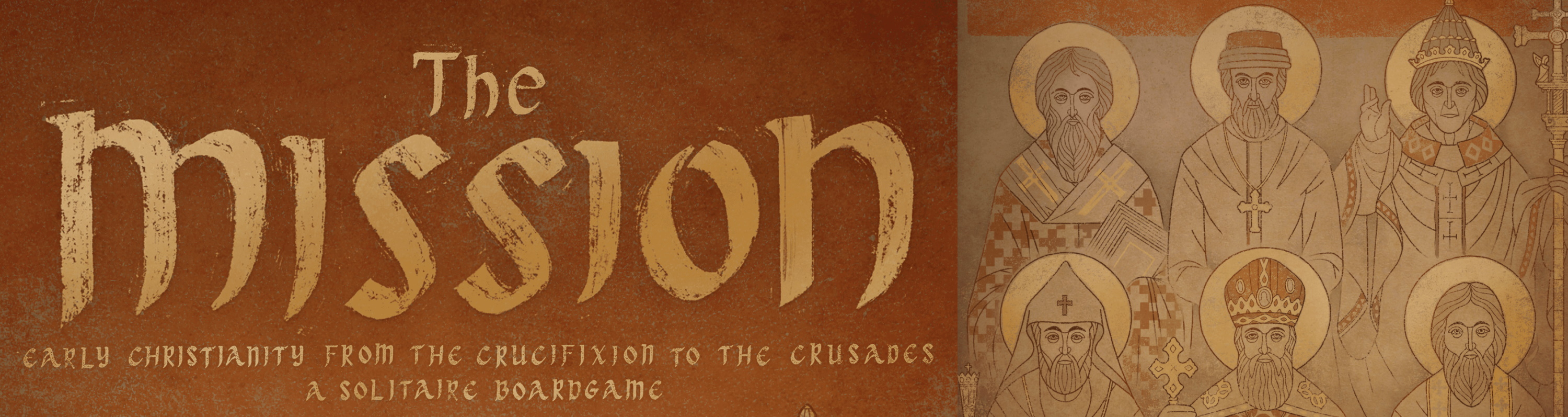
Too polemical. I’ve been waiting to drop that one on some unsuspecting victim ever since. You could even say it’s one of the reasons I was so eager to write about Ben Madison’s solo game The Mission, which charts the history of Christianity over its first thousand years. “From the Crucifixion to the Crusades,” as its subtitle goes. Sounds polemical to me! Brace yourself, Ben Madison, for thou art—
Medium polemical? Somewhat polemical? Acceptably polemical? Certainly not polemical enough for “too” polemical. If any “too” should be deployed, The Mission is too preoccupied with being playable. A difficult charge to make stick in court. If it please your honor, The Mission is guilty of being too good to be polemical. First-degree playable, second-degree polemical. And here I’d expected those to be the other way around.
The Non-Impartial Carnival

Impartiality, to me, means not making up my mind about something before I’ve given it a fair shake. Usually it’s a reminder. Not every game’s description or box art or choice of setting catches my eye right away. Yet some of my favorite titles are ones I initially overlooked. So it’s worthwhile to sit back, get past the parts that don’t immediately appeal to me, and try to evaluate this thing on its merits or problems rather than first glances.
The Grand Carnival is a premium example. If you’ve been around for a while, you’re probably aware that it isn’t my sort of thing. But I adore it. Whenever I open that box, I glow with happiness. There are tangible reasons, certainly, and I’d like to discuss them. But those reasons are impossible to untangle from my affection for its designer, Rob Cramer. Rob is a personal friend, you see. This is his first big publication. And I couldn’t be prouder of him for how beautifully and sharply it turned out.
So I’m going to talk about The Grand Carnival. But everything I say, I want you to take with a Salzburg-sized shaft of salt.
Go with the Flow

Not enough games choose “quiet contemplation” as their intended emotional response. Maybe all it takes is putting the phrase on the box. Then, like a snap of the fingers, Space Alert is no longer about frantic survival, but instead the stillness of accepting one’s fate. Even when that fate involves hot laser death.
Kawa, by Singaporean design studio The Aerie Games, lists quiet contemplation among its attractions. An accurate claim, provided that one of the topics under quiet contemplation is how many points you’re handing to your opponents.
Considering The Cost

Message games. There’s a loaded term. It’s a given that games can be more than “fun.” They can also be interesting, educational, enlightening, distressing; any number of things. But to hear some people talk, a game can do only one thing well. Either it will be good in the traditional sense — as a game, a plaything, no more thought running through its head than how to function as a toy — or it can carry a message. At which point it will be dour and lifeless, something to be experienced once and then consigned to a shelf to gather dust.
The Cost, designed by Armando Canales and co-authored by Lyndon Martin and Brian Willcutt, is a fistful of sand flung into the face of that assumption.
Project Polyomino

Polyominoes are all the rage. Or at least polyominoes up to a certain size are all the rage, which usually only includes monominoes, dominoes, trominoes, tetrominoes, and sometimes pentominoes and hexominoes.
But where most polyomino games boil down to “polyominoes plus something,” where the “plus something” is the substance of the game, Project L by Michal Mikeš, Adam Španěl, and Jan Soukal is all about the polyominoes, full stop. And the instant I’m done writing about it, I’m never typing the suffix -omino ever again.
Talking About Games: Portrayal vs. Endorsement

Morality has become a strange notion. Part of the problem is the mental imaging it tends to conjure: at odds with science and ethics, possibly relative, very likely handed down from Mount Sinai on stone tablets, definitely something to do with a scarlet letter. The term seems anachronistic, a throwback to a simpler age. And by “simpler,” I mean either “more enlightened” or “more backward,” depending on one’s assumptions about history.
Let’s set those images aside. Instead, I want to talk about morality as a function of art, and the role of both artists and critics in crafting and evaluating moral statements. In this regard, morality deserves a hopelessly hand-wavy definition of its own — that it’s preoccupied with the well-being of individuals and societies. Vague! Don’t worry, we’ll return to this.
At a more specific level, today we’re talking about one of the crucial delineations in evaluating board games on moral terms; namely, the difference between portraying and endorsing. And it all begins with a brief pamphlet entitled Histriomastix.
Colonial Struggle
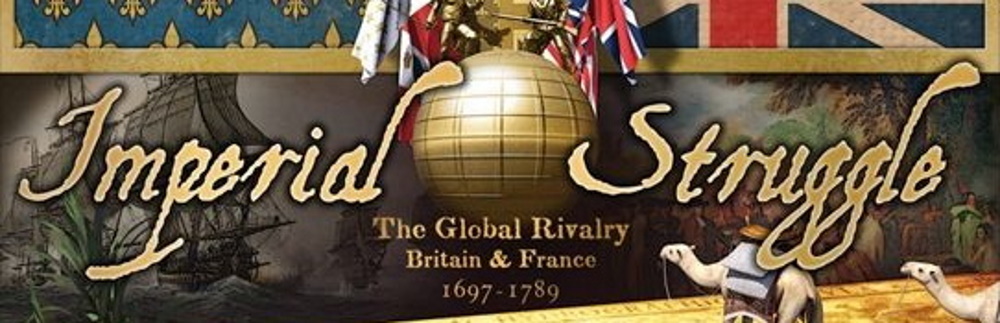
Jason Matthews and Ananda Gupta’s Imperial Struggle is a challenging game. In two senses, really. As a successor to the famous Twilight Struggle, it has significant boots to fill. As a meditation on the colonization of the wide world for the sake of empire — well, that’s a taller order in 2020 than in 2005, for better and for worse. It’s the sort of game that might easily spark a hundred think-pieces.
For my part, those dual challenges, heritage and setting, are the clearest lenses for framing what Matthews and Gupta have accomplished.

 SPACE-BIFF!