Author Archives: Dan Thurot
Klaus Teuber Saved My Life

By now you’ve likely heard of the passing of Klaus Teuber at 70 from a “brief and severe illness.” Even though his Google return defaults to identifying him as a “German former dental technician,” it isn’t an overstatement to say he may be the figure who’s had the single greatest impact on modern board gaming. His 1995 Spiel des Jahres game of the year win for Settlers of Catan was his fourth and final time bringing home that award.
I never had the pleasure of meeting Teuber, but his designs are written into my gaming DNA. Maybe that’s why the news of his passing has hit me so hard. I can’t recall feeling this saddened by any other celebrity death. Then again, no other creator gave me a relationship with my father or helped me survive the bleakest two years of my life.
How Space-Biff! Will Be Using A.I.

As the world’s premier board game critic, the question I receive most is “So, are your parents, like, verbally disappointed, or are they more of silent letdown people?” Number two is “Do you intend to use A.I. generated text and images so you can focus on the important stuff, such as getting your family back to work at the steel mill?”
A luddite at heart, I’ve spent my fair share of time kicking against the future. No more. Today, I’m ready to unveil the steps I’m taking to embrace artificial intelligence art.
Space-Cast! #27. No Rethemes
Dan Bullock is one of a handful of up-and-coming wargame designers determined to do things a little differently. A few months back, we down to chat about some of his games, including No Motherland Without, 1979: Revolution in Iran, and the yet-unpublished Blood & Treasure. Sadly, this was recorded before I’d played Bowie. Although maybe that’s a good thing, since otherwise that’s all we would have talked about.
Listen here or download here. Timestamps can be found after the jump.
Non Plus Ultra

As fascist forces encircled Madrid in 1936, Dolores Ibárruri delivered a string of speeches meant to rally those loyal to the Second Republic to its defense. Nicknamed la Pasionaria, the “passion flower,” Ibárruri had only been elected earlier that year as a deputy in the Cortes Generales for the Popular Front, a coalition of leftists, communists, socialists, anarchists, and regional nationalists. Her first act had been to empty the local prison of its political detainees, throwing open the cells with her own hands before the Cortes could waffle over drafting the order. Now, with a military coup threatening to seize the country by force, one of her broadcasts inflamed the city’s defenders. “¡No pasarán!” she declared. The fascists shall not pass.
But they did pass. After a siege of two and a half years, General Francisco Franco entered Madrid. “Hemos pasado,” he is reported to have said. We have passed.
Almoster Famous
I was somewhat cool on Chad DeShon’s On Tour, a roll- and flip-and-write about transiting either the United States or Europe and very likely getting stuck in a corner somewhere. It was a perfectly inoffensive but also perfectly inoffensive game, fifteen minutes long and not one of them too cerebral.
For the system’s second outing, Allplay has handed the reins to guest designer Alban Viard. The basics remain intact. The quality, however, has shot through the roof.
They Survived
One of the big questions in wargame design is how one ought to simulate the range of possible outcomes. Take the Battle of the Bulge. Should a designer concede to playability by pretending that the German Ardennenfront could turn aside the Allied advance? Or should they instead presume that German victory could only be measured by some other metric, such as days or weeks of delay? Press a little deeper and you get questions about balance and historical determinism. Maybe, just maybe, we can rethink what it means to “win” in the first place.
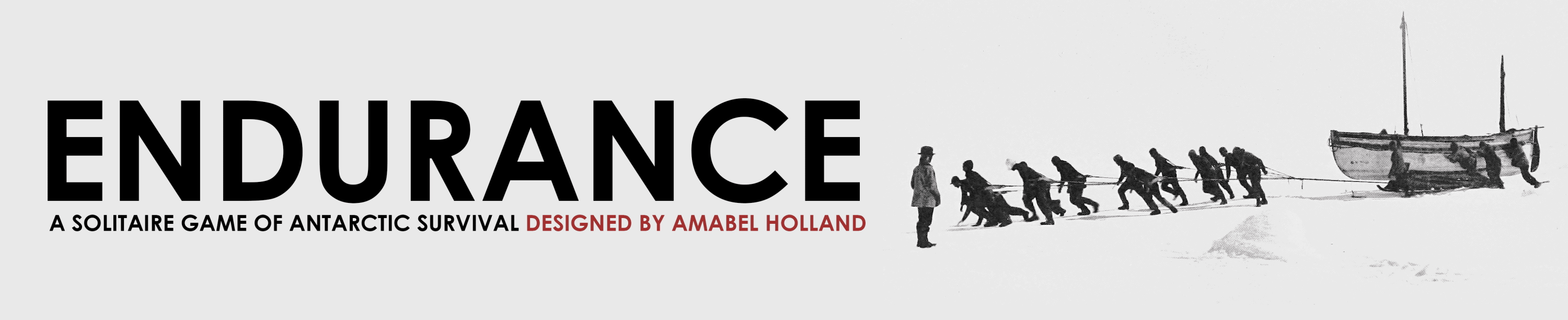
That’s exactly what Amabel Holland has done with Endurance. Right from the outset, her rulebook warns that the survival of Ernest Shackleton and the twenty-seven members of his crew is not a historical given. Their escape, in her words, was “a fluke.” It shouldn’t have happened. It nearly didn’t happen. Roll the dice a hundred times in a hundred parallel simulations and it might never happen again.
That’s the first thesis behind Endurance, but it isn’t the most essential of them.
Bowie Back to Bowie

My brain associates Dan Bullock with new-wave wargames like No Motherland Without, 1979: Revolution in Iran, and (hopefully published one day) Blood & Treasure. I’ve been consistently impressed with his ability to tackle tough topics, imbuing them with uncommon humanity while delivering a few well-deserved body blows to those who put politics and profit over personhood.
Or at least that was true until recently. From now on, I think I’ll forever associate Bullock with Bowie. Namely, the card game Bullock has designed about the life and existential crises of David Bowie in the 1970s. For reasons that will soon make themselves clear, Bowie is not an “official” title. Independent designer Dan Bullock has not somehow acquired the star’s life rights. Rather, it’s a print-and-play design, free to anybody with a printer and some scissors.
But here’s the thing: the unofficial nature of Bowie is precisely what makes it a treasure.
This Grimoire Isn’t Grim At All

Stop me if you’ve heard this one before. Two wizards walk into a—
Oh. Right. I guess it’s pretty obvious what happens next. The wizards fight, don’t they? They begin assaulting one another’s limited pools of health points, don’t they? They tussle until one of them is a pool of gunk and the other is secure in their mastery, don’t they?
True enough, Wizards of the Grimoire by Cole and Joel Banning doesn’t provide the most novel springboard. It’s about dueling wizards, as if there were any other kind. Scratch the surface with your fingernail, though, and it turns out there’s one heck of a self-contained dueling game to be found.
Grab Hold of One Long Sharp Tooth
Wargames are in a period of metamorphosis. One of last year’s most impactful titles was Resist!, a masterful release from Salt & Pepper Games designed by David Thompson, Trevor Benjamin, and Roger Tankersley. Resist! was an exemplar of what I like to call the “human touch” wave of wargames. Rather than fretting over the particulars of military paraphernalia, its interest was more psychological, emphasizing the human toll of insurgent warfare. Every play forced a reckoning. Brought to life by the illustrations of Albert Monteys, its cast of Maquis rebels stared you down as you undertook antifascist assaults and chose who to sacrifice or preserve. Its pedigree owed more to The Grizzled than to Advanced Squad Leader.
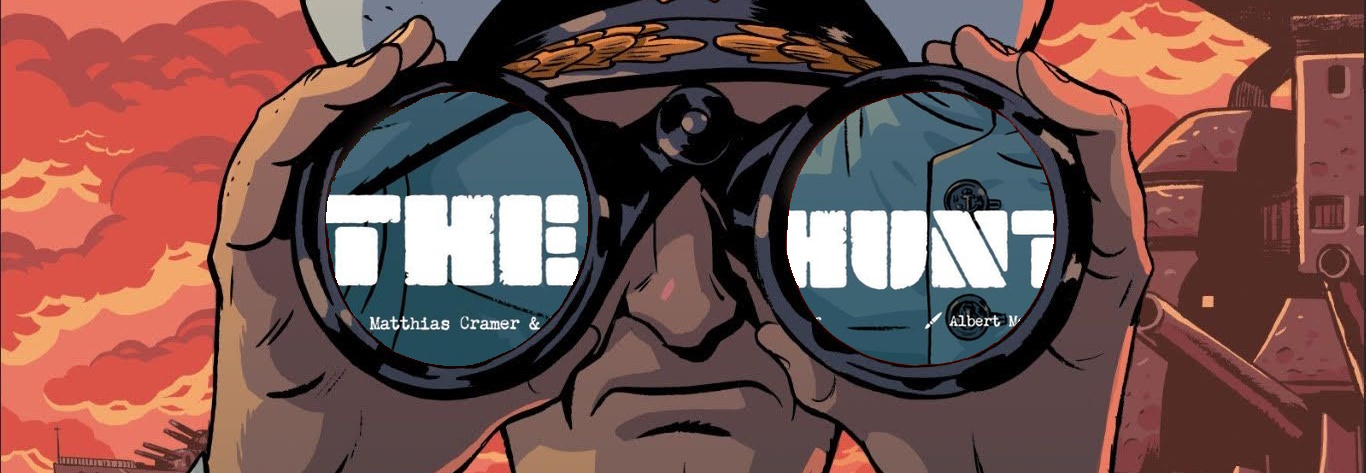
That pedigree continues this year with The Hunt, another Salt & Pepper release illustrated by Monteys. Designed by Matthias Cramer and Engin Kunter, The Hunt positions its lens somewhat farther out, encompassing the South Atlantic Ocean and the dueling searches of the German and British Navies.
Space-Cast! #26. Voting for Women

Now that Tory Brown’s supernal Votes for Women has escaped into the wild, it’s time to sit down and discuss the important questions. Listen in as we chat about approachable “war” games, the importance of understanding one’s political opposition, and why Brown chose to include a guano magnate’s whining about Emmeline Pankhurst. As a bonus, we also delve into the game’s relevance today.
Listen here or download here. Timestamps can be found after the jump.

 SPACE-BIFF!