Author Archives: Dan Thurot
Age of Blunders

In 2019, a video game named Age of Wonders: Planetfall came out. It was the fifth entry in the Age of Wonders series, a crossbreed of Civilization and Heroes of Might and Magic, and the only non-magical entry thus far. It has since been supplanted by Age of Wonders 4, the sixth entry in this increasingly inaccurately-numbered series.
Now there’s a board game adaptation of this four-year-old video game.
Why? Why is there a board game? I couldn’t tell you. Nor could I tell you why Stepan Opalev, the game’s designer, chose to adapt a series famous for its 4X openness by designing a tableau-builder. Apart from the in-game models that have been ported over as illustrations, Age of Wonders: Planetfall doesn’t capture the first thing about Age of Wonders: Planetfall.
Wingnut Spanner

Brett Sobol and Seth Van Orden seem to have enjoyed Wingspan. Or maybe they didn’t, and that’s how Raising Robots came to resemble Wingspan with the action selection system from Race for the Galaxy. So it goes. Board games are more often about recombination and iteration than they are about innovation. Raising Robots iterates by adding as many icons as possible.
That’s unfair. It also innovates by making me worry about free will.
Space-Cast! #33. Gab on the Clocktower

How much work goes into a successful social deduction game? If Blood on the Clocktower is anything to go by, a whole lot. Today we’re joined by Steven Medway, designer of this long-awaited game about the improper use of timekeeping apparatuses, to discuss unreliable identities, player elimination, and how chaos fosters memorable stories.
What’s All This About a Chair, Anyway?

You might have heard that a fairly large board game publisher recently crowdfunded an entry in a well-loved series using AI-generative illustrations. Now, here at Space-Biff!, it’s my policy to pass on any titles that use generative AI in place of human craftsmanship. There’s some nuance there; I’m talking about image and text generation, not assistive tools, although plenty of people talk about those two things like they’re identical.
But I get that many people may not understand such a stance. So let’s talk. What follows is an explanation of why I’m not interested in covering games that use generated images and text.
Gazette Trucker

It will surprise nobody to learn that I was one of the layout editors of my high school newspaper. There’s an art to fitting everything on the page — just don’t ask me to demonstrate that art or what any good examples are. Mostly I remember working late after school to meet deadlines.
In that regard, Peter McPherson has transcribed the topic accurately. This is the third of McPherson’s published titles, after Tiny Towns and Wormholes, and it’s the strongest of the three in no small part due to a frenetic nature inspired by Vlaada Chvátil’s Galaxy Trucker. The secret to Galaxy Trucker’s success is that it, like its sister title Space Alert, grows funnier as its players fail. It’s the hobby’s equivalent of slapstick. Fit to Print follows that tradition. It’s at its best when everything is falling apart.
Beads?

There’s an obvious appeal to Connie Vogelmann’s Apiary, if only because “space bees” is such an evocative pair of words as to bend light waves. Also, bee puns are really, really easy. “Bee” sounds exactly like the letter B. Come on.
But I want to set that aside, because Apiary excels at making difficult things look easy. This is a fine-tuned example of optimization gameplay and speculative fiction. I suspect there was nothing easy about designing it.
Observe, Feyd-Rautha
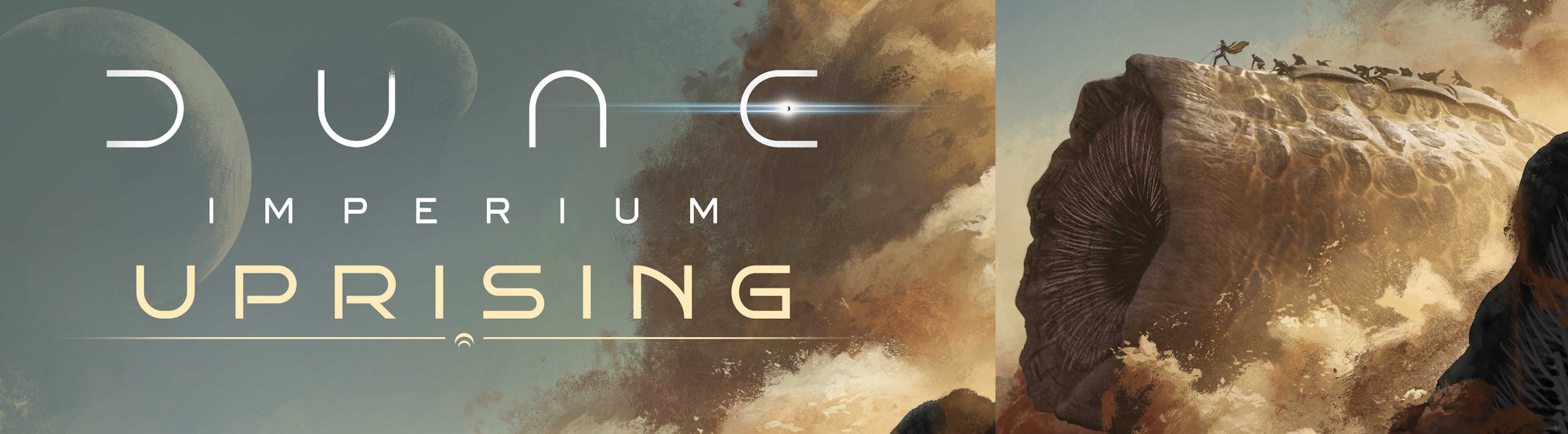
Arrakis. Dune. Desert planet. Warner Bros. property.
It’s not every day that a game I genuinely love hits it big in this hobby. I’ve been pleased to watch Paul Dennen’s Dune: Imperium thrive, earning two expansions in Rise of Ix and Immortality. That said, I’ve been as perplexed as anybody at the latest offering. Dune: Imperium — Uprising has a surfeit of subtitles and a questionable provenance, functioning neither as an expansion nor as a totally fresh start for the series. At a glance, it’s not all that far removed from the original game.
Colors of Abstraction

As a youngster one of my prize possessions was The Book of Classic Board Games from Klutz Press. I didn’t know at the time that I was in good hands, the book being authored by none other than Sid Sackson. While Sackson seemed intent on imparting how much could be accomplished with a single set of Go stones, mostly I was enamored with the more “thematic” games in the collection, such as the clay-molded landscape of Dalmatian Pirates and Volga Bulgars or the plump wrestling moves of Hasami Shogi. Thus began my lifelong appreciation for abstract games. (Although please note that “appreciation” and “skill for” are very different traits.)
Over the past few months, I’ve been enjoying three modern abstracts at a leisurely pace. Their common thread is that they were all designed and self-published by Khanat Sadomwattana. Not that you’d know they were self-published by looking at them. These are lavish productions, each visually arresting on their own, with striking aesthetics that aid in making their gameplay as smooth as possible.
Shiny and Chroma

One of this hobby’s great pleasures is coming across a designer whose creations adhere to a logic that’s unlike anything else. Jorge Zhang is one such designer. I’ve been obsessively playing and replaying his latest release, Chroma Mix, scouring it for new gems and cracks alike. It’s been a rewarding process, unfurling a game that touches on highlights from other titles — Cieslik and Chudyk’s Red7 springs to mind — without, it turns out, being very much like them at all.
MORE RHUBARB

All I play anymore is trick-taking games.
Pies, a remake of Matthias Cramer’s 2015 Plums, does not happen to be a trick-taker. Oh, I’m aware there’s some debate over the matter. Couldn’t this be considered a trick-taking game with but one suit and a slew of ranks? I guess so. That would transmogrify a whole lot of games into trick-takers, but sure. And a hot dog is a sandwich.
Semantic athletics aside, my concern has less to do with trick-taking essentialism and more with this pastry’s sogginess. Cramer has produced some excellent games over the years, from hefty fare like Weimar to more accessible titles like Watergate and The Hunt. Compared to those, Pies doesn’t rate.

 SPACE-BIFF!