We Lack Chemistry

What to make of Chemistry Set? This is the second tabletop design by Zach Barth — not counting his many digital cribbages and solitaires — and after such a strong inaugural outing with The Lucky Seven and its depot expansion, its blandness is all the more baffling. It would be unfair to compare this to Barth’s video games SpaceChem or MOLEK-SYNTEZ; apart from their shared affection for molecular arrangements, they’re so conceptually distinct that any parallels soon get lost in the mix. But it is dispiriting to see the periodic table stripped of the enthusiasm we know Barth has invested it with elsewhere.
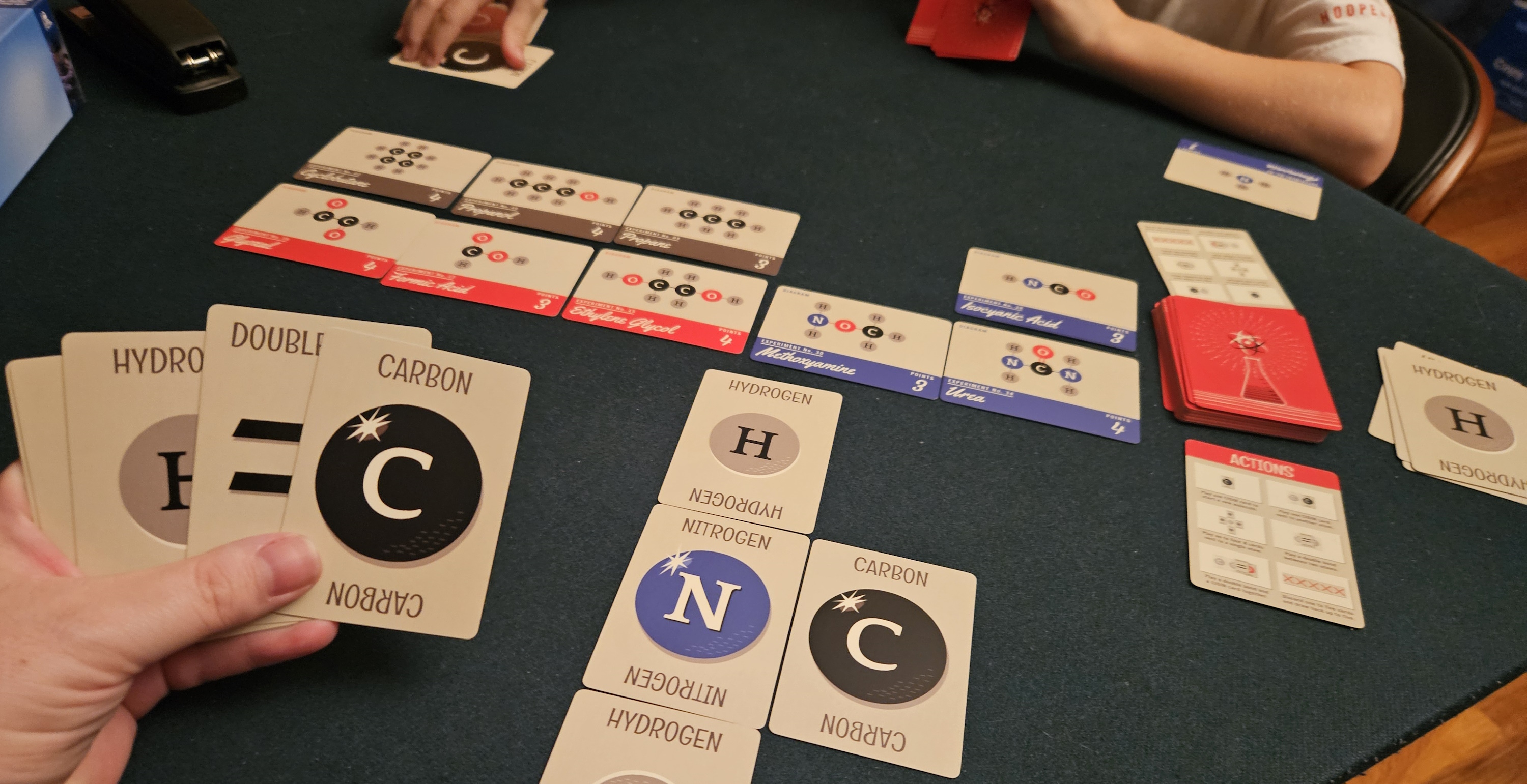
This is chemistry.
Chemistry Set starts off well enough, with a tableau of possible chemistry experiments and a deck of elements. These are the molecules you hope to create, whether with two players or in solitaire mode. In both cases the game is a race. Working either against an opponent or a thinning deck, your goal is to score ten points, with increasingly complex molecules netting more points than their simpler cousins.
This is accomplished mostly by dredging through the deck. These molecules are composed of only a handful of elements: all-present hydrogen, the Bethe-Weizsäcker trio of carbon, nitrogen, and oxygen, and a few double bonds for when electrons feel that especial attraction. The distribution of these elements isn’t wholly representative — the deck isn’t 75% hydrogen, thank Darwin — but one will soon find themselves plumbing for errant oxygen and nitrogen atoms.
Nothing about the rules is difficult to internalize, except for those rare moments when one accidentally slaps both a C/N/O atom and a hydrogen onto a molecule in the same turn, earning a mild hand-slap from their opponent. The gist is that you get two actions. Adding C/N/O is an action. Adding up to four hydrogen atoms to another single element is an action. Forming a covalent bond is an action. The biggest opportunity for streamlining is that one can add an atom and its double bond at the same time. You can also discard cards to draw extra options, a common occurrence in the default duel mode and an impossibility in solitaire.
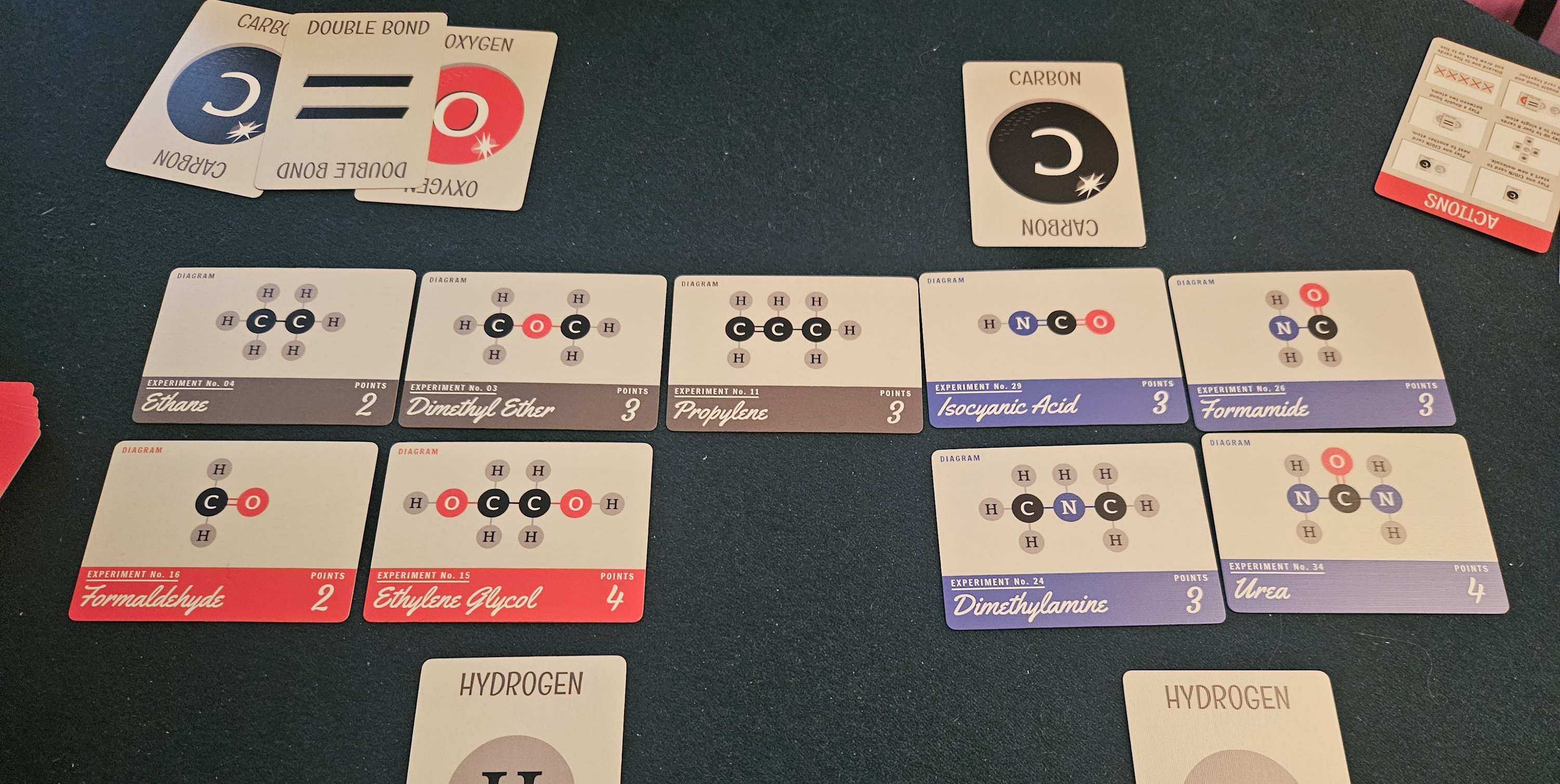
Choosing your experiments.
I don’t want to give the impression that there isn’t any strategy to these assemblages. There is. It’s just exceedingly minor. Building a molecule is a vaguely press-your-luck affair. Your opponent can see what you’re trying to construct, which in theory might result in both players competing to dredge the corresponding elements from the deck. More often, players avoid one another. There’s some advantage in playing to a molecule’s early ambiguity; carbon and oxygen in tandem could become one of a half-dozen molecules with further work, thus concealing your intentions from your opponent. But this possibility is downplayed in Chemistry Set. There are experiments aplenty to run, leaving very little room for friction.
Without friction, Chemistry Set never gets warm enough to excite a state change. Both modes suffer. As a duel, it feels like two solitaire modes in tandem, albeit solitaire where your rival might suck up all the oxygen in the room. In solitaire, it isn’t challenging enough to feel like more than a diversion. I don’t know whether Chemistry Set, like The Lucky Seven, will receive its equivalent of a depot — fluorine? dysprosium? — but it lacks that game’s foundational quality to begin with.
We have derived some enjoyment from it. Moving cards around feels as good as ever, and building little molecules like a two-dimensional version of one of those organic model kits holds some fiddly appeal. My ten-year-old wanted to know the function of every single chemical.
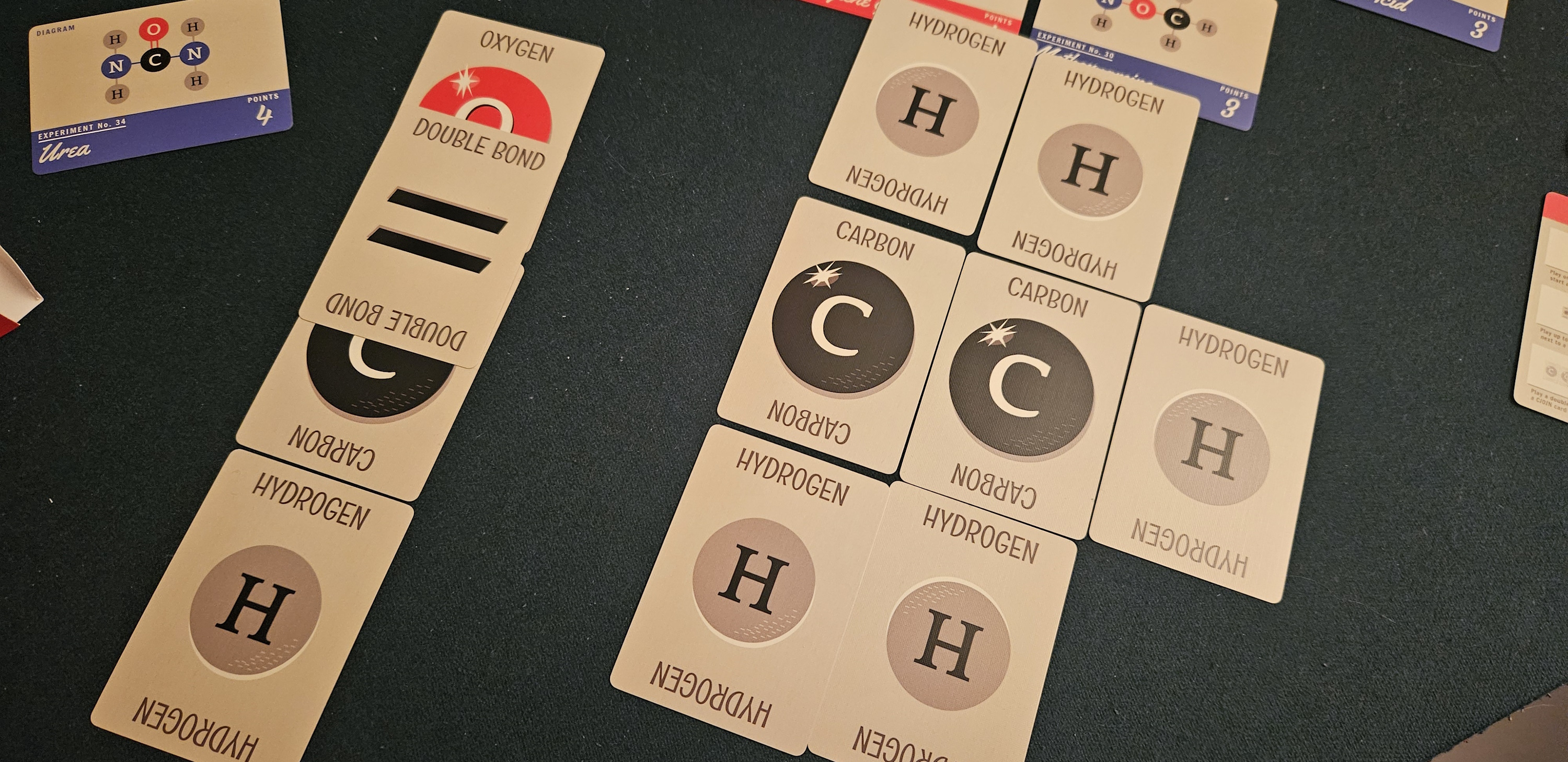
I wish I had a double bond for this game. Heyo!
But it’s telling that we had a better time looking up formaldehyde and dioxane on Wikipedia than we did actually playing the game. I know Barth has some experience in developing classroom games; with some adjustment, Chemistry Set might qualify as such a tool.
As it stands, however, there’s very little reason to come back. My high school chemistry class consisted of handouts and a bored teacher pretending he wasn’t playing Sid Meier’s Civilization on his computer. Chemistry Set leaves a better impression of chemistry than Mr. Lawyer ever did. I wish it could have cleared a more impressive benchmark.
(If what I’m doing at Space-Biff! is valuable to you in some way, please consider dropping by my Patreon campaign or Ko-fi.)
A complimentary copy was provided.
Posted on October 10, 2024, in Board Game and tagged Board Games, Chemistry Set, Coincidence. Bookmark the permalink. 9 Comments.

 SPACE-BIFF!
That makes it all the more frustrating that, if you’ve already bought The Lucky Seven like I have, the only way to get the new Depot card is to buy that game again, or buy Chemistry Set and you’ll get the card. Made me kinda salty to find that out.
You can buy a single print-on-demand copy of the Depot here:
https://buy.stripe.com/8wMcMM0qq0ag4hObIP
I stand corrected. Thank you, I hadn’t seen that option.
More like non-obtainium, amirite, amirite?
yerite
I’d like to add a counterpoint, as an early adopter, who auto-bought Chemistry Set after enjoying The Lucky Seven. I found a similar lack of urgency in head-to-head, but solo mode was much more satisfying. Being forced to discard all but one card each turn and racing the deck were sufficient restrictions to add tension to proceedings for me, making the choices between plentiful Hydrogen and more valuable elements, and between committing to or leaving open experiments meaningful enough for multiple plays.
The Depot for the Lucky Seven was just as transformative as promised.
I brought Chemistry Set on a two-week long trip with a friend. Having read this review, my hopes weren’t high, but I’d bought it mostly to get a copy of The Depot, and it was a new, portable, two-player game for us to try.
To my surprise, we ended up having a great time with it! We credited this to an optional rules variant added to the rules online since your review. (I think. It’s hard to tell when or whether online rules changed! Something I dislike about them.) We played tons of it that trip, even over Air Land and Sea, which I love! That was in November, and a few days ago we broke it out again, to see if we still enjoyed it. The verdict: we did, but also we realized we’ve had a rule wrong the whole time! We will not be fixing this.
The official variant: All cards dumped via the voluntary discard action, go into a “research” pile, which either player can draw from when refilling their hand. The mistake: we’d been playing that the voluntary discard action MUST be everything in your hand, not any number (and your refill during this action has to be from the deck, not the research pile).
Together, this has made the game consistently tense and interesting! Because you can’t dump only the cards you don’t want, and because you constantly have to judge the likelihood that you’re feeding your opponent cards they need, it’s very often not obvious what to do when you have a playable-but-suboptimal hand. We took to calling the dumping action “Researching”, and the game as we know it often revolves around when to do it.
That sounds much more interesting indeed!
Pingback: Space-Cast! #53. Scratch & Listen | SPACE-BIFF!