Blog Archives
The Hero We Became

Every time a pearl necklace is scattered across a rain-soaked alleyway behind a theater, a superhero is born. Sorry, them’s the rules. While endless reboots have turned origin stories into a topic of much lampooning, there’s no denying the appeal of watching an everyman transform bit by bit into a reluctant defender of justice. Or maybe a relatable villain. Or, perhaps, hear me out, both.
Origin Story, designed by Jamey Stegmaier and Pete Wissinger, tills the well-trod ground of superhero origin stories to craft a hybrid trick-taker and… wait for it… engine-builder. It’s a combination I haven’t seen yet, at least not in such a compact format, and it certainly seems like it was built to appeal to my preference for hybrid designs.
But I’ll say it right now: this is a weird one.
How to Train Your Fledgling
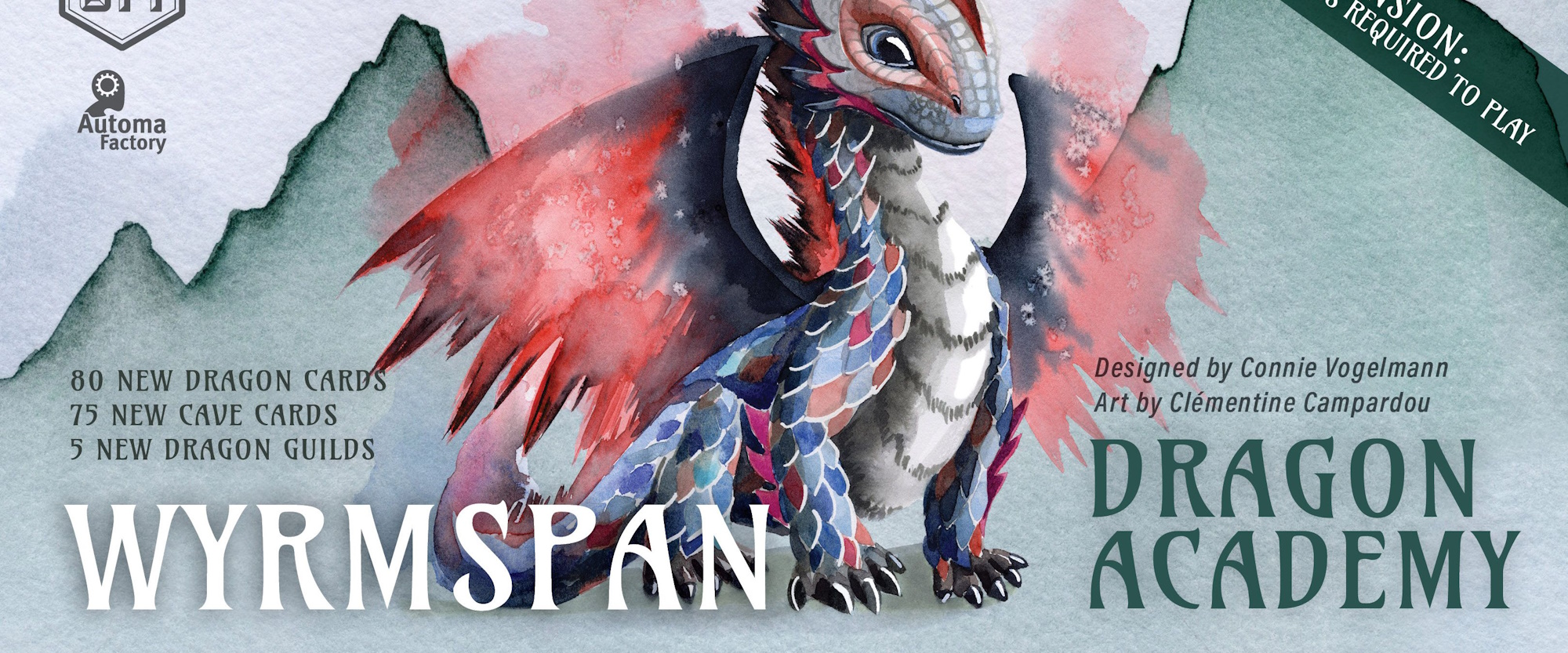
I don’t know why dragons are so popular all of a sudden, but as a parent I’m genetically predisposed to be invested in the same things as my eleven-year-old… so bring on the dragons. Dragon Academy is the first expansion to Connie Vogelmann’s Wyrmspan, the heftier and more draconic alternative to Wingspan and Finspan, and it understands the fad even more intimately than the base game.
Space-Cast! #49. A Vantage on Vantage

By now you’ve likely heard of Vantage, the ambition first-person exploration game about surviving and thriving on an alien planet. For today’s Space-Cast!, we’re joined by Jamey Stegmaier to discuss the eight-year inception, development, and eventual appearance of this wonderful and strange artifact. Along the way, we discuss Vantage’s inspirations, how design constraints can engender greater freedom, and games within games.
Listen over here or download here. Timestamps can be found after the jump.
Life in First-Person

There’s an exercise I sometimes use in class to help my students break out of their modern mindset. Everyone gets a sheet of paper and swears to avoid looking at anyone else’s work until we’re finished. Then I ask them to draw a picture of where they are in the world. To place themselves within their surroundings.
For most modern people, the reflex is to draw a map. The layout of the lecture hall, the nearby buildings, maybe our city or state or country. This isn’t universal; those with aphantasia might create rudimentary images, while my more artistically minded students sketch the nearby mountains. (Or me, sitting at the front of the class, looking more pouchy and tired than I’d prefer.) But in most cases, maybe seventy to eighty percent of the time, they draw a map. Bird’s eye view, top-down, like something you’d see on a navigation tool.
And then we talk. Because for most humans in most places and most times, a map was an impossibility. Perhaps surveyors and astronomers had created one, a painstaking process that still resulted in an unreliable thing with uncharted gaps and “here be dragons” scrawled in the margins. More often, the best one could hope for was a series of landmarks. A settlement here, a strange rock over there, a mountain or lake on the horizon. Your world was a series of visual cues, a vast maw that threatened to swallow you up the instant you strayed from its stepping stones.
This modern tendency to locate ourselves on a map creeps into our thinking about… well, everything. The identity of our kinsmen, neighbors, and rivals. The spaces that can be considered safe or dangerous. The distance between points. Our place within a country, continent, time zone, planet, ecology. Who we are.
Way more important than any of that identity junk, of course, is that maps also make their way into board games. Whether we’re talking about hex grids or squiggly provinces, nearly every board game about kingdom-building or exploration stands its players on firm footing, located safely within the confines of a perfectly scaled representation of reality.
Except for Vantage.
Meet the Faceless Cusk

We all know that one of the juvenile pleasures of Wingspan is calling out the birds that sound like human anatomical features. Abbott’s Boobie! American Woodcock! Truly, I will never age past thirteen.
Finspan is the second spinoff of Elizabeth Hargrave’s unexpected smash hit, following last year’s Wyrmspan by Connie Vogelmann. Designed by David Gordon and Michael O’Connell, Finspan drops us into the sea. It also changes the nature of the game. Now, instead of calling out funny body parts, it’s all about announcing which fish resemble the people at the table. Me? I’m a Porkfish.
Philatelist Fatalist

The history behind the word for stamp collectors, “philatelist,” is rather charming. Derived from the Greek words for love (philos) and tax exemption (ateleia), it’s bound to the early history of postage stamps, which placed the burden of payment for a letter or package on the sender rather than the recipient. Where receiving mail had once been a hassle, often representing an unexpected payout to the carrier lest they hold your letter hostage, it now became a source of childlike joy. Here’s a gift; you owe nothing for it.
That might be the most interesting thing you learn today. Paul Salomon’s Stamp Swap sure won’t beat it.
Expanditions

I didn’t love Expeditions, Jamey Stegmaier’s follow-up to Scythe. For a game with such an enticing setting, it was sterile and undifferentiated, more zoned out than Zone. But when Gears of Corruption showed up at my doorstep, I was eager to return to this meteor-blasted Siberia with my trusty animal companion and rusty mech. That’s a good sign. Right?
Right-ish. Gears of Corruption does indeed improve on the game it’s expanding. But like a few splashes of paint over the rusted flanks of my crawling longship, there’s only so much it can do.
Space-Cast! #34. Bees & Dragons

Which is more unexpected, science-fiction bees or realistic dragons? For today’s episode, we’re joined by Connie Vogelmann to discuss that very issue. In addition to discussing Apiary and Wyrmspan, we also dig into how these games came to be, the benefits of grounding a setting, and the behavioral biology of leaving negative ratings on a game one hasn’t played.
Listen here or download here. Timestamps can be found after the jump.
Dragons Greater and Lesser

It’s an odd thing to say, given that Connie Vogelmann’s spinoff of Elizabeth Hargrave’s Wingspan is about fictional creatures rather than real-world birds, but Wyrmspan benefits from its sense of grounding.
Yeah, yeah, I know. But it’s true. Wingspan, which I’ve always had a fondness for, requires some degree of acceptance. You’re arranging its avian wildlife into three rows that represent… sanctuaries? Bird-watches? Meals? I couldn’t tell you. By contrast, Wyrmspan settles into a fiction of carving dragon nests into a primeval mountain. You feed the beasts, fill their hoards, raise their hatchlings. It’s every bit as pleasant and appealing as Wingspan, but heftier and more established.
Also, it sends my ten-year-old into paroxysms of joy. So there’s that.
Beads?

There’s an obvious appeal to Connie Vogelmann’s Apiary, if only because “space bees” is such an evocative pair of words as to bend light waves. Also, bee puns are really, really easy. “Bee” sounds exactly like the letter B. Come on.
But I want to set that aside, because Apiary excels at making difficult things look easy. This is a fine-tuned example of optimization gameplay and speculative fiction. I suspect there was nothing easy about designing it.

 SPACE-BIFF!