Blog Archives
Chicago Gets It Up

Imagine checking into a hotel in 1861. Not just any hotel, but a six-story brick building. Over the course of your stay, the front stairs have grown noticeably steeper each time you return. When you check out five days later, the windows that once sat at eye level are now several feet above your head.
This isn’t a ghost story. It’s an actual anecdote from the raising of Chicago, when engineers used thousands of screwjacks to lift the city’s brick structures six feet above their previous elevation. In some cases, as with the Tremont House Hotel, the laborers worked in covered trenches, permitting business to be conducted as usual. This brought the city above the water line, permitted the construction of a sewer system, and hopefully prevented another outbreak of cholera from killing one in twenty inhabitants. Chicago was saved. At least until the next decade, when a cow would kick over a lantern in Mrs. O’Leary’s barn.
13xx

My favorite thing about Nick Case’s Pilgrim is how it seems to be winking at you. That’s saying a lot, given how many things it does well, but there it is: this is a game about a topic that could have been unbearably dry, yet it carries itself with a sparkle of irreverence that calls to mind the games of Alf Seegert.
The topic in question is a ring of abbeys in 14th-century England. Students of history will immediately recognize the period. Set anything in the 14th century and there’s a good chance the tone will hover somewhere between dismal and outright mortal crisis. There’s a plague on, and a war, and indulgences, and ecclesiastical abuses, and all the other things you were probably taught about in school as being symptoms of the wider Middle Ages.
Fluss und See: A Look at Weimar

Even as a prototype, Matthias Cramer’s Weimar is a sprawling work. Taking cues from Mark Herman’s Churchill and covering the entire span of the short-lived Weimar Republic, how could it not be? This is history that shaped everything about the following century. Few have bothered to learn anything about it.
Before we begin, it should be noted that I’ve played Weimar all of once. Normally my policy is three plays before I’ll write anything, even for previews. With only eleven days left on its crowdfunding clock, its six-hour playtime and four-player complement mean that won’t be possible. These thoughts are only halfway formulated. It’s entirely possible I’ll get something wrong. Still, I want to tell you about it.
Love Is a Ghost Train Howling

There is something initially morbid about London Necropolis Railway, and not only because Daniel Newman’s latest offering is set during a cholera epidemic and will release in the third calendar year of our own century’s mismanaged public health crisis. The historical Necropolis Railway was the solution to the bodies piling up in the streets, a line only twenty miles long but devoted entirely to the business of death and mourning. In Newman’s care, the whole thing takes on the pallor of a funeral celebrant both jaunty and jaundiced. More than that, it’s imbued with an uncommon dignity.
Like Sands Through the Hourglass
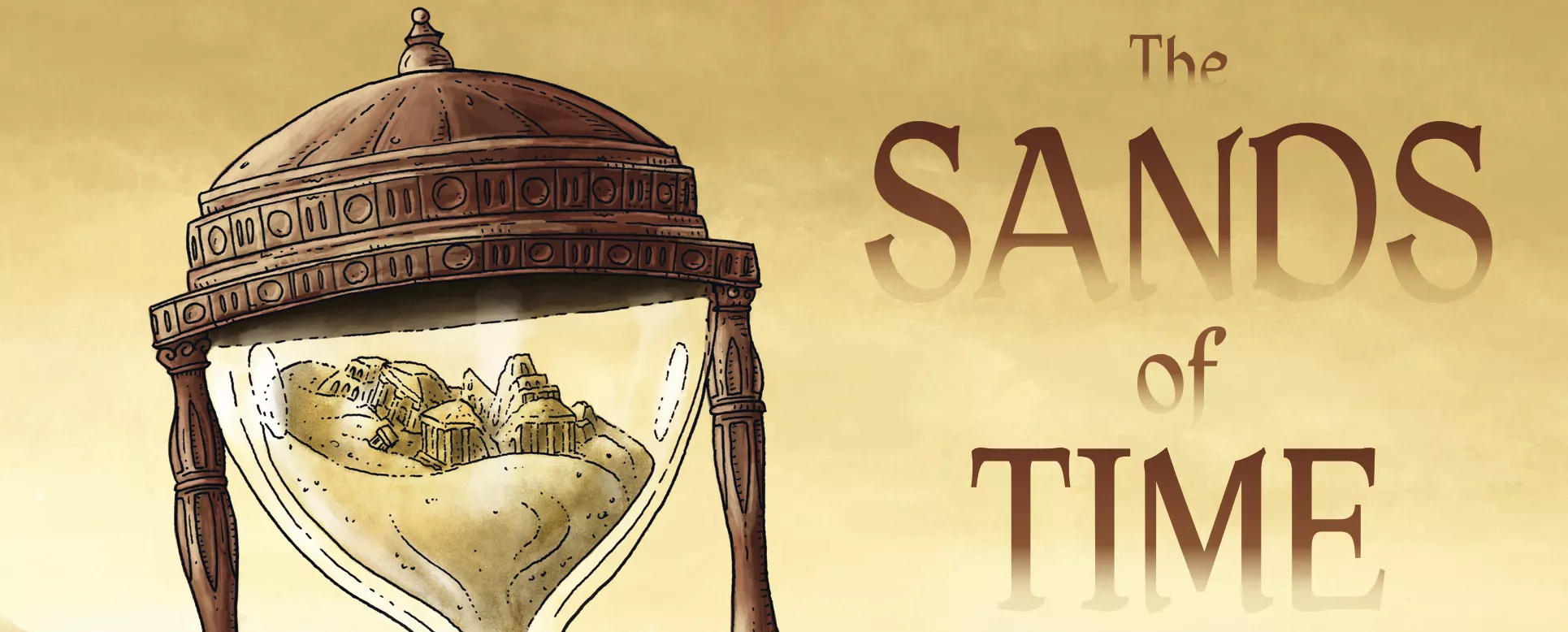
Longtime readers will probably be aware of my search for non-traditional civilization games. That’s why I was so eager to take a look at Jeff Warrender’s The Sands of Time, which flew under my radar a couple years back. Its approach could almost be described as abstract, crowded with cubes and cylinders alongside the more immediately evocative building tokens. Perhaps most notably, it manages to come across as the story of civilization as told over a long period. A millennium, maybe two.
And if nothing else, it definitely manages to be “non-traditional.”
Space-Cast! #9. Costly Design

I’m as surprised as you are — it’s the ninth episode of the Space-Biff! Space-Cast! Today I’m joined by Armando Canales, Lyndon Martin, and Brian Willcutt, the designers of this year’s controversial title The Cost. We discuss the game itself, along with broader concepts of moral game design and how to focus a game’s intended story on the elements that matter most.
Listen over here or download here. Timestamps can be found after the jump.
Considering The Cost

Message games. There’s a loaded term. It’s a given that games can be more than “fun.” They can also be interesting, educational, enlightening, distressing; any number of things. But to hear some people talk, a game can do only one thing well. Either it will be good in the traditional sense — as a game, a plaything, no more thought running through its head than how to function as a toy — or it can carry a message. At which point it will be dour and lifeless, something to be experienced once and then consigned to a shelf to gather dust.
The Cost, designed by Armando Canales and co-authored by Lyndon Martin and Brian Willcutt, is a fistful of sand flung into the face of that assumption.
Your Thumb on the Scales of History

The civilization genre has always been about gluttony. Think back on all those times you shepherded a civilization from tiny settlement to grand empire. When was having more not a good thing? The success of a game-based civilization is nearly always measured in size, stockpile, quantity, output. Even digital civgames, which occasionally fret over issues like expansion stress or population pressure, nearly always treat these issues as minor debuffs on the national scale, and offer solutions as something you can build, research, or buy. To solve the inflation caused by your treasure fleets, spend extra money on more treasure fleets.
Of course, historical civilizations have no such advantage. Too much gold infused into your economy and it sheds its value. Too many stockpiled resources invites theft and pestilence. Too many cities and your borders stretch until invasion or fragmentation is all but inevitable. A soaring population is a hotbed of plague and strife. Even happiness is a double-edged sword. When low, your people revolt; when high, they grow plump and expect new amusements. It’s easy to forget that Juvenal wasn’t being shrewd when he wrote about “bread and circuses.” He was decrying the complacency of the population. In game terms, Juvenal’s Rome had a maxed-out happiness score. It just so happened that max happiness also spelled significant dings to military readiness and civic duty.
Now let’s talk about Gentes.

 SPACE-BIFF!