Blog Archives
How to Write a Board Game Manual

Hi there! I’m Dan Thurot. I’m not a professional at writing board game rulebooks, but I’m here to tell you how to write board game rulebooks.
If you’re now thinking, Well why the hell should I listen to you?, here’s my response: Wow. That was kind of harsh. Maybe I’m just some dummy, but I’m a dummy who reads a freighter’s worth of board game manuals every year, and I’ve come to appreciate certain details that make them easier to read and much better at actually teaching me your game. What follows is a list of ten tips I’d appreciate you following the next time you’re seated at your computer trying to type out your new board game’s rules.
Archiwhatago?

Turns out 2013 is one hell of a year to be playing board games. Back in March, I wrote about a game called Kemet that I assumed would be one of the best titles of the year — and it turns out it still is, though now it has a competitor in the form of Archipelago, the latest from designer Christopher Boelinger. Now, maybe at this very instant you’re muttering that Archipelago technically released in 2012, but I have two counters for that: one, I had no idea this gem even existed, and we’ve always run things on our own time here at Space-Biff!, and two, if you knew that off the top of your head, why are you even reading this review? Surely you know it’s amazing by now? Why don’t you go play it instead of hassling unpaid board game reviewers?
Anyway, Kemet and Archipelago would be about as different as two games could be if it weren’t for precisely two similarities. For one thing, both force their players to ration a limited pool of actions like precious canteens of water in the desert; and for another, they’re both determined to make you despise your friends for the evening. This time around though, it’ll be because your best friend just swindled you out of a bumper pineapple crop. That little turd.
Building a Better Deck-Builder: Core Worlds

There’s a special place in my heart for deck-building games — it’s just that it’s a twisty, confusing place.
On the one hand, the basic concept behind deck-building is nothing less than an absolute stroke of genius. On the other, I’m one of those theme guys that can’t help but need a reason for all the sheep-shuffling, card-conscripting, and goblin-ganking that board games regularly task me with. And while it’s a hoot to listen to my Dominion-loving buddy Stephen try to explain away that game’s thematic failures by insisting on a historically plausible kingdom composed of two witches, three markets, and a half-dozen duchies, I remain unconvinced. Although there are exceptions (like Mage Knight, upon which you could read a three-part series and never guess is running on deck-built steam), this is a genre I admire more from a mechanical standpoint than because I’m actually smitten.
Until Core Worlds, that is. Because I’m in love with Core Worlds, and I don’t care who sees us making out in public.
Luck Be a Lady (& Gentleman) Tonight

It’s easy to read about the ladies and gentlemen of previous times — say, the Regency or Victorian eras — and cluck at just how silly and simple those people were, to care only as far into the future as next Friday’s ball or Jane Warmporridge’s upcoming wedding. To fret so intently over appearances and the ministrations of their servants. To live with such a vast gulf between husbands and wives. It’s so easy to read about those people in those different times and let out a sort of superior chuckle. The easiest thing in the world, really.
So although a few folks have voiced concerns that Ladies & Gentlemen sounds a bit, ahem, sexist, in reality it’s a marvelous tool. For, you see, by the end of the game you’ll understand precisely how much a well-matched dress and hat can matter. Most importantly, this is one of the first board games that has stood out to me as having actually taught me something. And I’m not talking about trivia, because I’ll be damned if I’m going to say Trivial Pursuit is an important game.
Quarantine: Graysles Anatomy

Once upon a time there was a cowboy by the name of Mark Klassen, though everybody called him Dr. Handsome. Nobody is sure what Mark did for a living — whether he erected hospitals with his bare hands, or just watched way too much Grey’s Anatomy and ER in between modeling gigs. Really, it’s a hell of a mystery. Whatever the case, Mark decided to design the board game equivalent of those fine television programs, though minus all the chiseled doctors and ravishing nurses hooking up. The result is Quarantine from Mercury Games, and it’s unlike anything you’ve played before.
Alone Time: Cthulhu Yahtzee

In last month’s installment of Alone Time, I mentioned that the Lord of the Rings Card Game from Fantasy Flight Games was very possibly the only solo game a fella would ever need. And perhaps you thought to yourself, “What if I don’t want to design decks and buy more quests? Also, I hate hobbits.” If that’s the case, today we’re going to talk about two different editions of another game from FFG. It’s Elder Sign, and it’s much more self-contained, has a lot more dice, and doesn’t have quite as high a barrier to entry. And anyway, what could be more anti-hobbit than H.P. Lovecraft’s Cthulhu mythos?
Phoenix Elves vs. Tundra Orcs, Round II

Queen Maldaria vs. Torgan’s floating head.
The original plan was to write a lengthy battle report showing off the capabilities of Queen Maldaria and Torgan, the second summoners for the Phoenix Elves and Tundra Orcs. You know, like we did last week for the new Guild Dwarves and Cave Goblins. Then the actual match didn’t go quite as me and Somerset hoped — as dynamic and interested as the battle had been, it didn’t feel like it would make for particularly good reading. Our rematch was similar, though inverted. That will make sense later.
Somerset then had two realizations: first, the crazy outcome of these two fights was actually a perfect example of what we both like most about Summoner Wars; and second, although I’d written about Summoner Wars over a dozen times, I’d never actually gotten around to writing a review. So that’s what this is: my unconventional review of why I love Summoner Wars, from the perspective of two matches that just didn’t want to be written as battle reports.
City of Turnips
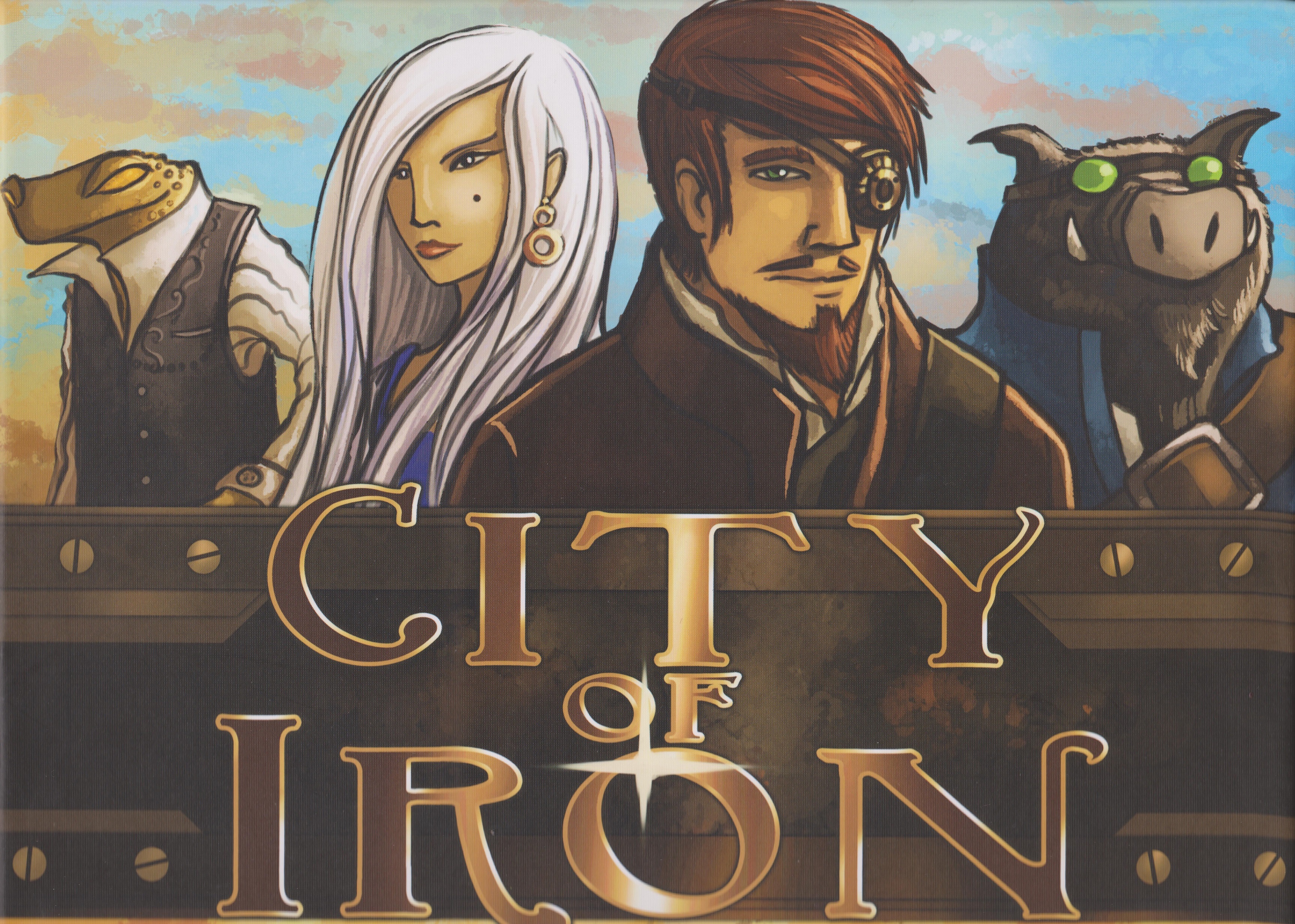
Looking at City of Iron for the first time is sort of like staring directly into a rainbow, which my father always said would burn my corneas. Or was that the sun? Either way, Ryan Laukat’s latest game appears all but incomprehensible at first glance, packed as it is with unique races, fantastic lands, and ample opportunities to corner the Bottled Demon market. It’s easily his most ambitious title yet. Is it also his best? Let’s take a look.
The Library of Minigame Library Reviews

The Minigame Library from Level 99 Games.
It’s always a relief to finish a series and compile an index (it’s a freebie article, so hey!), but I’ll confess I’m going to miss the anticipation of discovering what comes next in the Minigame Library from Level 99 Games. At least this collection has enjoyed enough success that we’ll be seeing another at some point, and Pixel Tactics will be getting a sequel sometime this summer! For your reading simplicity, I’ve compiled all my reviews below.
Mini-Review: Grimoire Shuffle

Minigame Library, Game #6: Grimoire Shuffle.
Back in the alt-text for the header image of my Blades of Legend review, I made some predictions about the remaining four games in the Minigame Library from Level 99 Games. I guessed (correctly) that Pixel Tactics and Noir would be good entries, underestimated Infinity Dungeon a bit, and supposed, based on the score over on BoardGameGeek, that Grimoire Shuffle would be “meh.” Reading the rulebook (which, let’s be fair, hasn’t been the Minigame Library’s strongest suit) didn’t do much to change that assumption.
So sitting down and actually playing Grimoire Shuffle was a pleasant surprise. Turns out, it’s a pretty slick team puzzle game. It isn’t on the same level as Pixel Tactics, but it definitely stands out as comparable to Master Plan in that it’s uncommonly smart for its size.

 SPACE-BIFF!